
An HVAC company running both install and sell technicians and a separate duct cleaning line had no reliable way to know when a technician crossed $250,000 in year-to-date sales. Automating the tier against ServiceTitan fixed it.
Every incentive plan makes a promise: hit this number, and your pay changes. It is a simple idea that gets surprisingly hard to keep once a business is running enough volume that nobody can hold the whole picture in their head. For an HVAC company running both installation and sales technicians alongside a separate duct cleaning service line, that promise had quietly become unreliable. The plan called for a technician's commission rate to step from 5% up to 6% once they crossed $250,000 in sold work for the year. Nobody could say, with confidence, exactly when that happened for any given tech.
Not because the rule was unclear. The rule was simple. The problem was that the systems available to check it were not built for the question the business was actually asking.
This is a more common gap than most owners expect, and it rarely gets discussed the way a labor cost problem or a retention problem does, because it does not show up as a single dramatic number on a P&L. It shows up as a slow accumulation of small inaccuracies: a technician paid at the wrong rate for a pay period here, a threshold crossed and missed there, none of it large enough on its own to trigger an audit, all of it large enough over a year to matter. A tiered commission plan is only as good as the system tracking the tiers, and for a long stretch, this company's tracking system was a person with a spreadsheet and limited time.
One Report Wasn't Enough, and Neither Was Two
ServiceTitan is the system of record for a lot of HVAC shops, and for good reason. But its standard reporting draws a line between what has been sold and what has been sold and completed, and that line matters enormously for commission. A technician might sell a large install early in the month and not complete it until weeks later. Counting it too early overstates their year-to-date total. Counting it too late understates it and can leave a technician sitting well past the $250,000 mark without anyone realizing their rate should have already moved.
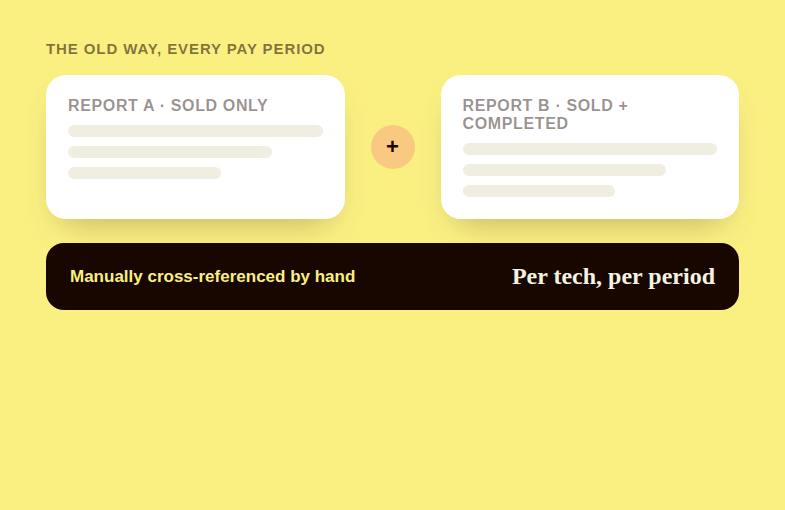
The workaround was to pull two separate reports, one for sold work and one for sold-plus-completed work, and manually reconcile them by hand for every technician, every pay period. That is exactly the kind of task that looks manageable with three technicians and becomes genuinely unworkable with a real crew running real volume. Multiply the reconciliation effort across every technician, every pay period, for months at a time, and it stops being a task and starts being a standing liability. Someone has to remember to do it. Someone has to do it correctly. And someone has to catch the technician who quietly crossed the threshold three weeks ago while everyone was focused on other things.
There was a second complication layered on top of the first. ServiceTitan's filtering by sold-by technician had a bug that, under certain conditions, would remove all of a technician's items from the report entirely rather than isolating them. A filter meant to narrow the view instead erased it. For a plan that depended on an accurate running total to trigger a rate change, a filter bug like that is not a cosmetic annoyance. It is a direct threat to whether the plan can be trusted to pay people correctly at all.
Why Manual Tracking Fails Quietly, Not Loudly
The dangerous thing about a threshold nobody is reliably tracking is that it fails silently. Nobody gets an alert when a technician crosses $250,000 by hand-counted spreadsheet math three weeks late. The technician simply keeps earning 5% when they have already earned 6%, and unless someone happens to notice, that gap just persists, sometimes for an entire pay period or more. It is not fraud and it is not carelessness. It is the predictable result of asking a manual process to do a job it was never built to do at scale.
This is where a lot of incentive plans quietly lose credibility with the people they are meant to motivate. A technician who eventually notices they should have tiered up weeks ago, and did not, does not conclude that the business made an honest reporting error. They conclude that the plan cannot be trusted to pay them correctly, and that conclusion is much harder to undo than the underlying math error was to fix. The same fragility that plagued this company's threshold tracking shows up constantly in HVAC and duct cleaning payroll built on manual spreadsheet reconciliation, where a single missed line item can quietly cost a technician real money for months before anyone notices.
Building the Threshold Into the System Instead of a Spreadsheet
The fix was not a better spreadsheet. It was removing the spreadsheet from the loop entirely. The redesigned plan kept the same underlying logic the company wanted: 5% on sold work, stepping up to 6% once a technician crossed $250,000 in year-to-date sold revenue, with a separate flat $25-per-cleaning rate for the duct cleaning line that runs on its own economics and should not be blended into the install and sell commission structure. What changed was how that threshold gets tracked.
Instead of pulling two reports and reconciling them by hand, the plan now pulls directly from ServiceTitan on a recurring sync, three times a day, calculating each technician's year-to-date sold total automatically and applying the tier the moment the threshold is crossed. The company's actual start date for the new plan was backfilled into the calculation, so the transition did not require anyone to re-derive months of history by hand just to get the counter correct on day one.
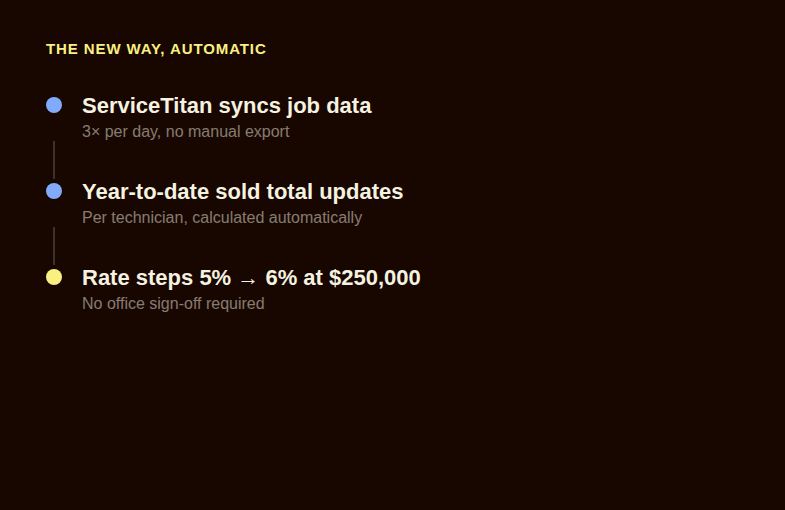
Three times a day sounds like a small operational detail, but it is the detail that actually closes the gap the old process left open. A technician who crosses $250,000 on a Tuesday afternoon job is reflected in the system by that evening, not whenever someone next finds time to run and compare two reports. The plan stopped being something the office had to remember to check and became something that simply stayed current on its own, the same shift behind consolidating multiple incentive pools into one system a shop can actually see clearly across locations.
Separating What Shouldn't Be Blended
Keeping the duct cleaning line on its own flat $25-per-cleaning rate, rather than folding it into the install and sell commission structure, was a deliberate choice worth calling out. Cleanings and installs are different kinds of work with different margins and different sales cycles, and collapsing them into one blended commission rate tends to either underpay technicians on one line of business or overpay them on the other. Keeping the rate structures separate, even while automating both against the same ServiceTitan sync, meant each line of business could be measured and paid on terms that actually reflected its own economics, instead of averaging two different jobs into one number that fit neither.
For the office staff who used to own the reconciliation task, the change was less about the commission math and more about getting a recurring chunk of every pay period back. Cross-referencing two reports for every technician was not a five-minute job. It was the kind of task that got scheduled around, postponed when something more urgent came up, and occasionally skipped entirely under deadline pressure, which is exactly how threshold crossings ended up sitting unnoticed for weeks. Automating the calculation did not just make the numbers more accurate. It freed up a predictable block of time every pay period that had previously gone to a task nobody enjoyed and everybody worried about getting wrong.
Profit sharing
made simple.
Give your team a stake in the company’s success. ShareWillow helps you create and manage profit-sharing programs that motivate employees and drive business results.
What Actually Changed
The most honest way to describe the outcome here is not a single dramatic percentage. It is the disappearance of a specific, recurring failure mode. Before the automation, a technician's move from 5% to 6% depended on someone in the office correctly cross-referencing two reports, catching a threshold crossing that could be weeks old by the time it was noticed, and manually adjusting pay to match. After, that same tier change happens automatically, synced up to three times a day, with no office sign-off required and no dependency on anyone remembering to run the check.
That is a meaningful outcome even without a headline number attached to it, because the thing it eliminates, a technician quietly earning the wrong rate for weeks at a time, is exactly the kind of error that erodes trust in a pay plan faster than almost anything else. A technician does not need to understand ServiceTitan's API limitations or the difference between a sold-only report and a sold-plus-completed report to notice that their commission rate changed exactly when it was supposed to, every time, without them having to ask.
There is a budgeting benefit here too, one that matters more to an owner or a facility manager than it does to any individual technician. A commission structure that depends on manual reconciliation is hard to forecast, because the true labor cost for a given period is not fully known until someone has finished catching up on the backlog of checks. A commission structure that updates against live job data three times a day gives leadership a number they can trust in real time, not a number that needs a retroactive correction once the reconciliation finally happens. That difference matters most exactly when it is needed most, during a tight month when every payroll dollar is being watched closely.
What This Means If Your Tiers Depend on Someone Remembering to Check
If your own incentive plan includes a threshold, a bracket, or a tier that depends on year-to-date totals, it is worth asking a blunt question: what actually triggers that change today? If the honest answer involves a person, a spreadsheet, and a recurring reminder to check, you have a plan that works in theory and slips in practice, usually in the technician's disfavor, and usually without anyone noticing until the technician brings it up themselves.
A few things are worth checking directly:
- Does your job management system distinguish between sold and completed revenue, and does your commission calculation know which one your plan actually promised technicians?
- If a threshold crossing depends on combining more than one report, how often does that reconciliation actually happen, and who is responsible for it?
- Would you know, today, which of your technicians are within a few thousand dollars of their next tier, without pulling a report and doing the math by hand?
- If two different lines of business, like installs and a separate service offering, are running under one blended commission rate, would separating them change what technicians are actually paid for each?
For HVAC operators running tiered or threshold-based commission on top of ServiceTitan or a similar platform, the goal is not a more complicated plan. It is a plan that stays accurate on its own, without a standing manual task holding it together. ShareWillow's plan automation and reporting tools can sync directly against your own job data so a tier change happens the day it is earned, not the next time someone has the hours to check.
Related reading
Conclusion
A commission plan that only works if someone remembers to check a spreadsheet is not really automated. It is just delayed.
Create incentives
that
drive results
You shouldn't need complex equity plans to align your team. ShareWillow makes it simple to create transparent profit-sharing programs that motivate employees and grow your business.

Incentive plans to help
small businesses thrive.
.png)
"I was able to leverage the knowledge of the ShareWillow team to learn how other companies were designing their bonus plans. The template was extremely helpful."

Brian Tustin
Owner, First Rate Movers
