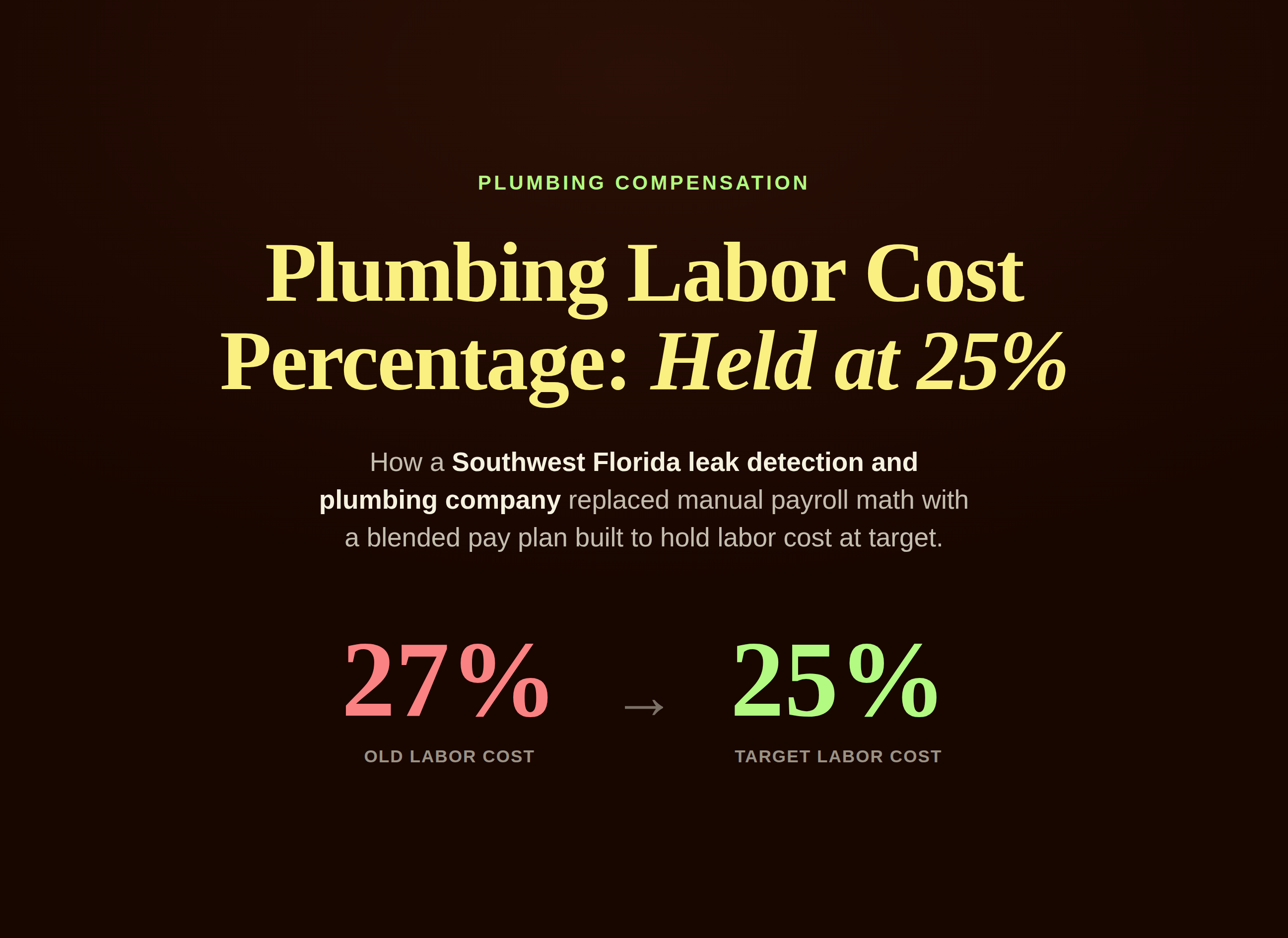
Wage inflation had crept in with no performance lever to offset it, and discounting was slipping out of control. Here is how a residential HVAC, plumbing, and electrical company rebuilt pay around a simple rule: technicians get their hourly base or a share of revenue, whichever pays more.
When Wages Keep Climbing and Nothing Climbs With Them
Picture a residential HVAC, plumbing, and electrical company running around a dozen trucks between field technicians and a CSR and dispatch team. Solid reputation, steady call volume, and a familiar problem that a lot of HVAC and plumbing owners will recognize: hourly pay had been creeping upward year over year, but there was no performance lever anywhere in the system to offset it. Techs were earning more for doing roughly the same thing they did last year, and the business had no mechanism tying pay growth to output growth.
Layered on top of that was a sales discipline problem. Discounting was inconsistent from one technician to the next, and occasionally it slipped outside anything close to authorized territory. In one instance, a staff member applied an unapproved $1,500 discount on a job, the kind of number that quietly erodes margin across a year of similar decisions nobody was tracking. Technicians also were not consistently following the sales workflow the company had actually built for them: creating estimates, converting them properly, and selling out of the price book instead of freelancing pricing on the spot.

None of this is a story about bad technicians. It is a story about a compensation structure that had drifted out of sync with the business, the way most flat hourly or straight-commission structures eventually do if nobody revisits them. Wage inflation on its own is not a crisis. Wage inflation with zero performance mechanism attached to it is how a healthy field service business slowly loses margin without anyone being able to point to the exact moment it happened.
The fix this company landed on was not a pay cut disguised as a bonus plan, which is how a lot of technicians correctly perceive compensation "redesigns" that quietly reduce their guaranteed income. It needed to protect what techs were already earning while giving the business a real lever for performance, and it needed to close the discounting gap without turning every job into a negotiation with a supervisor.
This is a familiar spot for a lot of owners and facility managers running field teams right now. Labor markets have pushed hourly rates up across the trades for several years running, and that trend is not reversing on its own. A business owner can either treat that as a fixed cost that just keeps climbing, or use it as the moment to introduce a performance component that makes the higher base pay something the business is actually getting a return on. The second path is harder to build, but it is the only one that scales, because a flat hourly increase compounds every year regardless of output, while a performance percentage only grows when the business grows with it.
Pay: Whichever Number Is Bigger
The plan that came out of it is a hybrid model with one rule simple enough to explain in a single sentence: every technician gets their guaranteed hourly base, or a performance-pay percentage of the revenue they generate, whichever is greater. Roughly 15% of revenue in this case. Nobody's guaranteed pay goes down. The performance side is pure upside layered on top of the floor that already existed.
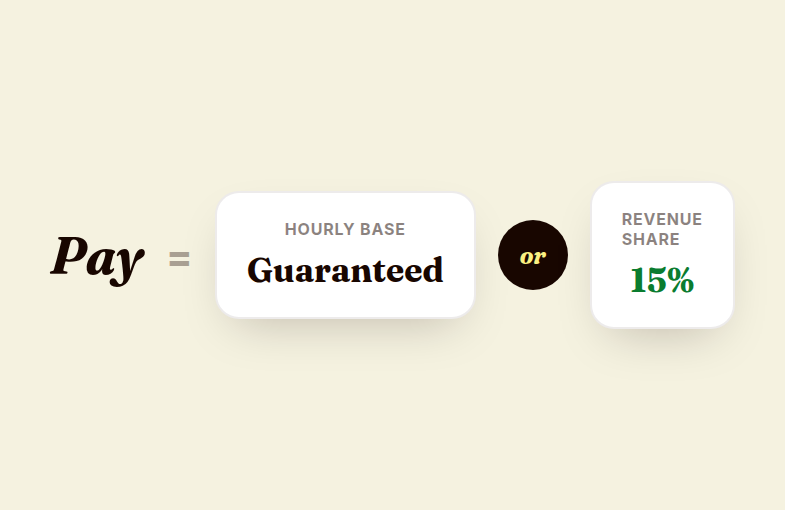
That framing matters more than the exact percentage. A lot of performance pay rollouts fail not because the math is wrong, but because the team hears "pay plan change" and assumes it means less money for the same work. A greater-of structure removes that fear entirely; the downside is protected, so the only conversation left to have is about the upside. That is a much easier rollout to sell to a room full of technicians who have seen pay plans change before and did not love the last one.
A straight commission plan would have accomplished some of the same goal, but it trades one problem for another: it makes a technician's income unpredictable in a slow week through no fault of their own, which tends to push good people toward employers offering something steadier. The greater-of structure keeps the predictability of hourly pay intact for slower stretches, while still rewarding the technicians who consistently generate more revenue than their base rate alone would justify. For a business owner weighing commission against hourly against something in between, that is usually the actual decision being made: how much income variability is fair to ask a technician to absorb, versus how much performance upside the business wants to fund.
The second half of the redesign tackled the discounting problem directly, by mapping sales-discount tiers to specific ServiceTitan item codes. Instead of relying on a technician's judgment call in the moment, or a supervisor catching a bad discount after the fact, out-of-band discounts now get flagged automatically against the codes already living in the system the company uses every day. No new software, no separate approval workflow. Just the existing data doing a job it was not doing before.
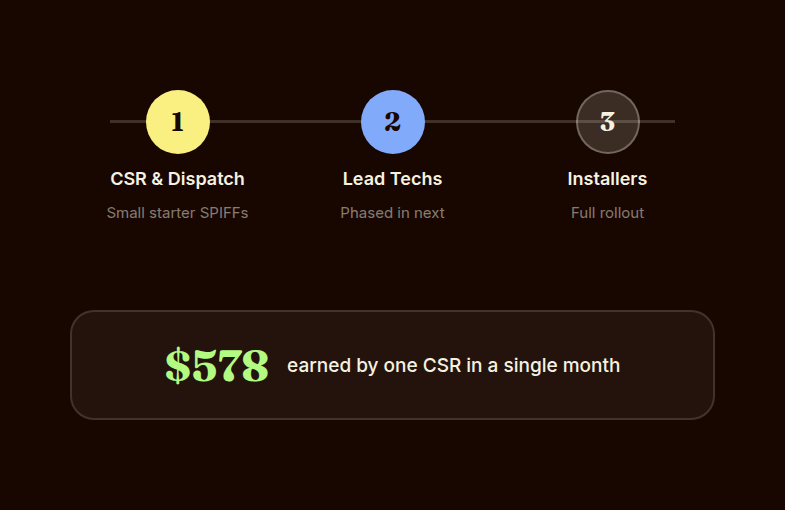
Rollout happened in phases rather than all at once, and that sequencing was deliberate. CSR and dispatch went first, with intentionally small starter SPIFFs designed not to overwhelm a team that had never seen performance pay before. One early SPIFF actually dropped from an initial $25 down to $5 mid-rollout, specifically to keep the introduction low-key rather than turning the first month into a big event. Lead service technicians come next, and installers after that, with full field rollout scheduled for the fall following an August test and backfill month.
That pacing is worth calling out on its own. It is tempting to flip a new pay structure on for the entire team at once, but starting with the CSR and dispatch team let the company work out any kinks in the mechanics, the reporting, and the payout cadence on a smaller group before the plan touched the technicians whose day-to-day income depends on getting it right. Any business considering a shift like this for its electrical, plumbing, or HVAC crews would do well to borrow that sequencing rather than rolling everything out in one pay period.
There is also a quieter benefit to starting with the office-side team: CSRs and dispatchers tend to have an easier time understanding a percentage-of-revenue concept, since it maps closely to the booking and scheduling numbers they already watch every day. By the time the plan reaches field technicians, the company will have a working example from its own team to point to, in its own numbers, rather than asking techs to trust a plan that has only been described to them on paper.
Profit sharing
made simple.
Give your team a stake in the company’s success. ShareWillow helps you create and manage profit-sharing programs that motivate employees and drive business results.
What the First Phase Is Already Showing
The CSR and dispatch rollout is live and paying out against real activity, not a projection. In one recent month, a single customer service representative earned $578 in performance pay, tied directly to booked calls, scheduled tune-ups, and membership sales, the exact behaviors the company wanted more of when it built the plan. That is not a company-wide revenue figure and nobody is claiming it is. It is a specific, real number earned by one person doing the job the new structure was designed to reward, which is precisely the kind of early proof point that makes the rest of the rollout an easier sell internally.
Full field-technician rollout is scheduled for September, following an August test and backfill month built specifically to catch any reporting or payout issues before the plan touches the group whose paychecks matter most to the daily operation. That is a company treating a compensation change with the same discipline it would apply to any other operational rollout: pilot it, watch it, fix what breaks, then scale it.
A few things about this redesign are worth pulling out if a hybrid model is on your radar:
- Protect the floor before you build the upside. A greater-of structure removes the biggest objection technicians have to any new pay plan: the fear that it is a pay cut wearing a bonus plan's clothing.
- Use the system you already have to catch discounting problems. Mapping discount tiers to existing item codes in ServiceTitan meant no new software and no added approval friction, just better use of data already being captured.
- Roll out in phases, starting with the team that carries the least day-to-day income risk. CSR and dispatch made an ideal first group precisely because a rocky first month there is far less costly than a rocky first month for field technicians living on their production pay.
- Small starter incentives are a feature, not a compromise. Dropping an early SPIFF from $25 to $5 was a deliberate choice to keep the first exposure low-stakes, not a sign the plan lacked ambition.
If you are sizing up whether a hybrid model fits your own company, a few honest questions tend to separate the businesses ready for this from the ones that should wait. Do you already have clean revenue-per-technician data sitting in your field service software, or would you be building that reporting from scratch? Is your current base pay actually competitive, so that a greater-of structure has a real floor worth protecting? And do you have a way to catch unauthorized discounting before it compounds across a year, the way mapping tiers to existing item codes did here? If the answer to most of those is yes, the redesign itself is often less work than owners expect, because the hardest part is usually deciding what to reward, not building the mechanism to reward it.
This kind of hybrid, greater-of structure shows up in other trades businesses that have gone through a similar rebuild. One HVAC company doubled what its technicians took home after fixing a broken bonus system, and another dropped labor cost from 58.5% to 40% with a sold-hours pay plan redesign. The specific mechanics differ from one shop to the next, but the underlying discipline does not: protect what techs already earn, tie the upside to the behavior that actually grows the business, and prove it out in phases before it touches everyone's paycheck at once.
Related reading
Conclusion
The plan is still mid-rollout, with field technicians joining in the fall after a deliberate test month. That pace is deliberate too. A pay model that touches every technician's paycheck is not something to flip on overnight, and the CSR team's early results are exactly the kind of proof point that makes the rest of the rollout an easier conversation. If wage costs have crept up at your own company with nothing on the performance side to balance them, a hybrid model built on data you already have may be a smaller lift than you think.
Create incentives
that
drive results
You shouldn't need complex equity plans to align your team. ShareWillow makes it simple to create transparent profit-sharing programs that motivate employees and grow your business.

Incentive plans to help
small businesses thrive.
.png)
"I was able to leverage the knowledge of the ShareWillow team to learn how other companies were designing their bonus plans. The template was extremely helpful."

Brian Tustin
Owner, First Rate Movers