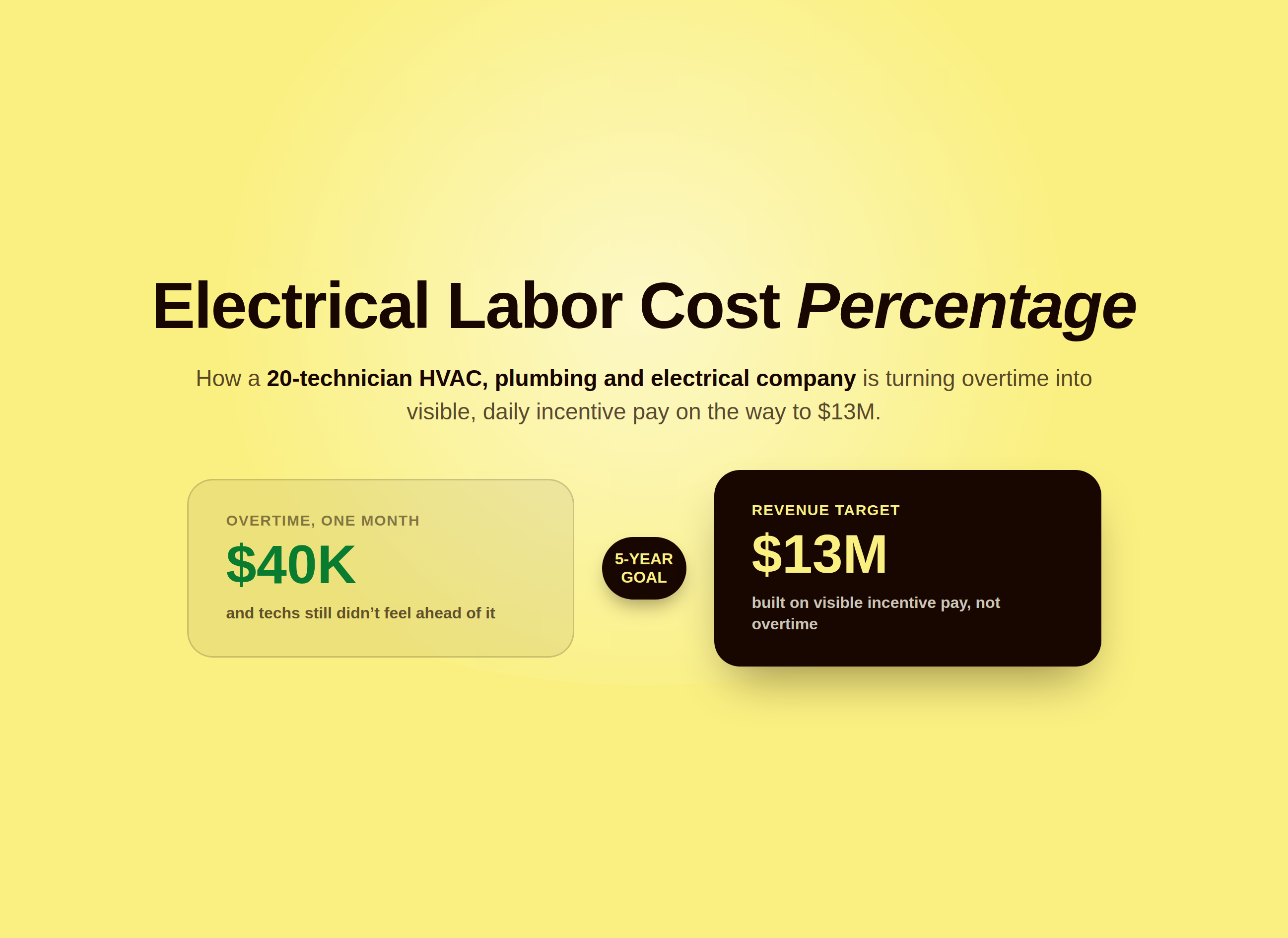
A multi-trade HVAC, plumbing, and electrical company used to track technician bonuses by hand, on a piece of paper, on a calendar. Here is what happened when that paper calendar turned into 18 automated incentive plans running across every department.
Before there was any software involved, there was a piece of paper. A technician at a multi-trade HVAC, plumbing, and electrical company kept his own commission numbers the old fashioned way: he wrote them down on a calendar he kept for himself, added them up by hand, and at the end of the month, that handwritten total was more or less the starting point for what he got paid. He was not doing anything wrong. It was just how bonus tracking had always worked at a lot of shops like his, one person's memory and one piece of paper standing in for a system that did not otherwise exist.
The trouble with a system like that is not that anyone is trying to cheat it. It is that nobody, including the person running the company, can actually see it. The office manager responsible for approving payouts had no real way to check a handwritten number against what had actually happened out in the field that month. "I never knew where these dollars, where this came from," she said, describing the old process. "This is people's pay." That is not a small thing to be foggy about. When the number a technician takes home depends on a calendar in his truck instead of a record everyone can see, the whole arrangement runs on trust that has no way to verify itself.
It also does not scale. This company runs technicians across four departments: general service techs, a dedicated install team, a plumbing on call crew, and an electrical on call crew, on top of a handful of individual sales reps each earning their own commission. A single handwritten calendar might just barely work for tracking one guy's bonus. It falls apart completely the moment you are trying to run fair, consistent incentive pay across dozens of people doing different jobs, on different schedules, with different pay structures, at the same time. Multiply one paper calendar by every technician who deserves the same clarity about their own pay, and you do not have a system anymore. You have a lot of separate, unverifiable guesses.
What A Real System Replaced It With
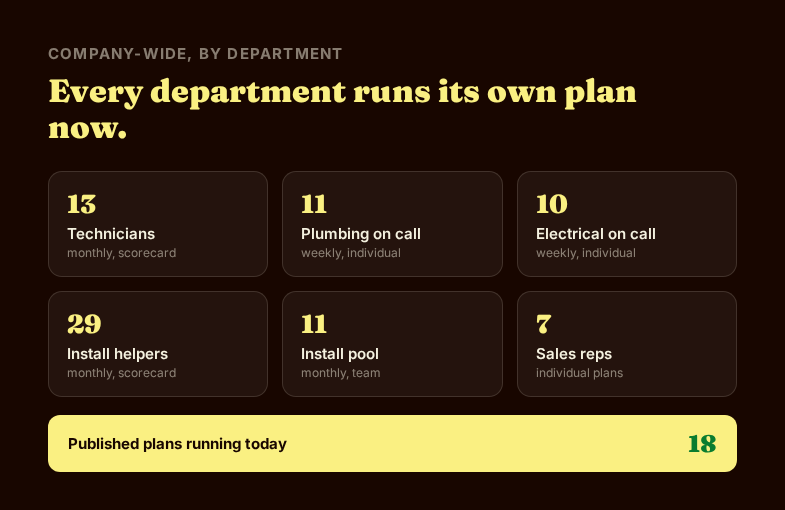
The fix was not a bigger spreadsheet or a stricter policy about writing things down more carefully. It was automated incentive plans that pull directly from the company's field service software, so a technician's numbers are the actual numbers, not a transcription of them. Today the company runs 18 published plans at once, split roughly evenly between weekly and monthly payout cycles, covering every department it operates: technicians on a monthly scorecard, an install pool paid as a team, plumbing and electrical crews each on their own weekly on call plan, install helpers, and individual sales reps each running their own plan tied to their own numbers.
That is a very different shape of problem than the one a paper calendar was ever built to solve. A calendar can hold one person's math. It cannot hold 18 plans running at once across four trades, each with its own metrics, its own payout cadence, and its own audit trail back to the job data that produced it. Once the incentive system was doing that work instead of a technician's memory, the office manager did not have to take anyone's word for a number. She could see exactly where it came from.
What Changed For The Plumbing Crew Alone
Numbers tell the rest of the story better than a description of the software can. Look at just one of those 18 plans, the weekly on call plan covering the plumbing crew. Over 30 straight weeks, from early January through early August, that single plan paid out $48,405 to the plumbers on it, averaging a little over $1,600 a week, with real weeks as high as $6,545 when call volume ran hot and real weeks as low as a few hundred dollars when it did not. That is not a projection or a target. It is what was actually confirmed and paid, week after week, without anyone having to reconcile a calendar against a memory of what happened.
The technician scorecard plan tells a similar story on a monthly cycle. Across February, March, and April, that plan paid out $20,491 to the technicians on it: $6,616 in February, $8,576 in March, and $5,300 in April. Those are three different numbers because three different months produced three different amounts of qualifying work, which is exactly the point. A payout that moves with the real work, up some months and down others, is a payout everyone can trust, because it is not being smoothed over or estimated. It is just what happened, reflected back accurately.
None of that would be possible to verify off a handwritten calendar, and that is really the heart of what changed. It was never really about the paper itself. It was about whether a technician's pay could be traced back to something concrete, something an office manager, an owner, or the technician themselves could look at and confirm without having to trust anyone's memory. "This is really protecting the company," the office manager said, describing what the shift to an automated system actually did for her. "Showing the incentives to the employees, but it's really a great protection for the company. So you have something so it's not subjective. It all comes like right outta the data."
That protection runs in both directions. It protects the company from having to defend a bonus decision it cannot fully explain, and it protects each technician from a payout that depends on whether someone remembered to write it down correctly that week. Neither side has to take the other's word for it anymore. The data is the record, for everyone, at the same time.
Why This Matters More The Bigger A Shop Gets
A single technician with a paper calendar is a minor inconvenience. A multi-trade company running dozens of technicians across service, install, plumbing, and electrical work is a different problem entirely, because the number of individual judgment calls a manual system requires multiplies with every technician added. Every new hire is another person whose bonus depends on someone else's handwriting, memory, and attention on a busy Friday afternoon. That is a lot of surface area for a small mistake to turn into a technician getting shorted, or overpaid, without anyone noticing until much later, if ever.
It also compounds across departments in ways that are easy to underestimate. A plumbing crew's on call pay works differently than an install team's monthly bonus, which works differently again than an individual sales rep's commission plan. Trying to hold all of that in one person's head, or across a handful of spreadsheets that do not talk to each other, is exactly how gaps and inconsistencies creep in. Not because anyone is careless, but because the system was never built to carry that much weight in the first place. Eighteen separate plans running cleanly at once is not something a manual process scales into. It is something you need real infrastructure for from the start.
There is also a recruiting and retention angle that is easy to miss when you are focused on fixing a broken process. A shop's best technicians, the ones other companies are actively trying to hire away, notice quickly whether their pay is something they can verify or something they just have to trust. An owner at this company reportedly compared several vendors at an industry conference before landing on the system they use now, and came back describing it directly to the account rep: "yours is the best of them all." That kind of endorsement does not usually come from software that just processes numbers faster. It comes from software that changes whether a technician's pay feels fair, and whether an office manager can sleep at night knowing exactly where every dollar on a payout came from.
Profit sharing
made simple.
Give your team a stake in the company’s success. ShareWillow helps you create and manage profit-sharing programs that motivate employees and drive business results.
The Bigger Picture For Trades Companies Scaling Fast
A lot of shops reach a point where the tools that got them to ten or fifteen employees quietly stop working at thirty or forty, and incentive pay is one of the first places that shows up. It is easy to miss because nothing breaks loudly. Payouts still go out. Technicians still get paid something. The problem is subtler: the numbers slowly stop being verifiable, the office manager starts spending more of her week reconciling than approving, and the whole process becomes something the company tolerates rather than trusts. By the time that becomes obvious, a shop has usually already outgrown a manual process by a wide margin, not just crossed some line.
Running a multi-trade operation makes this sharper, not softer, because the same company is managing several fundamentally different kinds of work under one roof. A weekly on call rotation for plumbing and electrical does not look like a monthly install bonus, and neither looks like an individual commission plan for a sales rep. Eighteen plans is not eighteen versions of the same spreadsheet. It is eighteen genuinely different structures, each tied to its own metrics and its own payout cadence, all needing to stay accurate at the same time without anyone manually reconciling them against each other.
What To Check Before Your Shop Outgrows Its Own Paper Calendar
If any part of your shop's incentive pay still depends on a spreadsheet one person maintains, or a running tally someone keeps in a notebook, it is worth asking a few honest questions before it becomes a bigger problem. Could you, right now, trace any technician's last bonus back to the specific jobs, revenue, or metrics that produced it, without asking that technician or relying on someone's memory of the month? If a key employee who manages that tracking took two weeks off, would payouts still go out accurately and on time? And as you add technicians, does your current process for calculating incentive pay get harder, or does it stay just as reliable at 40 people as it was at 4?
None of those questions have a comfortable answer if the honest response is a handwritten calendar, a personal spreadsheet, or "we just kind of know." The fix is not asking people to be more careful with their notes. It is building the incentive calculation into the same system that already has the job data, so the numbers are correct by construction instead of by diligence. That is what turned one technician's paper calendar into $48,405 paid out cleanly across 30 weeks on a single plan, and 18 plans running company-wide without anyone having to reconcile a single handwritten total against what actually happened in the field.
Related reading
Conclusion
One tech's paper calendar became an audit trail. One plumbing crew alone has now been paid $48,405 across 30 straight weeks, and the company runs 18 published incentive plans across every department it operates.
Create incentives
that
drive results
You shouldn't need complex equity plans to align your team. ShareWillow makes it simple to create transparent profit-sharing programs that motivate employees and grow your business.

Incentive plans to help
small businesses thrive.
.png)
"I was able to leverage the knowledge of the ShareWillow team to learn how other companies were designing their bonus plans. The template was extremely helpful."

Brian Tustin
Owner, First Rate Movers