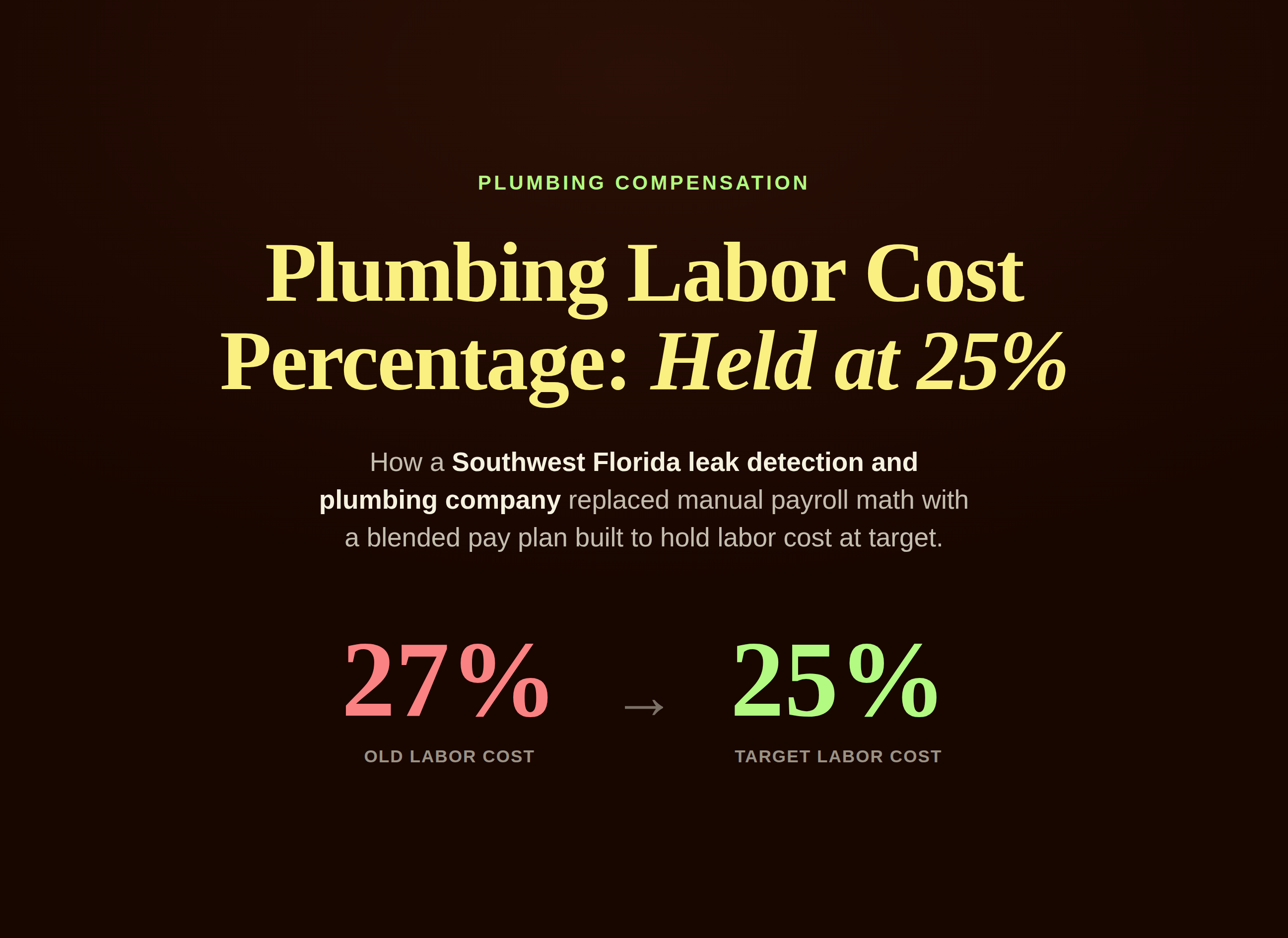
A multi-trade plumbing, heating, and electrical contractor ran nearly all its revenue, including a fast-growing generator business, through one blended 9% commission pool. Here is how separating generators, multi-trade tickets, and subcontracted work into their own rules stopped double payouts and caught a $76,000 misclassification before it needed another manual correction.
Picture a multi-trade plumbing, heating, and electrical contractor that also sells and installs whole-home generators. Three licensed trades running service calls every day, a dispatch board that never really slows down, and a specialty product line that had grown faster than anything else in the business over the past two years. On paper, the incentive structure behind all of it was simple: nearly every dollar of completed, sold revenue ran through one blended pool, and technicians split roughly 9% of whatever they closed.
That simplicity was the problem.
A single blended rate works fine when the work behind it looks the same job after job. It falls apart the moment the mix of work gets complicated, and this company's mix was about as complicated as it gets. Standard HVAC service, plumbing repair, and electrical work all ran through the same 9% pool as generator sales and water heater installs, even though those last two categories behave nothing like a routine service call. A generator sale might involve one person doing the sales conversation and a completely different crew doing the install a week later. A water heater swap might get sold and installed by the same tech in a single visit. None of that nuance existed in the commission logic. Everything just got treated as revenue, and revenue got a flat cut.
Where the Blended Pool Broke Down
The first crack showed up around double-paying. Because generators and water heaters had no separate handling, a sale could get credited through the generic 9% pool and then credited again through whatever ad hoc adjustment someone made later to account for the install work, or vice versa. Nobody was trying to overpay anyone. The logic simply had no concept of "this dollar already got paid out once." Multiply that across a growing generator business and the leakage adds up fast.
The second crack was multi-trade tickets, and this is where the blended pool really showed its age. A single job might involve a plumber diagnosing a leak, an electrician handling a related panel issue, and an HVAC tech servicing the connected system, all on one invoice. The commission system had no way to split that ticket by who actually did what. It just took the total revenue and applied the same undifferentiated split, which meant the tech who spent four hours on the hardest part of the job and the tech who spent forty minutes on a quick add-on ended up credited almost identically. Once word of that got around a crew, it stopped feeling like a bonus and started feeling like a coin flip.
The third crack was subcontracted work. This contractor occasionally brought in an outside crew for excavation work tied to bigger installs, digging that the company never touched with in-house labor. Because the commission logic tracked revenue rather than who performed the work, subcontracted digging had no clean way to be excluded from the same pool that in-house techs were splitting. Revenue the company paid straight out to a third party was quietly still eligible to draw from the internal bonus pool, which is exactly the kind of thing that looks fine until someone finally reconciles it line by line.
None of these were dramatic, headline-grabbing failures. They were the kind of quiet structural gaps that ServiceTitan and other field service platforms don't catch on their own, because job costing and commission logic are two different disciplines that happen to share the same revenue numbers. The fix wasn't a bigger bonus pool or a higher percentage. It was rebuilding the rules underneath the pool so each category of work finally had logic that matched how the work actually happened.
The rebuild started with the two carve-outs that had been causing the most damage: generators and multi-trade tickets. Instead of trying to force those categories into the existing 9% pool with exceptions bolted on, the team gave each one its own dedicated rate structure that sits entirely outside the standard pool.
A Separate Rate Table for Generators
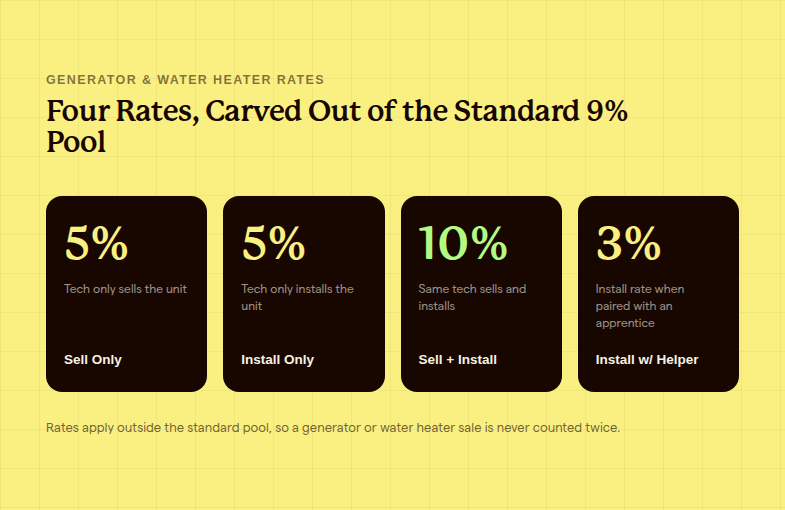
Generators and water heaters now run on four distinct rates instead of one blended number. A tech who only sells the unit, without touching the install, earns 5%. A tech who only installs a unit someone else sold also earns 5%. When the same person handles both the sale and the install on a generator, the rate combines to 10%, rewarding the tech who owns the whole transaction rather than splitting credit across two people who never actually collaborated. And when an apprentice or helper gets paired on an install, the lead's install rate holds at 3% rather than getting diluted by adding a second person to the job, while the apprentice's involvement still gets tracked and accounted for separately.
That last rule mattered more than it might look. Before the rebuild, pairing a newer tech with a lead on a generator install was a lose-lose. Either the lead's payout got cut to make room for the helper, which discouraged experienced techs from training anyone, or the system ignored the helper entirely, which meant apprentices got zero incentive to be on tougher jobs. Locking the install rate and tracking the apprentice separately fixed both problems with one rule.
Splitting Multi-Trade Tickets by Logged Time
The second carve-out addressed the multi-trade problem: jobs where a plumber, an electrician, and an HVAC tech all touched the same ticket. Rather than dumping that revenue into one shared split, the new logic attributes revenue by technician-logged time per trade. If a plumber logged 45% of the total hours on a ticket, an electrician logged 30%, and an HVAC tech logged the remaining 25%, each of them gets credited for their actual share of the work instead of an even or arbitrary split.

This is a small mechanical change with an outsized effect on trust. Techs on multi-trade crews had spent years half-suspecting that the tougher, longer parts of shared jobs were subsidizing the easier parts, and there was no way to prove or disprove it because the old system didn't track time by trade in the first place. Tying commission to logged time closed that gap. It also nudged techs toward better time logging generally, since accurate logs now directly determined their own payout rather than being an administrative afterthought.
Tagging In-House Work Versus Subcontracted Work
The third piece was simpler but just as necessary: tagging subcontracted work, like the excavation crews brought in for bigger generator and utility installs, as separate from in-house labor. Subcontracted digging now gets flagged at the data source level, so it never draws from the commission pool that in-house techs are splitting. The company still pays the subcontractor exactly what the subcontractor is owed. It just no longer counts as revenue eligible for internal commission, which closes a leak that had been quietly present for a long time.
Closing Jobs on the Right Date, Every Time
Alongside the rate changes, the team put a job-closure discipline in place that turned out to matter just as much as the new percentages. Jobs now get closed on their actual completion date, full stop. If work needs to be added after a job is already closed and paid out, the fix isn't to reopen the original invoice and skew its numbers. It's to open a new zero-dollar job specifically for that add-on, keeping the original ticket's numbers clean and keeping the add-on's revenue attributed to whoever actually did that follow-up work. This one habit prevents a whole category of pay-period confusion that has nothing to do with rates at all and everything to do with when work gets recorded as finished.
Profit sharing
made simple.
Give your team a stake in the company’s success. ShareWillow helps you create and manage profit-sharing programs that motivate employees and drive business results.
The result is one clean, defensible commission structure spanning three trades and a specialty product line, instead of a single blended rate trying to do too many jobs at once. Generators and water heaters no longer risk getting paid twice, once through the generic pool and again through some manual adjustment. Multi-trade tickets get split by who actually did the work. Subcontracted digging stays out of the in-house pool entirely. And job closures happen on the date the work actually finished, not whenever someone got around to closing the ticket in the system.
The $76,000 Problem That Now Catches Itself
Before the rebuild, this company had an incident where jobs closed on the wrong completion date pushed roughly $76,000 of revenue into the wrong pay period. Nobody caught it in real time. It surfaced during a month-end review, and fixing it meant a manual accounting correction after the fact, the kind of cleanup that eats a controller's afternoon and leaves everyone a little less confident in the numbers going forward.
That specific failure mode is structurally much harder to repeat now. Separating the plumbing and electrical pool from the generator and water heater pool means a misclassified generator sale can't quietly blend into routine service revenue without standing out. Combined with the job-closure discipline, a revenue swing of that size would show up as an anomaly in a specific, isolated pool rather than getting absorbed into one large blended number where it's easy to miss. The goal was never to promise that nothing will ever go wrong again. It's that when something does go sideways, the structure itself makes it visible instead of depending on someone noticing during a month-end review.
What This Means for Onboarding New Hires
There's a quieter benefit here too. Every time this company hired someone new who'd be earning performance pay, someone had to figure out, from scratch, how that person's pay should work, especially if the new hire would be touching generator sales or multi-trade tickets. That's a one-off spreadsheet fix multiplied by every new hire, and it's exactly the kind of manual process that quietly drifts out of sync with whatever the "real" rules are supposed to be. With the new rule set built and documented, a new hire moving onto performance pay gets added to a pre-built structure instead of a bespoke calculation someone has to reverse-engineer from last quarter's payouts.
What to Check in Your Own Shop
If you're running a multi-trade operation with any kind of specialty product line bolted on, a few questions are worth asking honestly. Does your specialty product line, whether that's generators, water heaters, or something else entirely, share a commission rate with your routine service work, even though the sales motion and install motion look nothing alike? Do multi-trade tickets get split evenly or arbitrarily rather than by who actually logged the hours? Is subcontracted labor cleanly excluded from your in-house commission pool, or is it just lumped into total job revenue? And when a job needs follow-up work after it's already closed and paid, does your team have a clean way to handle that without reopening and skewing the original numbers?
None of these questions require a bigger bonus budget to answer well. They require commission logic that actually reflects how the work gets done, trade by trade, technician by technician, dollar by dollar. A blended rate is easy to set up and easy to explain in a single sentence, which is exactly why so many multi-trade shops default to one. But easy to explain isn't the same as fair, and it's rarely the same as accurate once the business gets complicated enough to need more than one trade under the same roof. The shops that get ahead of this now, before their own version of a $76,000 surprise turns up in a month-end review, are the ones that end up trusting their numbers instead of just hoping they're close enough.
Related reading
- The Conversion Rate That Wasn't Real: Inside An Electrical Company's New Scorecard
- How a Lighting Company Found $192K in Phantom Revenue Hiding in Their Own Software
- Incentives, Commissions, and Bonuses: What’s the Difference and Why It Matters
- Companies with Profit Sharing: Who They Are & What They Offer
Conclusion
This multi-trade contractor went from one blended 9% commission pool that risked double-paying generator sales and blending subcontracted labor into in-house payouts, to a rate structure with dedicated generator tiers, time-based multi-trade splits, and clean job-closure rules, and the same kind of $76,000 month-end misclassification that once needed a manual fix is now caught by the structure itself.
Create incentives
that
drive results
You shouldn't need complex equity plans to align your team. ShareWillow makes it simple to create transparent profit-sharing programs that motivate employees and grow your business.

Incentive plans to help
small businesses thrive.
.png)
"I was able to leverage the knowledge of the ShareWillow team to learn how other companies were designing their bonus plans. The template was extremely helpful."

Brian Tustin
Owner, First Rate Movers