A 12-person exterior lighting company's job software said it made $363,849 in a month. The bank said $172,008.93. Here's how they closed a 53% gap and built a plan that actually pays what it should.
The Number That Didn't Add Up
Every month, the owner of a 12-person exterior lighting installation and service company in the eastern United States pulled up his job software, looked at the "completed revenue" number, and felt fine about it. Not great, not worried, just fine. The number was big enough that payroll got made, bills got paid, and nobody asked too many questions.
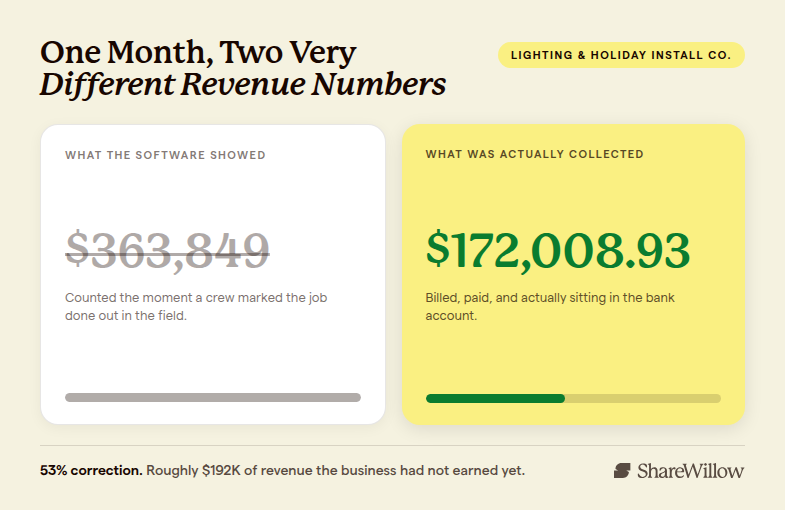
Then his ShareWillow rep pulled up the same month's numbers during a routine operations review, and the two didn't match. Not by a little. The software's completed-jobs report showed $363,849 in revenue for May. When you actually traced which of those jobs had been billed and collected, the real number was $172,008.93.
That's a 53 percent gap. Nearly $192,000 that the business believed it had earned but hadn't actually collected a dollar of yet.
The owner's reaction was immediate: "That's totally inaccurate." And then, a beat later, he diagnosed the cause himself before anyone finished explaining it: his crews were marking jobs "completed" in the field the moment the lights went up, whether or not the invoice had gone out or the customer had paid. The software was reporting on an accrual basis. The business actually ran on cash. Nobody had ever reconciled the two.
If you run a field service business of any size, you already know how this happens. You're not bad at your job. You're busy. The dashboards that came bundled with your job management software were built to look impressive on a sales call, not to survive contact with a real crew, a real busy season, and a real bilingual team working two jobs a day. This is a story about what happens when someone finally checks the math, and what a company does once it can trust its own numbers again.
A Business That Made Money Without Knowing Exactly How
This company installs and services permanent and seasonal exterior lighting, holiday displays being the busiest stretch of the year. It runs lean: an owner and a co-owner who both still sell jobs, a production manager who builds the crew schedule, and a rotating cast of lead technicians and helpers who go out two, three, sometimes four jobs a day during peak season.
They'd been on their current field service platform for less than a year. Before that, and honestly still true the day the real numbers surfaced, commission and payroll got assembled by hand once a month in a spreadsheet. The owner estimated labor hours in his head, job by job, because there was no clean way to pull "hours estimated" out of the software's price book. As he put it, describing his own operation with more honesty than most owners manage: "A lot of the problem is we don't have our act together well enough with the numbers to know what the guys are doing. We tend to make money at the end of every month, but sometimes I wonder how."
That sentence is worth sitting with, because it's true of a huge number of well-run home services companies. Making money and understanding exactly where it comes from are two different skills. Most owners are great at the first one out of necessity. Almost nobody has time to be great at the second, because it means auditing your own software against your own bank account, line by line, every month, forever.
Three specific gaps had been quietly compounding for this company:
- Revenue was counted the moment a job was marked complete in the field, regardless of whether it had actually been billed and paid.
- On multi-person install crews, there was no consistent rule for splitting credit between the lead technician running the job and the helper assisting. Some jobs it was tracked loosely. Most jobs it wasn't tracked at all.
- Technician-generated leads and add-on upsells, the extra strand of lights a homeowner adds on the spot, weren't captured anywhere the incentive system could see them. A tech who hustled and a tech who didn't looked identical on paper.
None of this was anyone's fault, exactly. It's what happens by default. Field service software is built to schedule jobs and send invoices. It is not built to answer the question "who actually earned what, and did we actually collect it."
Fixing the Math Before It Broke Payroll
The fix wasn't a personality change or a new spreadsheet nobody would keep updated. It was a set of specific, boring rules built directly into the incentive plan, sourced straight from the job data the company was already generating.
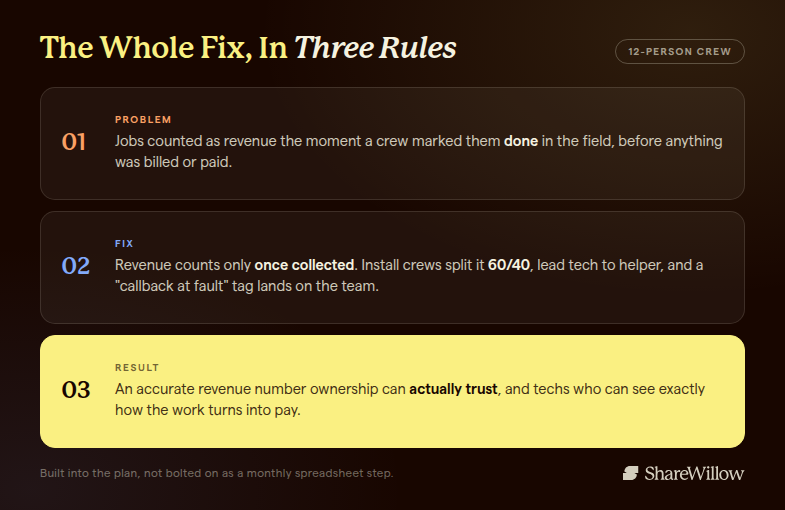
First, revenue only counted for commission once it was actually collected, not the moment a crew marked the job complete. That single change was the one that cut May's reported number from $363,849 to $172,008.93. It felt like a loss on the surface. It was actually the business seeing, for the first time, exactly how much cash it had really brought in that month, which is the number that matters when it's time to make payroll.
Second, a straightforward revenue split for install crews: 60 percent of commissionable value to the lead technician, 40 percent to the helper. No more guessing, no more "we'll figure it out at the end of the month." Every job, split the same way, automatically.
Third, a "callback at fault" tag, so a job that had to be redone showed up against the team responsible for it rather than disappearing into the noise. The owner almost talked himself out of this one. His crews include newer techs and a genuine language barrier on the team, and his instinct was protective: "I feel bad if you're penalizing everybody for one thing." His ShareWillow rep pointed out the tag was designed to land on the crew, not a single person, which nudges the two techs on a job to look out for each other rather than point fingers. He came around to it, landing on a version where the team shares accountability together instead of one person absorbing blame alone.
Fourth, commissionable line items and a job lead-source field, so the extra strand of lights a tech talked a homeowner into, and the referral a tech generated on their own time, both showed up as attributable, payable events instead of vanishing into "just part of the job."
None of these are complicated ideas. What made them work was that they were built directly into the plan and the payroll math, not bolted on as a manual step someone had to remember to do every two weeks. Once the rules existed, the software did the counting. Nobody had to trust their memory of who did what on a job three weeks ago.
Where It Got Honest: The Plan That Didn't Ship
Not every idea worked out, and that's worth including, because it's the difference between a real story and a highlight reel. During the same review, the team explored building a more ambitious plan: pay based on how efficiently a crew beat the estimated labor hours on a job, rewarding speed and skill directly.
It ran into a wall almost immediately. The field software had no exportable field for "estimated hours" per line item in the price book, which meant building the plan correctly would require manually rebuilding hundreds of price book entries by hand. The team looked at three different workaround approaches. In the end, the owner made the right call for his business: "I think we're gonna have to call a halt to this for right now. I don't think we're ready on our end."
That's not a failure. That's what an owner who actually understands his own operation sounds like. The data wasn't ready, so the plan waited. It's still on the table for later, once the price book work gets done. The lesson generalizes past this one company: an incentive plan is only as good as the data feeding it, and sometimes the most useful thing a plan design process does is show you exactly which part of your own systems needs cleaning up before you build on top of it.
Profit sharing
made simple.
Give your team a stake in the company’s success. ShareWillow helps you create and manage profit-sharing programs that motivate employees and drive business results.
What Changed on the Ground
Once the revenue counting was accurate and the split rules were automatic, two things happened that you can actually measure.
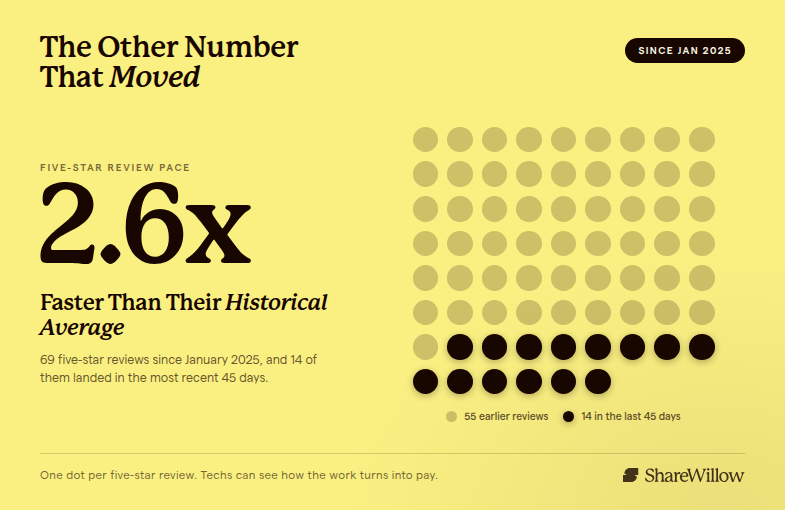
The first is the review pace. This company has racked up 69 five-star reviews since the start of last year, and 14 of those landed in just the most recent 45 days, a pace roughly 2.6 times faster than their historical monthly average. That's not a coincidence you can prove with a spreadsheet formula, but it lines up with what tends to happen once techs know exactly how their work translates into pay: the extra effort on a job, the polite conversation with a homeowner, the five extra minutes making sure everything looks clean before leaving, all of that becomes worth doing consistently instead of only when someone's watching.
The second is quieter but arguably more important: the owner can look at his numbers now and trust them. When your books are quietly overstating revenue by more than half, every decision built on top of that number, hiring, marketing spend, whether you can afford a new truck, is built on sand. Getting to $172,008.93 instead of $363,849 wasn't a bad-news moment. It was the first time in a while this owner knew exactly where he stood.
He said it himself, at the end of a call that had surfaced a duplicate job entry, a six-figure revenue correction, and a hard conversation about accountability tags, all in about 45 minutes: "thank you so much for all your hard work trying to help us." Not because the news was easy. Because it was finally true.
A Quick Self-Check Before Your Next Payroll Run
You don't need to hire a consultant to find out if your business has the same gap. Pull last month's "completed revenue" report from whatever field service software you use, then pull last month's actual bank deposits for the same period. If those two numbers are close, you're in good shape. If they're not, here's roughly where the gap usually hides:
- Jobs marked complete before they're billed. A crew finishing the physical work and a customer paying for it are two different events. Software often treats them as one.
- Multi-person crews with no split rule. If two techs worked a job and only one is credited, you're either overpaying one person or quietly demotivating the other.
- Upsells that live in a tech's head instead of a system. If a tech has to remember to tell someone about the extra work they sold, some percentage of that work is going untracked and unpaid every single week.
- Duplicate or renamed records. A copied job row or a truck that got renamed in your fleet tracker can quietly double-count revenue or miles for months before anyone spots it.
None of these require new software to fix. They require someone to actually look, on a recurring basis, and a plan that encodes the answer once so nobody has to remember it every pay period.
The Takeaway for Every Trades Owner Reading This
If you run a lighting company, an HVAC shop, a plumbing outfit, or any trades business where crews are out in the field generating revenue you can't watch in person, ask yourself one question this week: does your revenue number reflect what you've actually collected, or what your software thinks you've earned? Those are not the same question, and the gap between them can be five figures wide before anyone notices.
You don't need a finance degree to close that gap. You need three things: a rule for when revenue counts, a rule for how credit gets split when more than one person touches a job, and a way to see both without doing the math by hand every month. That's the whole plan. It's not glamorous. It's the difference between making money and knowing exactly how.
If you want to see what an incentive plan built directly on top of your existing field service data actually looks like before you commit to anything, ShareWillow's free incentive audit connects to your ServiceTitan, Housecall Pro, or Jobber account and shows you, in plain numbers, where the gaps are. You can also browse the full feature set to see exactly how revenue splits, callback tags, and commissionable line items get built into a plan without anyone touching a spreadsheet again.
Related reading
Conclusion
A 53% revenue correction, an honest plan that got shelved, and a company that trusts its numbers again.
Create incentives
that
drive results
You shouldn't need complex equity plans to align your team. ShareWillow makes it simple to create transparent profit-sharing programs that motivate employees and grow your business.

Incentive plans to help
small businesses thrive.
.png)
"I was able to leverage the knowledge of the ShareWillow team to learn how other companies were designing their bonus plans. The template was extremely helpful."

Brian Tustin
Owner, First Rate Movers