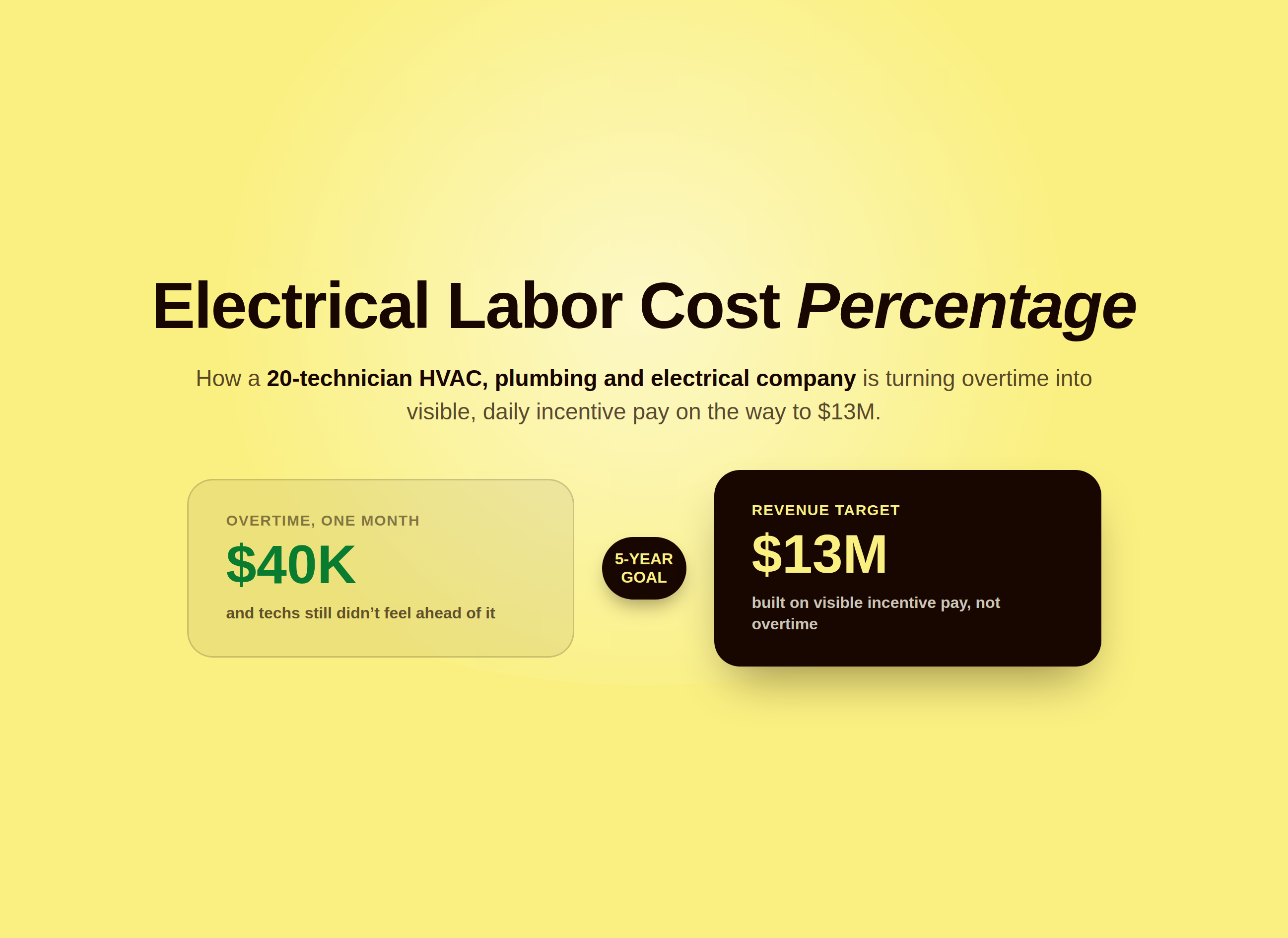
A plumbing and HVAC company gated its technician bonus behind a monthly company revenue target. Instead of the team barely scraping by, they cleared the bar every single month, so the company raised it twice in ninety days and kept paying out anyway.
Most technician incentive plans start with a simple question that turns out to be surprisingly hard to answer fairly: what should the company actually be measuring? For a plumbing and HVAC company running technicians across service calls, install jobs, and everything in between, the honest answer was messier than a single metric. Some technicians worked almost entirely service calls. Others split their time between service and install, and the two kinds of work carried different commission rates, different margins, and different reporting inside the company's field service software. A tech who did a little of both did not fit cleanly into either bucket, and the revenue numbers meant to describe fair pay for their work often did not either.
On top of that, getting straight answers out of the software itself was its own ongoing fight. The company described attempts to get a hold of its field service platform's support team about reporting issues as going on for weeks without resolution. That is a familiar problem for a lot of trades businesses: the system holding your job data was never really built to answer questions like "how much revenue did this specific technician actually generate this month, accounting for the install work he also picked up," and when the answer matters for someone's paycheck, a shrug from support is not good enough.
Building A Plan Around How The Business Actually Works
Rather than forcing every technician into one flat commission structure, the company built a custom revenue tier plan with a monthly company-wide revenue threshold gating the payout, plus a hybrid structure for technicians who worked across both service and install. Lead technicians had their own threshold layered on top, tied to the monthly revenue they personally generated. Callback rate and recall rate were folded in as quality metrics, so the plan was not just rewarding volume, it was rewarding volume that held up and did not come back as a redo. Ongoing account reviews gave the company a running checkpoint on whether the thresholds still made sense as conditions changed month to month, instead of setting a number once and hoping it aged well.
The company-wide revenue threshold is the part of this plan worth paying close attention to, because of what happened to it over the plan's first few months live. In January, the monthly revenue target was set at $350,000. The team's actual revenue that month came in at $646,620, nearly 85 percent over target. That is not a plan quietly hitting its number. That is a team blowing past it by a wide enough margin that the target itself stopped meaning much as a stretch goal.
The quality metrics folded into the plan mattered just as much as the revenue threshold, even though they get less attention. A callback is a job that did not actually get resolved the first time, and a recall is a customer calling back with the same problem shortly after a technician left. Both cost the company money and trust that a raw revenue number will never show. By tying part of the payout to keeping callback and recall rates in check alongside the revenue target, the plan made sure technicians were not incentivized to chase volume at the expense of doing the job right the first time. A technician who hit every revenue number but generated a trail of callbacks behind him would not see the same payout as one who hit the same numbers cleanly, and that distinction is what kept the incentive plan aligned with what the company actually wanted more of.
So the company did the thing a lot of businesses are reluctant to do: it raised the bar. In February, the monthly revenue threshold moved to $400,000. Actual revenue that month was $495,070, still nearly 24 percent over target. In March, the threshold moved again, this time to $450,000, a 28.6 percent increase from where it started the year just two months earlier. And the team kept clearing it. March actual revenue came in at $503,835, about 12 percent over target. April brought $535,232, just under 19 percent over. May brought $530,469, almost 18 percent over. June brought $598,599, over 33 percent above the $450,000 bar.
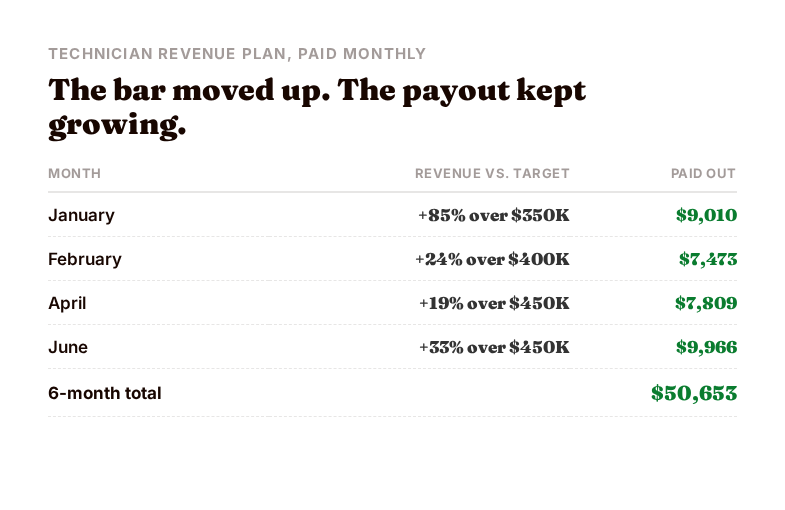
Six straight months of clearing a bar that had already been raised twice is not luck. It is what a fair, well-built incentive plan is supposed to produce: technicians who know exactly what is being measured and exactly what it takes to hit it, working toward a target that reflects the business's real trajectory instead of a number picked once and left alone. And because the plan paid out based on real performance against that moving target, the technicians on it were not just watching the company's revenue climb from the sidelines. Across those six months, the technician plan paid out $50,653 total: $9,010 in January, $7,473 in February, $7,525 in March, $7,809 in April, $8,870 in May, and $9,966 in June.
Why Raising The Bar Twice Did Not Break Trust
Raising a bonus threshold is a genuinely risky move if you get it wrong. Move it too aggressively and technicians stop believing the target is achievable, which kills motivation faster than almost anything else an incentive plan can do. Move it too cautiously and you are paying out a bonus pool for performance that was never really a stretch, which erodes the plan's credibility from the other direction. This company threaded that needle by tying the threshold to what the team was actually proving it could do, month over month, instead of guessing at a number in advance and defending it regardless of what the data said.
That is also where the hybrid structure for dual-role technicians mattered most. A technician who splits time between service and install work is exactly the kind of person a rigid, single-metric plan tends to shortchange, because their numbers do not cleanly match either bucket a simpler plan might use. Building the plan around how the business actually operates, instead of how it might look on a simplified org chart, meant nobody doing real, valuable work fell into a gap between two categories that were never designed with them in mind.
The Review Cadence That Kept The Threshold Honest
None of this worked because someone set a smart threshold once and walked away. It worked because the company treated the plan as something to check on a regular cadence rather than something to set and forget. Recurring account reviews gave the company a structured moment, every cycle, to look at actual revenue against the current threshold, actual callback and recall rates against target, and decide deliberately whether the plan still fit the business or needed to move. That is a very different posture than reacting only when something breaks or a technician complains. It meant the threshold increases in February and March were not emergency corrections. They were the natural output of a plan that was already being watched closely enough to know exactly when it needed to change.
That distinction matters more than it might seem. A company that only revisits its incentive plan when something feels off is always working from a position of catching up. A company reviewing it on a fixed schedule is working from a position of staying current. The technicians on the plan felt that difference too, even if they never saw the review meetings themselves, because every threshold change came with a track record behind it instead of arriving as a surprise.
Profit sharing
made simple.
Give your team a stake in the company’s success. ShareWillow helps you create and manage profit-sharing programs that motivate employees and drive business results.
When Your Field Service Software Cannot Answer The Question
It is worth returning to the support problem this company started with, because it explains why regular account reviews carried so much weight here specifically. When a company cannot get straight answers out of its own field service platform about how revenue should be attributed for a technician working across service and install, that gap does not go away on its own. It just moves somewhere else, usually onto whoever is left to manually reconcile the numbers before payout, under time pressure, without much support. Weeks of unsuccessful attempts to get that kind of question answered is not a minor annoyance. It is a structural risk sitting underneath every payout the company runs.
Regular account reviews turned that structural risk into a routine conversation instead. Instead of hoping the underlying software would eventually explain itself, the company built a cadence where a human being who understood both the plan design and the underlying data walked through the numbers every cycle. That is not a workaround anyone should need forever, but it is a realistic answer to a real problem: when the system holding your job data cannot fully explain itself, the fix is not to wait for it to improve. It is to build a process around it that does not depend on it being perfect.
What This Means For Other Plumbing And HVAC Shops
Plenty of plumbing and HVAC companies set a revenue or performance target for their team once a year, or once when the incentive plan first launches, and then leave it alone for the sake of consistency. That instinct makes sense on the surface. Nobody wants technicians to feel like the goalposts are always moving. But a target that never moves eventually stops measuring anything meaningful, either because the business has grown well past it or because it was set too conservatively in the first place. A target reviewed regularly and adjusted based on real, confirmed performance is not moving the goalposts. It is keeping the goalposts honest.
The mechanics worth borrowing here are straightforward even if your business looks nothing like a plumbing and HVAC shop. Set a threshold based on real historical performance, not a guess. Review it on a fixed cadence rather than waiting for a triggering event. And when the team clears it convincingly, more than once, treat that as a signal to reset the bar rather than a reason to celebrate and move on. A revenue target that always sits comfortably behind what the team can actually do is not protecting anyone. It is just quietly underpaying strong performance while calling it a bonus.
The Real Lesson Was Not The Dollar Amount
It would be easy to read this story as being about a big number: over $50,000 paid out in six months, or a threshold that climbed by more than a quarter in the same stretch. Those numbers matter, but they are downstream of something less flashy and more durable, which is a plan design that actually reflected how the business operated. Technicians who split time between service and install were not forced into a category that did not fit them. A company-wide revenue bar was allowed to move when the data said it should. And a support relationship that could not answer basic reporting questions got replaced with regular account reviews that could.
None of that requires a business to be unusually large or unusually sophisticated. It requires a willingness to look honestly at what a rigid, one-size-fits-all commission structure misses, and to build something that tracks the business as it actually runs, month after month, instead of the simplified version of it that fits neatly on a single spreadsheet tab. That is what let a revenue target climb twice in ninety days without anyone on the team losing trust in the number, because every time it moved, the data moving with it proved the bar was still fair.
Related reading
Conclusion
The monthly revenue target moved from $350,000 to $450,000 in three months, the team cleared it every month by double digits, and technicians were paid $50,653 across the six months it took to prove the plan was working.
Create incentives
that
drive results
You shouldn't need complex equity plans to align your team. ShareWillow makes it simple to create transparent profit-sharing programs that motivate employees and grow your business.

Incentive plans to help
small businesses thrive.
.png)
"I was able to leverage the knowledge of the ShareWillow team to learn how other companies were designing their bonus plans. The template was extremely helpful."

Brian Tustin
Owner, First Rate Movers