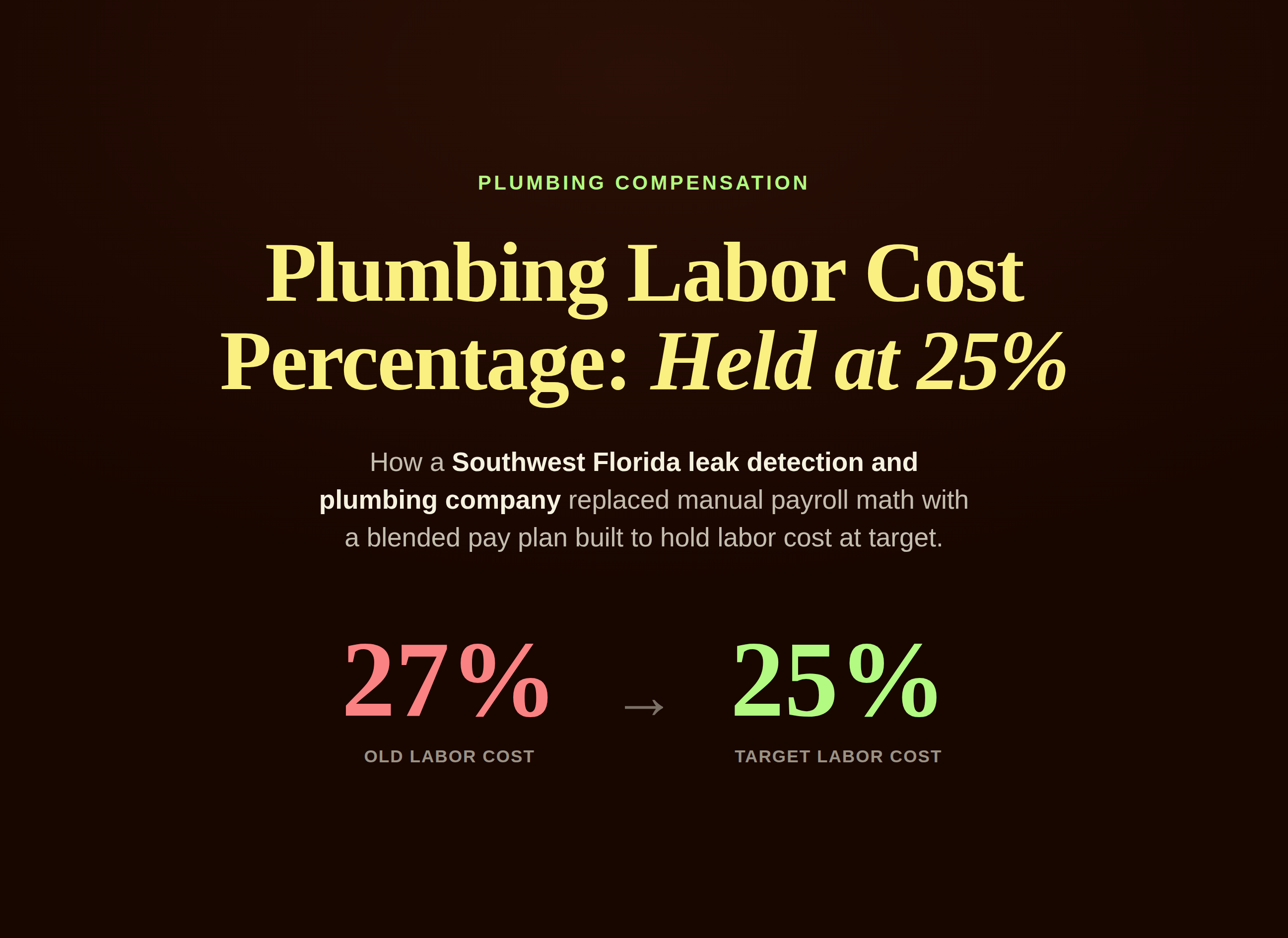
A 17-van plumbing and drain-cleaning company caught a CSR bonus formula that had quietly drifted from real performance requirements to an unqualified payout, on pace to cost roughly $60,000 a year per rep. Here is how a rate error and three missing qualifiers combined to triple a weekly bonus, and how the team rebuilt it live on the same call before that week's payroll ran.
The ops lead at a 17-van plumbing and drain-cleaning company was building the week's payroll when a number stopped her cold. The customer service reps who answer inbound calls and book jobs had a weekly bonus that normally landed somewhere around $150 to $200 a person. That week it was pushing $400. Not for one rep having a lucky week. Across the board. She did the math out loud on the call before payroll could run: if that number held, it was not a one-time bump, it was a new baseline, and a new baseline at $400 a week worked out to roughly $60,000 a year, per rep, that nobody had budgeted for and nobody could explain. "I can't pay $400, that's $20,000 a year," she said, before landing on the fuller number. "That's a whole another body."
The bonus had not gone up because the CSRs were suddenly doing twice the work. It had gone up because a rule change a few weeks earlier had quietly detached the payout from the behavior it was supposed to reward. Nobody had caught it because the number kept climbing gradually enough to look like a good week, until it didn't anymore. What the team found once they pulled it apart was a compensation plan that had drifted from "get paid for booking calls and hitting revenue targets" to "get paid, period," and a companion mess on the technician side where a manual "sold by" spreadsheet was creating its own version of the same problem: pay that no longer matched the work actually done.
A Payroll Run That Would Not Add Up
The call that surfaced all of this was framed as routine, a working session to true up a couple of open issues before payroll went out. But two separate problems were tangled together, and both traced back to the same root cause: pay rules that had been changed without anyone re-checking what the change would actually do to the math.
On the technician side, the company had been running commissions through a manual "sold by" spreadsheet, splitting invoice totals between whoever sold a job and whoever completed it. It worked fine as long as one tech did both. It fell apart the moment a tech sold a sewer job and handed it off to someone else to run the jetter, because the field service software was treating "assigned to the job" and "credited with the sale" as the same thing. The ops lead described the daily reality of it plainly: a tech spends an hour or two selling a job, orders the equipment, then leaves the site, and the system had no clean way to pay him for the sale without either double-paying him or losing his time on the job. "I don't have two different dollar amounts to work with," she said, describing a job that produced one invoice, not two. "I have one check."
The bigger dollar exposure, though, was the CSR bonus. And that one was not a data-entry problem. It was a structural one.
How Point-One-Eight Turned Into a Runaway Number
The plan had always paid CSRs a percentage of the revenue they helped bring in through inbound calls. At some point, the calculation moved from an individual basis to a group basis, splitting credit for booked revenue across the whole CSR team instead of each rep's own numbers. That change alone was reasonable. What nobody adjusted was the rate the group formula multiplied against.
As the team traced it back on the call, the reps had been getting roughly eighteen percent of a third of total booked revenue, a rate built around the assumption that credit would be split three ways. Once the mechanics shifted to a group model, that same eighteen percent started applying to the full pool of revenue instead of a third of it, tripling the payout with no one deciding that on purpose. "They went from getting point one eight of a third of this to point one eight of the total revenue," is how it was explained once the two of them traced it line by line. Nobody had touched the rate when the base it multiplied against changed underneath it, and the outcome was a bonus that looked like a clerical error but was actually simple math working exactly as configured, just against the wrong number.
That kind of drift is the quiet danger in any incentive plan built on a few interlocking variables, the same kind of plan a profit-sharing and incentive-pay platform is built to keep transparent instead of buried in a spreadsheet. Change one and leave the others alone, and the plan can keep running for weeks looking almost right before the gap becomes big enough to notice on a payroll report.
The Missing Qualifiers, and the Calls That Stopped Happening
The rate problem was only half of it. The other half was that the bonus had lost its guardrails. Before the rule change, a CSR needed to hit a real bar to earn the inbound bonus: make outbound calls, hold a booking rate, actually contribute to the calls coming in. After the change, the system was paying out the group percentage without checking any of that. The reps were still getting credited even when they were not making outbound calls at all.
People respond to what actually gets rewarded, not to what a job description says should get rewarded, and CSRs on the phones are no exception. Once outbound activity stopped being connected to the payout, outbound activity stopped. "Nobody's doing outbound calls anymore," the ops lead said flatly when she first spotted the pattern, and when the team checked, that was exactly right. The specific behavior the bonus existed to encourage, reps proactively calling old and prospective customers instead of waiting for the phone to ring, had quietly disappeared, and the plan kept paying as if it hadn't.
That is the part that makes a broken incentive worse than an ordinary payroll error. A wrong number on a report is a one-time headache. A wrong incentive changes what people do every day it stays live, and the longer it runs uncorrected, the more it trains a team toward the wrong habits. The company's plumbing and drain-cleaning operation depends on CSRs generating outbound activity, not just answering the phone when it rings, and the broken rule was paying the second behavior while quietly no longer requiring the first.
Rebuilding the Bonus Around Real Work
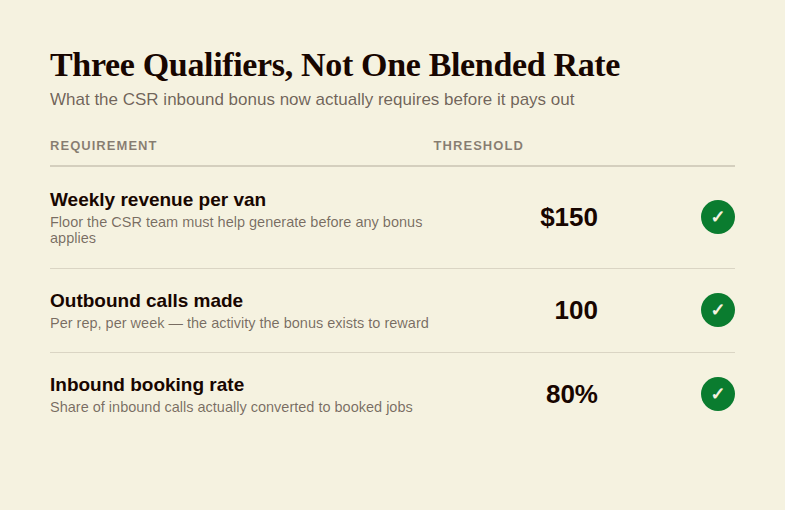
Fixing it meant putting three specific qualifiers back into the plan, each one tied to a behavior that actually mattered to the business, not to a single blended percentage that paid out regardless of what a rep did that week.
The first was a weekly revenue floor tied to the van, not the individual, since the CSR team collectively supports a fleet that needed to be earning a minimum amount to justify the payout at all. They settled on $150 per van per week as a starting threshold, with room to raise it once more data came in. The second was the outbound call requirement itself, rebuilt as 100 outbound calls per week per rep, the weekly equivalent of the 20-a-day standard the team had used before the rule drifted. The third was an inbound booking rate requirement, raised to 80 percent, so the bonus only paid out when calls that came in were actually being converted into booked jobs, not just answered.
Alongside those three qualifiers, the group payout rate itself got corrected, cut from 0.18 down to roughly 0.06, restoring the original math instead of leaving the group model paying triple what the plan intended. And a separate flat $50 weekly bonus that nobody could quite trace the origin of, one rep was getting it consistently while others weren't, and no one on the call could explain why, got converted into a stretch goal that only kicks in once a van clears $175 for the week instead of paying automatically at $150. That kept the incentive in place for reps who were already exceeding expectations without quietly padding every paycheck regardless of performance.
The technician commission side got a parallel fix. Techs who sell a job and complete it themselves keep the full 20 percent split. Techs who sell a job and hand it to someone else get 10 percent through the "sold by" field, with their split zeroed out so the system cannot pay them twice for the same job. It is a small distinction on paper, sold-by versus split, but it is the difference between a tech getting fairly paid for closing a sale he does not personally execute and a job silently double-counting labor that was never performed twice.
None of it was theoretical or scheduled for next quarter. The rate change, the three qualifiers, and the outbound call report all went live on the same call, in time for that week's payroll to run against the corrected numbers instead of the inflated ones. "I need a process that's scalable that everybody understands," the ops lead said partway through, and that line captures what the fix was actually solving for: not just this week's number, but a rule set specific and durable enough that it would not quietly drift again the next time something upstream changed.
What a Near Miss Like This Actually Costs
Run the arithmetic and the stakes are easy to see. A CSR bonus creeping from roughly $150 to $200 a week up to $400 a week, held constant across a team of reps for a year, is not a rounding error. It is the kind of gap that shows up as a surprise six-figure swing in payroll spend by the time someone notices it in a quarterly report instead of a weekly one. Catching it on the call it surfaced on, before that week's checks went out, is the difference between an uncomfortable finance conversation and an invisible one.
The deeper lesson is not really about CSR bonuses or sold-by fields specifically. It is that an incentive plan is a live system, not a document you write once and file away. Every variable in it, a percentage, a threshold, a qualifier, is connected to every other one, and changing a single input, like moving from individual to group payouts, can ripple through the whole formula in ways that are not obvious until a payroll run makes them impossible to ignore. The fix here worked because someone was watching the actual numbers closely enough to say a $400 bonus looked wrong before it went out the door, and because the underlying platform could be reconfigured with real qualifiers in the same sitting instead of requiring a multi-week engineering ticket.
For a business running a fleet of vans and a phone-based team that lives and dies by outbound activity, the whole point of a bonus is to buy more of the behavior that grows the business: more calls made, more jobs booked, more revenue per van. A plan that pays out regardless of whether any of that happened is not an incentive anymore. It is just an unplanned raise, and one that keeps compounding every week nobody catches it.
Profit sharing
made simple.
Give your team a stake in the company’s success. ShareWillow helps you create and manage profit-sharing programs that motivate employees and drive business results.
Related reading
- How a Southwest Florida Trades Company Rebuilt Pay Around a 25% Labor-Cost Target
- How a Family-Owned Plumbing Company Finally Got a KPI Scorecard That Works
- How to Calculate Bonus Pay: A Step-by-Step Guide to Fair and Motivating Compensation
- Companies with Profit Sharing: Who They Are & What They Offer
Conclusion
A CSR bonus formula quietly drifted from real performance requirements to an unqualified payout on pace to cost roughly $60,000 a year per rep, and rebuilding three qualifiers live on the call corrected that week's payroll before the inflated bonus ever went out.
Create incentives
that
drive results
You shouldn't need complex equity plans to align your team. ShareWillow makes it simple to create transparent profit-sharing programs that motivate employees and grow your business.

Incentive plans to help
small businesses thrive.
.png)
"I was able to leverage the knowledge of the ShareWillow team to learn how other companies were designing their bonus plans. The template was extremely helpful."

Brian Tustin
Owner, First Rate Movers