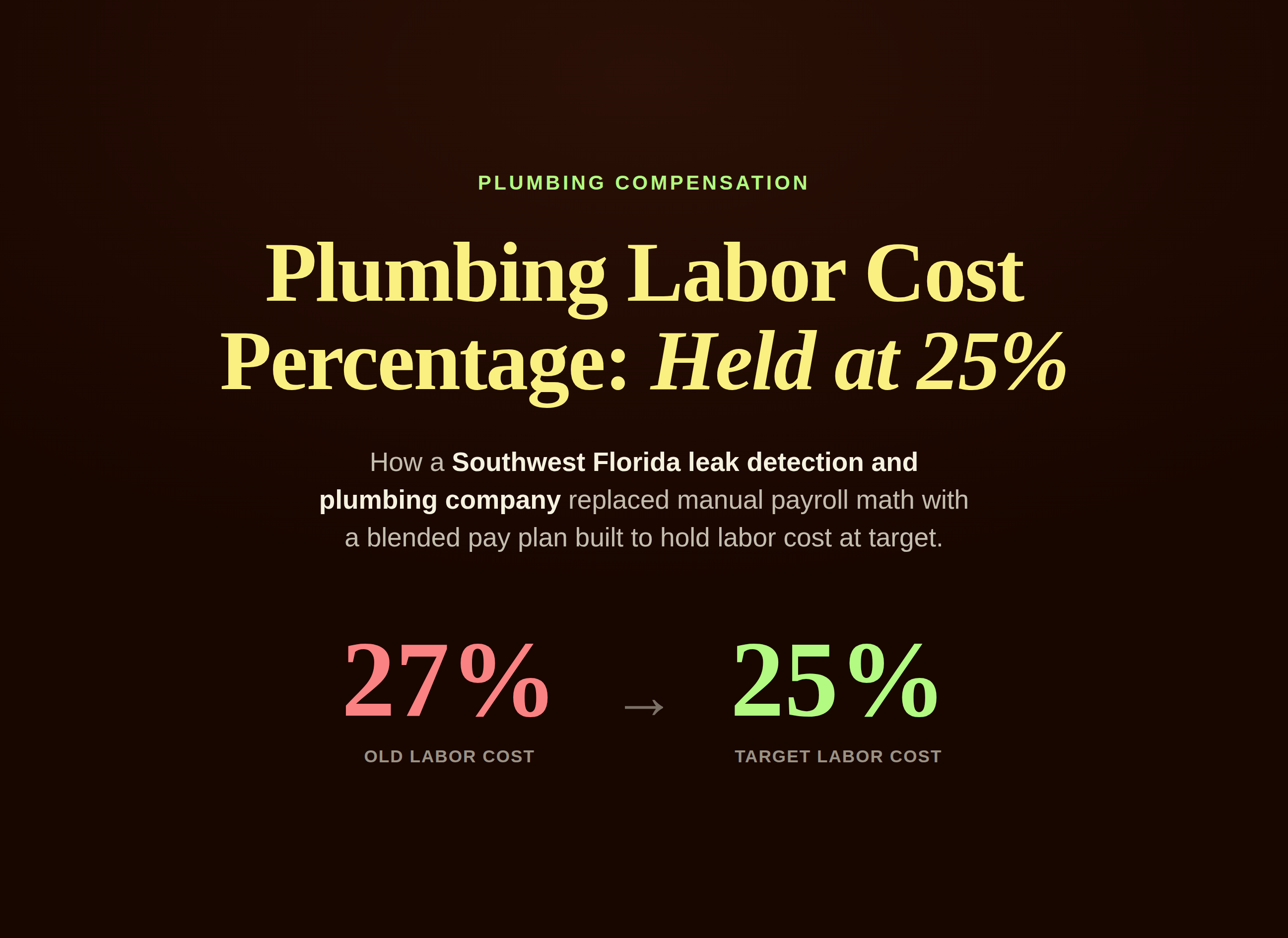
A Southwest Florida leak detection, plumbing, and pool company ran technician pay through a manual biweekly Excel process built on pure commission, with no way to see real labor cost or catch a booking-rate metric that was quietly being gamed. ShareWillow rebuilt pay around three selectable hourly-plus-commission tiers tied to a real 25% labor-cost target, giving the owner and technicians the same transparent number to work from.
Every other Friday, an office administrator at a Southwest Florida leak detection, plumbing, and pool service company sat down with a stack of PDFs pulled from ServiceTitan and a blank Excel sheet, and rebuilt every technician's paycheck from scratch by hand. She typed in the job type, the invoice total, the commission rate for that technician, whether the work happened on a weekend, whether there was a payroll adjustment for a callback. Fifteen to twenty technicians, three job categories each, twice a month, for years. It worked, in the sense that people got paid. But nobody, including the owner, could look at a single number and say with confidence what the company's labor cost actually was, or what a technician needed to do this week to earn more than they did last week.
That opacity became a real problem in the space of about a month. The company's best-performing technician, the one who consistently generated enough revenue to sit at the top 24 percent commission tier, left at the start of the year. Around the same time, the owner started worrying about how paid time off was interacting with a pure commission structure, particularly on the rare occasions a technician had to sit for a deposition on a leak detection report and needed to be paid for hours that did not map to any commissioned job. And then, listening back through call recordings with his son, the owner discovered something else: the office manager had been quietly excusing incoming calls from the "lead" count so they would not count against her booking rate. Her reported booking rate had jumped from the 40 to 50 percent range up to around 70 percent, and as the owner put it, "I don't believe that magically just happened." Three separate problems, one root cause: nobody had a compensation system built to be trusted, checked, or improved. So the company brought in ShareWillow to rebuild pay from the ground up, for both the field technicians and the office.
Straight Commission Hid the Real Cost of Doing Business
Before the rebuild, technicians were paid pure commission, 20 to 24 percent of the jobs they completed depending on tenure and performance, with a flat 30 percent on weekend work regardless of tier. There was no hourly component at all during a normal work week; the only time a technician touched an hourly rate was for vacation, holiday pay, or the occasional deposition, all paid at a flat $30 an hour that had nothing to do with what that technician actually earned in the field. The commission itself was split across three categories, leak detection, plumbing, and pools, because the owner's workers' compensation and liability insurance rates differ sharply by trade. Plumbing carries the highest premiums, pools are in the middle, and leak detection and inspection work is the cheapest to insure, so every invoice had to be tagged and paid out correctly by category or the company's insurance costs would not match its labor costs.
The structure had drifted for years without anyone recalculating what it actually cost. When the ShareWillow team modeled the company's real historical numbers against revenue, labor cost was running close to 27 percent, two points above where the owner wanted to be. "Are we shooting for a 25 percent? Is that the number we're currently working with?" the owner asked partway through the process, and confirmed it was still the target even as the design evolved. Two points might not sound like much, but on a payroll running twenty technicians it is real money every single pay period, and it was invisible inside a manual spreadsheet that only ever showed what people were paid, never what the company could actually afford to pay them.
There was a second, quieter cost buried in the same numbers: cancellations. Running the math on roughly ten technicians doing three jobs a day, five days a week, the owner worked out that a cancellation rate drifting up toward 10 percent was costing the company somewhere around 60 jobs a month. "That's close to a technician's worth of work," he said, and it became one of the reasons cancellations needed their own line in whatever came next, not just for technicians but for the office staff booking the jobs in the first place.
Three Hourly Tiers, Each Paired With Its Own Commission Rate
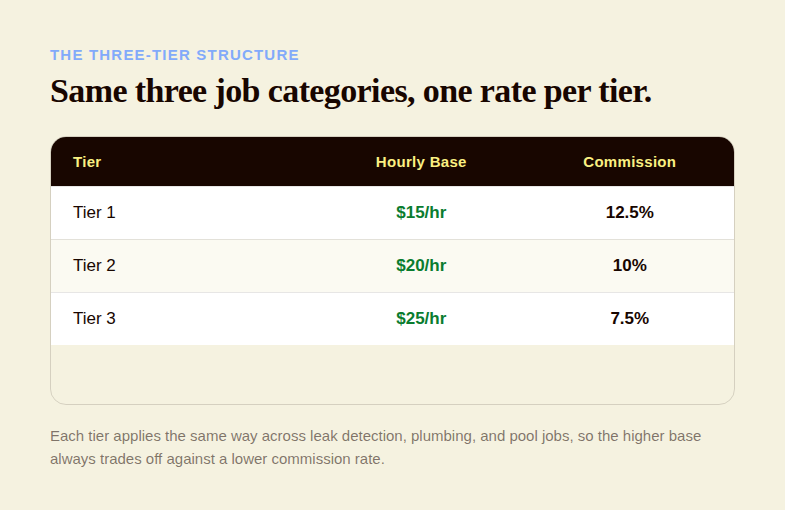
The plan ShareWillow built replaced the single flat commission with three selectable tiers, each pairing a base hourly rate with a lower, offsetting commission rate: $15 an hour with 12.5 percent commission, $20 an hour with 10 percent, and $25 an hour with 7.5 percent. A technician confident in their ability to sell and produce could choose the lower base and higher variable upside; a technician who wanted more predictable pay could choose the higher base and accept a smaller cut of each job. All three tiers kept the same three commission categories, leak detection, plumbing, and pools, so the insurance-driven structure the owner needed for compliance carried straight through into the new plan. The weekend premium was rebuilt too, moving from a flat 30 percent with no hourly base to a 5 percent add-on layered on top of whichever tier's commission rate a technician was already earning, which fixed a quirk nobody had noticed: under the old flat rate, a technician on the lowest 20 percent tier actually gained more from working a weekend than a technician on the 24 percent tier did, purely because the jump was steeper for him. As the owner said when it came up, "I'm shocked that nobody's ever come to me and said this isn't fair."
Building three real tiers instead of a single number only makes sense once you can model it against real payroll history, which is part of what a purpose-built incentive pay platform is for: running a technician's actual invoices from recent pay periods against each candidate tier before anyone commits to a number. When ShareWillow ran the company's historical data through all three tiers, the pattern was immediate. Technicians who worked fewer hours but closed high-dollar jobs came out worse off, because their commission rate dropped without enough hours to make up the difference in base pay. Technicians who worked closer to a full 40-hour week but produced less per job came out ahead, because the guaranteed hourly base now covered ground the old commission-only model never did. "Right now, we're subsidizing, you know, you, where you're getting paid more hourly than the commission plan, and that's gotta change," the owner said, describing exactly this kind of technician under the old system. Under the new plan, that gap closes, because the two payment paths are reconciled every pay period instead of drifting apart in a spreadsheet nobody rechecks.
Working Backward From $90,000 to Find the Real Number
The clearest moment in the redesign came when the owner and the ShareWillow team stopped talking in percentages and started talking in dollars. Instead of asking what commission rate felt fair, they picked a target: a technician earning $90,000 a year. Divided across 26 biweekly pay periods, that technician needed to gross $3,461 every two weeks. Working backward from the 25 percent labor-cost target, hitting that gross pay meant the technician needed to generate $360,000 a year in completed work, or $13,846 in revenue every two weeks. That is the number the whole plan design was built around: not a commission percentage in isolation, but a concrete revenue figure a technician could look at on a Tuesday afternoon and know whether they were on pace. The plumbing-specific structure the company had been running for years finally had a shared number attached to it that both the owner and the crew could check against.
Layered on top of the three tiers is a biweekly sales bonus with its own thresholds: 1 percent extra on $10,000 to $12,000 in booked sales for the period, 3 percent on $12,000 to $14,000, and 4 percent on anything over $14,000. Those first two thresholds had been sitting untouched for years, carried over from before the current owner even bought the business. He wanted to raise the next tier's floor to around $15,000, but pointed to exactly why the top bonus matters so much for behavior at the margins. Technicians frequently wrap up a big repair, like a pool skimmer replacement that can run $2,000 in a single visit, in four or five hours and then call it a day once they clear the current bonus threshold, with nothing pulling them to pick up one more job. "If they knew that there was, you know, at 15,000 or whatever number we end up setting, that there was a 5 percent bonus instead of the 3, that might encourage them to want to call in and say, hey, is there another job for me," the owner said. It is a small design detail, a single percentage point at a single threshold, but it is the difference between a bonus that rewards technicians for what they were already going to do and one that actually changes what happens at three in the afternoon when a truck could either go home or take one more call.
Fixing a Booking Rate That Was Being Quietly Gamed
The technician plan solved a compensation problem. It did not solve the trust problem sitting in the office. While reviewing call recordings, the owner and his son found calls the office manager had logged as not being real leads, calls that plainly were leads, simply excused from the count so they would not weigh down her booking rate. Her reported number had climbed from the 40 to 50 percent range to roughly 70 percent over a period where nothing about incoming call volume or crew availability had actually changed. That kind of manipulation does not show up as fraud on a spreadsheet. It shows up as a metric that looks great right up until someone cross-checks it against the raw call log.
ShareWillow built a separate plan for the office role built specifically to make that kind of quiet gaming much harder to pull off. Instead of one self-reported booking-rate number, the plan layers in cancellation rate and outbound call volume alongside booking rate, each pulled directly from the source system rather than typed in by the person being measured. Booking rate tiers start at 80 percent, cancellation rate is capped in two tiers, under 10 percent and then under 5 percent, and there is a team revenue goal from booked calls to keep everyone pulling toward the same weekly number. Cancellations matter here for the same reason they mattered on the technician side: every job that falls off the books after being scheduled is lost capacity nobody gets back. "When somebody wants to, you know, and even from right out of the gate with somebody that's got a problem, and we say, okay, we can't get there till next Tuesday, and they've got an active water leak, well, they're gonna be looking for solutions," the owner said, describing exactly the moment a cancellation gets born and exactly why the office needs a real incentive to prevent it rather than just log it.
What a Shared Number Actually Buys You
None of this required exotic math. A $90,000 salary divided by a 25 percent labor-cost target is arithmetic anyone could do on the back of an envelope. What the company never had was a system that ran that arithmetic consistently, attached it to real ServiceTitan data instead of a manually typed spreadsheet, and showed both the owner and the technicians the same number at the same time. The three-tier structure did not just move labor cost from 27 percent toward 25 percent on paper. It gave a technician deciding between the $15 and $25 hourly options a real choice instead of a single take-it-or-leave-it rate, and it gave the owner a plan he could explain in one sentence instead of a spreadsheet he had to walk someone through line by line. The office plan did something similar for a metric that had quietly become unreliable: it replaced a self-reported number with one built from data nobody in the office could selectively excuse.
The owner's instinct throughout was the right one. Before changing a single rate, he wanted to see the real numbers, run backward from a target salary, and know exactly who would come out ahead and who would come out behind before anyone's next paycheck depended on it. That is the difference between adjusting pay and rebuilding it. A trades business running commission on gut feel and a biweekly Excel sheet can survive for a while on inertia and trust. It stops working the moment a top performer walks out the door, a compliance question comes up that nobody planned for, or a metric everyone relied on turns out to have been managed rather than measured. Building the plan around real, checkable numbers is what makes it survive the next version of any of those problems, not just the one that surfaced first.
Profit sharing
made simple.
Give your team a stake in the company’s success. ShareWillow helps you create and manage profit-sharing programs that motivate employees and drive business results.
Conclusion
A Southwest Florida trades company replaced one flat commission rate tracked in a manual Excel process with three tiered hourly-plus-commission plans built around a real 25% labor-cost target, giving the owner and technicians a shared, checkable number instead of a guess.
Create incentives
that
drive results
You shouldn't need complex equity plans to align your team. ShareWillow makes it simple to create transparent profit-sharing programs that motivate employees and grow your business.

Incentive plans to help
small businesses thrive.
.png)
"I was able to leverage the knowledge of the ShareWillow team to learn how other companies were designing their bonus plans. The template was extremely helpful."

Brian Tustin
Owner, First Rate Movers