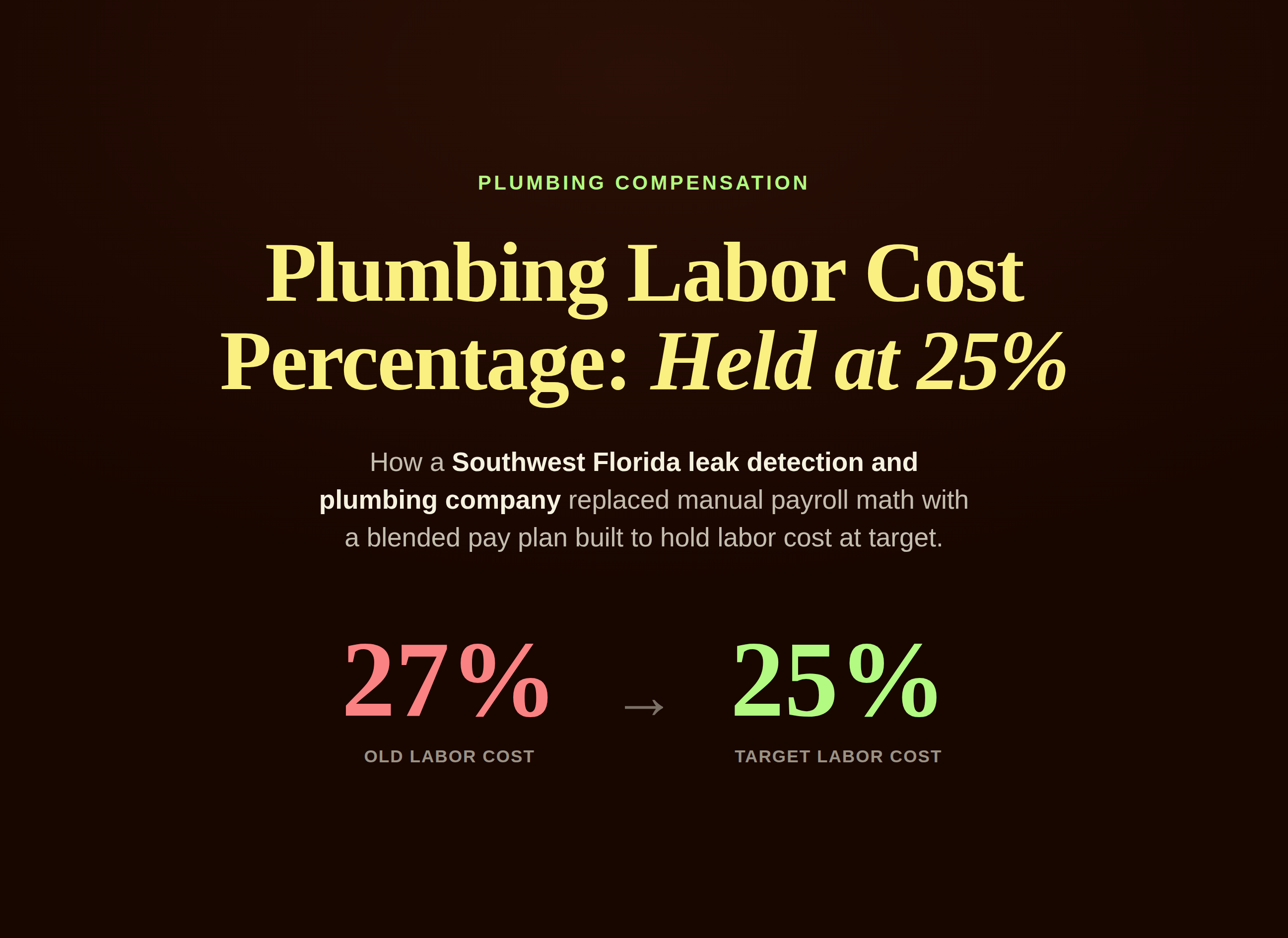
For ten years, a water treatment and plumbing company tried and failed to pull usable technician metrics out of ServiceTitan. Here is how a rebuilt KPI scorecard, plus two new incentive plans layered on top of it, finally gave the owner numbers he could trust and act on.
Ten Years of ServiceTitan, Zero Usable Metrics
Picture a family-owned water treatment and plumbing service company that has been in business for about a decade, running a lean team of roughly six field technicians alongside a small dispatch and service management office. The company has always run its jobs through ServiceTitan, and for just as long, the owner had tried to get something useful out of it: a report, a dashboard, anything that would tell him which technicians were actually performing well and which ones were quietly costing him money on recalls and comebacks.
It never worked. Not because the owner did not try. Over ten years he attempted more than one round of building reports and scorecards inside ServiceTitan itself, and each time the numbers came back wrong, incomplete, or impossible to trust. Recall rates would not tie out. Efficiency numbers did not match what he saw in the field. Eventually he stopped trying and ran the business the way a lot of trades owners do without realizing it: on instinct, tenure, and whoever complained loudest about their paycheck.
That is a genuinely common place for a plumbing or water treatment business to land. ServiceTitan is a powerful system of record, but building a technician scorecard on top of it, one that pulls the right fields, weights them sensibly, and updates automatically every pay period, is a different skill than running the software day to day. A lot of owners try it once, watch the numbers come back garbage, and conclude the data problem is unsolvable. So they go back to flat hourly pay or a vague year-end bonus, and the business loses the one thing that would let it actually reward its best people: a number everyone agrees is true.
Going into this rebuild, the owner said as much directly. He had tried metrics inside ServiceTitan before and watched them fail, so he came in skeptical that this attempt would be any different. That skepticism is worth sitting with for a second, because it is the default emotional state of almost every owner who has been burned by a bad reporting project. Trust in the data has to be rebuilt one correct number at a time, and the only way to do that is to actually get the pull right.
Building a Scorecard Technicians Could Actually Trust
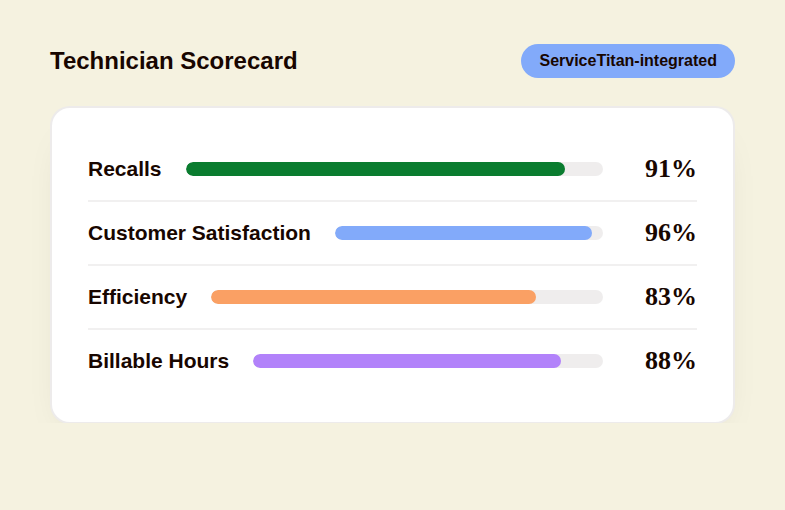
The rebuild started with a single technician-facing KPI scorecard pulled directly from ServiceTitan, tracking four numbers: recall rate, customer satisfaction, efficiency, and billable hours. None of those four metrics is exotic. Every HVAC, plumbing, or electrical shop already has this data sitting in its field service platform. The work is in mapping the right fields, filtering out the noise, jobs that got recoded, warranty callbacks that should not count against a tech twice, canceled work orders, and then presenting the result in a way a technician can glance at and understand without a finance degree.
That is the part that had failed for ten years. Getting a scorecard to pull clean data from ServiceTitan is less about the concept and more about the plumbing underneath it, literally and figuratively: which job statuses count, how a recall within thirty days should be attributed, whether a technician who inherits someone else's unfinished job should be penalized for the prior tech's mistake. Get those rules wrong and the scorecard becomes exactly the kind of thing this owner had already learned to distrust.
Once the scorecard was live and running correctly for a full pay cycle, the tone of the conversation changed noticeably. The owner's own words were direct: metrics are actually working, and after so many previous attempts that quietly broke on bad data, he said he was genuinely impressed that this one held up. That is not a small thing for a business that had essentially given up on the idea of trustworthy technician data. A decade of frustration does not get erased by one clean report, but it does buy the kind of credibility that makes an owner willing to build real pay structures on top of the numbers instead of just admiring them from a distance.
Turning the Office Into a Second Profit Center
Most incentive pay conversations in the trades start and end with field technicians, and understandably so. But once this company had a scorecard it trusted, the more interesting move was extending the same discipline to the office staff who had never had a performance plan of any kind: the dispatch manager and the service manager.
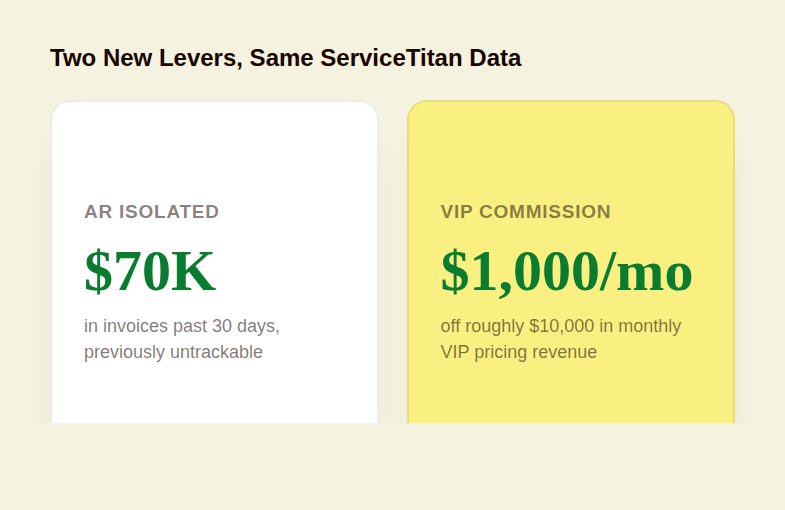
The dispatch manager's plan is structured as a monthly bonus pool worth about ten percent of her roughly $47,000 salary, close to $400 a month, split across two to four weighted KPIs pulled straight from dispatch data: on-time arrival percentage, call classification accuracy, and accounts receivable performance. That last one turned out to be the sleeper metric. Before this rebuild, the company had no reliable way to see which invoices were aging past thirty days. Once AR tracking was wired into the incentive plan, it isolated roughly $70,000 in invoices that had quietly drifted past the thirty-day mark, money that was owed to the company and simply was not being chased with any urgency because nobody had a clean view of it.
That is the kind of number that changes how an owner thinks about incentive pay entirely. It is easy to assume a KPI plan is purely a cost, a percentage of payroll handed out for hitting targets. But when the KPI itself is accounts receivable aging, the plan pays for itself by surfacing money the business already earned and was at risk of never collecting. A $400-a-month bonus pool that helps recover a five-figure AR backlog is not really a cost center at all.
The service manager's plan works differently: a five percent commission on sold estimates, weighted against two guardrails so the incentive cannot be gamed. The first guardrail checks for $0 jobs, estimates that get sold and then quietly zeroed out or heavily discounted after the fact, a pattern that can hide margin erosion behind a commission that still gets paid in full. The second guardrail ties back to the same recall rate tracked on the technician scorecard, so a service manager cannot juice their commission by pushing volume at the expense of job quality. Selling more only pays more if the work behind it holds up.
This is the layered design a lot of home services companies eventually need and rarely build on the first attempt: one plan for the people doing the work, a second for the people managing the schedule, and a third for the person selling the job, each pulling from the same underlying data but weighted against the specific ways that role could otherwise game its own number.
Profit sharing
made simple.
Give your team a stake in the company’s success. ShareWillow helps you create and manage profit-sharing programs that motivate employees and drive business results.
VIP Pricing Becomes Its Own Commission Engine
The last piece was a dedicated incentive plan built around the company's VIP pricing program, a premium service tier the business already offered but had never directly compensated anyone for selling. The new plan pays a flat ten percent commission on VIP-priced work. Against roughly $10,000 in monthly VIP revenue, that works out to about $1,000 a month in commission, real money that did not exist as a line item six months earlier because nobody was specifically incentivized to offer the VIP tier over the standard one.
It is a useful reminder that incentive plans are not only about fixing underperformance. Sometimes the highest-leverage move is noticing a product or pricing tier that already exists, already has a proven margin, and simply has nobody whose paycheck depends on selling it. A ten percent commission is a small number against a real number, a monthly revenue line built almost entirely out of behavior change, not new marketing spend or new customers.
Seven Months of Payouts and a Trust Rebuilt
All of this has now been running for more than seven months, live monthly incentive payouts calculated automatically from the same ServiceTitan data that had frustrated this owner for a decade. That duration matters as much as any individual number in this story. A scorecard that works for one pay period can be a fluke. A scorecard and three linked incentive plans that have now survived seven consecutive months of real payroll are a system.
What makes this story worth reading if you run a plumbing, HVAC, or water treatment company is not any single metric. It is the shape of the problem: ten years of a good business owner assuming his field service software simply could not produce trustworthy performance data, followed by the realization that the data was there all along, and the missing piece was building the scorecard and the incentive logic correctly around it the first time. If your own ServiceTitan, Housecall Pro, or similar system has felt like a black box that never quite produces a number you would bet a paycheck on, that is usually a sign the reporting was built wrong, not that the data does not exist.
The office incentive layer is the other half worth taking from this. Dispatchers, service managers, and CSRs influence revenue and cash flow just as directly as the technicians turning wrenches, and most of them have never been offered a performance plan of any kind. A ten percent bonus pool tied to accounts receivable, or a commission plan with the right guardrails against gaming it, can turn a support role into a genuine second profit center almost overnight.
What to Check Before You Build Your Own Scorecard
A few questions are worth answering honestly before any trades business tries this again on its own. First, does the recall definition actually match how the business thinks about a recall, or does it double-count a callback that was really a continuation of the same job? Second, does the efficiency metric account for job complexity, or does it quietly punish technicians who get handed the hardest calls? Third, and this is the one that tanked this company's first nine years of attempts, is the data pull actually being validated against a manual spot check before it goes live, or is everyone just trusting the export and hoping it holds up?
None of those questions require exotic tooling. They require someone willing to sit with the raw ServiceTitan data long enough to find the edge cases before a technician finds them first, in the form of a paycheck that does not match what they know they earned. That validation step is invisible when it is done well and expensive when it is skipped, which is exactly why it got skipped for a decade at this company before anyone got it right.
It is also worth noticing what did not happen here. The company did not rip out ServiceTitan, did not hire a data analyst, and did not build a custom reporting tool from scratch. Every number in this story, the recall rate, the AR aging, the VIP revenue, was already sitting inside software the business was already paying for and already using every day. The gap for ten years was never access to data. It was a scorecard built correctly on top of data that was there the entire time, which is a far more common gap in the trades than most owners assume when they conclude their own reporting problem is unsolvable.
Related reading
Conclusion
Ten years of failed attempts at ServiceTitan reporting ended with one working technician scorecard, and that single change unlocked three linked incentive plans covering the field, the dispatch office, and a premium pricing tier nobody had been selling on purpose. If your own field service data has never produced a number you trust enough to pay someone on, the fix is usually not more reporting. It is rebuilding the one report that matters correctly.
Create incentives
that
drive results
You shouldn't need complex equity plans to align your team. ShareWillow makes it simple to create transparent profit-sharing programs that motivate employees and grow your business.

Incentive plans to help
small businesses thrive.
.png)
"I was able to leverage the knowledge of the ShareWillow team to learn how other companies were designing their bonus plans. The template was extremely helpful."

Brian Tustin
Owner, First Rate Movers