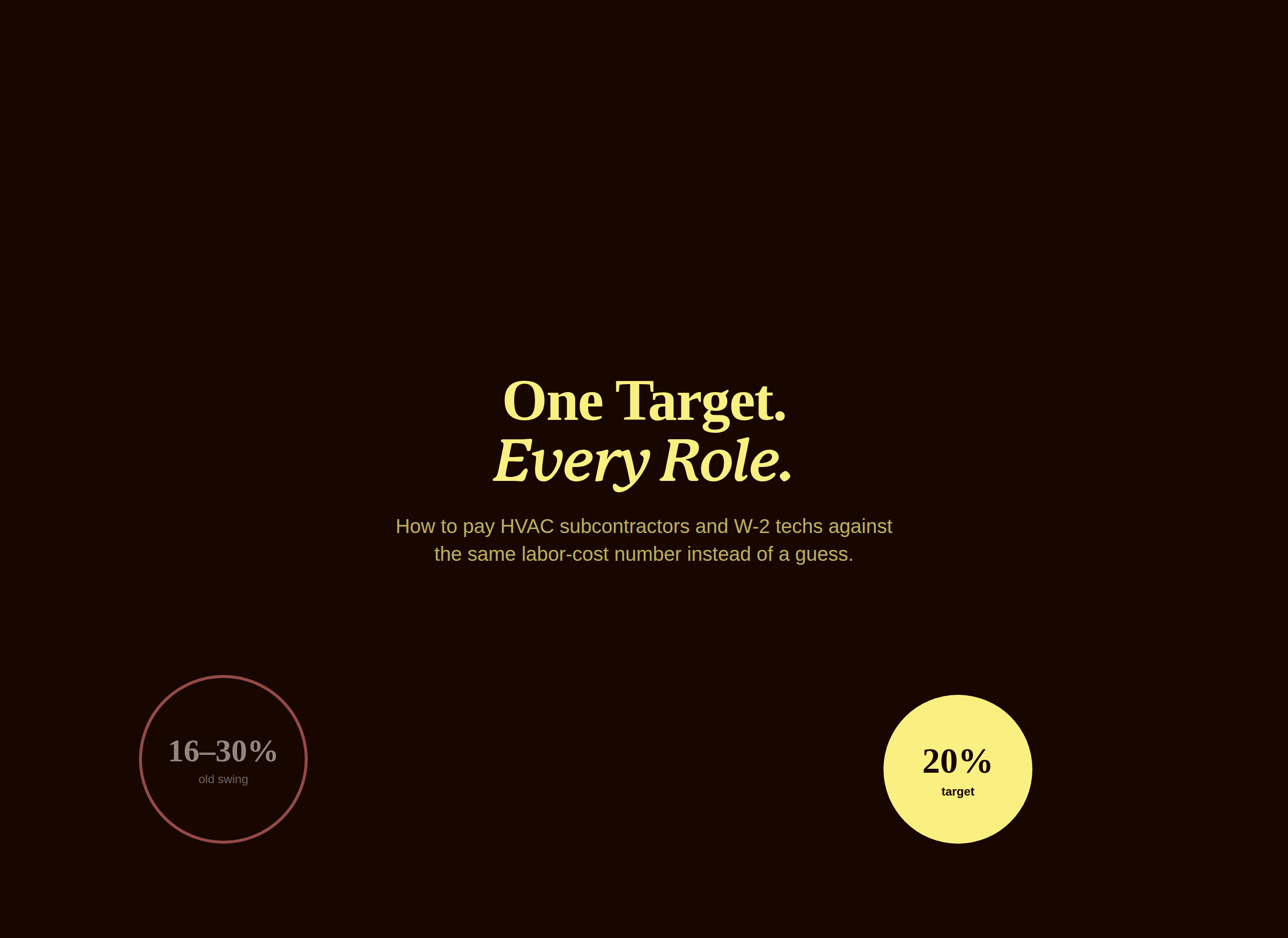
An 11-person residential plumbing company had already tried incentive pay once, a $500 bonus for five-star reviews that quietly died because it made the team compete against each other instead of the clock. Here is what changed once the bonus math moved onto their own ServiceTitan data and started running every single month without fail.
Most companies that call an incentive plan provider have never tried one before. This one had, and it had not gone well. An 11-person residential plumbing company had previously run its own version of incentive pay: a flat $500 award for technicians who racked up the most five-star reviews, plus informal recognition for handling callbacks cleanly. On paper it sounds reasonable. In practice, the owner watched it turn into something closer to a competition than a team incentive. Whoever got out to the reviews first each month effectively locked the bonus up, and everyone else disengaged once they realized catching up was unlikely. The plan did not build momentum. It built resentment, and eventually it just faded out, the kind of quiet death that incentive programs have all the time without anyone ever officially canceling them.
There was a second, quieter problem sitting underneath the review contest. The company's technicians were also working under a straightforward commission structure for equipment and repair sales, and over time that commission had stopped doing its job too. Sales had flattened out into a kind of complacency: the same conversations, the same close rate, month after month, with no real pressure pushing anyone to improve on it. A commission plan that has been in place long enough without adjustment tends to become background noise rather than motivation, something technicians know exists but no longer actively think about on a service call. Between a review contest that had curdled into resentment and a commission structure that had faded into the wallpaper, the company was paying for two incentive programs that were no longer incentivizing much of anything.
That history matters, because it explains why the second attempt needed to look nothing like the first. The company was already running ServiceTitan for dispatch and job tracking, but according to the owner's own account, key parts of it, the integrated reporting, the dashboard analytics, the tools that would have made a fair bonus program possible, were sitting mostly unused. The data to build something better was already being generated by every job on the board. Nobody had connected it to a payout.
Building A Plan That Could Not Turn Into A Race
The fix was not a bigger bonus or a cleverer review incentive. It was a monthly technician scorecard plan built directly on ServiceTitan job data, with metrics broad enough that a technician did not need to out-hustle a coworker to a specific review to see a payout land. Five technicians enrolled at launch in October 2025. The plan ran its first confirmed monthly cycle that same month and paid out $378.87, a modest number by design: a new plan proving it works before anyone starts expecting a specific dollar figure every time.
November came in at $229.57, December at $595.19, both confirmed, both processed without incident. That might not sound like a headline, but a plan that survives three consecutive months without breaking, without a payout dispute, without someone in the office manually re-checking the math, is already outperforming the company's first attempt at incentive pay, which never made it that far before people stopped trusting it.
The Second Plan Year: Enrollment Nearly Doubles
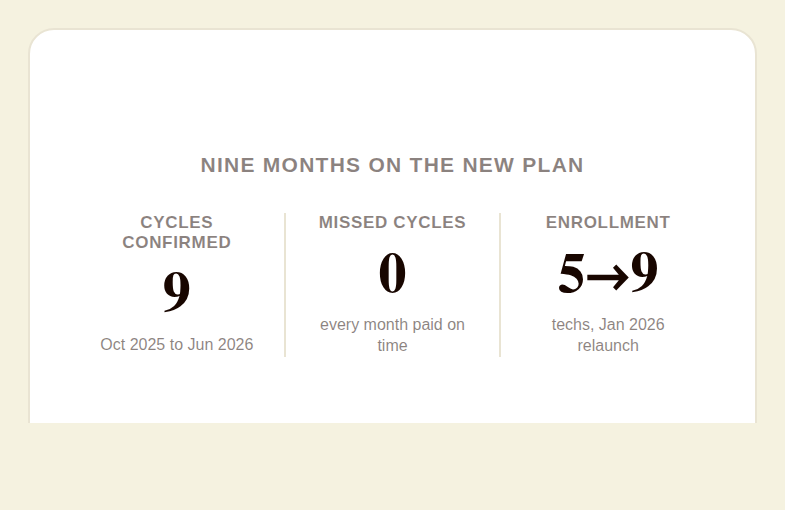
What happened next is the part worth paying attention to. When the plan rolled into its 2026 cycle in January, enrollment grew from five technicians to nine, close to double the original group, without the owner having to sell anyone on rejoining. Technicians who had watched the first three months from the sidelines signed up once they saw the plan actually pay out on schedule, which is a far more convincing pitch than anything a manager can say in a meeting. Word of mouth from a coworker who got a real check tends to do more recruiting for an incentive plan than the plan's own paperwork ever could.
From January through June 2026, the plan confirmed a payout every single month: January $603.00, February $794.40, March $1,716.42, April $554.80, May $3,462.35, June $684.03. That is nine consecutive confirmed monthly cycles going back to the October 2025 launch, with zero missed or rejected payouts anywhere in the run. Cumulative confirmed payouts across those nine months come to $7,815.00. May stands out as a clear high point, more than double any other month in the run, the kind of standout month that is worth watching rather than assuming as a new baseline, but even the quieter months never dropped to zero or skipped a cycle entirely.
Why "Never Missed A Cycle" Matters More Than Any Single Number
It is tempting to focus on the $3,462.35 month, since it is the biggest number in the run. The more useful number for another owner reading this is nine. Nine consecutive months where the plan ran, confirmed, and paid out, without the process ever needing to be rescued, paused, or reworked mid-cycle. Reliability is the part of an incentive pay program that almost never gets marketed, because it is boring compared to a big dollar figure, but it is the actual thing that determines whether a plan is still running in month twelve or quietly dead like the company's first attempt at one.
A plan that pays out reliably every month builds a specific kind of trust that a plan with occasional gaps never earns, even if the gap-prone plan pays more on its best months. Technicians do not average out a year of bonus history in their heads. They remember the last time the bonus did not show up, or showed up wrong, and that memory colors how much attention they pay to every plan afterward. Nine straight confirmed cycles means nine straight months where nobody on this plumbing team had a reason to stop trusting it, which is exactly the opposite of what happened with the $500 review bonus that came before it.
What Changed Beyond The Core Technician Plan
The original technician scorecard was never meant to be the whole program, just the part that had to work first. Once it did, the company added a second plan for helpers, running weekly and monthly cadences alongside the core technician plan, which confirmed its own string of payouts from February through May 2026: $100, $100, $200, and $150, a smaller plan for a smaller role, but built on the same principle of paying against real, current job data rather than an end-of-quarter guess. It is also worth noting the plan has grown well beyond that: the company now has seven plans total in various stages, including a foreman project bonus and both a team and board-level profit share still being finalized, on top of the technician and helper plans already live and paying out. That is not the behavior of an owner who is lukewarm on the program. It is the behavior of someone who watched the core plan hold up for nine straight months and decided to build the rest of the compensation structure around the same idea.
Profit sharing
made simple.
Give your team a stake in the company’s success. ShareWillow helps you create and manage profit-sharing programs that motivate employees and drive business results.
The Real Fix Was Removing The Competition, Not Adding More Money
It is worth returning to why the first incentive attempt failed, because the fix was not primarily about the dollar amounts. The $500 review bonus failed because it pitted technicians against each other for a single prize, and once someone pulled ahead early in the month, everyone else's incentive to keep pushing evaporated. A monthly scorecard tied to each technician's own numbers removes that dynamic entirely. Nobody is racing a coworker to lock up the only bonus available. Everybody's payout is a function of their own work, which is a small structural difference that changes the entire psychology of the plan. It is the difference between a bonus that motivates one person a month and a bonus that can motivate all nine simultaneously, which shows up directly in the fact that this plan kept paying out, month after month, instead of quietly dying the way the review contest did.
Companies still running a first-generation incentive plan, the kind built around a single prize or an informal handshake bonus that nobody has revisited in years, are usually running exactly the version of the problem this plumbing company already solved. A plan built on real job data, scored individually instead of competitively, does not need to be complicated to outperform a bigger bonus that only reaches one person a month. It just needs to be built so that reliability, not size, is the first thing it proves.
How The Numbers Stack Up Against Other Plumbing Shops
Across plumbing companies running similar monthly incentive plans, the typical shop generates close to 42 payout cycles over its history with a median payout per cycle a little above $1,100. Measured against that benchmark, this company's typical month, somewhere between $550 and $800, runs a bit below the broader plumbing cohort's median. Its standout months, March at $1,716.42 and May at $3,462.35, land well above it. That is a fair and honest way to read the data: a smaller shop with a smaller team running a plan that is more modest than the industry median on an average month but fully capable of producing a peer-beating result when the work and the metrics line up. It is also exactly the shape of number an owner should expect from a plan still in its first two plan years rather than its fifth, and it is a far more useful comparison than either inflating a strong month into a permanent baseline or dismissing a quiet month as evidence the plan is not working.
What that comparison does not capture, and what matters more for a team this size, is consistency. A cohort median built from dozens of shops averages out the ones that skip cycles, pause plans, or let a bonus program lapse the way this company's own first attempt did. Nine for nine on confirmed cycles is a number that does not show up in a median at all, and it is the number that predicts whether technicians will still trust the plan in month eighteen.
Nine Months In, The Real Test Is Month Ten
Nine consecutive confirmed cycles is a genuinely strong track record, and it is also just the halfway point of a plan's first full year. The honest way to read this data is not "this company is done building its incentive program," it is "this company found a structure durable enough to keep expanding on," which is exactly what the move from one technician plan to seven total plans in various stages suggests is happening. For an owner watching technicians disengage from a bonus program that never quite worked the first time, the lesson from this account is not about the size of any single check. It is about building a plan simple enough, and fair enough, that it can survive nine months without anyone needing to fix it, then trusting that reliability enough to build the rest of the pay structure on top of it.
Related reading
Conclusion
Nine straight confirmed monthly payouts, zero missed cycles, and enrollment nearly doubled from five technicians to nine. The plumbing company that watched its first incentive attempt quietly die now has seven plans in various stages, all built on the same principle: pay against real job data, not a race to a single prize.
Create incentives
that
drive results
You shouldn't need complex equity plans to align your team. ShareWillow makes it simple to create transparent profit-sharing programs that motivate employees and grow your business.

Incentive plans to help
small businesses thrive.
.png)
"I was able to leverage the knowledge of the ShareWillow team to learn how other companies were designing their bonus plans. The template was extremely helpful."

Brian Tustin
Owner, First Rate Movers