An 8-technician plumbing company had built its pay structure the way most shops do: one exception at a time, until nobody could say with confidence what a fair paycheck actually looked like. Here is what happened when the owner rebuilt technician pay into four experience tiers and, eight months later, pulled the numbers to see who actually came out ahead.
Most incentive plans do not fail because the math is wrong. They fail because the math stopped being consistent a long time ago, one reasonable exception at a time, until nobody on the team, including the owner, can fully explain how a given paycheck was calculated. That was the situation at an 8-technician residential and commercial plumbing company running Housecall Pro, about a year into using ShareWillow to manage its incentive pay. Some technicians were on custom hourly rates negotiated one at a time. Subcontractor and pass-through costs, permits, drywall repair, sewer contractors, were deducted from commissionable revenue in some jobs and not in others, depending on who did the math that week. There was no consistent answer to a question every technician eventually asks: if I get better at this job, what happens to my pay?
The owner put it plainly in a working session on the plan: the company had, in his words, quietly started actually removing and deducting subcontractor costs from commissionable revenue, but inconsistently, because there was no system forcing consistency. Some jobs had a ten dollar subcontractor cost that was easy to absorb. Others did not, and the technician on that job effectively got a smaller commission base than a peer doing similar work the week before. None of this was malicious. It was just what happens when pay rules get built job by job instead of designed once and applied evenly.
A Pay Structure With No Path Forward
The deeper problem was not any single inconsistency. It was that the company had no leveled structure at all. A first-year technician and a ten-year technician could be earning commission at rates that had more to do with when they were hired than what they had learned since. There was no answer to "what do I need to do to earn more," which is the single most common reason a good technician starts taking calls from a competitor. Plumbing companies lose their best people this way constantly: not because the pay is bad, but because the path to better pay does not exist on paper anywhere a technician can actually see it.
There was also a real fear sitting underneath the whole project. The owner knew that fixing the inconsistencies, standardizing how subcontractor costs got deducted, tightening up the commission math, could easily look like a pay cut to some technicians even though it was fixing a genuine accounting problem. Rebuilding a pay structure to be more accurate and more disciplined always carries that risk. Technicians do not experience "more accurate." They experience their next paycheck, and if that number goes down even slightly, the reason why almost never lands the way an owner intends it to.
Building Four Tiers Instead Of One Blended Rate
The plan that came out of this was a leveled compensation structure built directly around experience: four tiers, Level 1 through Level 4, each with its own commission rate for both install and service work. Install commission scales up to a 6 percent cap by the top tier. Service commission scales up to 12 percent. Every tier up moves the rate roughly one percentage point higher, so a technician can see, concretely, what leveling up is actually worth in their own paycheck rather than as an abstract promise.
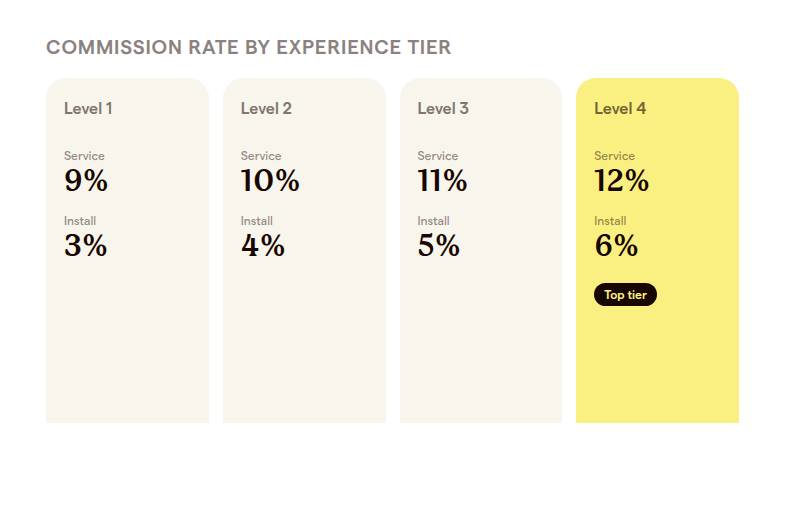
Leveling alone would not have fixed the subcontractor problem, so the plan also standardized exactly how pass-through costs get deducted from commissionable revenue, the same way, on every job, regardless of who is running the numbers that week. A 75 percent conversion-rate qualifier was added as a gate on top of the tiered commission, so the plan rewards technicians who close the work they quote, not just technicians who happen to get dispatched to bigger jobs. And because a handful of technicians were already on custom hourly arrangements that predated the new system, the plan included grandfathered thresholds for those specific cases, so nobody with an unusual but fair existing deal got unfairly clipped by a system built for the general case.
What The Conversion-Rate Qualifier Actually Prevents
It would have been simpler to build the plan around revenue alone: bigger job, bigger commission, done. The company chose not to do that, and the reason matters more than it might look at first glance. Revenue by itself rewards volume without regard to whether the work was priced honestly or the customer was given real options. A technician chasing pure revenue has a quiet incentive to upsell whether or not the upsell is actually the right call for the homeowner. Tying the tiered commission rate to a 75 percent conversion-rate qualifier changes the incentive underneath the incentive: a technician only unlocks the full value of their tier if they are also closing a healthy share of what they quote, which in practice means presenting options customers actually want rather than padding an estimate and hoping.
This is a small design choice that is easy to skip and expensive to skip badly. A commission plan with no qualifying metric at all can accidentally train a team to optimize for the wrong thing, and by the time an owner notices the pattern in the numbers, it has usually already shaped how technicians talk to customers for months. Building the qualifier in from day one, rather than bolting it on after a problem shows up, is part of why this particular rebuild held up over eight months instead of needing a correction partway through.
The Grandfathering Problem Nobody Talks About
Every company that has been running informal pay arrangements for years has a handful of technicians whose current deal does not fit neatly into a new, cleaner structure, usually for good reasons: a senior hire who negotiated a custom hourly rate on the way in, someone who took on responsibilities outside the standard job description, a long-tenured tech whose historical pay reflects loyalty as much as current output. A leveled system built without accounting for these cases risks quietly cutting exactly the people a company can least afford to lose, the ones who have been there long enough to have other options.
The plan handled this directly instead of pretending the problem did not exist: specific grandfathered thresholds were built in for the technicians already on custom arrangements, so the new tiered structure could roll out company-wide without forcing an awkward renegotiation with the handful of people it was never really designed to touch in the first place. That is a small detail in the plan documentation and a large detail in whether a rollout like this actually survives contact with a real team instead of causing an exodus in month one.
Giving Technicians The Dashboard, Not Just The Formula
A tiered commission structure only works if technicians can actually see where they stand against it. The plan includes a real-time dashboard pulling directly from Housecall Pro, showing each technician their own contribution across turnovers, installs, completed service work, and conversion rate, the same inputs that drive their tier and their commission rate. That visibility matters as much as the rate table itself. A technician who can check, mid-month, exactly how close they are to the next tier has a reason to think about their conversion rate on today's call, not just react to a number that shows up on payday with no explanation attached.
This is the same principle behind any well-built incentive plan dashboard: a plan a technician cannot see mid-cycle is not really an incentive, it is a surprise that happens to them after the fact. The difference between those two things is not the dollar amount. It is whether a person can act on the information while it still matters.
Eight Months Later, The Company Pulled The Numbers
Standing up a new pay structure is the easy part, relatively speaking. The harder and more honest part is checking, months later, whether it actually did what it was supposed to do, especially when the company simultaneously tightened up cost accounting in ways that could have offset any gains from the new commission tiers. So the company did exactly that: an eight-month, old-plan-versus-new-plan comparison, technician by technician, not just an aggregate revenue number that could hide who won and who lost underneath it.
The result, in the owner's own words reviewing the comparison: summed up over those eight months, it was so much more than the old plan that you could not even evaluate it fairly month to month, you had to look at the full stretch to see it clearly. And the team-wide finding underneath that statement was specific: in 90 percent or more of individual cases, technicians came out ahead under the new leveled structure compared to what they would have earned under the old patchwork, even after subcontractor costs started getting deducted consistently instead of inconsistently. One senior technician's case became a concrete example inside the company: a technician who had been earning the rough equivalent of $28 an hour under the old system moved to the equivalent of $30 an hour once the leveled tiers and updated commission rates were in place, not because of a raise negotiation, but because the new structure paid out what the leveled rate table said it should for the level of work that technician was actually doing.
Profit sharing
made simple.
Give your team a stake in the company’s success. ShareWillow helps you create and manage profit-sharing programs that motivate employees and drive business results.
Why "90 Percent" Is A More Useful Number Than A Single Big Payout
A lot of incentive plan stories lead with one dramatic number: a single technician's best month, or a company-wide total that sounds impressive in isolation. Ninety percent of technicians earning more is a different kind of number, and it is arguably a more useful one for another owner trying to decide whether a similar rebuild is worth the disruption. It says something about fairness at scale rather than about one outlier. A plan that works for one star performer is easy to build. A plan that works for nine out of ten people on a real team, across different tenure levels and different job types, is the harder and more valuable thing to get right.
It also directly answers the fear the owner started with: that fixing the accounting would look like a pay cut. The honest answer, eight months in, is that it mostly did the opposite. Tightening up subcontractor deductions did not shrink most technicians' pay. It made the whole system fairer in a way that, combined with leveled commission rates that actually reward experience, left the large majority of the team better off than they were under the old, looser rules. That is not a coincidence. A structure with clear tiers and a real dashboard gives technicians a reason to move up in ways an inconsistent, undocumented system never could.
What Other Plumbing Companies Should Take From This
Most plumbing companies running an informal or partially-documented commission structure are sitting on some version of this same problem: pay that made sense when it was first set up, one exception at a time, and now nobody can fully explain it, including the owner. The fix here was not a bigger commission rate across the board. It was structure: four honest tiers instead of one blended rate, one standardized rule for handling subcontractor costs instead of a judgment call made fresh on every job, and a dashboard that lets a technician see their own number instead of waiting for it to arrive on a pay stub with no explanation.
Companies sitting on a similar patchwork, custom rates for a few people, inconsistent deductions, no real leveling, do not need to guess whether a rebuild like this is worth the disruption. A free incentive plan audit can usually surface, within a few days, roughly how many technicians on a real team would land where under a leveled structure like this one, before anyone has to commit to rolling it out. For an 8-technician plumbing company, that answer turned out to be 90 percent better off, and a dashboard busy enough now that most of the team checks it without being asked to.
Related reading
Conclusion
Eight months of old-plan-versus-new-plan data, and roughly nine out of every ten technicians on the team are earning more under the new structure than they were under the patchwork it replaced. The plan that made that possible was not a bigger bonus. It was four honest tiers, one standardized way to handle subcontractor costs, and a dashboard that finally let a technician see the math for themselves.
Create incentives
that
drive results
You shouldn't need complex equity plans to align your team. ShareWillow makes it simple to create transparent profit-sharing programs that motivate employees and grow your business.

Incentive plans to help
small businesses thrive.
.png)
"I was able to leverage the knowledge of the ShareWillow team to learn how other companies were designing their bonus plans. The template was extremely helpful."

Brian Tustin
Owner, First Rate Movers