A restoration and mitigation company running three mitigation crews, soon scaling to five, had never once paid a crew chief a bonus tied to how profitably a job ran. Here is how a gross-margin threshold plan and a built-in buffer for the company's own tracking gaps turned that around, and what the real numbers already show before the first full quarter of payouts.
Ask most restoration company owners whether their crew chiefs have a financial incentive tied to how profitably a job runs, and the honest answer at a lot of shops is no. Crew chiefs get paid to get the job done: dry the structure, document the loss, keep the customer calm. Whether that job ran at a 55 percent margin or an 85 percent margin has historically had nothing to do with what shows up in their paycheck. That was exactly the situation at a fire and water damage restoration and mitigation company running three mitigation crews, soon scaling to five, plus a separate three-person reconstruction team, overseeing roughly $3 million in annual mitigation revenue.
The owner did not sugarcoat what that meant in a working session on the plan. Describing the jobs the company was actively completing under the existing pay structure, he put it in the starkest terms possible: those jobs would not have rewarded any bonus at all. Zero. Not a small bonus, not a disappointing one. None, because there was no mechanism connecting job profitability to a crew chief's pay in the first place. Two salaried project managers were in an even more exposed version of the same gap: between them, they oversaw roughly $3 million in mitigation revenue with nothing on paper reflecting how well they were actually managing it.
Why Restoration Makes This Especially Hard To Fix
Building an incentive plan around job profitability is harder in restoration than in almost any other trade, for a specific reason: the real costs of a job are genuinely difficult to see in real time. Fuel and drive time between job sites were going completely untracked at this company, which meant every job's costing understated its true cost by an unknown, inconsistent amount. A crew chief thinking about "how profitable was that job" had never had a reliable number to even ask the question against, because the number itself was quietly wrong before anyone looked at it.
There was a second, less obvious problem underneath the tracking gap. Crew chiefs in this company, like at most restoration companies, had been trained to think about a job operationally: what needs to get fixed, what equipment goes in, how long the dry-out will take. Nobody had trained them to think about a job in dollar terms, what it was actually worth, because nothing about their pay had ever depended on that number. Asking a crew chief to suddenly care about gross margin without giving them a system built to make that number visible and fair was never going to work on its own.
A Threshold Plan, Not A Flat Bonus
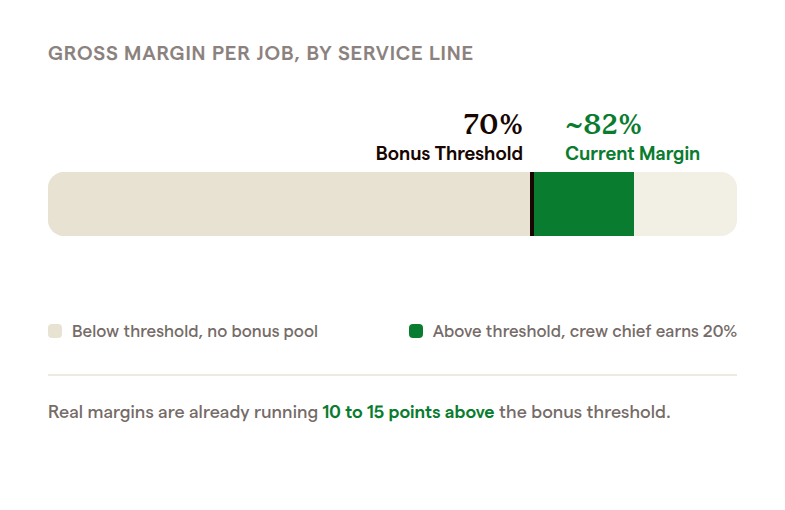
The plan ShareWillow built with the company is a gross-profit threshold bonus, structured around a 70 percent expected gross margin per job, set by service line rather than as one blanket number across every job type. Anything a job earns above that 70 percent threshold funds a bonus pool, and the crew chief who ran that job earns 20 percent of the amount above the threshold. A job that clears its margin target comfortably pays a real, visible bonus. A job that limps in under threshold pays nothing, which is a genuine change from a flat hourly structure where the outcome of the job had no bearing on pay at all.
Building In A Buffer For The Company's Own Data Gaps
Rolling out a margin-based bonus on top of costing that everyone already knew was incomplete would have been unfair to the crew chiefs actually being measured against it. The plan accounts for that directly: every job automatically gets a 2 percent job-cost buffer added on top of its tracked costs, a stopgap built specifically to absorb currently-untracked expenses like fuel and drive time while the company matures its cost tracking over time. It is a small design decision with an important effect: crew chiefs are not being penalized today for a data gap that is the company's problem to fix, not theirs.
The plan also had to solve a fairness problem that has nothing to do with cost tracking and everything to do with job assignment. Not every job a crew chief gets dispatched to is the same size, and a bonus plan that simply rewarded raw dollar margin would quietly reward whoever got lucky enough to land the big jobs that month, regardless of how well those jobs were actually run. Worse, it could create a real incentive to inflate scope on a small job just to chase a bigger number, which edges uncomfortably close to the kind of behavior that gets a restoration company in trouble with an insurance carrier. The plan avoids that by normalizing on revenue and gross profit per affected square foot instead of raw job size, so a crew chief running a small job efficiently and a crew chief running a large job efficiently are being measured on a comparable basis, and nobody has a reason to pad a scope just to hit a bigger number. A callback deduction is built into the same structure, so a job that comes back for rework does not quietly keep paying out as if it were a clean, closed file.
What The Real Numbers Already Show
Because this is the crew's first live bonus program, there is no multi-month payout history to report yet, and it would not be honest to pretend otherwise. What the company does have, and what makes this plan worth watching, is real historical job data that the owner reviewed directly while the plan was being built. Current real gross margins on many jobs are already running in the low-to-mid 80s, well above the 70 percent threshold the bonus plan is built around, according to the owner's own review of his numbers during that session. That is not a projection. It is where the business already is, which means the bonus pool the plan creates is not a hypothetical stretch goal. It is money the crews are already generating that simply had no mechanism to reach them before now.
Modeled against roughly four days of real job data across the three crew chiefs, the plan's early estimate suggested each crew chief could see an extra $100 to $300 a week, or as much as an extra $2,400 depending on individual performance and job mix. Those numbers come from real historical margins run through the plan's actual formula, not a hopeful guess, but they are still a pre-launch model rather than a confirmed multi-month result, and the honest way to present them is exactly that: a credible early estimate built on real data, not yet a track record.
Profit sharing
made simple.
Give your team a stake in the company’s success. ShareWillow helps you create and manage profit-sharing programs that motivate employees and drive business results.
Teaching Crew Chiefs To See A Job In Dollars
A threshold and a percentage on a plan document do not automatically change how a crew chief thinks on site. The harder, slower part of this rollout is the habit change underneath the math: getting a crew chief who has spent years thinking purely in operational terms, what needs to dry, what needs to be torn out, what equipment is needed, to also glance at a job and have some sense of what it is worth. That shift does not happen from a single training session. It happens gradually, from a crew chief checking their own numbers after a job closes, noticing which jobs cleared the threshold comfortably and which ones barely did, and starting to connect specific decisions on site (how quickly equipment went in, how tightly documentation was handled, how a scope conversation with the adjuster went) to the number that shows up afterward.
This is really the same argument for visibility that shows up in every well-designed incentive plan, just applied to a trade where the underlying job economics are unusually hard to see. A plan a crew can actually track against real, current data does more than pay out fairly. It teaches the exact behavior an owner is trying to encourage, simply by making the connection between behavior and outcome visible for the first time. Crew chiefs at this company are, for the first time, in a position to learn what actually drives margin on their jobs instead of guessing.
The Ops Managers Finally Get Something On Paper
The crew chief plan was not the only gap this project closed. The two salaried project managers overseeing the mitigation group, together responsible for roughly $3 million in annual revenue, had never had any bonus structure at all despite the scale of what they managed. The company built a separate, fixed ops-manager bonus plan tied to overall mitigation-group performance, giving both of them a stake in the same numbers the crew chiefs are now working against, rather than leaving management compensation as a conversation that never quite happened. An owner managing $3 million in revenue through two people with nothing on paper reflecting how well they do that job is carrying real retention risk without realizing it, and this closes that gap alongside the crew-level plan rather than treating it as a separate project for later.
Why Restoration Companies Should Pay Attention To This One
A lot of restoration companies are running the exact version of this problem right now: crews that are, in practice, already running profitable jobs, with no system in place that lets any of that profitability reach the people actually running the work. The instinct is often to wait, to get costing perfectly clean before building any kind of incentive plan on top of it. This company's approach argues for the opposite: build the plan now, with an honest buffer for the data gaps you know about, and let the plan's existence create pressure to close those gaps faster than they ever would have closed on their own. A crew chief who understands that untracked fuel costs are quietly eating into a bonus pool has a very different relationship to fixing that tracking problem than a company that is only asking nicely.
The plan mechanics here, a margin threshold instead of a flat number, a built-in buffer for known data gaps, and a normalizing metric that prevents gaming, are not restoration-specific tricks. They are the same principles that make any margin-based incentive plan fair rather than just generous. What is specific to restoration is the size of the gap this company was starting from: crew chiefs who had never once had a bonus land, on jobs already running at 80-plus percent margins, managed by two project managers with nothing written down about their own performance. Companies sitting on a similar gap can start by getting an honest look at how their own real job data would translate into a threshold plan like this one, before committing to a full rollout.
What Comes Next
The honest next chapter of this story is the one that has not been written yet: a full quarter or two of confirmed payouts against the plan's actual formula, run against real jobs as they close rather than modeled from a four-day sample. That is the point at which this becomes a results story instead of a design story, and it is worth revisiting once that data exists. What is already true, and worth taking seriously in the meantime, is that the company is no longer flying blind on crew-level profitability. A crew chief today can look at a closed job and know, roughly, whether it cleared threshold. Six months ago, that same crew chief had no reason to ask the question at all, because the answer had never once affected their paycheck.
Related reading
Conclusion
The plan has not run a full confirmed quarter yet, so the honest headline is not a payout total. It is that crew chiefs who had never once seen a bonus, on jobs already running at 80-plus percent margins, now have a live plan built to pay out 20 percent of everything above a 70 percent threshold, with two long-overlooked project managers finally on a plan of their own.
Create incentives
that
drive results
You shouldn't need complex equity plans to align your team. ShareWillow makes it simple to create transparent profit-sharing programs that motivate employees and grow your business.

Incentive plans to help
small businesses thrive.
.png)
"I was able to leverage the knowledge of the ShareWillow team to learn how other companies were designing their bonus plans. The template was extremely helpful."

Brian Tustin
Owner, First Rate Movers