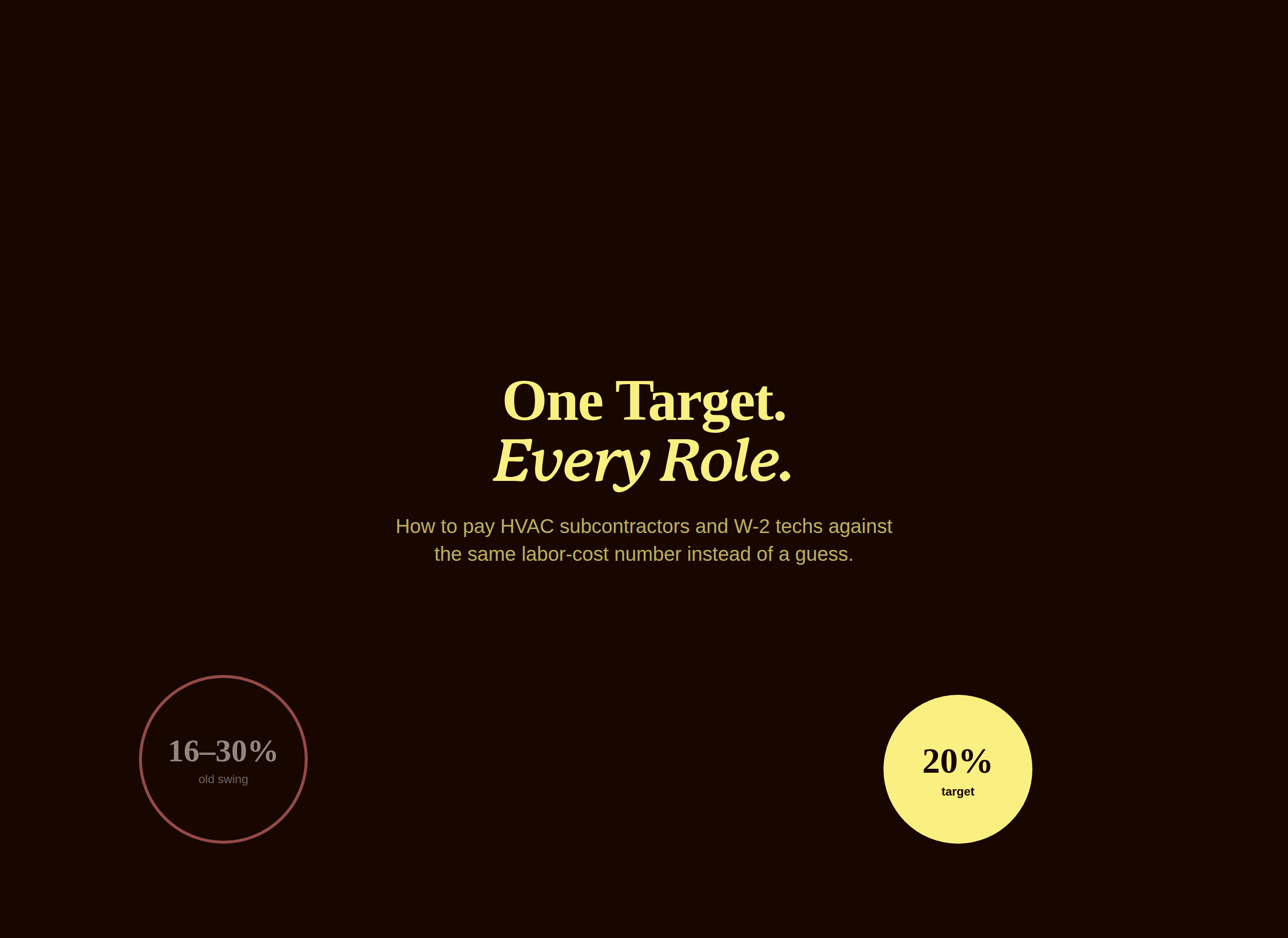
A 7-person water and fire damage restoration company was running its incentive program out of a Google Sheet, which meant nobody, not the owner and not the technicians, knew what a bonus actually looked like until the quarter was already over. Here is what changed once that spreadsheet got replaced with a live scorecard tied to real job data.
A restoration job does not run on a fixed schedule the way a maintenance visit does. A water damage call can turn into a two-week drying job, a fire loss can drag through weeks of mitigation before reconstruction even starts, and margins move around depending on how a claim gets scoped and how quickly a crew gets equipment out of a structure. That variability makes restoration one of the harder trades to build a fair incentive plan around, and it is exactly why a 7-person water and fire damage restoration company had spent so long trying to track bonuses in a Google Sheet instead of a real system: nothing off the shelf seemed built for how uneven the work actually is.
The spreadsheet did the job, in the sense that it existed and someone updated it. What it did not do was give anyone real-time visibility into what a bonus was worth at any given moment. According to the company's own account of the problem, technicians could not see where they stood until the quarter closed out, which meant every quarter ended the same way: a wave of questions about why a specific number looked the way it did, arriving after the window to do anything about it had already passed. Compiling the numbers for a single quarter was itself a real chunk of work for whoever owned the spreadsheet, and even after the company had already trimmed that process down from roughly four weeks to about a day through their own internal fixes, the fundamental problem remained. A bonus a technician cannot see until it is too late to influence is not really functioning as an incentive. It is functioning as a quarterly surprise, good or bad, that happens to technicians rather than something they can actively work toward.
Replacing The Spreadsheet, Not Just Updating It
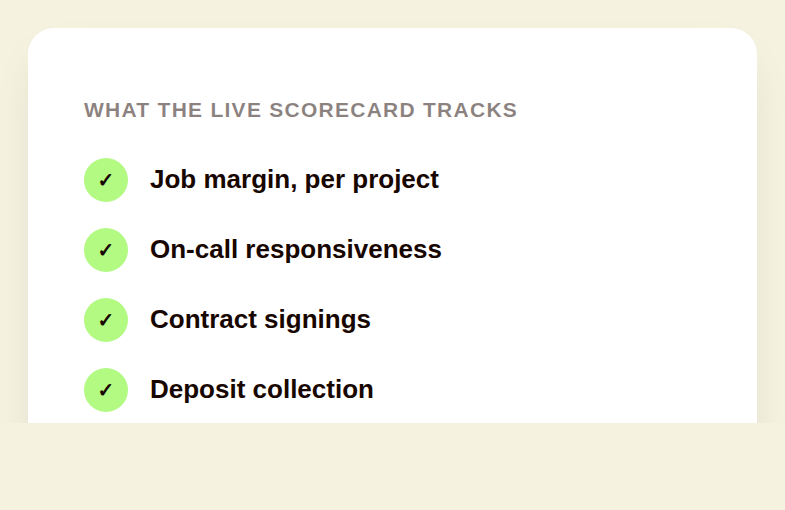
The fix here was not a better spreadsheet template or a faster monthly close process. It was moving the entire bonus calculation onto a live scorecard plan built directly from the company's own job data, covering the metrics that actually determine whether a restoration job was profitable and well run: job margin, on-call responsiveness, contract signings, and deposit collection. Four technicians enrolled when the plan published at the end of April 2026, with the quarterly structure chosen deliberately to match how restoration work actually gets measured, in claim cycles and project completions rather than in tidy calendar weeks.
What changed immediately was not the payout amount. It was visibility. Where the spreadsheet only told a technician anything once a quarter had already closed, a live scorecard meant a technician could check, mid-quarter, exactly where their margin numbers and on-call responsiveness stood against the plan's benchmarks. That is the difference between an incentive a technician can manage toward and one they can only react to after the fact, and for a company whose owner had explicitly framed the goal as getting technicians and managers to "treat the business as their own rather than an hourly job," that kind of ongoing visibility is not a minor feature. It is close to the entire point.
The First Confirmed Number
The plan's first quarter, covering January through March 2026, confirmed a combined payout of $1,700.00 across the enrolled technicians. It is worth being straightforward about what that number is and is not. This is a small company, four technicians on the plan, running its first quarter on a brand-new system, and $1,700 reflects that scale honestly rather than inflating it. What matters about this particular number is not its size. It is that it is real, confirmed, and fully traceable back to specific job margins, specific on-call responses, and specific contracts signed during that quarter, the exact kind of transparency the old spreadsheet process could never quite deliver even in the version that had already been streamlined down to a single day of manual compilation.
The second quarter, April through June 2026, is currently projecting a higher total of roughly $1,975 pending final confirmation, which would represent meaningful growth over the first quarter if it holds once the numbers are locked. That number is not yet confirmed as of this writing, and the honest way to read it is as an encouraging early trend rather than a settled result. A single company's first two quarters on a new plan are the very beginning of a track record, not the end of one, and it would be a disservice to this restoration company's real, still-developing story to present a pending number as though it were already in the books.
Why A Smaller, Newer Story Still Matters
Most of the incentive plan success stories that circulate in the trades involve bigger numbers: a shop with two dozen technicians, a plan that has run for a year, a payout figure with enough zeroes to make for a compelling headline. Those stories are useful, but they can also make an incentive plan look like something only a larger, more established company can pull off. A 7-person restoration company running its first confirmed quarter at $1,700 is a more honest picture of where a lot of shops actually start, and it is worth documenting precisely because it is modest. The mechanics that matter here (real job data instead of a spreadsheet, visibility a technician can check mid-quarter instead of only at quarter-end, a payout that is confirmed and traceable rather than compiled by hand under time pressure) are the same mechanics that eventually produce the bigger numbers in a company's second or third year on a plan. They just have not had a year to compound yet.
There is also a version of this story that is easy to miss if you only look at the dollar figure: the underlying problem this company solved, no real-time visibility into incentive pay, is one of the single most common complaints among restoration companies and facility service businesses more broadly, precisely because the work itself is so uneven month to month. A fixed monthly bonus does not map cleanly onto a trade where one job can take two days and the next can take three weeks. A quarterly scorecard tied to job-level margin and responsiveness data maps onto that reality far better, which is likely part of why the company chose a quarterly cadence over the monthly structure that works well in steadier trades like routine HVAC maintenance.
Profit sharing
made simple.
Give your team a stake in the company’s success. ShareWillow helps you create and manage profit-sharing programs that motivate employees and drive business results.
What Real-Time Visibility Actually Replaces
It is worth sitting with what "no visibility until the quarter ends" actually costs a small company beyond the obvious frustration. Every quarter under the old system, the owner was fielding the same round of bonus questions after the fact, questions that could not be answered with anything more useful than "here is what already happened," because there was no earlier checkpoint where a technician could have seen the number forming and adjusted their focus. That is a management tax that shows up nowhere on a spreadsheet: hours spent explaining a number after the window to act on it has closed, repeated every single quarter, indefinitely, for as long as the old process stayed in place.
A live scorecard removes that tax by moving the conversation earlier. Instead of a technician asking the owner why their bonus looks a certain way in April for work done in January, a technician can check their own standing against job margin and responsiveness benchmarks in real time and adjust before the quarter closes, the same way a live incentive dashboard works for companies in steadier trades. For an owner running a 7-person shop with no dedicated back-office staff to spend a full day every quarter reconciling a spreadsheet, that time back is worth almost as much as the payout total itself, even if it does not show up as a line item anywhere.
What Facility Managers And Owners Should Take From This
Restoration work sits at an odd intersection: the crews doing the work usually report up through a business owner, but a large share of the jobs themselves are coordinated with facility managers and property managers on the other end, people who are judging the restoration company not on its internal bonus structure but on responsiveness, communication, and whether the job gets done right the first time. That connection is not a coincidence. A technician who can see, in real time, that on-call responsiveness is a metric tied directly to their own pay has a very concrete reason to answer the phone quickly and communicate clearly with whoever is managing the property on the other end of that call. An incentive plan built around the right metrics does not just affect internal morale. It shapes the actual experience a facility manager has when they call a restoration company at eleven at night because a pipe just burst.
That is part of why job margin, on-call responsiveness, contract signings, and deposit collection were chosen as the four pillars of this particular scorecard instead of something simpler like total revenue or job count. Revenue alone can reward a technician for volume without regard to whether the job was priced and executed well. This plan ties pay to the specific behaviors, fast response, clean scoping, and reliable collection, that determine whether a restoration company keeps the facility managers and property owners who call it back the next time something goes wrong.
Starting Small On Purpose
There is a version of this story where the company waits until it has grown to twenty or thirty technicians before building any kind of formal incentive structure, on the theory that a small team does not need one yet. That is a common instinct, and it is usually the wrong one. A four-person enrolled group is actually an easier environment to prove a plan's mechanics in than a large one: fewer variables, fewer edge cases in how a job gets attributed, a shorter path from "we built this metric" to "we can see whether it is working." Getting the plan right at this scale, before headcount pressure forces changes on a tighter timeline, is exactly the kind of groundwork that makes a plan easy to extend later instead of needing to be rebuilt from scratch once the team doubles.
The company's own history backs this up. Its first attempt at solving the visibility problem, trimming the quarterly compilation process down from four weeks to about a day, was a real improvement and still was not enough, because the underlying issue was never really about how long compilation took. It was about the fact that no one could see anything until compilation was finished. Moving to a live scorecard did not just make the existing process faster. It replaced the entire idea of a "compilation step" with something that updates continuously, which is a different kind of fix than the company had tried on its own, and part of why it is the one that appears to be sticking.
A Story Still Being Written
Unlike a company with a year or more of confirmed history, this one is still in its opening chapters, one confirmed quarter and one pending quarter into a plan that replaced a process the company had already tried, and failed, to fix on its own with a faster spreadsheet. That makes it a useful story for a different reason than a bigger, more established account would be. It shows what the first real quarter of an incentive plan built on live job data actually looks like for a small restoration company: not a dramatic before-and-after, but a straightforward, traceable $1,700 payout, a team that can finally see where they stand before the quarter ends instead of after, and an early trend pointing toward a stronger second quarter once those numbers are confirmed. For a trade built on jobs that never run on a predictable schedule, that kind of visibility is the whole foundation an incentive plan needs before it can grow into anything bigger.
Related reading
Conclusion
One confirmed quarter, $1,700 paid out, and a second quarter trending higher but not yet confirmed. The restoration company that used to wait until quarter-end to see a bonus number now has a live scorecard its four technicians can check any day of the week.
Create incentives
that
drive results
You shouldn't need complex equity plans to align your team. ShareWillow makes it simple to create transparent profit-sharing programs that motivate employees and grow your business.

Incentive plans to help
small businesses thrive.
.png)
"I was able to leverage the knowledge of the ShareWillow team to learn how other companies were designing their bonus plans. The template was extremely helpful."

Brian Tustin
Owner, First Rate Movers