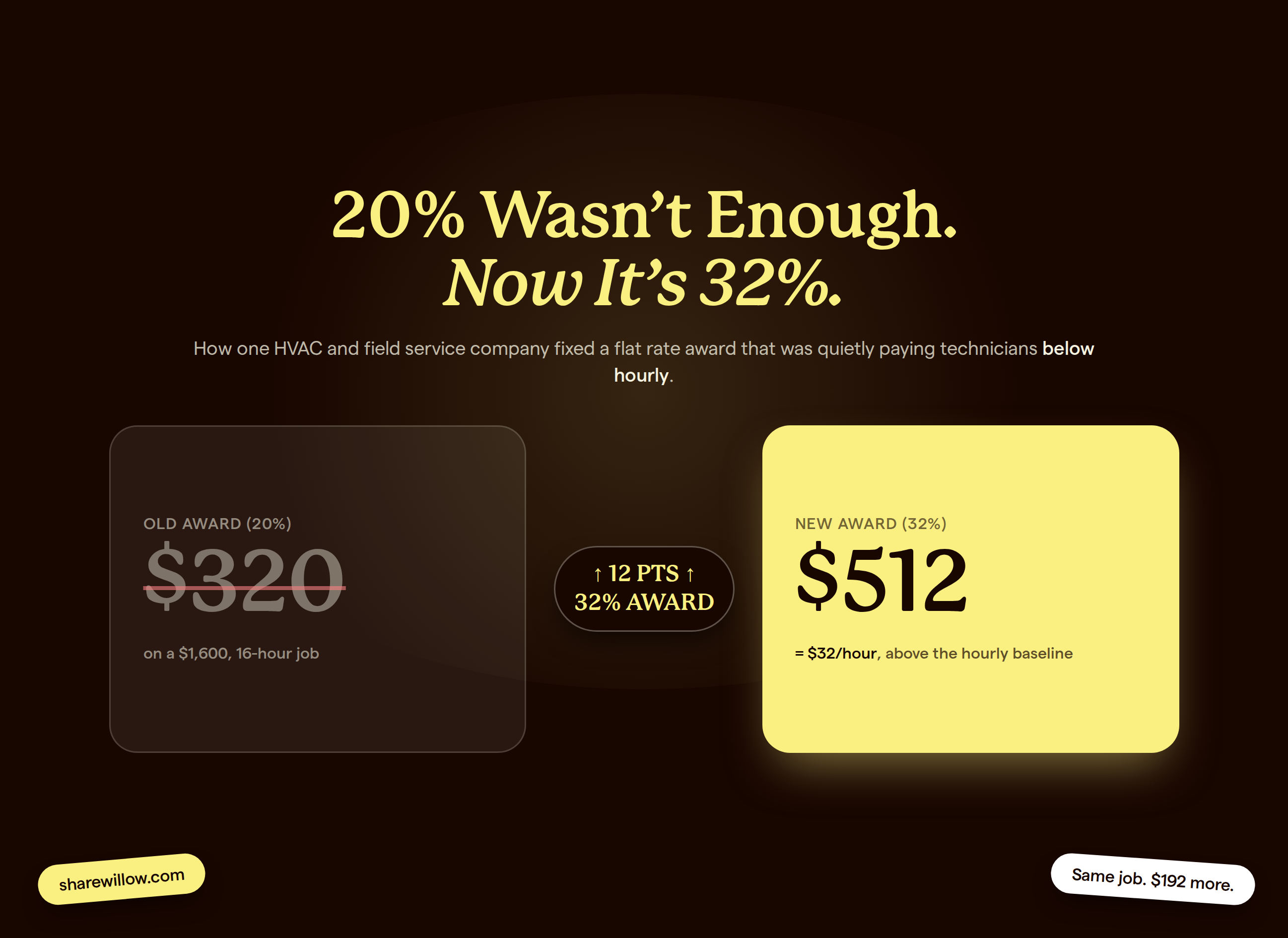
A 35-person HVAC, plumbing, and electrical company ditched ten manual spreadsheets for automated, role-specific pay plans built on ServiceTitan data. Here's what changed and what the real payout numbers looked like.
Picture the Friday before payroll at a growing home services company. Someone in the office is pulling job data out of ServiceTitan, cross-referencing it against a tab for service techs, another tab for installers, a third for inside sales, and so on, ten spreadsheets deep, trying to figure out who gets paid what before the deadline hits. That was reality for a 35-person multi-trade company running HVAC, plumbing, and electrical crews, and it's a scene that plays out at trade businesses everywhere every single week.
The company wasn't disorganized. They had a real incentive plan, real intentions, and a team that wanted to reward good work. The problem was the machinery underneath it. Commissions were calculated manually, off spreadsheets that someone had to rebuild and reconcile week after week, pulling numbers out of ServiceTitan by hand and hoping nothing got missed. That kind of system doesn't scale, and it definitely doesn't stay accurate for long.
When the Math Stops Matching the Business
The clearest sign something was broken was the lead spiff. Techs earned a flat $2.50 per lead they generated for the sales team. That number probably made sense at some point. But average ticket sizes had climbed steadily, and the flat spiff never moved with them. Techs were doing the same job, generating leads worth more to the business than ever, and getting paid the same $2.50 they'd have gotten years earlier. The incentive was quietly losing its power to incentivize anything.
Underneath that was a bigger structural issue: there was no clean report separating service revenue from install revenue for commission purposes. Those are fundamentally different jobs with different margins and different sales dynamics, but the reporting treated them as one blurry bucket. That made it nearly impossible to build a plan that paid people fairly for the specific type of work they were doing.
Then there was the "primary tech" problem. On any job with more than one technician involved, someone had to decide who got credit, and how much, and the ServiceTitan data alone didn't make that obvious. Job splits became a judgment call made under a deadline, which meant inconsistency, which meant techs noticing when the math didn't add up the same way twice.
The "$5 Check" Problem
The most damaging issue wasn't a data problem at all. It was psychological, and it's one that trips up a lot of trade businesses running commission-style pay. Because payouts were calculated weekly and split across many small categories, a lot of techs were getting checks in the $1 to $25 range on a regular basis.
Mathematically, those numbers were correct. The formulas worked. But a tech who puts in a full week and opens their pay stub to find an extra dollar and change doesn't feel rewarded. They feel like the program is a formality, or worse, a joke. Owners in this situation often assume the fix is a better formula. It usually isn't. It's a perception problem, and perception is what actually drives behavior on the floor.
As the owner put it, the old spreadsheet system technically worked, it just never made anyone feel like the extra effort was worth it.
This is the pattern we see constantly with home services companies once they cross 20 or 30 employees. The business has outgrown the spreadsheet, but nobody has stopped to rebuild the incentive structure to match. Techs are smart. They do the mental math on their own pay, and when a spiff doesn't track the value they're actually creating, or when a check is too small to notice, the plan stops motivating anyone. It just becomes administrative overhead that happens to show up in a pay stub.
The company running this 35-person shop wasn't failing. Revenue was growing, ServiceTitan was capturing good data, and the team was skilled. What was missing was the connective tissue between the data sitting in the field service platform and a pay structure that actually reflected how the business made money now, not how it made money three years ago. That gap is exactly where most manual commission systems eventually break.
Building Ten Plans Instead of Forcing One
The instinct a lot of owners have when their commission plan feels broken is to simplify: collapse everything into one flat structure so it's easier to manage. That's usually the wrong move. A multi-trade shop has fundamentally different roles doing fundamentally different work, and a single one-size-fits-all commission formula either overpays some roles, underpays others, or measures the wrong thing entirely.
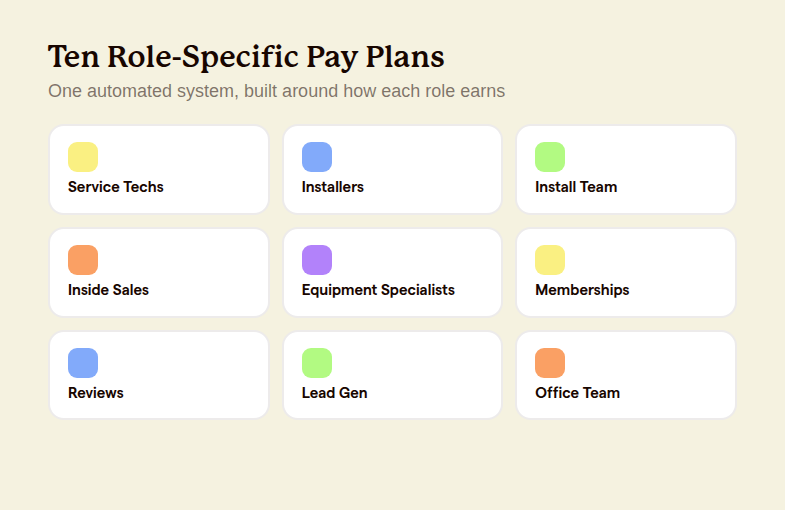
So instead of consolidating into one messy plan, ShareWillow went the other direction and built out ten separate, role-specific pay plans, each one designed around how that particular role actually creates value for the business. Service techs and installers were split into their own structures. Install got its own plan. Inside sales, equipment specialists, and office staff tied to memberships, reviews, and lead generation each had a plan built around the metrics that actually mattered for their job.
Some of these plans ran on weekly team performance pay, where a group shares in a pool tied to collective results. Others were structured as individual spiff-style commissions, paid per action or per job, closer to what the team had before but rebuilt to actually track with revenue. The point wasn't to standardize the format. It was to match the pay mechanism to the way each role actually contributes to the business, whether that's team-based service delivery or individual sales performance.
Data That Pulls Itself
None of those ten plans would have mattered much if someone still had to rebuild them by hand every week. The core fix was automation: every plan pulls directly from ServiceTitan data, calculating commissionable revenue, job splits, and primary tech assignments without a human reconciling spreadsheets on a Friday afternoon. The service versus install separation that didn't exist before became a built-in part of the reporting, so techs and installers were finally being measured against the right revenue bucket for their actual work.
This is the part of the fix that's easy to undervalue until you've lived without it. Manual commission tracking doesn't just waste hours, it introduces errors, and errors erode trust in the plan faster than almost anything else. Once a tech catches one mistake in their favor or against it, they start double-checking every check, and the plan stops being something people trust and starts being something people audit. Automating the pull from ServiceTitan removed that failure point entirely, which you can read more about in how payroll automation changes the day-to-day reality for HVAC teams specifically.
Seeing the Number Before Payday
The other major change was visibility. Instead of techs finding out their commission total on payday, with no way to have predicted it, the new system gave everyone daily-updating dashboards showing running totals throughout the pay period. A tech could look at the app on a Wednesday and see exactly where their pay stood, what they'd earned so far, and what was still in progress.
That single change does more for morale than most people expect. A surprise number, even a good one, doesn't feel earned the same way a number you watched build up in real time does. Daily visibility turns pay from something that happens to you into something you can actually see yourself driving, job by job. It's the same shift a lot of shops make when they move performance data off a spreadsheet and onto something visible to the whole team, similar to what we've written about in moving commission tracking off spreadsheets and onto a shared leaderboard.
Fixing the Small-Check Problem Directly
Automated data and dashboards solved the accuracy and visibility problems, but they didn't solve the psychological one on their own. The $1 to $25 checks were still going to happen under a weekly structure with enough categories splitting the pool. So for several of the plans, ShareWillow shifted the payout cadence to monthly instead of weekly.
The formulas didn't change. The total dollars earned didn't change. What changed is that instead of five small, forgettable checks a month, techs in those roles got one meaningful number that actually registered as a reward. Cadence turned out to matter as much as the math itself, and it's a lever most owners never think to pull because they assume more frequent pay is automatically better. For a specialized trade like HVAC, where ticket sizes and job complexity vary widely, getting that cadence right for each role is part of what makes a plan built for HVAC teams different from a generic commission template. You can see the mechanics of how these automated, role-specific plans get built on the product features page.
Profit sharing
made simple.
Give your team a stake in the company’s success. ShareWillow helps you create and manage profit-sharing programs that motivate employees and drive business results.
What a Year of Real Payouts Looks Like
Here's the part that matters most: this plan has been live and running continuously for over a year. Not a pilot, not a one-time setup that got forgotten. A working system the company relies on every pay period. That kind of longevity is the real test of whether an incentive plan works, because bad plans tend to get quietly abandoned or ignored within a few months.
Look at the flagship team performance-pay plan, where 16 techs share a weekly pool tied to collective results. Over five consecutive weeks, the actual payouts looked like this:
- Week 1: $11,050
- Week 2: $11,375
- Week 3: $11,132
- Week 4: $9,247
- Week 5: $6,559
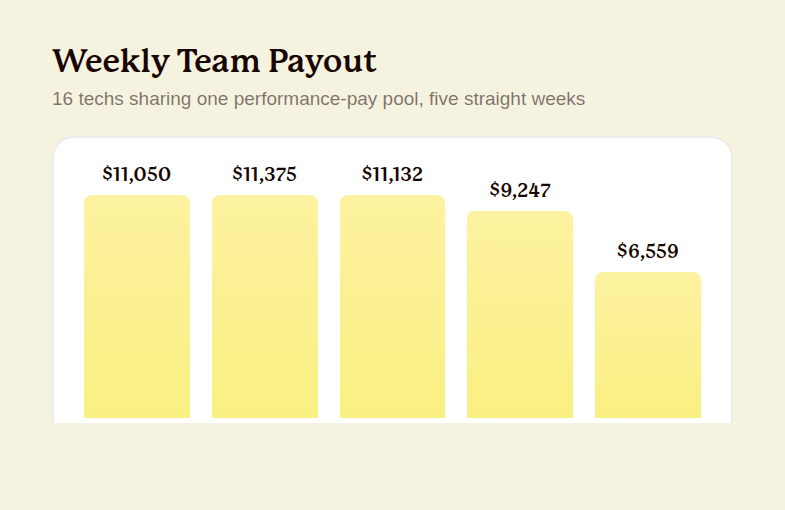
Notice what that trend does. It doesn't sit flat at a suspiciously round number, and it doesn't stay artificially high to make the plan look good on paper. It tracks seasonal demand honestly, climbing slightly through the strongest weeks and tapering as call volume cooled. That's exactly what a well-built pool should do: reflect the actual business, not a fixed number someone picked to keep techs happy regardless of performance. A plan that pays the same amount whether the shop is slammed or slow isn't measuring anything real.
Alongside that team pool, a separate spiff-style plan covers 31 techs individually, and it runs a lot steadier, generally landing in the $80 to $380 range per person per week. That steadiness is by design. Spiffs are meant to reward specific individual actions consistently, week over week, while the team pool is meant to flex with overall shop performance. Running both structures side by side, instead of forcing every role into the same mechanism, is a big part of why the numbers hold up under real scrutiny.
A Plan That Keeps Getting Better
What's easy to miss in a case like this is that the plan didn't launch perfect and then sit untouched. The company has gone back into it multiple times based on real payroll feedback, adjusting tiers, tweaking cadence, refining how certain roles are measured. That's the difference between a program and a project. A project gets finished and left alone. A program gets watched, questioned, and improved as the business changes.
That iteration matters more than any single number in this story. Ticket sizes will keep rising. Team composition will shift. New service lines will get added. A pay plan that can't adapt to those changes will end up exactly where the original spreadsheet system did: technically functional, quietly out of step with the business it's supposed to be motivating. Building the plan on live ServiceTitan data with daily dashboards means the company can see problems early and adjust before a tier or a rate quietly stops making sense, instead of discovering it a year later in a spreadsheet nobody's opened in months.
What This Means for Your Shop
If any of this sounds familiar, the spreadsheet gymnastics, the spiff that hasn't kept pace with your average ticket, the small checks that make techs shrug instead of push harder, you're not dealing with a people problem. You're dealing with a systems problem, and it's a solvable one. The company in this story didn't need more effort from their team. They needed their pay plan to actually reflect the work being done and to show up in a way people could see and trust.
Take a look at your own incentive structure with fresh eyes. Are you still measuring the business the way it worked a few years ago? Are your techs finding out their pay on payday, or watching it build all week? Are your checks big enough to actually feel like something? Those are the questions worth sitting with, whether the answer leads you to rebuild one plan or ten.
Related reading
Conclusion
The fix wasn't a better spreadsheet, it was retiring spreadsheets entirely and letting pay finally track the real work being done.
Create incentives
that
drive results
You shouldn't need complex equity plans to align your team. ShareWillow makes it simple to create transparent profit-sharing programs that motivate employees and grow your business.

Incentive plans to help
small businesses thrive.
.png)
"I was able to leverage the knowledge of the ShareWillow team to learn how other companies were designing their bonus plans. The template was extremely helpful."

Brian Tustin
Owner, First Rate Movers