A small home services company's tiered commission plan had a bar set so high that most technicians had no real shot at hitting it, and a floor payout that undercut the whole point of the tiers. One redesign later, a single technician's real July numbers produced a $3,000 bonus check.
A tiered commission plan sounds simple on paper: hit a threshold, earn a percentage, hit a higher threshold, earn more. In practice, the threshold is doing almost all the work. Set it too low and it's not really an incentive, everyone clears it without trying. Set it too high and it stops functioning as a target at all, it becomes background noise that top performers ignore and everyone else has given up on.
That's roughly the situation a small, owner-operated home services company found itself in. Their technicians were paid on a tiered, sold-hours commission structure through ShareWillow, meaning a technician's bonus percentage steps up as the hours of work they sell and complete in a period climb past set benchmarks, and during a routine operations review closing out July's numbers, the owner raised two problems that had been quietly undermining the plan for months.
Sold-hours models like this one are common in home services because they reward the thing owners actually care about, a technician converting their day into billed, completed work, rather than just clocking in. But that also means the whole plan lives or dies on where the tier lines get drawn. Draw them from an old benchmark, a slower season, or a different crew than the one you have today, and the plan quietly stops matching reality even though nothing about the software has changed.
A floor that defeated the purpose of a ceiling
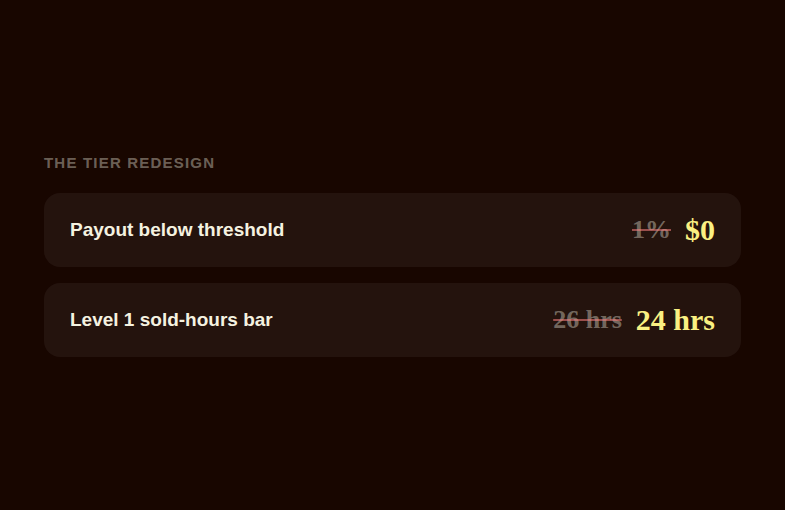
The first issue was structural. The plan was supposed to pay nothing until a technician cleared a minimum sold-hours threshold, then scale up from there. But a baseline 1% payout was firing regardless of whether that threshold had actually been hit. "I don't want them to get 1% unless they hit the threshold," the owner said, and it's hard to argue with the logic. If everyone gets paid something no matter what, the threshold isn't a threshold. It's decoration.
The second issue was about where the bar sat in the first place. Level 1 required 26 sold hours, and for a meaningful slice of the team, that number was realistically out of reach given their normal workload and job mix. The owner didn't need a spreadsheet to see the problem; he could feel it in how his crew talked about the plan. "Just give these guys a nugget where they can hit something for once," he said, which is about as plain a description of a demotivating pay structure as you'll hear from an owner who actually pays attention to his team.
A third problem: numbers that seemed to move on their own
Underneath both structural issues sat a trust problem. The owner had noticed payout numbers occasionally shifting overnight, without him touching anything in his field service software, and that kind of unexplained movement is corrosive in a different way than a bad threshold. A technician can accept a hard target. It's much harder to accept a number that seems to change for no visible reason, because it makes the whole system feel unaccountable, whether or not it actually is.
The explanation turned out to be mechanical rather than mysterious: job data syncs from the field service platform to ShareWillow roughly three times a day, with the final sync running after hours. A job completed late in the day simply wouldn't show up until the next morning's sync, which looks like a number changing overnight if you don't know that's how the pipeline works. Once that mechanism was explained plainly, on the call, most of the mystery went with it. The remaining piece, occasional real discrepancies most likely tied to how a job's split or assignment was set up, got a concrete next step: send specific examples going forward so each one can be traced individually instead of treated as an unexplainable black box.
That distinction, between a genuine sync delay and an actual error, matters more than it might seem. Owners who don't understand their own data pipeline tend to treat every unexpected change the same way, as evidence something is broken. Once you know which of your numbers update on a schedule and which should be static once calculated, a shifting figure stops being scary and starts being diagnostic: either it's an expected sync, or it's worth flagging specifically instead of writing off the whole system as unreliable.
The redesign, decided and applied in one call
None of these fixes required new software or a long project. They required a real conversation about what the plan was actually supposed to reward, followed by a few concrete changes applied immediately.
The guaranteed 1% floor payout was removed entirely. Technicians below the minimum threshold now earn zero, not a token amount that made the threshold meaningless. Level 1 came down from 26 sold hours to 24, a small move on paper but a meaningful one for the technicians closest to the old bar. Level 2 was restructured underneath it: under 28 sold hours pays zero, 28 to 30 sold hours pays 1%, scaling up from there. Level 3, the top tier at 38 sold hours, stayed where it was; the fix was about making the lower rungs reachable, not lowering the ceiling.
Because July hadn't been formally closed out yet, the new structure applied retroactively to that month rather than waiting for August. That timing mattered. It meant the very first numbers to run through the corrected plan were real, current performance data, not a hypothetical projection of what the new tiers might someday produce.
What one technician's real July looked like under the new tiers
When the owner ran the review-and-finalize workflow under the corrected logic, one technician's number stood out immediately: a $3,000 bonus, calculated from close to $100,000 in actual completed revenue that month. This wasn't a forecast or an example built to illustrate the new plan. It was that specific technician's real July, run through the redesigned tiers for the first time.
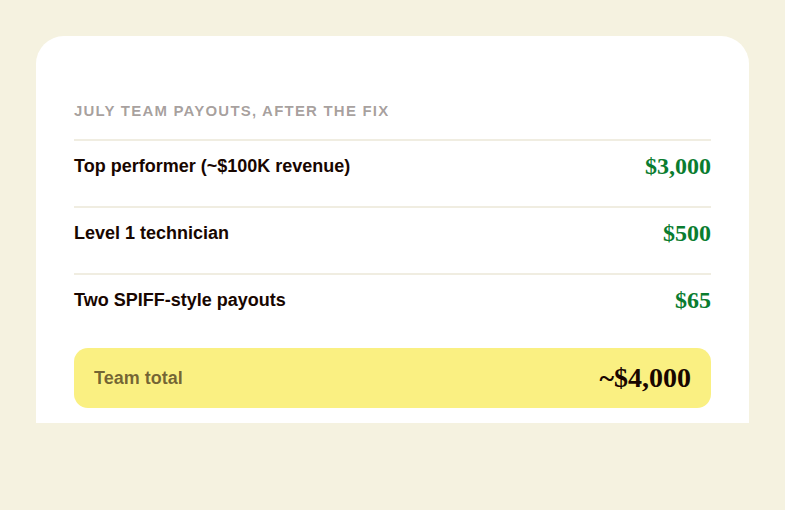
The rep put the number in context against a named competitor platform technicians in the trade sometimes compare notes on: similarly performing technicians there, in the low 40s for sold hours, typically land in the $2,000 to $3,000 range, with standout performers around 60 sold hours reaching closer to $7,000. The $3,000 result on roughly $100,000 in revenue landed squarely inside that range, described as "in line" with the benchmark, if a little conservative rather than an outlier. Across the whole team for the month, total payouts under the corrected plan came to roughly $4,000: the $3,000 result for the top performer, about $500 for a technician who cleared the new Level 1 bar, and two smaller commission-style payouts worth roughly $65 combined.
He's gonna get $3,000. He had almost a hundred k in revenue.
That's the ShareWillow rep, reading the corrected number off the screen. The owner's reaction was immediate and, notably, about more than just the dollar figure.
That'll give him something to shoot for. I'm gonna make a big, big paycheck, and I'm gonna present it to him tomorrow for the guys.
Profit sharing
made simple.
Give your team a stake in the company’s success. ShareWillow helps you create and manage profit-sharing programs that motivate employees and drive business results.
The part that mattered more than the check
It would be easy to read this story as being about a $3,000 payout, but the owner's own framing suggests the bigger win was somewhere else. He wasn't just planning to hand over a check. He was planning to walk it into the shop and present it to the crew as proof the plan actually pays out for real performance, not just in theory.
That's the real function of a reachable tier structure. A threshold that's realistically out of range for most of the team doesn't just fail to motivate the people who can't hit it. It quietly undercuts the credibility of the whole plan, because everyone can see the tiers exist mostly on paper. Lower the bar to something a solid, hardworking technician can actually clear, and suddenly the plan has proof of concept walking around the shop with a paycheck in hand.
The owner also mentioned something worth noting on its own: his technicians are genuinely engaged with the numbers, calling him to ask why a particular figure looks the way it does. That's not a complaint. A crew that's paying close enough attention to question their pay is a crew that cares whether the plan is fair, which is exactly the audience a threshold needs to be calibrated for.
It's worth contrasting that with the alternative, a crew that's gone quiet about their bonus plan entirely. Silence usually doesn't mean satisfaction. More often it means people stopped believing the plan had anything to do with them, and they've mentally filed it under things they can't influence. A technician calling to ask why a number looks a certain way is, paradoxically, a much healthier sign than a technician who never asks at all.
Questions worth asking about your own tiered plan
If your shop runs any kind of tiered, threshold-based incentive plan, a few things worth checking against your own structure:
- Does your floor undercut your threshold? If technicians below the minimum bar still get paid something automatically, the threshold isn't really gating anything, it's just a formality.
- Is your entry-level tier realistically reachable? Pull last quarter's actual sold-hours or production numbers for your median technician, not your top performer, and see how close they land to your Level 1 bar.
- Can you explain why numbers change? If payout figures ever shift without an obvious cause, know your own sync timing and data pipeline well enough to explain it plainly, rather than letting it read as unaccountable.
- Do you know what similar shops actually pay? A benchmark, even an informal one, helps you tell the difference between a generous plan and one that's quietly too conservative to motivate anyone.
None of this requires ripping up your plan and starting over. It requires pulling real numbers, checking them against a bar you set a while ago, and being honest about whether that bar still makes sense for the team you actually have today.
You're not the only shop rethinking its tiers
Threshold and tier design is one of the most common reasons an otherwise reasonable incentive plan stops working, and it shows up across trades in different shapes. One shop found its sold-hours tiers needed a full rebuild to actually reflect how the team was working, while another went through a broader commission tier redesign after realizing the old structure rewarded the wrong behavior entirely.
The lesson each time is the same: a tier structure isn't a set-it-and-forget-it decision. It's worth revisiting anytime a plan feels like it's stopped motivating the team it was built for. If you're building or auditing a tiered incentive plan for a home services team of any size, start with the same question this owner did: can a solid, average technician actually reach the first rung, or does the plan just look good on a slide?
Related reading
Conclusion
A tiered incentive only works if the tiers are actually reachable. Set the bar out of range and you don't get harder work, you get quiet disengagement.
Create incentives
that
drive results
You shouldn't need complex equity plans to align your team. ShareWillow makes it simple to create transparent profit-sharing programs that motivate employees and grow your business.

Incentive plans to help
small businesses thrive.
.png)
"I was able to leverage the knowledge of the ShareWillow team to learn how other companies were designing their bonus plans. The template was extremely helpful."

Brian Tustin
Owner, First Rate Movers