A small electrical contractor was about to launch a new commission plan for his one full-time salesperson, but he was guessing at what it would actually pay out. Running the same real month of sales through three different structures turned a guess into a decision, and led to a tiered rate instead of a flat one.
Designing a commission plan from scratch is one part math and one part nerve. The math tells you what a structure would pay under a given set of numbers. The nerve is what it takes to actually commit to a rate, knowing that too low and you lose a good salesperson, too high and you can't sustain it. Most owners end up doing that second part on instinct, because running the real math against every option they're considering takes more time than a day usually allows.
That's roughly the position a small, owner-operated electrical contractor found himself in. His business runs on one full-commission salesperson handling most of the sales work, alongside a handful of technicians, and he was actively trying to finalize a new pay structure before rolling it out. He didn't have a plan yet so much as a set of worries about every plan he could think of.
Electrical contracting sales tends to run hotter and colder than a lot of trades, since a single large project, a service upgrade, a generator install, a full rewire, can swing a month's numbers on its own. That volatility makes commission design harder than it looks. A rate that seems generous in a strong month can feel punishing in a slow one, and an owner has to design for both without seeing either in advance.
Guessing at a number is not the same as knowing it
"I'm still trying to figure out the method that I want to pay for my salesman and my technicians," the owner told his ShareWillow rep on a financial projections review call, "and I can't figure out what can I do to actually make sure that they're actually making the amount of money that I'm looking for?" That's a strikingly honest way to frame the problem: not "what's the right percentage," but "how do I know what any given percentage would actually produce."
Underneath the math question was a real retention worry. A flat, low commission rate is simple to run, but the owner was concerned it wouldn't hold up against the unpredictability of straight commission work. "A salesman cannot stay at home," he said. "He cannot go to work and not getting paid in that week." Commission-only sales pay is inherently lumpy, and an owner who's thought that through knows a rate that looks fine on paper can still lose someone during a slow stretch if there's no floor underneath it.
Three structures, one real month of data
Rather than debate rates in the abstract, the rep pulled the salesperson's actual sales data from June through August and ran it through three candidate structures side by side, live on the call, using numbers that had already happened rather than projections of what might.
The first was the simplest: a flat 10% commission, no base pay, no bonuses. The second was a net-profit model, 40% of net profit calculated as revenue minus a 10% lead cost, 25% overhead, materials, and $60 an hour in labor, again with no base. The third was the fuller plan the owner had been sketching, combining a base commission with bonus metrics layered on top: average ticket size, conversion rate, gross profit margin, and a small $10-per-five-star-review bonus tied to customer reviews mentioning the salesperson by name.
What the same month looked like under each structure
The results made the trade-offs concrete in a way no amount of talking through options would have. On that month's roughly $19,214 in sales, the flat 10% commission structure produced about $1,900, no bonuses, no variability beyond the raw sales number, averaging out to roughly $1,122 a week across the test period.
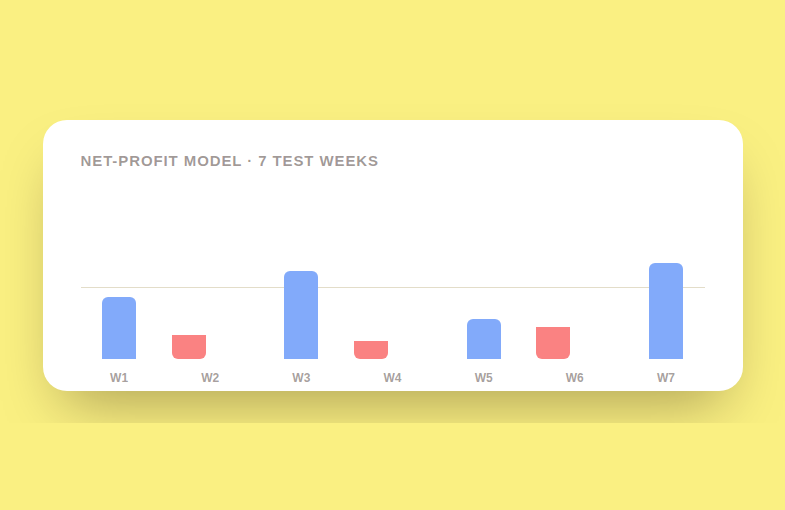
The 40%-of-net-profit model told a more volatile story. Averaged across the test weeks it came out to about $1,458 a week with no base pay underneath it, but that average hid the real risk: it only beat what the salesperson would have earned on a straight hourly base in two of the seven weeks tested. Several weeks in the sample were negative once lead cost, overhead, materials, and labor were all netted out, meaning a commission-only salesperson on that structure could have gone multiple weeks with essentially nothing to show for real, completed sales work. For a business already worried about retention during slow stretches, that's close to the worst-case scenario, dressed up as a percentage that sounds generous on paper.
The full plan, base commission plus the bonus metrics, produced the strongest result: $2,467 for that same June, once average ticket, conversion rate, gross margin, and the review bonus were all factored in. The owner did the mental math himself, out loud, on the call: "So in the end of the day, it's like around the 12% with the bonuses and everything." That's the exact moment abstract commission design turned into a concrete, comparable number, an effective blended rate he could weigh directly against the flat 10% option.
Seeing all three numbers side by side, on the same real month, did something a conversation about percentages alone couldn't: it made the trade-offs impossible to ignore. A flat rate that looked perfectly reasonable in isolation looked thin once it was sitting next to a plan that paid $567 more for identical work. A profit-share model that sounded appealingly aligned with the business's actual margins looked risky once its worst weeks were visible instead of just its average.
Turning three data points into one decision
With real numbers on the table instead of estimates, the decision got noticeably easier. A flat 10% risked being too thin to retain a salesperson who was, by the owner's own account, already producing close to $19,000 a month. The pure net-profit model was too volatile to trust as someone's only income, especially with real weeks in the sample landing negative. The full bonus-metric plan performed best but added real complexity to administer every pay period.
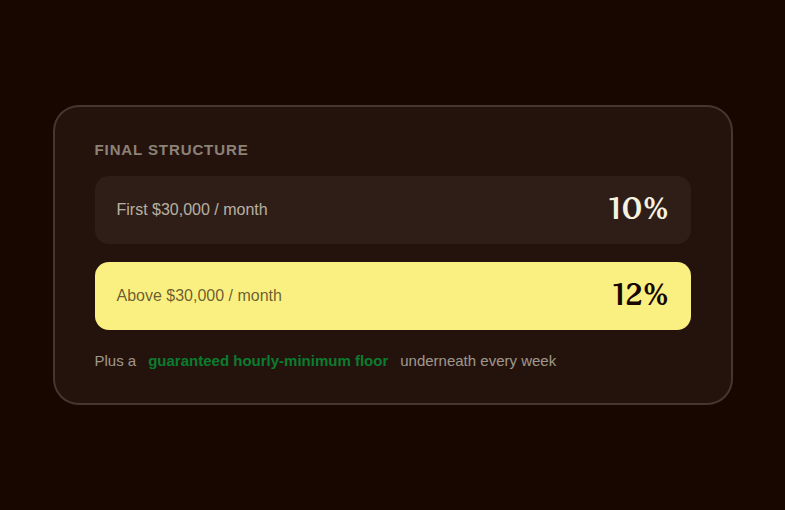
The structure the owner settled on split the difference in a way none of the three original candidates had proposed outright: a tiered commission, 10% on monthly sales up to $30,000, stepping up to 12% on everything above that threshold, with a guaranteed hourly-minimum floor underneath the whole thing. The tiering gives the salesperson a real incentive to push past his current baseline, roughly $19,000 a month in the test data, rather than coasting at a flat rate no matter how much he sells. The floor solves the retention worry directly: no matter how a slow week or a slow month goes, there's a guaranteed minimum underneath it, which happens to also keep the plan on the right side of wage law rather than leaving pay entirely at the mercy of closed deals.
Profit sharing
made simple.
Give your team a stake in the company’s success. ShareWillow helps you create and manage profit-sharing programs that motivate employees and drive business results.
Why modeling beats debating
The most useful thing about this call wasn't any single number, it was the method. Every commission structure sounds reasonable when you're only describing it in words. A flat 10% sounds simple and fair. A profit-share model sounds like it aligns everyone's incentives. A layered bonus plan sounds thorough. None of those descriptions tell you what a real salesperson, doing real work in a real month, would have actually taken home. Only running the actual numbers does that.
That's a habit worth borrowing even if you're not redesigning a plan from scratch. Before you finalize any commission or bonus structure, whether you're building one for the first time or adjusting an existing one, pull a real recent period of production and run it through the candidate structure exactly as written. If the number that comes out surprises you, in either direction, that's information you needed before launch, not after the first paycheck lands.
It's also worth noting what the owner was really solving for underneath the math: not the highest possible payout, but a structure his salesperson could trust week to week. A plan that pays generously in a strong month but leaves someone with nothing in a slow one will lose people just as fast as a plan that's stingy across the board. The floor underneath the tiered structure exists because the owner had already articulated the actual risk out loud, someone going to work and not getting paid in a given week, and built the plan to specifically prevent that outcome rather than hoping the averages would work out.
A quick exercise for your own plan
If you're building or reconsidering a commission structure for a salesperson or technician, a few steps worth taking before you commit to a rate:
- Pull a real recent period of production. Two or three months of actual sales or completed job data will tell you far more than any hypothetical.
- Model every structure you're seriously considering against the same data. Don't compare a flat rate against a rough estimate of what a tiered plan might do. Run the exact numbers for each.
- Check the worst weeks, not just the average. A structure that averages well but goes negative or near-zero in a bad week carries real retention risk that an average can hide.
- Decide what problem the floor or base is solving. If your real fear is a slow week leaving someone unpaid, build a guaranteed minimum that directly addresses that, rather than hoping a generous top-end rate compensates for it on average.
None of this requires special software, just a willingness to do the arithmetic before you commit rather than after.
You're not the only shop working through this
Commission and bonus design decisions get easier once real numbers are on the table instead of assumptions. One HVAC company found their bonus report was quietly keyed to the wrong date, throwing off every payout without anyone realizing why, while an electrical contractor elsewhere caught commission being calculated on invoices that were never actually finished or paid.
Whether you're designing a plan from nothing or auditing one you already run, the same principle holds: pull the real data, run it through every structure you're actually considering, and let the numbers, not the instinct, make the final call. If you're building or refining commission or incentive pay for an electrical or trades sales team, model it against a real month before you launch it.
Related reading
- The Commission Report That Was Always a Week Behind
- The Invoice Said $9,874. The Payment Said $2,075.
- Incentives, Commissions, and Bonuses: What’s the Difference and Why It Matters
- 7 Profit Sharing Plan Examples for Your Small Business
- Draw Against Commission: How a Home Services Company Found Only $9,900 of Commission Behind $24,000 in Draws
Conclusion
A commission structure that sounds fair in a conversation and one that actually holds up against a real month of sales data are two different things. Model it before you launch it.
Create incentives
that
drive results
You shouldn't need complex equity plans to align your team. ShareWillow makes it simple to create transparent profit-sharing programs that motivate employees and grow your business.

Incentive plans to help
small businesses thrive.
.png)
"I was able to leverage the knowledge of the ShareWillow team to learn how other companies were designing their bonus plans. The template was extremely helpful."

Brian Tustin
Owner, First Rate Movers