
A field service company running time-and-materials billing had a performance pay program nobody could actually earn. Rebuilding what counts as a qualifying job, not the payout rate, is what finally made the incentive real.
Picture a bonus program with a perfectly reasonable payout rate, offered to a whole team of technicians, that almost nobody ever actually earns. Not because the technicians are underperforming. Because the rules for what even counts toward the bonus were so narrow, so rarely triggered, that the incentive existed mostly on paper. That was the quiet problem sitting inside one field service company's performance pay program, running mostly on time-and-materials billing across its technician team.
The complaint that surfaced it was almost understated in how directly it named the issue: there was a lack of qualifying jobs available for awards, and it was hindering motivation. Not a complaint about the size of the bonus. A complaint that the bonus was structurally out of reach for most of the work technicians were actually doing every day.
An Incentive Program Technicians Couldn't Actually Reach
Time-and-materials billing creates a specific kind of pressure that a lot of incentive plans do not account for. Unlike a flat-rate job, where the price is fixed and the technician's job is simply to do the work well, a T&M job's profitability depends heavily on how efficiently it gets done relative to how it was scoped. A job that runs long is not just slower. It directly erodes the margin the business was counting on, and if the original bonus criteria did not clearly define what counted as an efficient, well-executed T&M job, technicians had no real target to aim at. They were being asked to perform well against a standard nobody had actually written down in a way that connected to their paycheck.
The predictable result of a bonus program technicians cannot reliably reach is not outrage. It is disengagement. A technician who tries for a few pay periods to hit a bonus that never quite triggers eventually stops trying, not because they stopped caring about doing good work, but because they concluded, reasonably, that the bonus was not really available to them. That conclusion is corrosive precisely because it is quiet. Nobody files a complaint about a bonus program fading into irrelevance. It just stops being a factor in how people show up to work.
A Second, More Visible Symptom
Underneath the qualification problem sat a related issue that was much easier to see once anyone looked: technicians were staying clocked in well beyond the actual scope of the job. In one case, a single technician logged sixteen hours and forty-seven minutes across jobs in a single day, a number that raises immediate questions about both billing accuracy and client expectations, regardless of how the hours broke down.
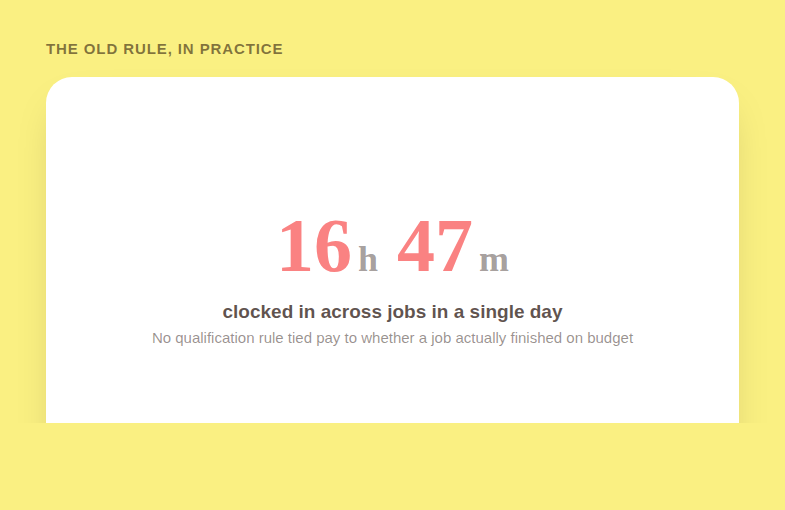
This is not necessarily a story about a technician padding hours in bad faith. When a pay plan gives no clear incentive for finishing efficiently, and no clear penalty or flag for running long, the path of least resistance is simply to stay on the clock. Nothing in the old structure rewarded wrapping a job up close to its budgeted time, and nothing flagged a job that ran dramatically over. The time tracking gap and the qualification gap were really the same underlying problem, viewed from two different angles: a plan that did not clearly define what good, efficient, billable work looked like, and therefore could not reward it or catch its absence. Similar gaps show up whenever a bonus is meant to reward one specific behavior but ends up paying out regardless of whether that behavior actually happened.
There is a client-facing cost hiding inside that same 16 hour 47 minute day, and it is easy to miss if you only look at the incentive plan in isolation. Time-and-materials billing depends on customer trust that the hours on the invoice reflect the hours the work actually required. A job that runs dramatically over scope, with no internal flag and no clear reason recorded, is exactly the kind of invoice a facility manager or homeowner questions, sometimes months later when the relationship has already soured. An incentive plan that quietly encourages jobs to run long is not just a payroll problem. It is a slow erosion of the billing trust the whole T&M model depends on.
Rewriting What Actually Counts
The fix did not touch the headline number. The performance pay rate stayed at 30% on qualifying time-and-materials jobs. What changed entirely was the definition of qualifying, replacing a vague, rarely-triggered standard with four specific, checkable conditions.
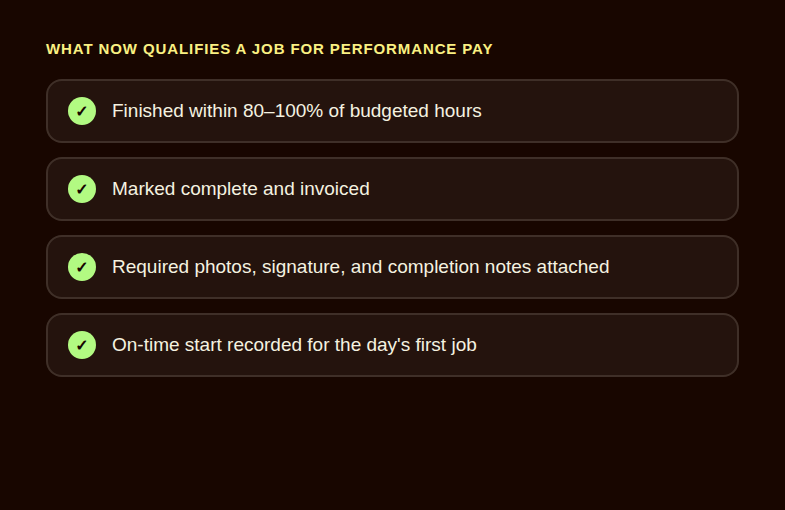
A job now has to finish within 80 to 100% of its budgeted hours, be marked complete and invoiced, and carry the documentation, photos, a signature, and completion notes, that proves the work actually happened the way it was recorded. None of these criteria are subjective. A technician does not need to guess whether a job is likely to qualify. They can look at the budgeted hours for the job in front of them and know, in real time, whether they are tracking toward a bonus or drifting away from one.
That 80 to 100% window deserves a closer look, because it is doing more work than it first appears to. Setting the floor at 80% rather than 100% acknowledges that jobs sometimes go faster than budgeted for good reasons, a technician's skill, a straightforward site, the right part on the truck, and the plan should not punish that efficiency by treating a fast job as somehow suspicious. Setting the ceiling at 100% draws a clean, defensible line against the exact problem the business was trying to solve: jobs that ran long without a rewarded reason to wrap them up. A technician chasing the bonus now has a real target range instead of an open-ended clock.
The documentation requirement does double duty here too. Requiring photos, a signature, and completion notes on every qualifying job was not added as a bureaucratic hurdle. It exists so that when a job does run close to its upper budgeted limit, there is a clear, contemporaneous record of what actually happened on site, rather than a reconstruction pieced together weeks later from memory. That record protects the technician as much as it protects the business. A technician who did the work efficiently and correctly now has proof of it attached directly to the job, instead of relying on a manager's general impression of how things usually go.
Fixing the Clock Problem at the Source
Alongside the qualification rules, the company added a new on-time start field, tracking whether a technician's first job of the day actually began on schedule. This might look like a small addition next to the qualification overhaul, but it targets the exact failure mode that produced a 16 hour 47 minute day in the first place. A technician who starts late is already behind before the first job begins, and everything after tends to run long in a chain reaction that is nearly impossible to untangle after the fact. Catching the problem at its first domino, the start of the day, does more to prevent an extreme outlier day than trying to police hours after they have already been logged. The same logic, catching a structural gap early rather than patching its downstream symptoms, runs through rebuilding a bonus structure so every role can actually explain how their pay is calculated instead of leaving technicians to guess.
Profit sharing
made simple.
Give your team a stake in the company’s success. ShareWillow helps you create and manage profit-sharing programs that motivate employees and drive business results.
A Target Technicians Can Actually See
The honest outcome to report here is not a revenue number or a retention statistic, because the new plan had only just launched. What changed, immediately and verifiably, is the shape of the incentive itself. A performance pay program that used to depend on vague, rarely-triggered qualification now runs on four specific conditions a technician can check against their own job in real time. That is a meaningfully different program even before a single new metric comes in, because the entire premise of an incentive plan is that people can see the target clearly enough to aim for it.
There is a real difference between a bonus program that exists on paper and one that shapes daily behavior, and the gap between those two states is almost always a qualification problem, not a payout problem. Raising a rate that nobody can reach does nothing. Narrowing an unreachable target into one technicians can actually see and hit changes what happens on the job site immediately, well before the first bonus check reflects it.
For a business owner, there is a margin story underneath the motivation story that is easy to overlook. Every T&M job that runs past its budgeted hours without a clear reason is margin quietly leaking out of that job, whether or not a technician was ever chasing a bonus for it. A qualification rule tied to the 80 to 100% window does not just make the incentive fairer. It gives leadership a built-in, technician-level signal for exactly which jobs ran hot and by how much, data that used to be buried in raw time logs and is now visible the moment a job fails to qualify. That is a byproduct worth as much as the morale improvement, because it turns every pay period into a small, automatic audit of where jobs are actually running long.
What This Means If Your Bonus Program Feels Quietly Ignored
If a performance pay or bonus program at your business has gone quiet, technicians stopped mentioning it, stopped asking about it, stopped visibly chasing it, the instinct is often to assume the number is too small. Before changing the rate, it is worth checking whether the real problem is reachability.
- Pull the last three pay periods and count how many jobs actually qualified for the bonus versus how many technicians completed in total. A wide gap is the tell.
- Ask a handful of technicians, directly, whether they could explain in one sentence what makes a job qualify. If the answers vary, the rule is not clear enough to motivate anyone.
- Check whether your qualification criteria are tied to something technicians can see in real time, like budgeted hours, or something that only becomes visible after the fact, like a manager's end-of-month review.
- Look for the single point early in a job or a day where a small fix, like an on-time start requirement, could prevent a downstream cascade of problems rather than trying to police the cascade itself.
For construction and field service businesses running time-and-materials billing, the lesson holds regardless of trade: a bonus program only works if the people it is meant to motivate can tell, on any given day, whether they are on track to earn it. ShareWillow's plan design tools can help define qualification rules tied to your own budgeted hours and documentation requirements, so the incentive is something technicians can actually chase instead of quietly writing off.
Related reading
Conclusion
An incentive plan does not fail because the rate is too low. It fails when almost nothing a technician does actually qualifies for it.
Create incentives
that
drive results
You shouldn't need complex equity plans to align your team. ShareWillow makes it simple to create transparent profit-sharing programs that motivate employees and grow your business.

Incentive plans to help
small businesses thrive.
.png)
"I was able to leverage the knowledge of the ShareWillow team to learn how other companies were designing their bonus plans. The template was extremely helpful."

Brian Tustin
Owner, First Rate Movers
