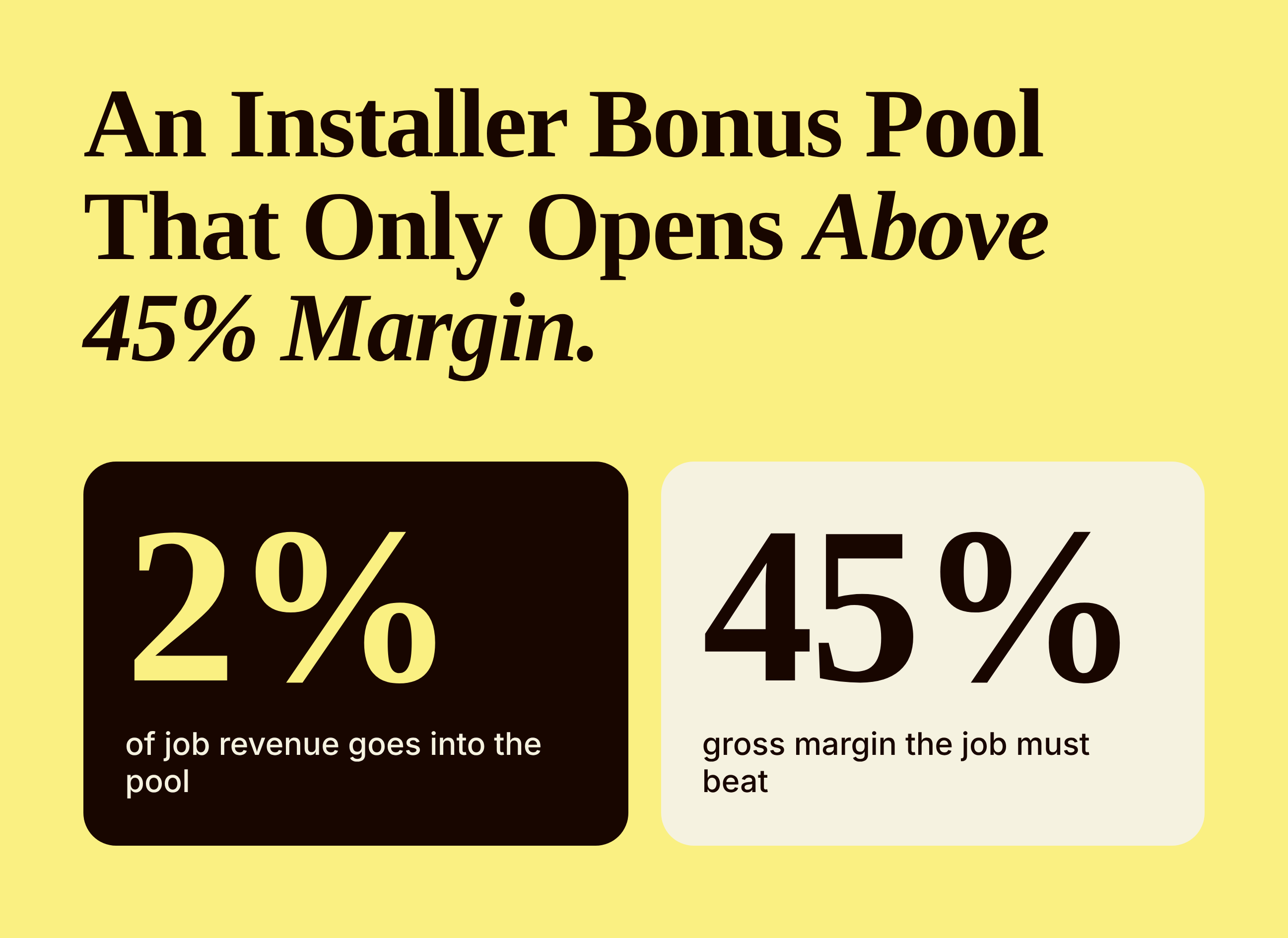
A two-location HVAC and plumbing company was calculating every technician's bonus off one undifferentiated formula. Here's the four-pool structure and phased rollout that replaced it.
When a home services company grows from one location to two, almost everything about the business gets harder to standardize. Marketing, hiring, even which brand of van wrap you use. But the thing that quietly breaks first is usually pay. A two-location HVAC, plumbing, and install company based in upstate New York found that out the hard way, and the fix ended up being one of the more instructive incentive redesigns we've seen come through recently.
The company runs HVAC service and install crews out of one branch and a combined HVAC and plumbing team out of a second branch a short drive away. For a while, incentive pay across both locations was calculated the same rough way: pull a report out of ServiceTitan at the end of the month, tally up job revenue by technician, and cut a bonus check based on that number. It worked fine when the company was smaller. It stopped working the moment two locations, three trades, and more than a dozen field technicians were all running through the same undifferentiated formula.
One formula, too many jobs
The cracks showed up in a few specific places. There was no minimum revenue threshold before a technician qualified for a bonus, which meant a slow month with barely any billed work could still technically trigger a payout. Callback and recall jobs, the ones where a tech has to go back out and fix something that shouldn't have needed fixing, were counted the same as first-time completed jobs, which meant the bonus formula was occasionally rewarding rework. And several newer hires didn't even have complete employee profiles set up in the system, so their production wasn't being captured correctly at all.
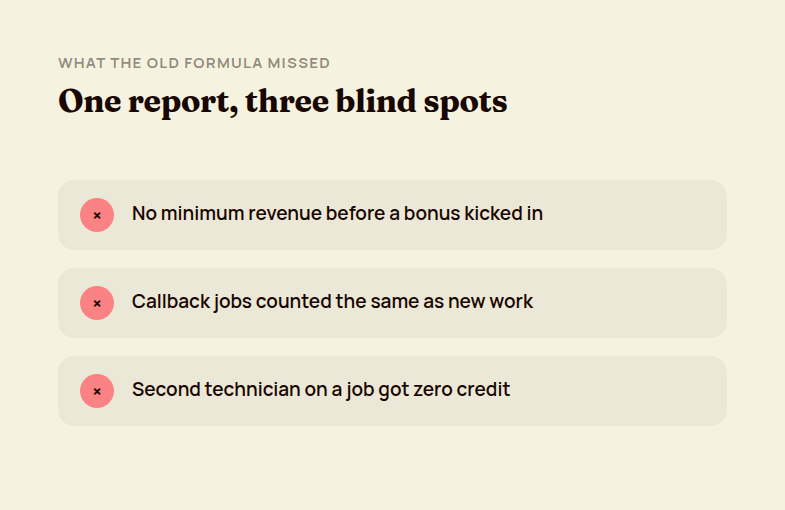
Then there was the ServiceTitan wrinkle that trips up a lot of multi-tech shops: the platform only lets you assign one lead technician per job. On a two-person install crew, that meant the second tech on the job, the one who spent the same eight hours on the same roof, wasn't getting credited for it at all in any report the company pulled. It's a small technical limitation with a real financial consequence, and it's exactly the kind of thing that erodes trust in an incentive plan faster than almost anything else. Technicians don't need a perfect system. They need a system that doesn't quietly shortchange them because of a checkbox in someone else's software.
None of these problems were dramatic on their own. Together, they added up to a plan that leadership couldn't fully explain or defend if a technician asked a pointed question about their bonus check, which is close to the worst position an incentive plan can put an owner in.
It's worth pausing on why a single formula tends to survive so long even after it stops making sense. When a company operates out of one location with one core trade, a simple percentage-of-revenue bonus is genuinely fine. The job mix is consistent, the technicians are cross-trained similarly, and everyone's rough sense of what's fair lines up with what the report says. The formula doesn't get rebuilt when a second branch opens or a second trade gets added, not because anyone decided it was still the right approach, but because rebuilding a comp plan while you're also standing up a new location is rarely anyone's top priority in the moment. The plan just keeps running on autopilot until enough small inconsistencies pile up that someone finally sits down and asks why.
Four pools instead of one
Rather than patch the existing formula, the company rebuilt it around how the business actually operates: by location and by job type. Yorkville HVAC service, Syracuse HVAC service, Syracuse plumbing, and installs across both branches each got their own incentive pool, with its own rules. A minimum monthly revenue threshold, in the neighborhood of $20,000 to $25,000 depending on the pool, had to be cleared before the service bonus kicked in at all, calculated off the same 25% labor-cost framework that shows up again and again in well-built HVAC incentive plans. Callback and recall-flagged jobs were excluded from the revenue that counted toward a bonus, so rework stopped quietly padding anyone's numbers.
The multi-tech credit problem got solved with a workaround rather than a platform migration: a system of tags and a custom field inside ServiceTitan that let the team manually flag and split credit on jobs with more than one technician, so a two-person install crew could both get paid for the work they actually did. It's not an elegant fix in the sense of being automatic, but it's the kind of practical patch that matters more than an elegant one when the alternative is technicians quietly noticing they're not being paid for real work.
Rolling it out in phases, on purpose
Most of the incentive-plan mistakes we hear about aren't design mistakes. They're rollout mistakes: a company builds a genuinely better structure, announces it to the entire team on the same day, and then spends the next month fielding confused questions and quiet resentment from people who didn't have time to understand what changed or why. This company avoided that by choosing to phase the rollout deliberately instead of flipping a switch company-wide.
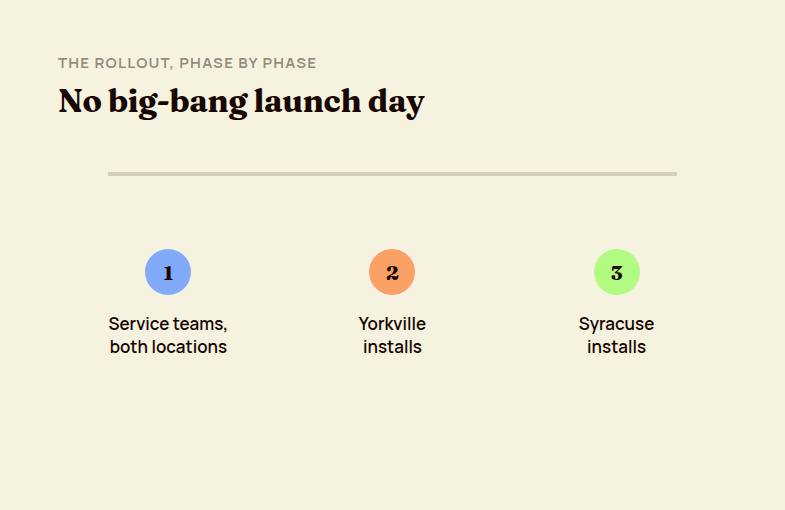
Service teams went first, since their pools were the most straightforward to explain and the easiest to validate against a month of real data before installs came online. From there, install crews were brought in branch by branch, starting with Yorkville. Leadership backed the rollout with simple one-pagers explaining how each pool worked, and offered technicians and managers individual sessions to review exactly where their numbers fell inside the new bracket structure, rather than leaving people to reverse-engineer a spreadsheet on their own.
At a check-in roughly two months into the rollout, the operations lead's read on how it was landing was about as good as an owner can hope for: no complaints from the install side, technicians who'd shown early interest getting their invites first, and the rest of the team gradually getting oriented to what the new plan expected of them. That's not a dramatic before-and-after headline. It's something arguably more valuable for a rollout this size: quiet. A pay-plan change across two locations and three trades that generates zero complaints two months in is a rollout that worked.
What the pools are actually worth
The numbers behind these pools aren't hypothetical. The Yorkville HVAC pool alone runs monthly incentive payouts in the range of $8,000 to $9,000, with quarterly totals for that same pool historically landing around $28,000. That's real money moving through a structure that used to be a single undifferentiated report pulled at month's end. Now it's four pools, each with its own threshold, its own exclusions for rework, and its own defensible math behind every check that goes out.
The lesson for any multi-location operator, whether you're running HVAC, plumbing, electrical, or some combination of trades across more than one branch, isn't that you need four pools specifically. It's that a single incentive formula almost never survives contact with more than one location or more than one job type for long. The moment a second branch or a second trade enters the picture, the differences that seemed minor (different labor markets, different job mixes, different crew structures) start showing up as real inconsistency in who gets paid what for comparable work. Segmenting the plan isn't added complexity for its own sake. It's the thing that makes the plan defensible when a technician, reasonably, asks how their number was calculated.
Why a minimum threshold matters more than it seems
The minimum revenue threshold deserves a closer look, because it's the kind of guardrail that's easy to skip when you're first building a plan and expensive to skip once technicians get used to its absence. Without a floor, a bonus formula pays out something on almost any month, even a genuinely slow one where a technician barely covered their own labor cost. That might feel generous in the short term, but it quietly breaks the connection between the incentive and the behavior it's supposed to encourage. A technician doesn't need to hustle for the next job if a token bonus is coming regardless of how the month actually went.
Setting the threshold around the same 25% labor-cost framework used across the rest of the plan keeps that connection intact. If a technician's booked revenue for the period doesn't clear the number needed to keep labor cost healthy, there's nothing to distribute yet, full stop. That's a harder conversation to have upfront, but it's a far easier one to have consistently, because the rule doesn't bend based on who's asking or how the month felt. It also protects the technicians who are hitting their numbers from watching a slower month get rewarded the same as their strong one, which is its own quiet retention risk if it happens often enough.
Profit sharing
made simple.
Give your team a stake in the company’s success. ShareWillow helps you create and manage profit-sharing programs that motivate employees and drive business results.
The ongoing work of keeping it fair
This wasn't a one-and-done redesign, and it shouldn't be treated like one. A few weeks after the phased rollout wrapped, the company came back to refine the multi-tech credit workaround further, since a manual tagging system, while functional, still asks someone to remember to apply it correctly on every job. That's the honest reality of running incentive pay well: the initial build solves the big structural problems, and the ongoing maintenance solves the smaller ones that only show up once real technicians are running real jobs through the new rules. Plans that work long-term treat that maintenance as part of the job, not as a sign the original design failed.
Multi-location field service businesses run into a version of this problem constantly, and it rarely announces itself clearly. It shows up as a technician who quietly stops picking up extra jobs, a manager who can't answer a straightforward question about how a bonus was calculated, or a bonus report that takes longer to reconcile every month instead of shorter. If any of that sounds familiar, the fix usually isn't a bigger bonus pool. It's a plan that's actually built around how your locations and trades are different from each other, the same way this HVAC company rebuilt its incentive math when nobody could explain how the numbers worked, or the way this shop caught commission being paid on revenue it hadn't actually collected yet.
If you're running more than one location or more than one trade under a single pay plan right now, it's worth asking the same question this company asked: does the formula actually reflect how the business runs, or is it just the formula that was easiest to build back when there was only one location to worry about? ShareWillow's plan-building tools are built specifically to model pools like these, location by location and trade by trade, before you roll anything out to your team.
Related reading
Conclusion
A pay plan built for one location almost never survives a second one intact, and pretending otherwise is what costs a good technician their trust in it.
Create incentives
that
drive results
You shouldn't need complex equity plans to align your team. ShareWillow makes it simple to create transparent profit-sharing programs that motivate employees and grow your business.

Incentive plans to help
small businesses thrive.
.png)
"I was able to leverage the knowledge of the ShareWillow team to learn how other companies were designing their bonus plans. The template was extremely helpful."

Brian Tustin
Owner, First Rate Movers