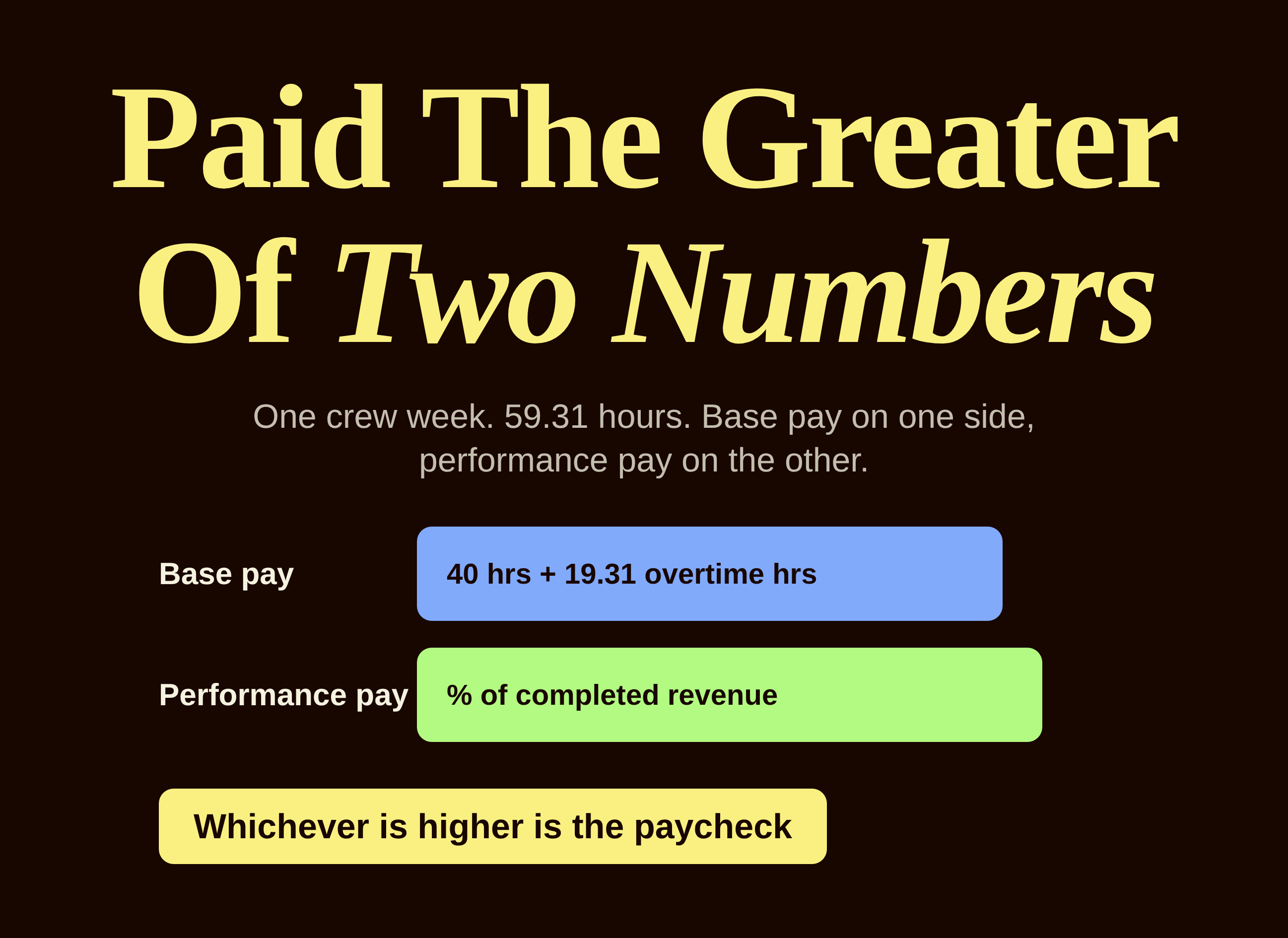
Fence installer pay: how a fencing company is testing a 7% crew commission against its hourly plan, with a two-week callback hold before any payout.
Fence installer pay looks simple from the outside: a crew shows up, builds the fence, and gets paid. Inside a growing fencing company, it is rarely that clean. One company with crews of two or more, a mix of lead installers and apprentices, and a gate-operator technician had reached the point where its pay process worked only because a manager kept patching it. Awards came from a spreadsheet comparing projected and actual job performance. They were paid every four to six weeks. Uneven crew splits were adjusted by hand.
Before moving to automated payouts, the company did something most owners skip. It put two different pay models side by side, decided to test both against its own history, and started working backward from a labor target instead of forward from a guess.
The Problem: A Plan That Depended on a Manager's Spreadsheet
Nothing about the old process was broken enough to scream. That is exactly why it was risky. Three gaps kept showing up in the first planning call:
- Slow payouts. Awards landed every four to six weeks, long after the work that earned them
- Hand-built splits. When a crew did not share a job evenly, a manager adjusted the split manually, 60/40 on one job and 30/70 on another
- No quality check and no target. Callbacks were never tracked, and there was no labor-rate target to tell the company whether a payout was affordable
The manager only had to make the split call once or twice a week, so it was not an overwhelming chore. But a plan that rewards crews every month and a half, with no callback data, gives installers a weak link between effort and pay. If you are seeing the same pattern, our case study on the 20% productivity gap between two install crews shows what changes when hours data finally reaches the plan.
Two Fence Installer Pay Models, Side by Side
Instead of picking one plan on instinct, the company defined two and agreed to model both on every installer using past jobs.
Option 1: Keep the hourly-plus-efficiency plan, but automate it
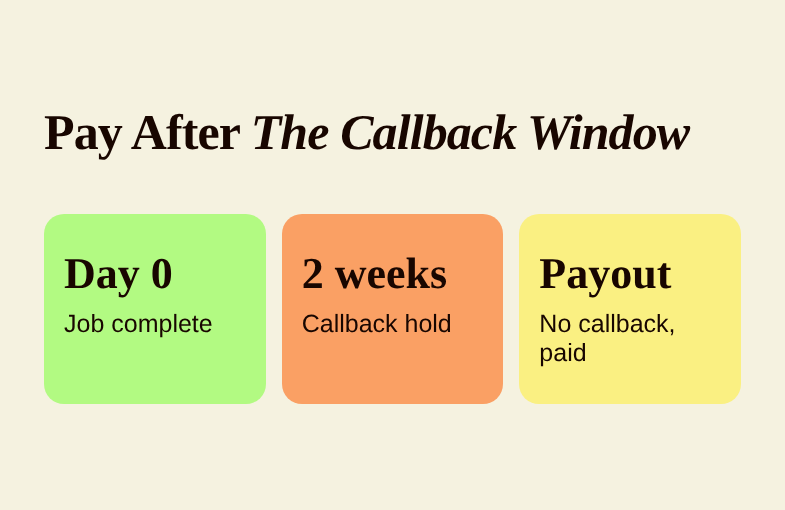
The first option mirrors what the company already does: hourly pay plus an award tied to how a job performed against its projection. The changes are structural. Periods become monthly. Managers still enter crew splits, but inside the system instead of a spreadsheet. A callback qualifier is added, along with a two-week hold before payout, so a job has to stay clean before anyone is paid for it.
Option 2: Pure commission on installer-assigned revenue
The second option is meant for newer hires. Installers earn a percentage of the invoice revenue assigned to them, with the manager's split applied first. Here is the example the company used: a $10,000 job split 50/50 means each installer is paid their percentage on $5,000. Because the splits sum to the whole job, the total labor on that job stays capped no matter how the crew divides it.
Commission-only pay raises an obvious fairness question, so the company added a minimum wage guarantee that applies to every hour worked on the pure commission option. Installers cannot slip below the legal floor because a job ran long or a customer rescheduled. This pairs naturally with the idea in our guide to tiered bonus structures, where a protected floor and a performance upside work together.
How to Set Fence Installer Pay From a Labor Target
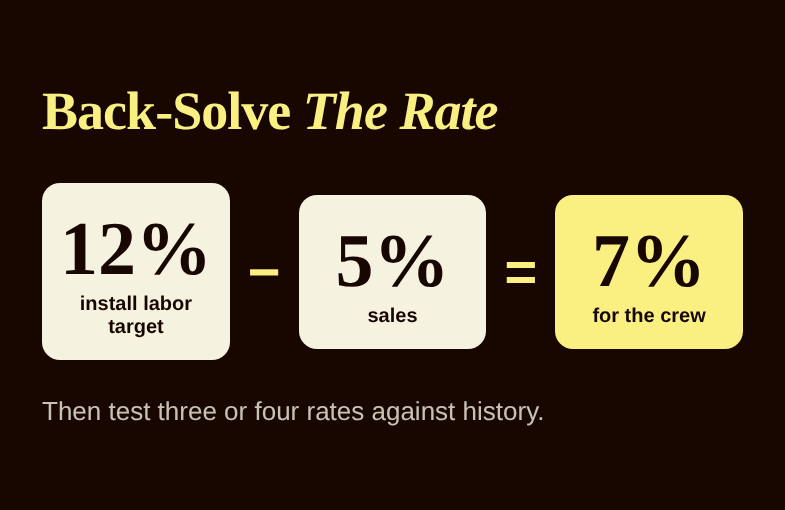
The most useful idea from this kickoff is how the company chose its commission rate. It did not ask what percentage felt right. It started from a labor-rate target and worked backward.
Here is the math. If install labor should land around 12% of job revenue, and about 5% of revenue already goes to sales, that leaves roughly 7% for the install crew. That 7% becomes the starting point for the commission. Then the company tests three or four rates around it against every installer's history to see what each would have paid.
Using 7% as an illustration, the arithmetic is easy to check. On a $10,000 job, the crew's commission pool is $700. Split 50/50, each installer earns $350. Split 60/40, the two earn $420 and $280. Split 30/70, they earn $210 and $490. The total never moves, which is the point. The manager can still decide who did what, and the company knows exactly what the job costs in labor. Our case study on why one roofing company ditched team bonuses for a labor-rate target follows the same logic in a different trade.
Why a Two-Week Callback Hold Changes Behavior
The old plan never tracked callbacks, so there was no cost to cutting a corner on a gate latch or a post set. The new design builds in a two-week barrier. A completed job is not paid out until the company can see whether a callback came in during that window. If it did, the job does not qualify.
It is a small rule with a large effect. Installers learn that a clean install pays and a sloppy one does not, and the company stops paying twice for the same work. The same principle shows up in other trades too. Our look at an hours-saved crew bonus pairs the award with eligibility rules for a similar reason.
Modeling Both Plans Before Anyone Is Paid
The company is not rolling either plan out blind. Both are being modeled against all installers and their past jobs, and the model run is due the week of October 12. That gives the owner a side-by-side answer to a question that is usually settled by gut feel: what would each plan have paid last quarter, and could the company have afforded it?
Testing on history also surfaces the awkward cases early. A lead installer with a heavy workload, an apprentice on a lighter share, and a gate-operator technician working on a different kind of job will each look different under the two options. Better to find that on a spreadsheet of old jobs than in a paycheck dispute.
What This Plan Does Not Know Yet
It is worth being plain about where this story stands. There are no payout totals yet, because the plans have not run. What exists today is a better set of questions and a method for answering them: a target labor rate, two defined models, a minimum wage guarantee, a callback hold, and a test on real history. For many owners, that is already a step ahead of a bonus formula nobody can explain.
Profit sharing
made simple.
Give your team a stake in the company’s success. ShareWillow helps you create and manage profit-sharing programs that motivate employees and drive business results.
How to Build Your Own Fence Crew Pay Plan
- Pick a labor target. Decide what percentage of job revenue installation labor should cost.
- Subtract the other roles. Take out the share that goes to sales or other people on the job, and treat what is left as the crew's pool.
- Choose the model by experience. A proven crew might stay on hourly plus efficiency, while newer installers might fit a commission plan with a wage guarantee.
- Add a quality gate. Hold payouts through a callback window.
- Run it on history first. Test three or four rates before anyone sees a check. Our guide on how to calculate bonus pay is a good place to start.
If you want pay plans like these to calculate automatically from your job data, explore ShareWillow's product features.
Frequently Asked Questions
How are fence installers usually paid?
Most fence installers are paid hourly, and many companies add a bonus tied to job performance. Some use a percentage of the job revenue, especially for newer crew members. The right choice depends on how much control the company wants over total labor cost.
What percentage of a fence job should go to installation labor?
There is no universal number, because it depends on your margins and the type of fence. The company in this story is working from a 12% install labor target, with about 5% going to sales and roughly 7% left for the crew. Set yours from your own job costing, then test it on past jobs.
How do you handle crew members who split a job unevenly?
Let the manager set the split, then apply each installer's commission to their share of the revenue. A $10,000 job split 50/50 pays each installer on $5,000. Because the shares add up to the whole job, total labor stays the same however the split moves.
Related reading
- The 20% Productivity Gap Between Two Install Crews Nobody Could See, Until the Clock Told the Truth
- Why One Roofing Company Ditched Team Bonuses for a Labor-Rate Target
- Crew Bonus Plan: How an Outdoor Living Company Is Paying $50 for Every Hour Its Crews Save
- How to Maximize Employee Performance with Tiered Bonus Structures
Conclusion
Back-solve crew commission from a labor target, hold payouts through a callback window, and model every plan on history first.
Create incentives
that
drive results
You shouldn't need complex equity plans to align your team. ShareWillow makes it simple to create transparent profit-sharing programs that motivate employees and grow your business.

Incentive plans to help
small businesses thrive.
.png)
"I was able to leverage the knowledge of the ShareWillow team to learn how other companies were designing their bonus plans. The template was extremely helpful."

Brian Tustin
Owner, First Rate Movers