A field service technician pay plan that replaced flat hourly pay with a real scorecard, built by an 11-person company running crews in three states.
Building a field service technician pay plan gets harder the moment you stop operating in one city. An 11-person field service infrastructure company based in the Southeast learned that the hard way. The company installs and services technology, electrical, and HVAC infrastructure for a large national client, and it had just signed a five-year contract that meant expanding from a handful of local technicians to crews working in Florida, the Southeast region, and New York, all at once. Flat hourly pay, the owner realized, was not going to hold that together.
"The hourly pay doesn't make sense for this line of work. It doesn't work," the owner said flatly during one planning call. Technicians on a truck all day, driving between sites, finishing service calls and flat-rate installs, needed pay that moved with what they actually produced. But the owner also wanted something specific: a plan that didn't just reward revenue. "It has to be a serious motivator," he said, and he wanted the office staff pulled into the same logic. "I want everybody to be able to make a dollar, because the more they generate, the more I'm gonna make."
Why a Field Service Technician Pay Plan Needs More Than One Number
The company's first instinct, like a lot of growing field service businesses, was to build a single incentive around revenue per technician. It didn't survive first contact with the actual work. Some jobs were time and materials service calls. Others were flat-rate installs with fixed pricing regardless of how long they took. Techs also logged regular hours, overtime, and drive time that had nothing to do with a specific ticket, but still needed to be paid fairly and tracked accurately across three separate regions with three different rollout timelines.
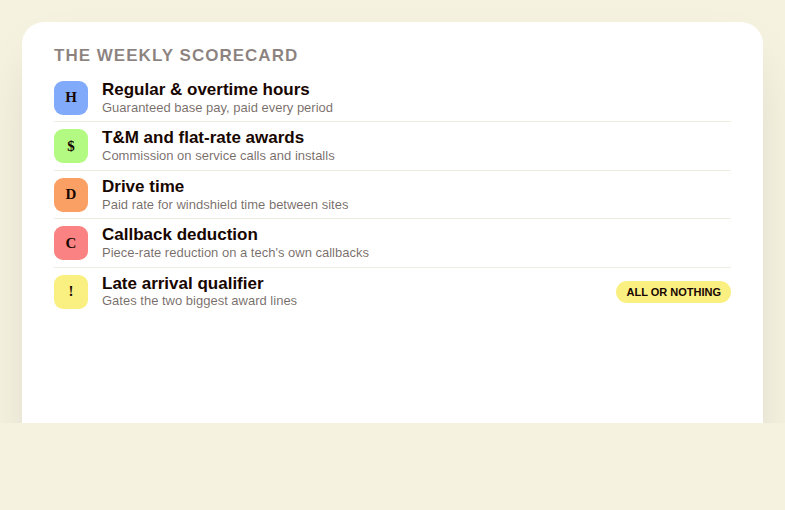
So instead of one number, the company built a scorecard. Working with ShareWillow, they laid out a weekly plan with six separate metrics feeding into a single technician's pay:
- Regular hours and overtime hours, paid at the technician's base hourly rate and 1.5x respectively, so no one's guaranteed pay depended on job performance.
- Service Call T&M Award, a commission on time-and-materials work performed, calculated as a fixed percentage of the value the technician generated.
- Flat Rate Project Award, a separate commission line for flat-rate installs, since those jobs don't behave like hourly service calls and needed their own rate.
- Drive Time Hours, paid at a defined rate so technicians weren't absorbing unpaid windshield time between sites spread across a multi-state footprint.
- Callback Deduction, a piece-rate reduction applied when a technician had to return to fix their own work, so quality stayed tied to pay without turning into a punitive flat penalty.
Layered on top of all five was a single qualifier: Late Arrival. If a technician had any late arrivals in the period, it gated the T&M and flat-rate award lines entirely, an all-or-nothing rule that made on-time performance a prerequisite for the plan's two biggest payout categories, not just one more line item competing for attention.
Rolling the Same Plan Out Region by Region, on Purpose
Because the five-year contract ramped up unevenly, the company didn't roll the scorecard out everywhere at once. The Southeast region crew, the largest at the time with five technicians, went live first on a weekly cycle, then moved to a biweekly payout schedule once the process was proven. Florida and New York followed on their own timelines, each starting as a standalone weekly plan before converting to biweekly. That staged rollout meant the company was running several versions of essentially the same plan simultaneously, which created its own management problem: technicians whose assignments changed needed their enrollment to follow them.
That problem showed up directly in a support call midway through the rollout. One technician had been moved off the Southeast Region plan and onto the Florida plan, but the Florida plan was still on a weekly cycle while the technician's other plan had already converted to biweekly. The result was a technician who couldn't find his prior pay-period payouts because they were split across two differently-paced plans, and an office team who had to manually track down and reconcile both weeks by hand before they could tell him what he'd actually earned. It's a small, specific failure mode, but it's exactly the kind of thing that erodes trust in a field service technician pay plan fast: the math might be right, but if nobody can find the number, it doesn't matter.
The fix wasn't a new formula. It was operational discipline: standardizing pay-period cadence across regions as each one matured, and building payout reports that could be pulled by a custom date range from Payouts > Summary rather than reconstructed by hand every time someone changed plans. Once a technician's biweekly payout was finalized, the office could generate and export the report directly, and both the owner and the technician could see the same number without a manual reconciliation step in between.
Building Pay for Roles the Scorecard Didn't Cover Yet
As the company grew past its original field crew, it ran into a second, quieter version of the same problem: roles that didn't fit the technician scorecard at all. A director of technical services needed a plan built around service quality rather than production volume, since the role didn't generate billable jobs directly. The company settled on three metrics for that role: 95 percent on-time arrival, 96 percent or higher first-pass quality, and 100 percent documentation completion, with an additional tag under consideration to flag whenever a required immediate-checklist was completed on a job. It's the same underlying philosophy as the technician scorecard, just measuring management of the work instead of the work itself.
The company also thought carefully about base pay before building performance pay on top of it. Technicians were paid a base rate between roughly $24 and $32 an hour depending on level and tenure, with travel time compensated at half the base rate. A subset of technicians on a client retainer arrangement earned a guaranteed retainer fee layered underneath their scorecard pay, so the incentive plan added upside without removing the income floor those techs needed. That base-plus-scorecard structure, rather than a commission-only model, is a large part of why the plan held up across a five-year contract with three different regional rollouts instead of collapsing the first time revenue dipped in one market.
Profit sharing
made simple.
Give your team a stake in the company’s success. ShareWillow helps you create and manage profit-sharing programs that motivate employees and drive business results.
What a Multi-Region Field Service Technician Pay Plan Actually Requires
The lesson from this rollout isn't really about the specific percentages or the exact metric list, since those will vary by trade and by client contract. It's that a field service technician pay plan built for one location rarely survives multiplication by three. The formulas that felt intuitive with five technicians in one region get genuinely hard to track once you have staggered pay cycles, technicians moving between regional plans mid-cycle, and non-technician roles that need an entirely different scorecard. Building the plan with that growth in mind from the start, rather than retrofitting it after the second or third region goes live, is what kept this company's payouts predictable instead of becoming a weekly reconciliation project.
It also helped that the plan never asked technicians to trust a black box. Every metric on the scorecard, from drive time to the late-arrival qualifier, maps to something a technician can see and control on a given day. That's the same principle behind a well-built HVAC commission pay structure or a multi-region weekly performance pay plan: the more directly a technician can connect their own day to their own paycheck, the less a company has to spend convincing people the numbers are fair.
If you're weighing whether performance pay makes sense for a field service crew spread across more than one market, it's worth reading through this breakdown of field service KPIs that actually drive profit before you pick your metrics, since the KPIs you choose to track are what your pay plan will end up reinforcing. Purpose-built profit-sharing and incentive pay software also removes most of the manual reconciliation work described above, since payouts, enrollments, and pay-period cadence are all tracked in one place instead of split across spreadsheets per region.
FAQ
How do you pay technicians who work across multiple regions or job types?
Build separate metric lines for each type of work a technician performs, such as a time-and-materials commission rate and a separate flat-rate install rate, rather than forcing every job into one formula. Keep a consistent base hourly rate underneath so income never depends entirely on job mix.
What should a field service technician pay plan include besides commission?
Most durable plans pay regular hours and overtime at a guaranteed hourly rate, then layer performance metrics on top, such as commission on completed work, a drive-time rate, and a quality gate like a late-arrival or callback qualifier that has to be met before the biggest payout lines unlock.
How do you roll out a new pay plan across multiple locations without confusing technicians?
Stage the rollout by region instead of switching everyone over on the same day, and standardize the pay-period cadence as each region matures. Give technicians a single place to check prior payouts, since a plan that pays correctly but can't be easily verified will still generate the same complaints as a plan that pays incorrectly.
Related reading
Conclusion
One scorecard, rebuilt region by region, turned three states of flat hourly pay into a field service technician pay plan techs could actually predict.
Create incentives
that
drive results
You shouldn't need complex equity plans to align your team. ShareWillow makes it simple to create transparent profit-sharing programs that motivate employees and grow your business.

Incentive plans to help
small businesses thrive.
.png)
"I was able to leverage the knowledge of the ShareWillow team to learn how other companies were designing their bonus plans. The template was extremely helpful."

Brian Tustin
Owner, First Rate Movers