
An HVAC company's technicians were generating referrals constantly with no way to track or reward it. Tagging the job at the point of scheduling and paying automatically once the invoice clears turned an invisible lead source into a real, trusted incentive.
Your techs are already generating leads. Are you paying them for it?
Ask any HVAC business owner where their best leads come from, and revenue-per-channel reports will usually point to two places: paid ads and referrals. What often gets missed is where a huge share of those referrals actually start. Not a Google review, not a neighborhood Facebook group. A technician, standing in someone's kitchen, mentioning that the same maintenance plan is available for the customer's sister two streets over.
That is exactly what was happening at one HVAC company before they had any system to capture it. Their techs were closing jobs, building rapport with homeowners, and picking up word-of-mouth referrals constantly, the kind of organic lead generation most marketing teams would kill for. The problem was not that referrals weren't happening. The problem was that nobody in the office had a reliable way to know they had happened at all.
A tech would mention, almost in passing, that a customer's neighbor wanted a quote too. Dispatch would sometimes catch it, sometimes not. If the referral eventually turned into a booked job, there was no field connecting that new customer back to the technician who originally earned the credit. The lead simply became "inbound," indistinguishable from someone who found the company through a Google search. The tech who did the actual work of generating that new customer got nothing for it, not even acknowledgment, let alone pay.
This is a common gap in HVAC and home service businesses generally, and it is a strange one, because it means companies are running a referral program without knowing it, and paying nothing for a channel that is quietly worth real money. Ask around most shops and you will hear a version of the same story: "yeah, we probably get some referrals from the guys, but we don't really track it." That sentence is describing a missed incentive, not a minor operational quirk.
It is also worth separating this from a customer-facing referral program, the kind where a homeowner gets a gift card for referring a neighbor. Plenty of HVAC companies already run one of those. Far fewer have thought about the technician side of the same equation, even though the tech is usually the one actually planting the seed for the referral in the first place. The homeowner mentions a neighbor's aging furnace because the tech asked the right question at the end of the job, not because a postcard in the mail reminded them to. Building the incentive around the person doing the asking, not just the person doing the referring, is the piece most shops skip entirely.
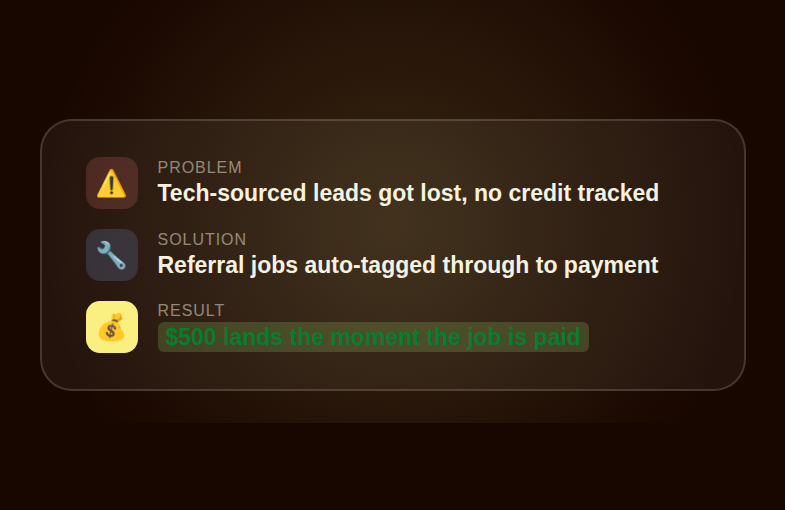
The fix did not require a new marketing campaign or a customer-facing referral app. It required building a bridge between two things that already existed: the moment a tech mentions a referral in the field, and the moment that referral turns into a paid invoice. Once that bridge existed, the company could finally do the obvious thing. Pay the tech who earned it.
How the tagging actually works
The mechanism the company landed on is straightforward, which is exactly why it holds up under real-world use instead of falling apart the first time someone forgets a step. When a technician flags a job as tech-sourced, meaning the customer came from a referral that tech personally generated, that job gets tagged in the field service platform at the point of scheduling. From there, the tag rides along with the job through every stage: scheduled, completed, invoiced, paid.
The bonus itself does not release the moment the referral is mentioned or even the moment the job is scheduled. It releases when the invoice is actually paid. That timing choice matters more than it looks like it should. Paying out on a scheduled job would mean paying for referrals that later cancel, no-show, or get billed at a steep discount. Tying the payout to the paid invoice means the incentive only fires when the company has actually collected real revenue from the referral, which keeps the math honest for both the business and the tech.
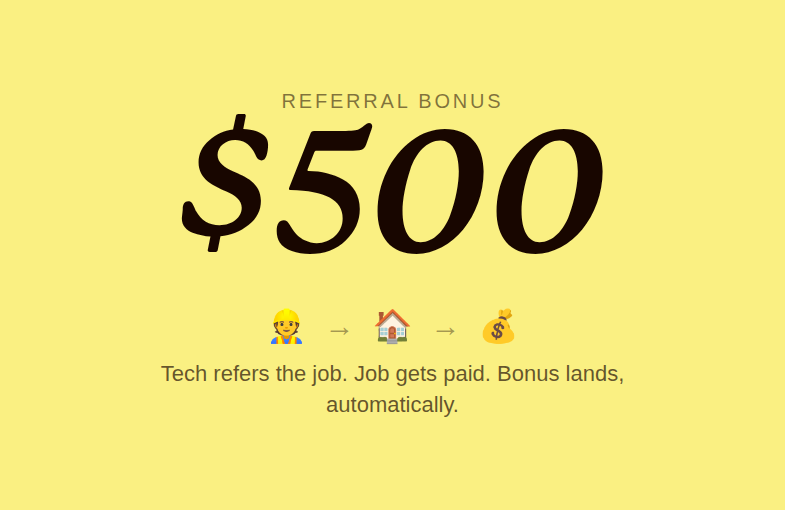
None of this runs through a spreadsheet, and that is deliberate. Manual tracking is exactly how referral programs like this die within a few months. Someone forgets to log a tag, a tech stops mentioning referrals because "what's the point, it never gets tracked anyway," and the whole thing quietly evaporates. ShareWillow's platform pulls the referral tag directly from the job data already sitting in the company's field service software, matches it against invoice and payment status automatically, and calculates the $500 bonus the moment the job clears, no manual reconciliation required. The tech does not have to submit a form or ask a manager to confirm anything happened. The system already knows.
One question that comes up quickly whenever a shop builds something like this: what happens when two techs both claim credit for the same referral, or a referral shows up weeks after the original job? The company handled it with a simple rule rather than a case-by-case judgment call. Credit goes to whichever tech tags the referral first, at the point the new customer's job gets scheduled, and the tag has to happen before the new job is booked, not retroactively after the fact. A clear, mechanical rule like this removes almost all the ambiguity that tends to create friction on a team, and because the tagging happens inside the same system the office already uses for scheduling, there is a timestamped record settling any dispute in seconds rather than turning into a he-said-she-said conversation between two techs.
There is a reason the flat $500 figure works better here than a percentage-based commission might. A flat bonus is easy to explain in a five-second conversation between a tech and a homeowner, and it is easy for the tech to remember and repeat to the next customer. "Refer a neighbor, I get five hundred bucks when it's done" is a sentence a tech will actually say out loud. A formula involving a percentage of first-year contract value is not. The best incentive structures tend to be the ones simple enough to become part of a tech's actual pitch, not just a line item on a pay stub they glance at once a month.
Profit sharing
made simple.
Give your team a stake in the company’s success. ShareWillow helps you create and manage profit-sharing programs that motivate employees and drive business results.
What changed once the bonus became visible
The most immediate shift was not the volume of referrals. It was the visibility of referrals that had probably been happening all along, just uncaptured. Once techs knew a referral would actually turn into $500 in their pocket, tracked automatically with no extra paperwork on their end, they started flagging them consistently instead of mentioning them in passing and letting the moment slip by. The company got a clearer picture of exactly how much of its new business was coming from the field, not just the marketing budget, something that had previously been a total blind spot in their reporting.
There is a retention angle here too, one that is easy to underweight. A tech who is earning real, visible money from referrals has a direct financial stake in the company's reputation in their own community. That is a different kind of engagement than a standard commission plan built purely around job completion volume, which is the exact plateau problem covered in how one HVAC company broke a 3-job-a-day ceiling. A referral incentive does not compete with a technician's daily production goals; it runs alongside them, rewarding a completely different behavior that a standard per-job bonus never touches.
If you are considering building something similar, a few practical lessons from this rollout are worth carrying over. First, keep the tagging step as close to zero-friction as possible. If flagging a referral takes more than a few taps in whatever field app your techs already use daily, it will not get used consistently, no matter how generous the bonus is. Second, tie the payout to a real, collected outcome rather than an earlier step like a scheduled appointment; it protects the business from paying out on leads that never actually convert into revenue. Third, make the number itself easy to say out loud. A flat dollar figure a tech can repeat to a customer in one sentence will always outperform a formula that needs a spreadsheet to explain.
It is also worth thinking about this alongside whatever else already sits on your incentive plan. Referral bonuses work best as an addition, not a replacement, for the kind of predictable, transparent commission structure discussed in how a 6-tech HVAC shop turned a wild labor cost into one predictable number. Techs should never feel like chasing a referral trades off against hitting their regular production targets. When both run at the same time, cleanly tracked and clearly paid, the company gets a lead-gen channel it never had to buy ads for, and the tech gets rewarded for something they were already doing for free.
The bigger point underneath the $500 figure is this: your field techs are in more homes, having more conversations with more potential customers, than any single piece of your marketing budget. If there is no system connecting what happens in that conversation to a paycheck, that channel is running at a fraction of its real potential. Tracking it does not require a new department or a new piece of software your team has to learn from scratch. It requires tagging what is already happening and paying for it honestly, every time, without anyone having to remember to ask.
The math owners care about
Run the comparison an HVAC owner actually cares about: what does a $500 referral bonus cost against what that same customer is worth over a multi-year maintenance relationship, plus whatever equipment replacement eventually comes their way? For most residential HVAC businesses, a single referred customer's lifetime value clears the bonus cost within the first service call or two, and everything after that is close to pure margin. Compare that to the customer acquisition cost of a paid lead from a home services marketplace or a pay-per-click campaign, which routinely runs higher than $500 once you account for the leads that never convert at all. A referral a tech generates for free, simply by doing good work and asking one extra question at the end of a job, is often the cheapest customer a home service business will ever acquire. Paying $500 for that customer is not generosity. It is one of the better-returning line items on the entire marketing budget.
For an owner or operations manager sizing this up, the real work is not designing an elaborate program. It is deciding on a fair number, building the tagging step into whatever field workflow techs already use, and making sure the payout actually happens reliably enough that techs trust it. Trust is the part that compounds. A tech who gets paid cleanly and quickly the first time they refer someone will keep doing it, and will tell the rest of the crew it actually works. A tech who has to chase down a bonus that never quite materializes will stop mentioning referrals within a month, and take that habit right back to keeping their mouth shut in the customer's kitchen.
Related reading
- Bonus In A Month, Or In Two Weeks? How A Refrigeration And HVAC Company Fixed Its Payout Timing
- The Greater-Of Rule: How a Fire Protection Company Built Pay Techs Could Trust
- HVAC Technician Incentives to Motivate Your Team
- Companies with Profit Sharing: Who They Are & What They Offer
- HVAC Membership Sales Commission: The Capped Spiff That Caught a $440 Payroll Gap
- Technician Lead Generation Bonus: How an HVAC and Plumbing Company Found $52K in Tech-Sourced Sales Its Report Showed as Zero
Conclusion
A referral your team already generates for free is the cheapest customer you will ever acquire, if you actually pay for it.
Create incentives
that
drive results
You shouldn't need complex equity plans to align your team. ShareWillow makes it simple to create transparent profit-sharing programs that motivate employees and grow your business.

Incentive plans to help
small businesses thrive.
.png)
"I was able to leverage the knowledge of the ShareWillow team to learn how other companies were designing their bonus plans. The template was extremely helpful."

Brian Tustin
Owner, First Rate Movers
