A small electrical contractor's commission plan was about to pay out on jobs that were never finished and never fully paid for. One ticket alone showed a completed $9,874 invoice against just $2,074.88 actually collected. Here's how a routine support call caught it before that payroll cycle ever went out.
Commission plans built on job revenue only work if the revenue is real. That sounds obvious until you watch what happens in the field: a technician starts a job, the customer wants more work added, and instead of writing up a fresh estimate for the extra scope, it's easier to just tack a few more line items onto the ticket that's already open. The job gets marked complete in the field service software because, from the technician's perspective, the visit is over. Nobody upstream necessarily notices that the invoice total jumped, or that the customer never actually paid for the added scope.
That's roughly what a small, single-office electrical contractor running a handful of technicians in California ran into during a routine support call with their ShareWillow rep. The owner had pulled up that pay period's commission report to do a gut check before payroll went out, the way a careful owner does every cycle, and one number stopped him cold.
Electrical work in particular tends to produce this kind of ticket sprawl. A residential panel upgrade often turns up code issues once a technician actually opens the panel, additional circuits the homeowner decides they want mid-visit, or a second trip needed to pass a permit inspection before the job can be fully closed out. Every one of those is a legitimate reason for a ticket to change after the first visit. None of them are a reason for an invoice to say "completed" before the work and the payment both actually match.
A panel job that didn't add up
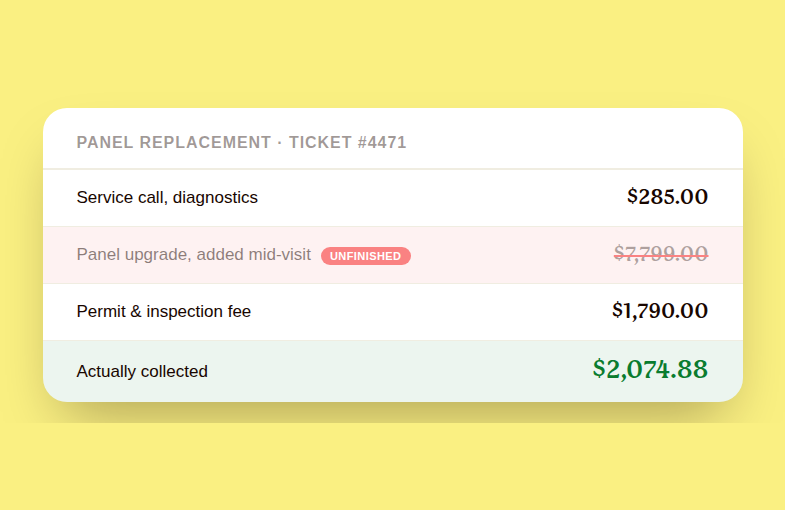
The ticket in question was a panel replacement. In the field service system, it showed as a completed job with a $9,874 invoice attached, the kind of number that should represent a fully finished, fully billed piece of work. But when the owner checked what had actually been collected against that invoice, the real figure was $2,074.88. Not close. Not a rounding issue. A gap of nearly $7,800 between what the system said was done and paid for, and what had actually landed in the bank.
"Almost $10,000 worth of work. Something's way wrong here," the owner said, pulling the ticket up live on the call. "Why is it marked as completed for $9,874? I don't even know if any of this is done."
That last line is worth sitting with. The owner wasn't just questioning a dollar figure, he was questioning whether the underlying work had even happened. And that uncertainty is exactly the risk a revenue-based commission plan is supposed to protect against, except in this case the protection had a hole in it.
How a ticket quietly grows past what was actually done
The rep traced the pattern back to a habit on the technician side, not a bug in the software. "It looks like he added additional invoice items to the initial service visit rather than scheduling a new visit for the remaining work," she explained. In plain terms: instead of creating a new estimate for follow-on work, whether that was additional scope the customer approved mid-job or work planned for a return trip, the technician kept adding it to the same invoice that was already open from the first visit.
One added line at a time, that habit is nearly invisible. A ticket that started as a straightforward, fully-paid job for a smaller amount slowly grows into an invoice for thousands more than the customer has actually agreed to pay for right now, sometimes more than they've agreed to pay for at all. And because the field service software marks the job "completed" the moment the technician closes out the visit, the commission report has no way of knowing that a big chunk of that invoice is really a placeholder for work that hasn't happened yet, or a deposit for work still in progress.
That's the mechanism worth remembering if you run any kind of trades business on invoice-based commission: a completed status in your field service software describes what a technician did with a screen, not necessarily what happened on the job site or in the customer's bank account.
Auditing every ticket before a single check went out
To their credit, neither the owner nor the rep treated this as a one-ticket problem. Once the pattern was visible on this job, the obvious next question was how many other tickets in that pay period had the same issue quietly baked in. So instead of patching the one job and moving on, they went through the commission-relevant invoices from that period together, live on the call, checking each one against what had actually been collected.
Where a ticket had line items for work that wasn't finished, or dollar amounts that didn't match a real, collected payment, those amounts got zeroed out or corrected before anything synced back into the commission calculation. It's slow, unglamorous work, the trades equivalent of reconciling a bank statement line by line. But it's also the only way to know, with confidence, that a commission report reflects real, paid-for work rather than a hopeful projection of it.
The bonus that almost went out on inflated numbers
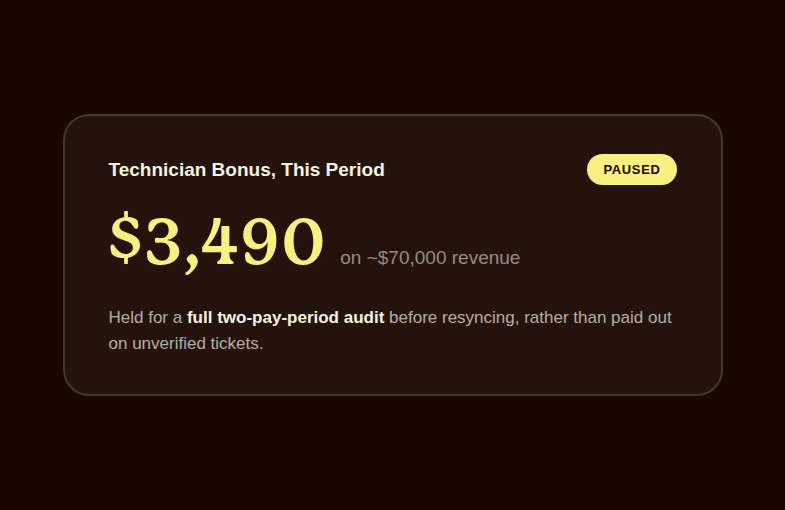
The stakes of catching this became concrete fast. One technician on the team was tracking toward a bonus of roughly $3,490 for the period, calculated against close to $70,000 in apparent revenue. Some meaningful slice of that revenue total was sitting inside tickets with the same problem as the panel job, work marked done and billed that hadn't actually been finished or paid for. Left uncorrected, that technician's bonus would have been calculated on numbers that didn't reflect real, collected revenue, and the company would have paid out real money against invoices that were still, in a very real sense, open.
Rather than let that pay period run on the flawed sync, the owner made a call that's easy to underrate: he ran that cycle's payroll manually rather than trusting the automated commission numbers, and committed to a full audit of the prior two pay periods before letting anything resync automatically. It's not a glamorous fix. It's also exactly the right instinct, because it treats a data problem as a data problem, worth pausing for, rather than a headache to route around so payroll can go out on schedule.
Alongside the audit, the fix that actually prevents this from recurring is a coaching one: train technicians to open a new estimate for additional or future work instead of stacking it onto whatever invoice happens to already be open. That's a habit change on the field side, not a software change, and it's the kind of fix that costs nothing but attention.
Profit sharing
made simple.
Give your team a stake in the company’s success. ShareWillow helps you create and manage profit-sharing programs that motivate employees and drive business results.
Why "caught in time" is the better headline than "solved"
It would be tidy to end this story with a single corrected number, the way a before-and-after story usually wraps up. This one doesn't work that way, and that's worth being honest about. By the end of the call, the fix wasn't a finished audit with a clean final total, it was a payroll cycle run manually out of caution, and a commitment to check the two periods before it line by line. That's a less satisfying ending than a big reveal number. It's also, arguably, a better outcome, because it means the company protected its payroll before a bad number ever reached a paycheck.
There's a real lesson in that distinction for any owner running commission or bonus pay on top of job revenue. The moment to catch a data problem like this isn't after the check clears, it's in the ten minutes before you approve payroll, when a number still looks off and you're willing to ask why instead of assuming the software got it right. The owner in this story didn't need a forensic audit to catch the issue. He needed a habit: pull up the report, sanity-check a few big numbers against what he actually knew about the jobs, and flag anything that didn't feel right.
It's also worth noticing what made the catch possible in the first place: the owner actually knew the jobs. He recognized that a $9,874 panel replacement was an unusually large number for that kind of ticket, and he trusted that instinct enough to pull up the underlying invoice instead of letting the report stand. An owner who's disconnected from the day-to-day job mix loses that instinct fast, which is its own argument for staying close to the numbers even as a shop grows past the size where one person can remember every job.
A quick audit for your own commission-based pay plan
If your shop pays any kind of commission, bonus, or profit share on job revenue, a few things worth checking before your next payroll run:
- Do your "completed" jobs match your collected payments? Pull a handful of your largest invoices for the period and check the collected amount against the invoiced amount. A gap like this one is rarely a single bad job, it's usually a pattern.
- Are technicians opening new estimates for new work, or stacking it onto old tickets? If your team's habit is to add scope to whatever invoice is already open, your revenue numbers are quietly drifting away from what's actually been sold and collected.
- Does "completed" in your field service software actually mean paid? In most platforms it doesn't, it just means a technician closed out the visit. Know the difference before you build a commission plan on top of that status.
- Would you rather run payroll a day late or pay out on numbers you haven't checked? An owner willing to run a cycle manually while an audit finishes is protecting the whole team's trust in the plan, not just the dollars.
None of this requires new software or a policy overhaul. It requires a five-minute habit before payroll runs, and a team that's been coached to create new paperwork for new work instead of quietly inflating what's already open.
You're not the only shop checking this
Revenue that looks real but isn't quite there yet shows up in more places than invoicing habits. One HVAC installer found their commission report was pulling from the wrong date entirely, paying out based on when a job was sold instead of when it was actually finished and paid for, while another shop had to model three different pay structures against real numbers before trusting any of them enough to launch.
The common thread is the same one running through this story: a commission plan is only as trustworthy as the data feeding it, and that data is worth checking by hand at least as often as you check your bank balance. If you're running any kind of revenue-based incentive or commission plan for an electrical or home services team, build that five-minute check into every payroll cycle. It's a lot cheaper than a bonus paid out on a job that wasn't really done.
Related reading
Conclusion
A completed job in your field service software just means a technician closed the ticket. It doesn't mean the customer paid, and your commission plan needs to know the difference.
Create incentives
that
drive results
You shouldn't need complex equity plans to align your team. ShareWillow makes it simple to create transparent profit-sharing programs that motivate employees and grow your business.

Incentive plans to help
small businesses thrive.
.png)
"I was able to leverage the knowledge of the ShareWillow team to learn how other companies were designing their bonus plans. The template was extremely helpful."

Brian Tustin
Owner, First Rate Movers