A water treatment and plumbing company had gone a full decade without a single reporting system it could trust. The week its new technician, CSR, dispatch, service manager, and office manager metrics finally went live, the company discovered $70,000 in overdue invoices it did not know it had.
Ten years is a long time to run a business on guesswork. That is roughly how long a water treatment and plumbing company had gone without a single piece of internal reporting it actually trusted. Not because nobody tried. The owner had tried more than once to get real numbers out of ServiceTitan, the field service platform the company runs on, and every attempt ended the same way: reports that almost worked, numbers that did not tie out, and eventually a quiet decision to stop relying on them.
That kind of history leaves a mark. By the time this company sat down to roll out technician scorecards and performance pay for its office staff, the person on the other side of the table was not excited. He was skeptical, and he said so plainly. So many things we have tried to get metrics out of ServiceTitan, and it is just never right, he said during one of the setup calls. You can't bank on it because it's not good enough. That sentence is worth sitting with, because it captures something a lot of small field service companies experience quietly: the promise of data-driven operations sounds great until you have been burned by broken reports one too many times, and then every new attempt starts from a place of doubt instead of enthusiasm.
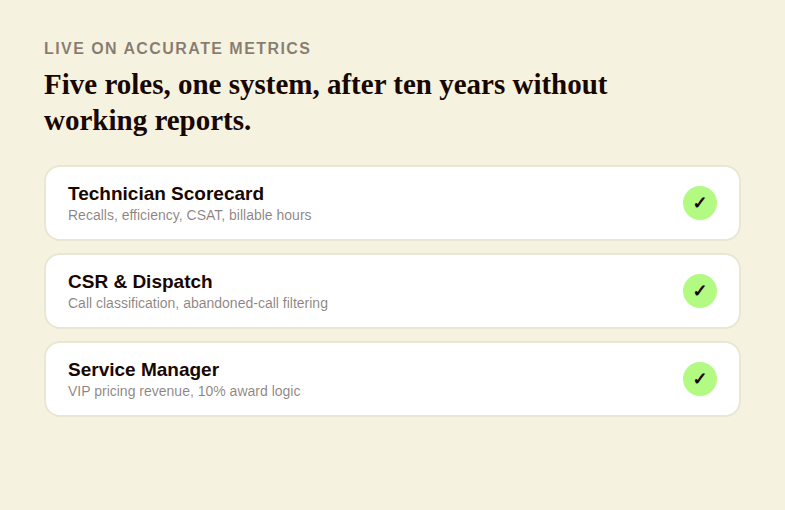
The company runs six field technicians plus a small office team covering customer service, dispatch, a service manager, and an office manager. That is a lot of different jobs to try to measure accurately, and each one has its own version of the same underlying problem. Technician performance depends on knowing which recalls were real, which jobs were billable, and how customer satisfaction actually broke down by person, not by guesswork. Dispatch and CSR performance depends on knowing which calls were correctly classified and which abandoned calls actually mattered, filtered down to business hours instead of getting skewed by after-hours noise. None of that shows up cleanly in a standard report. It has to be built, field by field, against the actual data the business generates every day.
The Real Problem Was Never the Concept. It Was Whether the Numbers Could Be Trusted.
This is a pattern worth naming, because it is not unique to one water treatment company. A lot of field service operators want to move to performance pay tied to real numbers, and the idea is almost never the obstacle. The obstacle is that the underlying data is messy, inconsistent, or flat out wrong, and nobody wants to attach a paycheck to a number they do not trust. Getting that right required going metric by metric through the company's actual operations and rebuilding the logic underneath each one until it matched reality.
The accounts receivable metric is a good example of how deep this had to go. The first pass at the number was inflated, because it was picking up duplicate entries and counting invoices that had already rolled off the relevant window. Once that logic was corrected, tightened to a clean thirty-day lookback with duplicates removed, the number that came out was close to seventy thousand dollars in new overdue invoices. That is not a rounding error. That is real, collectible money that the business could see clearly for what may have been the first time in ten years.
The office manager metric needed similar surgery. The original version measured whether a task got closed the same day it was reported, which sounds reasonable until you account for the fact that a task reported late in the afternoon has almost no realistic chance of same-day closure no matter how good the office manager is. Once the logic shifted to measuring closure within the next business day instead of the same calendar day, the metric stopped punishing people for a scheduling artifact and started measuring what it was actually supposed to measure.
The CSR and dispatch metrics needed the same kind of care. Abandoned call counts had to be filtered down to actual business hours on actual business days, because raw call data includes plenty of noise that has nothing to do with how well the team is performing. And there was a moment where a ServiceTitan phone outage inflated the abandoned call count for a single day. Rather than let a bad system day quietly tank someone's metric, the fix was to adjust the goal for that specific day rather than touch the underlying data, since raw numbers should never get edited after the fact. That distinction, adjusting goals instead of editing data, is a small detail that matters enormously if you want technicians and office staff to actually believe in the system.
Even something as specific as VIP pricing revenue got its own careful treatment. One service manager's revenue from VIP pricing came in at roughly ten thousand dollars for the month, and the plan was built to apply a clean ten percent award on top of that gross number rather than making him do math or guess whether he was being paid correctly. Every one of these fixes is small on its own. Stacked together across five different roles, they are the difference between a reporting system nobody trusts and one that finally works.
From Ten Years of Skepticism to Ten Words That Changed the Conversation
The turnaround in this account did not happen because of a single big reveal. It happened because, metric by metric, the numbers kept holding up under scrutiny. Recalls, customer satisfaction, efficiency, invoices not sent, billable hours, and technician payouts all got reviewed line by line against what the technicians already knew to be true about their own weeks, and they kept matching. That is the quiet, unglamorous work that has to happen before anyone will trust a system enough to tie their pay to it.
By the time the last few metrics were reviewed, the tone of the conversation had shifted completely. This is amazing, thank you so much, the operator said, before adding the line that mattered most. I was kind of skeptical because so many things we have tried to get metrics in ServiceTitan, and it just never is right there, and it doesn't, you can't bank on it because it's not good enough. And I'm sure you have heard that. Right, and so I was kind of like, I know you guys were good, but I just was skeptical that it would actually play nice and everything. Yeah. It's actually, it's actually gonna work.
That sentence, said almost to himself mid-call, is the entire story in miniature. A decade of broken reporting had trained him not to expect much. What actually shipped was a set of metrics accurate enough to survive direct comparison against his own operational knowledge, week after week, until skepticism gave way to something closer to relief. We've never had metrics in ten years, he said, so this is a big deal for us. That is not a marketing line. That is what it sounds like when a real operational gap finally closes.
What $70,000 in Newly Visible Overdue Invoices Actually Means
The accounts receivable number deserves its own moment, because it is easy to read seventy thousand dollars as an abstract figure and miss what it represents. This was not new debt. It was debt that already existed, sitting in the business the entire time, uncollected simply because nobody had a report accurate enough to surface it cleanly. Ten years of imperfect reporting meant ten years of that kind of money living in the blind spot between what the business had earned and what it had actually collected. The moment the accounts receivable logic got corrected, that money became visible, and visibility is the first and most necessary step toward actually going and collecting it.
The same logic applies across every other role that finally went live. A plumbing and water treatment operation running five distinct incentive plans, technician, CSR, dispatch, service manager, and office manager, needs every one of those plans built on numbers each person can independently verify against their own week. That is a very different bar than simply having a dashboard. A dashboard that looks reasonable is not the same thing as a dashboard someone will actually stake their paycheck on, and this company had already learned that difference the hard way over ten years of near-misses.
Why the Slow, Metric-by-Metric Approach Was the Only Way This Worked
It would have been faster to launch with rough approximations and fix problems as they surfaced. For a company that had already spent a decade losing faith in exactly that kind of shortcut, faster was never really on the table. Every metric had to be checked against real technician weeks, real call logs, and real invoice data before it went live, because the cost of shipping one more inaccurate report to this particular operator was not just an inconvenience. It risked confirming the exact skepticism he walked in with and losing the account's trust for good.
That is also why the rollout covers five roles instead of one. Performance pay that only reaches technicians leaves dispatch, CSRs, service managers, and office staff outside the incentive entirely, even though their work directly shapes whether the business runs efficiently. A plumbing company tying pay to performance gets the most value when the whole operation is measured consistently, not just the technicians standing in front of the customer.
The Lesson for Any Owner Who Has Given Up on Getting Real Numbers Out of Their Field Service Software
If there is a broader takeaway here, it is that skepticism about performance metrics is usually earned rather than irrational. Owners who have watched report after report come out wrong are not being difficult when they ask hard questions about where a number came from. They are protecting their team from the exact kind of paycheck confusion that erodes trust the moment a bonus does not match what a technician knows they actually did that week. The right response to that skepticism is not a better sales pitch. It is showing the work: pulling up the actual dataset behind a metric, walking through the filter logic line by line, and letting the operator compare it against a week he already knows cold.
That is also why this rollout took the time it did. Five different roles, each with its own metrics, each needing independent verification before going live, is slower than shipping a single technician bonus plan and calling it done. But a water treatment and plumbing company that had already spent ten years watching promising systems fail was never going to be won over by speed. It was won over by numbers that kept holding up, review after review, until the pattern of accuracy became impossible to ignore. That is what turned a skeptical operator into one telling his own team that, after a decade of nothing, this was finally a system worth trusting.
Ten years without trustworthy numbers is a long stretch for any business to operate inside. What changed here was not a new philosophy about incentive pay. It was the unglamorous, metric-by-metric work of making the numbers actually correct, one report at a time, until an operator who had every reason to expect another disappointment instead found himself saying, out loud, that it was actually going to work.
Profit sharing
made simple.
Give your team a stake in the company’s success. ShareWillow helps you create and manage profit-sharing programs that motivate employees and drive business results.
Conclusion
A company that had never had working metrics in ten years now runs five roles on numbers it trusts, and found $70,000 in overdue invoices the moment the system finally worked.
Create incentives
that
drive results
You shouldn't need complex equity plans to align your team. ShareWillow makes it simple to create transparent profit-sharing programs that motivate employees and grow your business.

Incentive plans to help
small businesses thrive.
.png)
"I was able to leverage the knowledge of the ShareWillow team to learn how other companies were designing their bonus plans. The template was extremely helpful."

Brian Tustin
Owner, First Rate Movers