A plumbing company running flat commission for every technician built a real career ladder instead. Junior, service, and senior tiers gave technicians an actual answer to how they earn more.
Ask most plumbing company owners how a technician gets a raise, and you'll get some version of the same answer: they ask for one. Maybe they've been around long enough, maybe they push back hard enough during a review, maybe the labor market gets tight enough that the owner feels pressure to bump everyone's hourly rate before someone gets poached. What you rarely hear is a clear, standing answer to the question every ambitious technician eventually asks themselves: what do I actually need to do to earn more here?
That was the exact gap a plumbing company running on Housecall Pro set out to close, and it's a more common problem than the size of the fix might suggest.
A flat plan treats everyone the same, which isn't actually fair
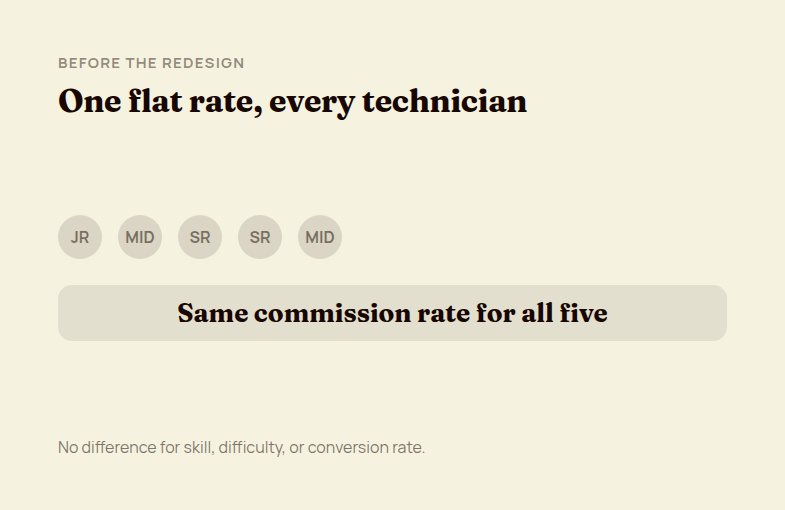
The company's original pay structure was simple almost to a fault: every technician, junior or senior, install specialist or service generalist, worked under the same hourly-plus-commission formula. On paper, simple sounds like a virtue. In practice, it meant there was no built-in mechanism to reward the things that actually separate a great technician from an average one: a higher conversion rate on estimates, a better average ticket, fewer callbacks. A technician who consistently upsold maintenance plans and closed bigger jobs earned essentially the same commission structure as one who did the bare minimum to get by, which is a quiet but real drag on the performance of your best people.
There was a second, more technical problem underneath the pay structure itself. Housecall Pro's API doesn't expose the level of line-item detail that a clean commission calculation really needs. Pass-through costs like permits, subcontractor fees, and materials don't come through cleanly, and neither does the connection between a customer's Google review and the specific technician who earned it. In practice, that meant somewhere between five and ten percent of jobs each pay period needed a human being to manually reconcile the numbers in a spreadsheet before anyone could be paid accurately. It's the kind of quiet, ongoing tax on the office team's time that never shows up on a P&L line item but eats a real afternoon every two weeks.
Put together, the company was dealing with a pay structure that didn't differentiate for skill and a data pipeline that couldn't fully automate itself even if the pay structure had been more sophisticated. Fixing one without the other wasn't going to be enough.
It's worth naming the retention risk hiding inside a flat plan, because it's rarely obvious until a technician is already halfway out the door. Your best people know they're your best people. They can feel the difference between the jobs they close and the jobs an average tech closes, even if the paycheck doesn't reflect it. When pay doesn't track that difference, the message a strong technician eventually receives, whether the company intends to send it or not, is that there's no financial upside to being excellent here. Some of them stay anyway out of loyalty or convenience. Plenty of them start taking calls from a competitor who's willing to differentiate.
Field service in particular tends to underestimate this risk because the work itself is often satisfying enough to mask the pay problem for a while. A tech who genuinely likes solving hard problems will tolerate flat pay longer than someone in a less hands-on trade. But "longer" isn't "forever," and the moment a competing shop offers a structure that visibly rewards skill, that patience runs out fast.
Building a ladder instead of a flat line
The redesign started with the most obvious lever: replacing the single flat commission rate with a multi-level structure, initially junior, service, and senior technician tiers, that used revenue-band thresholds similar to how income tax brackets work. Commission rates step up marginally as a technician's booked revenue crosses set thresholds, roughly $6,000, $14,000, and $22,000 in a period, rather than one flat percentage applying to every dollar regardless of how much a technician actually produced. Install work and service work were also separated into their own commission ceilings, 6% for install and 12% for service, reflecting the very different margin structures behind each type of job.
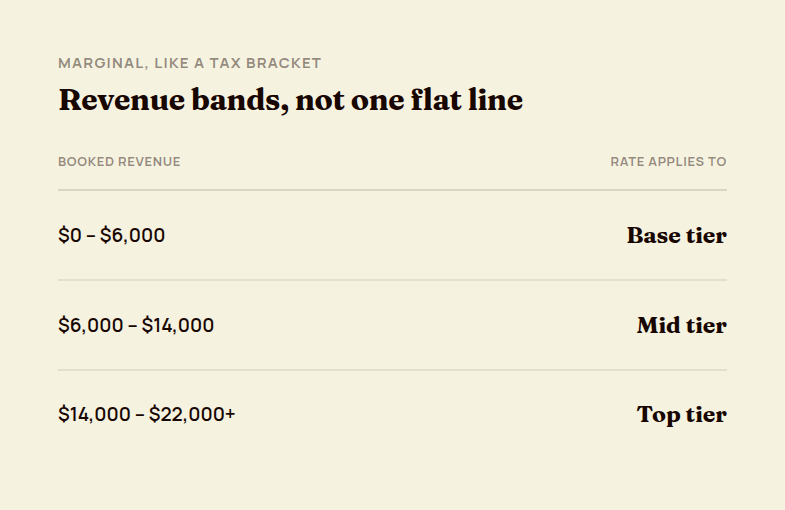
The tiered structure did more than reshuffle who earned what. It gave every technician, for the first time, a concrete answer to the raise question. Instead of "ask the owner and hope," the answer became "hit these numbers, and your rate moves with you." That's a genuinely different kind of motivation than a flat commission plan can offer, because it turns pay progression into something a technician can actively pursue rather than something that happens to them during an annual review, the same logic behind tiered redesigns that stop a single big sale from distorting an entire pay period.
The company didn't stop at revenue tiers, either. Performance gates got layered on top over time: a 75% or higher estimate-conversion-rate threshold and an average-ticket target, so the tiers rewarded genuine sales performance and not just being scheduled for a lot of high-ticket calls by luck of the draw. Splitting install and service into separate ceilings addressed a subtler issue too: without that split, a technician who happened to land a run of high-dollar installs could end up earning a disproportionate commission relative to the actual margin on that work, since install jobs typically carry thinner margins than service calls. Two different rates for two different kinds of work meant the incentive stayed lined up with what the job actually contributed to the business, not just its sticker price.
The plan is still evolving; the most recent redesign expanded the original three tiers into a more granular junior, service, and senior structure, and the team is building a feature to automatically match Google reviews to the technician who earned them, aiming to cut down the roughly 30% of reviews that currently require manual attribution. That review-matching piece matters more than it might sound like on the surface. A tiered plan that rewards customer satisfaction alongside revenue only works if the satisfaction data is actually attributed correctly, and right now that attribution is a manual, error-prone step for a third of all reviews coming in. Automating it isn't a nice-to-have; it's what makes the reputation side of the tiers trustworthy enough to actually tie pay to.
Choosing between two real numbers, not two guesses
One detail from the plan's development is worth calling out specifically, because it captures something a lot of owners get wrong about incentive design: the decision between one commission structure and another doesn't have to be a gut call. When the team was weighing where to set the middle tier's threshold, the choice came down to two concrete figures pulled from actual technician production data, not a round number that sounded reasonable. That's the difference between a plan built on a hunch and a plan built on math you can defend to a technician who asks why the line falls where it does, the same discipline behind choosing between two specific commission numbers instead of splitting the difference.
Profit sharing
made simple.
Give your team a stake in the company’s success. ShareWillow helps you create and manage profit-sharing programs that motivate employees and drive business results.
A softer outcome, and an honest one
Here's where this story earns its place as a slightly different kind of case study. There's no single dramatic percentage or dollar figure to point to as the outcome, and that's worth saying plainly rather than dressing it up. What the data showed, aggregated across several months of the new plan running against the old one, was a net gain overall, with a few isolated dips in specific pay periods tied to cost deductions that hadn't been fully accounted for yet. Leadership's own read on it, in a later review, was that the new structure had been net positive for the business and for technician clarity around career advancement.
What tells you more than the topline number is what the company chose to do next: seven months after the original tiered plan launched, they came back and made it more granular rather than reverting to something simpler. That's not the behavior of a team that got burned by added complexity. It's the behavior of a team that saw enough value in differentiating pay by skill level that they wanted more precision, not less.
That pattern shows up often enough with tiered plans that it's worth naming directly: the first version rarely stays the final version, and that's a feature of doing this well, not a sign the original design was wrong. A three-tier structure is a reasonable starting point when you don't yet have months of data showing exactly where your technicians cluster in skill and production. Once you do have that data, as this company did after running the plan for months, the natural next step is almost always to add resolution, not remove it. Going from three tiers to a more granular junior, service, and senior structure isn't scope creep. It's the plan catching up to information the company didn't have on day one.
There's a broader point here for any owner nervous about adding tiers because it sounds like more complexity to manage. The complexity doesn't disappear if you stick with a flat rate; it just moves somewhere less visible. Instead of complexity in the pay formula, you get complexity in the retention conversations you'll eventually have with your best people, the ones who figure out, sooner or later, that there's no financial reason to keep being your best people. A few extra revenue bands in a spreadsheet is a much easier problem to manage than that one.
For any plumbing or field service owner running a flat commission plan today, the real question this story raises isn't "will a tiered plan make more money overnight." Sometimes it will, sometimes the gains show up more slowly and unevenly than a case study headline would suggest. The real question is whether your best technicians currently have an honest, specific answer to how they get paid more, or whether the honest answer is still "ask and see what happens." One of those answers builds a career path. The other builds a reason to eventually look elsewhere.
If you're weighing whether a flat plan is quietly capping your best people, ShareWillow's plan design tools can model a tiered structure against your own technicians' real production data before you change a single paycheck.
Related reading
Conclusion
A flat commission rate is easy to run and quietly expensive to keep, because your best technicians are always doing the math on whether staying is worth it.
Create incentives
that
drive results
You shouldn't need complex equity plans to align your team. ShareWillow makes it simple to create transparent profit-sharing programs that motivate employees and grow your business.

Incentive plans to help
small businesses thrive.
.png)
"I was able to leverage the knowledge of the ShareWillow team to learn how other companies were designing their bonus plans. The template was extremely helpful."

Brian Tustin
Owner, First Rate Movers