A Southwest Florida plumbing and pool-service company had just lost a top technician and couldn't explain why labor cost had crept to 27% of revenue. Here's the three-tier pay plan that fixed both problems.
A ten-person plumbing, leak-detection, and pool-service company in Southwest Florida spent years running technician pay the way a lot of shops do: mostly by feel. Techs earned a loose commission on top of an hourly rate, the split changed depending on who you asked, and every two weeks an office admin pulled a ServiceTitan report into a spreadsheet and did the math by hand. Nobody loved the process, but it worked well enough that nobody questioned it either.
Then the company's best technician quit.
He wasn't the loudest guy on the team or the one who booked the most calls. He was the one who quietly closed the hardest jobs, the leak detections that took three hours instead of one, the pool equipment swaps nobody else wanted to touch. When he left, the owner did the thing a lot of owners do only after it's too late: he went back and looked at what he'd actually been paying his top performers relative to everyone else. What he found didn't sit right. The pay structure rewarded volume, not difficulty or skill, which meant the tech who juggled the most annoying, most technical jobs on the board was, in some pay periods, taking home less than a tech who blitzed through easy maintenance calls.
That would have been enough on its own. But when the owner brought the numbers to his ShareWillow team for a routine check-in, a second problem surfaced that he hadn't been tracking at all: technician labor cost, as a percentage of revenue, had drifted up to roughly 27%.
The number nobody was watching
Twenty-seven percent doesn't sound dramatic until you translate it into dollars across a full year of payroll. For a shop this size, every point above a healthy target is real money leaking out of the business, and the owner had no idea it was happening because nobody was tracking labor cost as its own metric. Commission got paid, hours got logged, and the relationship between the two was never actually measured.

This is a more common blind spot than most owners want to admit. It's easy to track revenue. It's easy to track headcount. It's much harder to track the relationship between the two in real time, especially when payroll is being reconstructed from a PDF export every other Friday. By the time a number like 27% shows up on anyone's radar, it's usually because a good tech already walked, a bank balance came in lighter than expected, or an accountant flagged it in a year-end review. Nobody catches labor-cost creep while it's still a mild problem. It always arrives dressed as a fire.
There was a third issue tangled up in the first two, and it was arguably the most uncomfortable one. The company's office and customer service team, the people answering phones and booking jobs, had no incentive plan at all. Their performance was tracked informally by a manager who reported booking rates up the chain. Somewhere along the way, that manager had started quietly excusing leads that should have counted against the booking rate, which meant the number the owner was seeing on paper wasn't the number that was actually true. It's the kind of thing that happens in growing service businesses more often than anyone likes to say: a metric gets self-reported for long enough that it stops being a metric and starts being a story.
So the company was dealing with three separate, compounding problems that all traced back to the same root cause. Pay didn't reflect skill or difficulty, which put retention of top performers at risk. Labor cost had crept two full points above a healthy target with zero visibility into why. And the one team that could have caught the booking-rate problem early, the CSRs, had no stake in the outcome and no reason to flag it.
Redesigning pay around a target, not a habit
The fix started with a question that sounds simple and almost never gets asked out loud: what should labor cost actually be, as a percentage of revenue, for a shop like this? The plumbing and field service businesses ShareWillow works with tend to land in a healthy range around 25% once you account for a market rate hourly floor, commission, and the overtime that always shows up during storm season. That 25% wasn't a guess pulled from a benchmark deck; it was reverse-engineered from what the company could sustainably pay while still hitting its margin targets.
Once that target existed, the plan design flipped from "figure out commission, hope labor cost works out" to "protect a 25% labor cost, then figure out what commission structure gets us there." That's a meaningfully different exercise, and it's the one most flat-commission plans skip entirely.
Three tiers, one target
Rather than roll out a single new commission rate and hope it landed in the right place, the owner and his ShareWillow team modeled three separate plan structures side by side: a $15-an-hour floor with 12.5% commission, a $20 floor with 10% commission, and a $25 floor with 7.5% commission. All three were built to protect that same 25% labor-cost target; they just distributed pay differently between guaranteed hourly and performance-based commission.
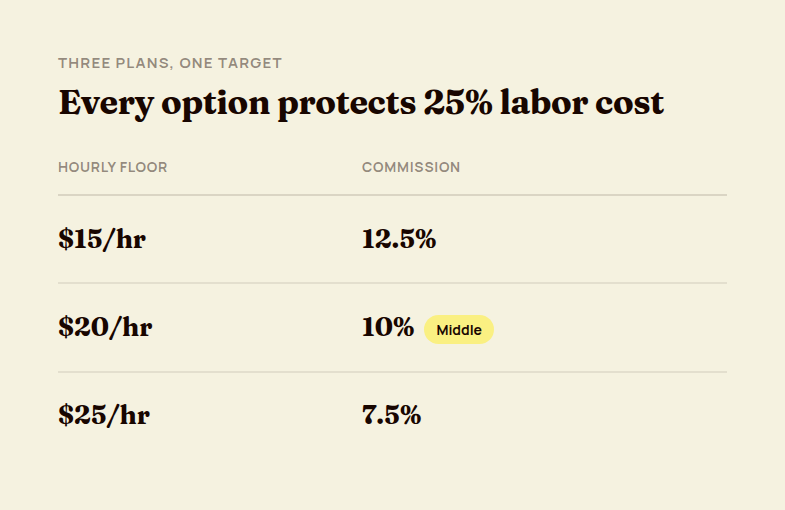
The reason for building three options instead of one comes down to something every owner running a mixed crew already knows intuitively: a flat plan never actually treats everyone fairly. A high-hours, steady-but-unspectacular technician does better under a higher hourly floor with lower commission. A low-hours technician who closes hard, high-ticket jobs does better under a lower floor with a bigger commission cut. Before making a decision, the team ran every technician's actual historical hours and production through all three models to see exactly what each person would have earned under each structure.
That simulation step mattered more than the plan design itself. It surfaced, by name, which technicians would come out ahead and which would come out behind under each option, before a single dollar changed hands. In one case, it flagged that the two technicians who worked the fewest hours but sold the most were the ones most exposed to a pay cut under the new structure, which meant they were also the ones most likely to walk if the transition was handled clumsily. Building the plan doesn't stop at picking a formula; the harder part is being honest, ahead of time, about who wins and who loses.
On top of the base hourly-plus-commission structure, the team layered a biweekly sales bonus with its own tiers: 1% on revenue between $10,000 and $12,000 in a pay period, 3% between $12,000 and $14,000, and 4% above $14,000. It's the same logic behind tying bonuses to production instead of a flat percentage: the tiers reward the technicians who push into the next bracket rather than paying everyone the same rate regardless of how hard they worked that pay period. A 5% weekend-work premium stacked on top, since weekend calls are historically the hardest to staff and the easiest to under-compensate.
Giving the office a stake in the truth
The last piece addressed the problem that had been hiding in plain sight: the office and CSR team. For the first time, the company built a formal incentive layer for the people booking the jobs, not just the people running them. It included a tiered booking-rate bonus starting at 80%, a cancellation-rate cap targeting under 5%, and a team-wide weekly revenue goal tied to booked calls.
This did two things at once. It gave the CSR team a real reason to care about booking quality instead of just call volume, and it replaced a manager's self-reported, occasionally massaged number with a formula anyone could check against the actual data in the system. Once booking rate and cancellation rate were tied to real pay, the incentive to quietly excuse a bad lead disappeared, because there was finally a dollar amount attached to reporting it honestly. It's a pattern worth remembering for any owner who has ever had a nagging feeling that a metric on a dashboard doesn't quite match what's happening on the ground: the fastest way to fix a fudged number is rarely more oversight, it's tying that number to something the person reporting it actually cares about.
Profit sharing
made simple.
Give your team a stake in the company’s success. ShareWillow helps you create and manage profit-sharing programs that motivate employees and drive business results.
Telling technicians they're getting a pay cut, honestly
Here's the part most owners dread and most articles about incentive design skip entirely: on average, the new plan meant a roughly two-percentage-point reduction in what technicians were earning as a share of revenue, because the old structure had been quietly overpaying relative to the company's real margin. That's not a comfortable conversation to walk into.
The owner didn't try to spin it. In the plan review, his ShareWillow team laid it out plainly: the new structure was built to protect a 25% labor cost, the shop had been running at 27%, and that meant some technicians would see a modest dip in take-home pay. The owner's response was straightforward too, something close to, "so you're saying it's about a two percent drop for them overall." No hedging, no softened language. Just a direct acknowledgment of the tradeoff, which is exactly the kind of conversation that keeps a team's trust intact even when the news isn't great. Technicians can smell a plan that's designed to quietly squeeze them. They're far more forgiving of a plan that's transparent about protecting the business, especially when the tiers give the top performers a real path to earn it back through the bonus brackets.
And that path mattered. The owner pushed to raise the top sales-bonus threshold specifically so his best closers had more room to earn above the base structure, reasoning that an extra $1,000 per pay period across 26 pay periods works out to $26,000 a year in incremental sales the plan would be pulling out of the team. That's the kind of math that turns a margin-protection conversation into a growth conversation, which is a much easier room to be in.
What actually changed
Seven months later, the plan wasn't a one-time fix; it was a living structure the company kept tuning at regular check-ins. But the core outcome held: labor cost is modeled and tracked against a real 25% target instead of drifting unmonitored, the pay structure now differentiates for skill and job difficulty instead of rewarding volume alone, and the office team has its own accountability layer built on numbers pulled straight from the system instead of a manager's summary.
None of this required firing anyone, slashing pay across the board, or bringing in an outside consultant to overhaul the org chart. It required building a plan around an actual target, running the numbers before making promises, and having a plain conversation about the tradeoffs instead of burying them in fine print. If there's a version of this story that applies outside plumbing and pool service, it's that: most incentive plans aren't broken because owners are careless. They're broken because nobody ever wrote down what "good" looks like as a number, so there was nothing to build the plan around in the first place.
If your own technician pay has drifted the same way, ad hoc raises here, a commission tweak there, until nobody can say with confidence what it's actually costing you as a share of revenue, that's usually the first thing worth fixing. You can read more about how a departed top performer forced a similar rebuild at another field service company, or see how ShareWillow's plan-modeling tools let you run this same before-you-commit simulation on your own crew before changing a single paycheck.
Related reading
Conclusion
The lesson isn't that this company got the numbers right on the first try. It's that they could finally see the numbers at all.
Create incentives
that
drive results
You shouldn't need complex equity plans to align your team. ShareWillow makes it simple to create transparent profit-sharing programs that motivate employees and grow your business.

Incentive plans to help
small businesses thrive.
.png)
"I was able to leverage the knowledge of the ShareWillow team to learn how other companies were designing their bonus plans. The template was extremely helpful."

Brian Tustin
Owner, First Rate Movers