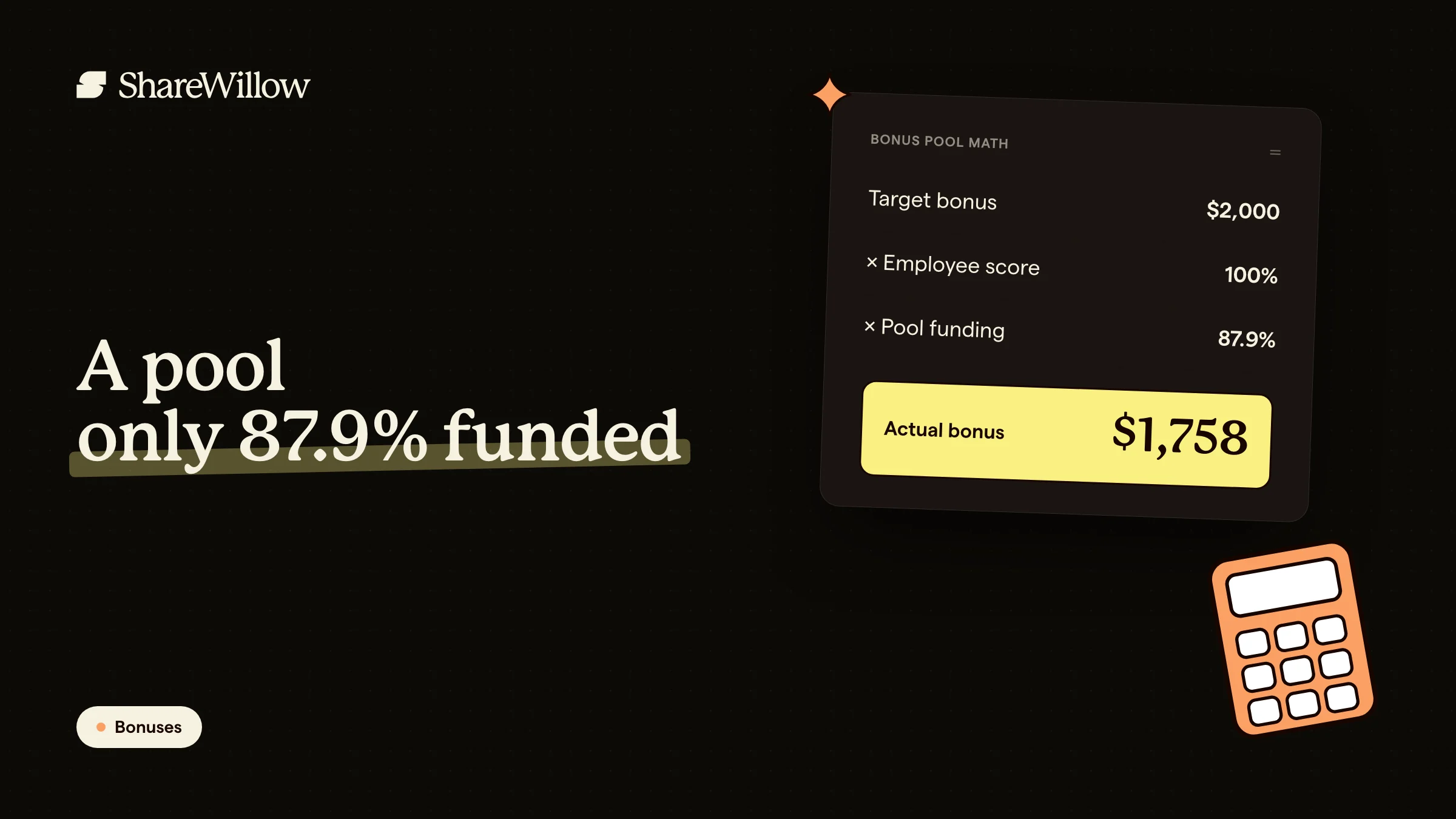
Employee bonus pool calculation: a healthcare company found bonuses showing 100% on an 87.9% funded pool and fixed it with one multiplication.
An employee bonus pool calculation sounds like simple arithmetic until the pool is not fully funded. One healthcare company runs an annual bonus pool that fills month by month from profit. When the pool reached 87.9% of its target, about $91,000, the spreadsheet column labeled calculated bonus still showed every employee at 100% of their maximum. Nobody would have been paid wrong that day, but the number staff were about to see was wrong, and the company caught it before the invitations went out.
The company has salaried staff, hourly employees, and a group of practitioners who are paid under a separate plan. For years, the finance lead built the bonus calculations in spreadsheets and kept the logic in their head. This fall, the plan moved into software that reads those same spreadsheets four times a day, with a launch date set for the first week of November. A launch is exactly when a hidden assumption turns into a visible mistake.
The Problem: A Bonus Column That Ignored the Pool
The plan works like many annual pools. Each employee has a maximum bonus based on salary and a performance rating on a one-to-five scale. The pool is funded gradually from company profit, and the funding percentage tells you how much of the target has actually been collected. If the pool is 87.9% funded, nobody should expect more than 87.9% of the maximum.
In the first setup, the calculated bonus pulled each person's maximum opportunity and stopped there. It never applied the funding percentage. Every row read 100%, while the pool itself clearly showed less. The error was easy to miss because each number looked reasonable on its own. It only became obvious when the finance lead put the pool status and the bonus column side by side.
This is a familiar pattern. When two figures that should agree are calculated in different places, they drift apart without warning. A garage door company hit the same kind of gap when its report and its payroll disagreed, as we described in a commission reconciliation that traced a 16-versus-12 job gap to one pay-week offset.
Employee Bonus Pool Calculation: Funded Percent Times Maximum Bonus
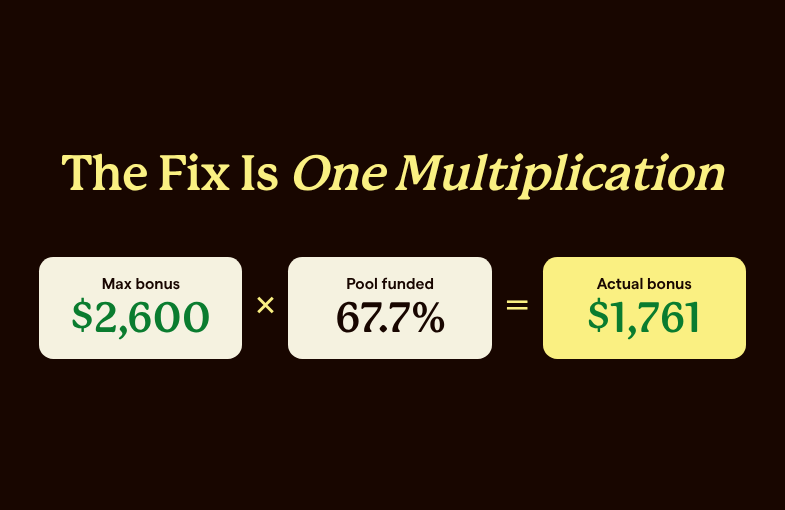
The fix is a single multiplication. The calculated bonus should equal the employee's maximum bonus times the pool's funded percentage. Anything else either overpromises when the pool is short or hides how much is actually in the pot.
The finance lead checked the idea against an older period. Backing out the June and July funding, the pool had been 67.7% funded. An employee with a $2,600 maximum bonus should therefore have been looking at about $1,761, not $2,600. The company's own Excel model already produced that reduced figure, which is how the team knew the formula was right and the platform setup was wrong.
One more rule keeps the math honest. When the pool ends the year above target, the extra money is not automatically added to bonuses. In this case, a surplus of $11,661 stayed out of the individual calculations. The funding percentage matters only when the pool falls short, and the plan caps each person at their maximum. If you are building your own version, the basics of how to calculate bonus pay will help you decide whether surplus should roll over, be shared, or be left alone.
Proving the Formula Against a Second Spreadsheet
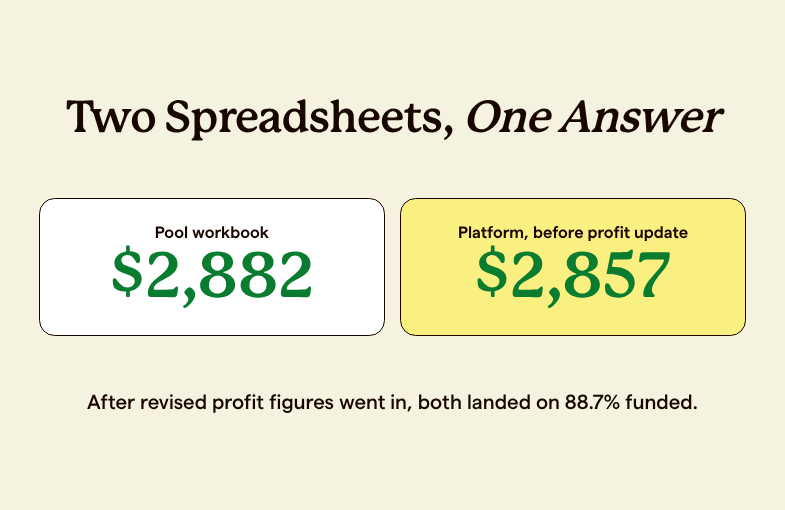
After the formula was corrected, the company did not simply trust it. The finance lead compared the platform's figure for a test employee with their own workbook. The platform showed $2,856.75. The workbook showed roughly $2,882, a difference of less than 1%.
The gap had an ordinary explanation. The workbook had been updated with revised profit figures from the accounting system, and the platform had not yet received them. Once the numbers were refreshed, the pool landed at 88.7% funded in both places and the two results matched. A difference you can explain is a good result. A difference you cannot explain is the one to chase.
The habit is worth copying. Before any bonus plan goes live, pick two or three employees, calculate their bonuses by hand, and compare the result with what your system shows. It takes an hour and it protects trust, which is the real asset in any bonus plan.
Eligibility Without a Cliff
The original plan made new employees wait two years before they could share in the pool. The finance lead dropped that rule for non-practitioner staff and replaced it with proration. A newer employee earns a share based on time worked. In one example, the prorated share came to about 64.1% of a full bonus.
Proration fits employees whose status changes during the year. Someone who moved from part-time to full-time about three weeks before the calculation should be eligible from the full-time start date, with the amount prorated from there. A waiting period feels clean on paper, but it produces cliff effects: someone who started one week too late gets nothing, and the person next to them gets everything. Proration is easier to explain and easier to defend.
When a Raise Lands Mid-Year
Raises create a quiet problem for any salary-based bonus. An employee earning about $39,000 a year had received a $2-per-hour raise roughly a month before the calculation. If the bonus uses the old salary all year, the employee is underpaid. If it uses the new salary all year, the company overpays.
The answer is a weighted salary. Hourly pay is annualized at 2,080 hours, the plan records the raise effective date, and the system blends the old and new rates across the months each one applied. That requires two extra fields in the data, a raise date and an updated rate, and a formula that uses them. It is a small build that prevents a recurring argument every January.
Practitioners Get Their Own Plan
Practitioners are covered by a separate plan on a calendar-year cycle that starts January 1. It tracks three figures: annual collections, commission paid year to date, and cost of goods sold year to date. The finance lead enters them quarterly, and payouts are due 30 days after each quarter closes. The plan replaces an arrangement that had been managed in a Power BI report.
Targets are usually set at five times salary, with two practitioners set at three times salary and one practitioner excluded. Mid-quarter raises follow a clear rule: the current quarter's target stays where it is, and the higher target applies starting the next quarter. A target that moves while someone is working toward it feels unfair, so the company chose predictability over precision.
Separate plans for separate roles keep each formula short. If you are deciding how to layer them, our roundup of bonus structure examples shows how different companies divide pools by role, tenure, and performance.
Keeping the Data and the Privacy Clean
The plan's source data lives in linked Google Sheets, which refresh automatically four times a day. That means edits happen in the sheet, not in the platform's dataset view, and a manual sync button forces an immediate update when something changes. A formatting problem in one column briefly blocked the performance ratings from syncing, and it was corrected by hand and resynced. Small problems like that are normal during a launch. What matters is that someone is watching the numbers closely enough to see them.
Salary privacy was the one hard limit. The finance lead did not want an office administrator to become a platform user if that would expose salary data, and chose to manage employee details personally. Employees can be removed from the whole platform or from a single plan, so a person who is not eligible for the practitioner plan can stay out of it without being deleted. A platform built for access control, like the one on the ShareWillow product features page, makes that kind of separation a setting instead of a spreadsheet trick.
What to Take From This
Four lessons apply to any company running an annual pool. First, show the funding percentage next to every calculated bonus so a gap cannot hide. Second, multiply the maximum bonus by the funding percentage, and decide in advance what happens to a surplus. Third, prorate eligibility and weight salary for raises instead of using cliffs. Fourth, reconcile against a second calculation before launch, and explain every difference. For a similar approach to sharing a pool among a field team, see how an electrical company plans to share 5% of gross profit on project work.
Frequently Asked Questions
How do you calculate an employee bonus from a bonus pool?
Start with each employee's maximum bonus, based on salary and rating. Multiply it by the pool's funded percentage. If the pool is 87.9% funded, each person receives 87.9% of their maximum, up to the cap.
What happens if the bonus pool is not fully funded?
Every bonus shrinks by the same percentage. That keeps the plan fair and keeps the total payout inside what the company can afford. Show the funding percentage in the plan so employees understand why the number moved.
Should a surplus in the bonus pool be paid out?
That is a plan design choice. Some companies cap bonuses at the maximum and keep the surplus, others roll it into next year, and others share it. Write the rule down before the year starts so nobody has to guess.
Related reading
- How to Calculate Bonus Pay: A Step-by-Step Guide to Fair and Motivating Compensation
- Team Bonus Pool for Technicians: How an Electrical Company Plans to Share 5% of Gross Profit on Project Work and Keep Flat-Rate Pay Individual
- Technician Commission Reconciliation: How a Garage Door Company Traced a 16-vs-12 Job Gap to a One-Day Pay Week Offset
- 9 Bonus Structure Examples Employees and Employers Love
- 7 Profit Sharing Plan Examples for Your Small Business
Conclusion
Multiply each maximum bonus by the pool's funded percentage, then check the result against a second calculation before anyone is paid.
See what performance pay would pay your techs.
On a free call, we'll show you what your techs would earn for the great work they already do.
Book a free call
Ryan Shank is the founder of ShareWillow. Before ShareWillow, he spent 15 years building software for the trades and founded PhoneWagon, which CallRail acquired.