HVAC installer pay built on 6% of each install invoice, with a $480 floor and a $900 cap, so crews earn more on bigger jobs without overpaying.
Getting HVAC installer pay right is harder than paying service technicians, and most owners feel it without being able to say why. Pay installers hourly and nothing rewards a clean, fast changeout. Pay them a percentage of the job and the paycheck swings with the price of the equipment, which they did not choose and did not sell.
The owner of a residential HVAC company we work with was stuck on exactly that. His installers were hourly. He wanted to move them to performance pay, but every version of a percentage plan he looked at paid too much on the biggest systems. On a call with our team he worked out a fix in about ten minutes: 6% of each install invoice, never less than $480, never more than $900.
This post covers how he got to those three numbers, what they do on real ticket sizes, and how to set your own. The plan was still being back-tested against past weeks when we last spoke, so this is a design story with the math shown, not a results story.
Why Hourly Pay and a Straight Percentage Both Fall Short
The company runs on ServiceTitan and already had performance pay taking shape for its service technicians and its office team. Install was the holdout. In the owner's words, "we basically just pay the hourly rate."
The first draft of an install plan paid a percentage of the completed job, 6% to 7% depending on the equipment tier. He ran one job through it in his head and did not like the answer. At 7%, a $13,000 install pays the crew $900 to $1,000 to split. That is a strong day for two installers. On a larger system it only goes up from there.
His objection was simple, and it applies to nearly every replacement company:
"There's not that much difference in installing an $18,000 job than there is installing an $8,000 job."
His install tickets run from about $7,000 to $18,000. Most of that spread is equipment. He put the equipment cost at roughly $3,000 on an $8,000 job and roughly $6,000 on an $18,000 job. The crew is doing close to the same day of work either way: pull the old system, set the new one, braze, wire, charge, start up, clean up. A straight percentage pays them for the price tag.
A percentage also ignores things an owner has to carry, such as overhead, partial refunds, and callbacks. "Percentages, sometimes it's gonna pay too much money," he said.
So he considered the opposite: a flat dollar amount per install. That solves the overpay problem and creates a new one. Some installs really are more work. A job with added accessories takes longer, and he wanted the crew to earn more for it. A flat fee treats every job the same. It can also drift out of date without anyone noticing, which is what happened to an HVAC flat rate pay plan that slipped below hourly at another company we wrote about.
He wanted the middle: pay that rises with the job, inside limits he could defend.
The HVAC Installer Pay Formula: 6% With a Floor and a Cap
The plan he settled on has three parts, and each number has a reason behind it.
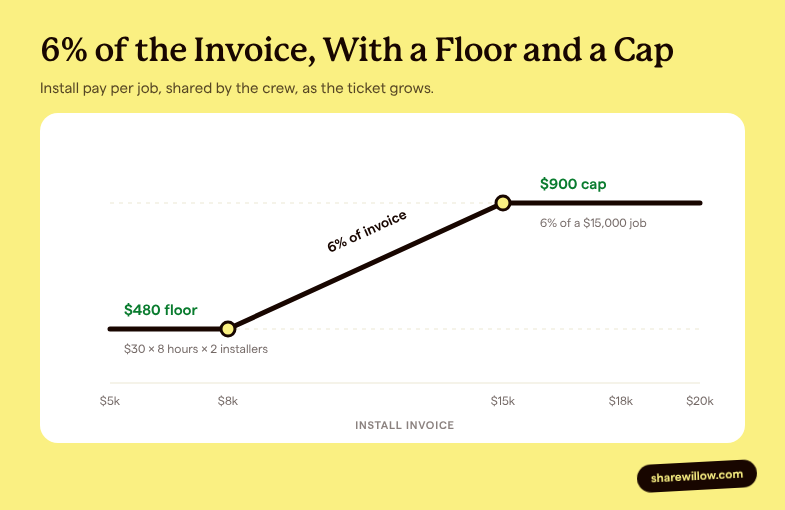
The rate: 6% of the install invoice. One rate, at the low end of the 6% to 7% he started with. It keeps the link he cared about. Add accessories to the job and the invoice goes up, so the pay goes up.
The floor: $480 per install. He did not pull this from the air. It is a full day of work for a two-person crew at a fair wage: $30 an hour, times 8 hours, times 2 installers. The floor means the crew is paid for a full day on every install, even if they wrap up in five or six hours. That is a real reward for working efficiently, and it means the smallest jobs are never the ones nobody wants.
The cap: $900 per install. This one came from the ticket sizes. "$900 will be 6% of a $15,000 job," he said, and that became the ceiling. Above $15,000 the extra revenue is almost all equipment, so the pay stops climbing.
Put together, the 6% rate does the work on any invoice between $8,000 and $15,000. Below $8,000 the floor takes over. Above $15,000 the cap does. As he summed it up, the crew gets paid between $480 and $900 on every install.
Two more rules round it out. Pay is calculated on paid invoices, so the crew is not paid ahead of the customer. And like the rest of the company's technician pay, install performance pay is compared against hourly base pay each week, so the base is always protected.
What the Formula Pays on Real Ticket Sizes
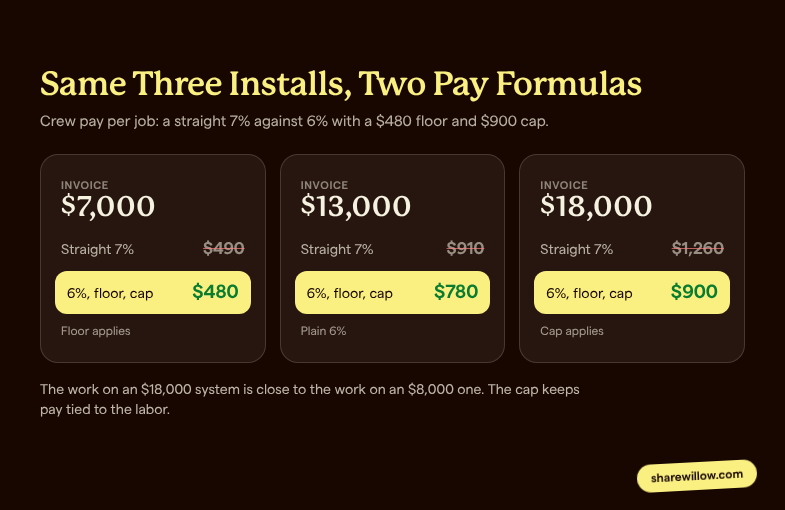
Here is the formula run on three invoices from across his range, next to the straight 7% he was weighing.
- A $7,000 install. 6% is $420, so the floor applies and the crew earns $480. A straight 7% would pay $490. Almost no difference.
- A $13,000 install. 6% is $780, inside the range, so the crew earns $780. A straight 7% would pay $910.
- An $18,000 install. 6% is $1,080, so the cap applies and the crew earns $900. A straight 7% would pay $1,260.
On the small job the two formulas are $10 apart. On the big one they are $360 apart, on a day when the crew did roughly the same work. That gap is the overpayment he was worried about, and the cap removes it without touching what the crew earns on an ordinary job.
Look at it from the installer's side too. The best day is nearly double the worst one: $900 against $480. There is still a clear reason to want the larger, more involved jobs and to do them well. And the worst day is a full day's pay at $30 an hour for each person, whatever the clock says. Most installers will take that trade.
The owner's side is just as clear. Install labor on performance pay can never cost more than $900 on a job, and as a share of the invoice it shrinks as the ticket grows past $15,000. On an $18,000 system, $900 is 5%.
The Rest of the Plan Around It
The install formula is one piece of a wider plan, and a few of the other pieces are worth borrowing.
- Equipment tiers stay separate. Economy, mid-range, and top-tier systems all pay 6% today, but they are tracked as separate lines. If one tier later deserves a different rate, it can change without rebuilding the plan.
- Reviews pay a small bonus. A five-star review earns $15, split evenly when two technicians were on the job, with a deduction for a one-star review.
- The leaderboard shows rank, not dollars. Technicians see where they stand on average ticket, recalls, and reviews, without seeing each other's pay. The owner's reason: "Sometimes they think they're doing better than they're actually doing or doing worse than they're actually doing."
- Pay runs weekly. A short cycle keeps the link between a job and the money it earned easy to see.
Capping install labor per job is a close cousin of setting a labor-cost target for the whole department. If you use subcontract crews alongside employees, the same thinking applies to both, as it did for an HVAC company that built one labor-cost target for employees and subcontractors.
Where the Plan Stands
Three days after that call, the 6%, $480, and $900 logic was built and running against the company's job data, with September through November being backfilled so the owner can see what each past install would have paid. He has said he may still adjust the percentages once he sees those weeks. That is the right order. The rule is simple enough to explain in one breath, and the back-test will show whether the floor or the cap is doing more of the work than he expects.
We do not have payout results to report yet. What we can say is that the company has replaced an open-ended percentage with a formula whose best and worst case are both known in advance: $480 to $900 per install.
How to Set Your Own Floor and Cap
You can copy the method without copying the numbers.
- Set the floor from a fair day's wage. Take the hourly rate you would be comfortable guaranteeing, multiply by a standard day, and multiply by your usual crew size. That is the least an install should pay.
- Pick a rate that beats the floor on a typical job. If your common install is $10,000 to $12,000 and your floor is $480, a 6% rate pays $600 to $720 on those jobs. The percentage should matter on most of your work.
- Set the cap where the extra revenue stops being labor. Find the ticket size where a bigger invoice mostly means pricier equipment. Multiply that by your rate. That is your ceiling.
- Decide how a crew splits it. Even shares, lead and helper shares, or time on the job. Write it down before the first payout.
- Back-test a few months of installs. Count how many jobs hit the floor, how many hit the cap, and how many land in between. If most jobs hit one limit, you have a flat fee in disguise and the numbers need to move.
For the wider picture, our guide to HVAC commission pay compares the common structures for selling and installing roles, and how to pay HVAC technicians covers the hourly, flat rate, and performance options side by side. If you want to run a floor and a cap against your own install history before changing anyone's paycheck, that is what ShareWillow does for HVAC companies.
FAQ: HVAC Installer Pay
How much commission should HVAC installers get per install?
There is no single standard. The company in this story pays the crew 6% of the install invoice, with a $480 minimum and a $900 maximum per job. Work backward from what a fair day's pay is for your crew and from the ticket size where more revenue no longer means more labor.
Should HVAC installers be paid hourly or per job?
Hourly pay is simple but gives no reward for finishing well and on time. Per-job pay rewards efficiency but can overpay on large systems or underpay on small ones. A percentage with a floor and a cap sits between the two: pay rises with the job, the crew is guaranteed a full day, and the owner knows the most a job can cost.
Why put a cap on installer commission?
Because install revenue grows faster than install labor. On high-end systems most of the added price is equipment, so an uncapped percentage pays the crew for the cost of the box. A cap set at a sensible ticket size keeps pay tied to the work the crew controls.
Related reading
- HVAC Flat Rate Pay Plan: How a Multi-State Field Service Company Fixed a Formula That Paid Techs Below Hourly
- How to Pay HVAC Subcontractors: How a Growing HVAC Company Built One Labor-Cost Target for W-2 Techs and 1099 Subs
- HVAC Commission Pay: How to Design a Plan That Drives Profit (Not Problems)
- Plumbing Commission Structure: How One Company Back-Tested an 18% Plan to Within $18 of Payroll
Conclusion
A percentage tells installers that bigger jobs pay more. A floor and a cap tell them, and you, exactly how much more. Set all three from your own job data and the plan explains itself.
See what performance pay would pay your techs.
On a free call, we'll show you what your techs would earn for the great work they already do.
Book a free call
Ryan Shank is the founder of ShareWillow. Before ShareWillow, he spent 15 years building software for the trades and founded PhoneWagon, which CallRail acquired.