A pest control technician commission plan with 1% to 3% weekly revenue tiers, $20 review bonuses, and up to $500 a quarter for a low callback rate.
A pest control technician commission plan has a problem that most trades share but pest control feels more sharply: the work is easy to do fast and hard to check. Pay on revenue alone and you will get more jobs finished each week. You may also get more return visits a month later, when the customer hears scratching in the wall again.
A pest control company in the Midwest that specializes in rodent exclusion, with an owner and four field technicians, went live with its first incentive plan in mid-November. Until then everyone was paid hourly and nothing else. The owner wanted two things at once: more installs completed each week, and fewer jobs the team had to go back to. The plan he built with us pays for both, on separate clocks.
Here is how the plan works, what the back-test showed, and what the technicians said when they saw it. The plan has only been live for a short time, so the pay figures below come from running it against earlier weeks, not from months of results.
The Problem: Hourly Pay Rewards Neither Speed Nor Care
Rodent exclusion is install work. A technician inspects the building, finds the entry points, and seals them. Good work is invisible. Missed work shows up weeks later as a retreat: a return visit, at the company's cost, to fix what was missed the first time.
On straight hourly pay, a technician earns the same whether the crew finishes four installs in a week or seven, and the same whether a job holds or needs a second trip. The owner had no complaint about his team. He simply had no way to share the upside of a strong week, and no shared reason for anyone to double-check a job before leaving.
He was also wary of the obvious fix. A revenue commission by itself tells the team to move faster. On the go-live call he told his technicians plainly what he wanted instead: "We wanna make sure that we don't have to go back to any of these jobs because our work was sloppy or we missed something."
The Pest Control Technician Commission Plan, Piece by Piece
The plan sits on top of hourly pay. Nobody's base changed. It has four parts.
1. A weekly tiered commission on completed work
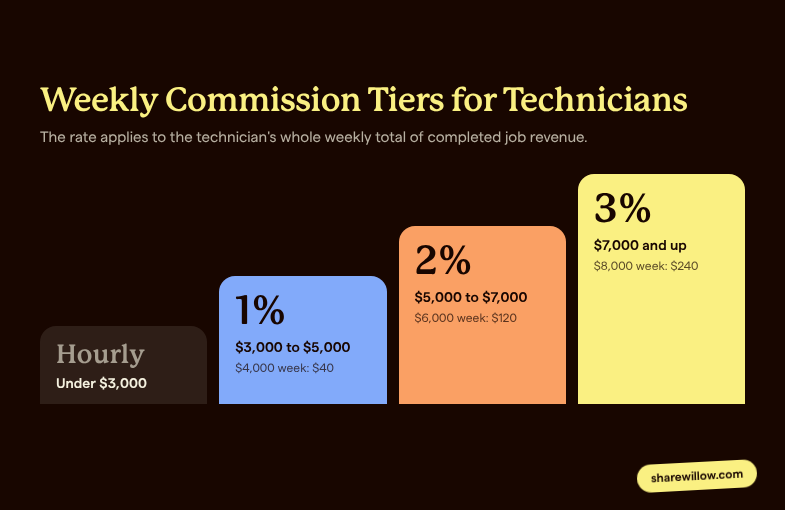
Each technician earns a percentage of the job revenue they complete in a week, and the percentage steps up as the week gets bigger:
- Under $3,000 for the week: hourly pay only
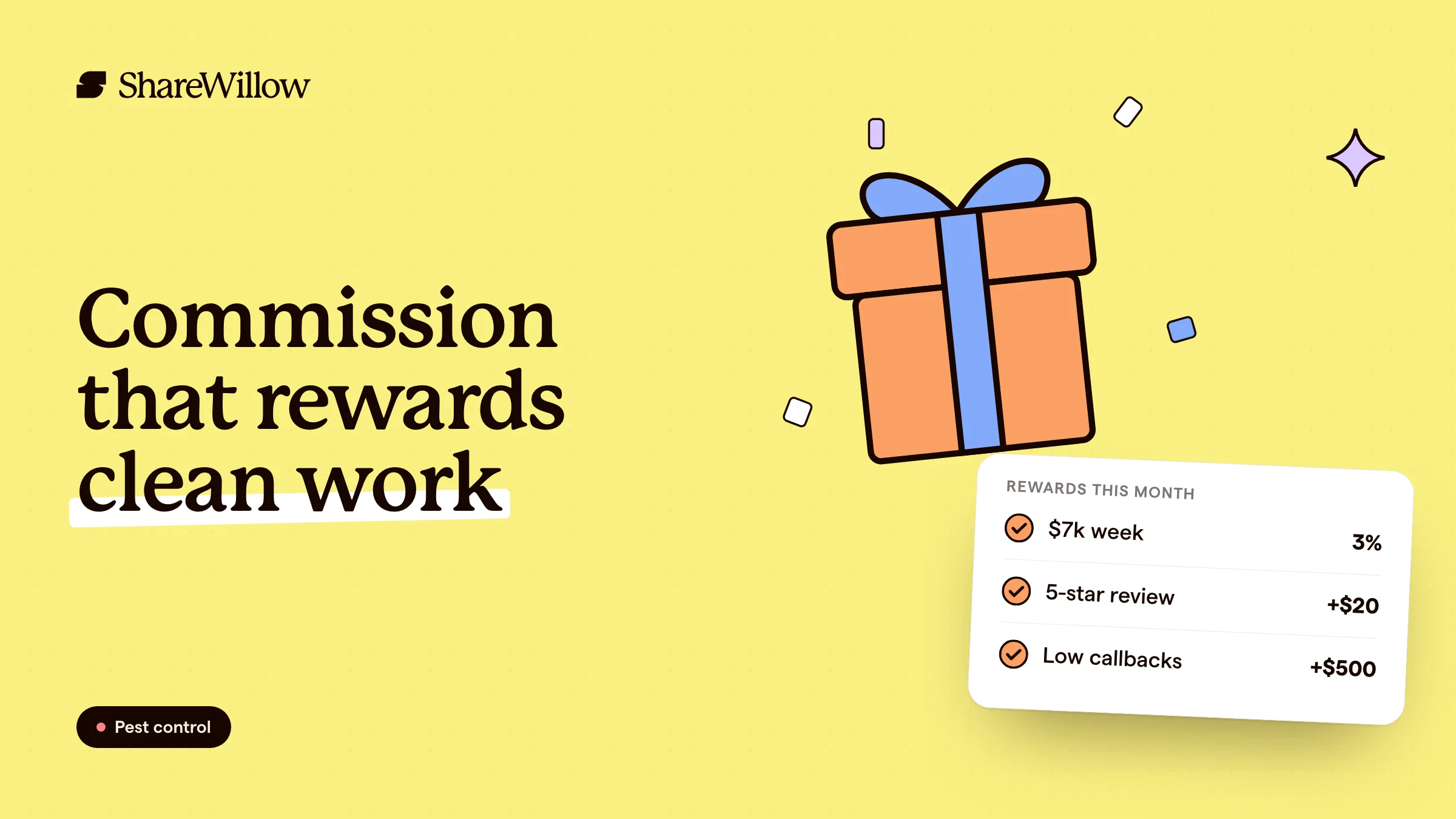
- $3,000 to $5,000: 1%
- $5,000 to $7,000: 2%
- $7,000 and up: 3%
The rate applies to the technician's whole weekly total, not only the dollars above the line. A $6,000 week pays 2% of $6,000, or $120. An $8,000 week pays 3% of $8,000, or $240. Crossing a tier is worth real money, which is the point: the last job on a Friday can move the whole week up a step.
When two technicians work a job together, the revenue is split evenly between them. A $300 job with two technicians counts as $150 toward each person's week. Revenue is taken from the job total in the company's field service software, Workiz.
The percentages are small on purpose. This is a first plan, layered on unchanged hourly wages, and the owner can afford it in any week it pays. If you are weighing step-up rates against a flat one, our guide to tiered bonus structures covers where to set the lines.
2. $20 for every five-star review
A technician named in a five-star review earns $20, paid weekly with the commission. It is a small, fast reward for the part of the job the customer actually sees. Review bonuses like this work the same way in any trade, and our post on HVAC spiffs has more examples of what to pay for and what to leave out.
3. A quarterly bonus for a low callback rate
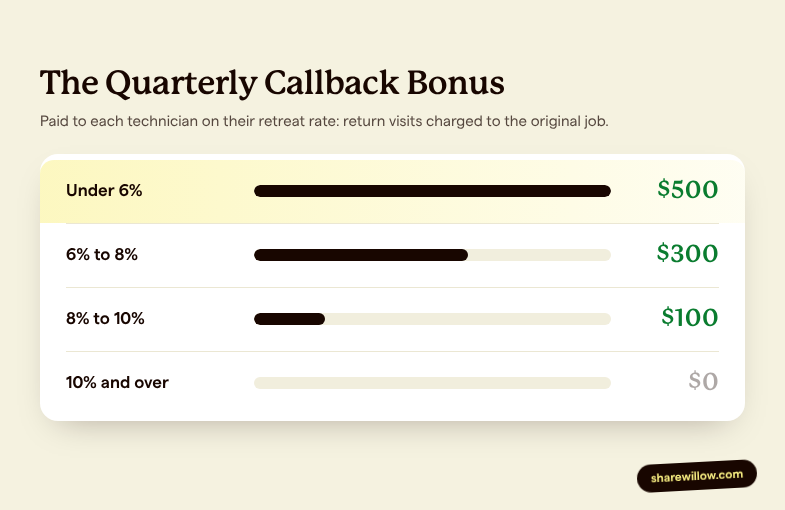
This is the piece that balances the commission. Every quarter, each technician's retreat rate is measured: the share of their jobs that needed a return visit. The lower the rate, the bigger the bonus.
- Under 6%: $500
- 6% to 8%: $300
- 8% to 10%: $100
- 10% and over: nothing
Two rules make it fair. A retreat is charged to the technicians who did the original job, not to whoever gets sent back. And visits that are not the technician's fault do not count, such as a return trip because a customer did not respond, or a warranty renewal.
The timing matters as much as the amount. Callbacks on exclusion work surface weeks after the job, so a weekly measure would miss them. A quarter is long enough for the truth to show up.
4. A commission for estimates that turn into jobs
A technician who completes the estimate on a job earns 10% of that job's revenue once the customer's initial deposit is paid. The lead technician, who does most of the estimating, has his own weekly rates on completed revenue: 2% once he reaches $3,000 and 5% above $5,000.
What the Back-Test Showed
Before the plan went live, it was run against September and October, weeks the team had already worked on hourly pay.
In the busier weeks, each of the two technicians on the weekly plan would have taken home roughly $100 to $150 on top of their hourly pay. In the three strongest weeks modeled, the two together would have earned $152, $206, and $311. In a slower October week the figure was closer to $50 to $100 each. The lead technician would have reached his 5% rate in his better weeks.
Those are not life-changing numbers, and they are not meant to be yet. They are large enough to notice on a weekly paycheck and small enough that the owner is not betting the margin on a first attempt. Add a clean quarter at $500 and a few reviews, and a careful, productive technician is looking at a meaningful raise that the company only pays when the work was there to fund it.
Testing against past weeks before launch is the step we push hardest. It is how a home services company tested commission against hourly pay and found its top technicians would earn up to 55% more.
The back-test also found a data gap
Checking one technician's week job by job, seven jobs added up to $2,129 across the technicians on them, and one completed job was missing. It had been finished in the field but was still sitting in the software as a lead, so it never counted as revenue. That is a five-second fix in the office, and it would have been a real argument on payday. An incentive plan pays on what the system says happened, so the system has to be right. Better to learn that in a test week.
How the Team Took It
The owner put three of his technicians on the go-live call, walked through each person's plan, and showed them their own back-tested weeks. Then he connected the two halves of the plan for them. "The goal is really to have us install as much as we can during the week to hit the bonuses," he said, and in the same breath asked the two technicians who often work together to check each other's work before leaving a job.
That request lands differently when both people are paid on the result. A missed entry point now costs both technicians on the original job part of a quarterly bonus. Peer review stops being a favor and becomes self-interest.
One technician summed it up better than we could:
"The system that we're doing right now is benefiting the company, us, and the customer. So everyone wins, basically."
The plan went live the week of November 16, paid weekly. The first callback bonus will be measured at the end of the quarter.
What to Borrow for Your Own Plan
- Pair every volume incentive with a quality one. If you pay on revenue, pay on callbacks too. Otherwise you are buying speed.
- Match the clock to the measure. Revenue is known every week, so pay it weekly. Callbacks take time to appear, so measure them quarterly.
- Set the first tier just above an ordinary week. The $3,000 starting line means a slow week pays hourly and a decent one pays something.
- Charge callbacks to the original crew. And write down what does not count, so nobody is penalized for a customer who missed an appointment.
- Start small and back-test. Rates of 1% to 3% on top of hourly are easy to raise later. They are much harder to lower.
- Show the team their own numbers. A back-tested week with a technician's name on it explains the plan faster than any policy document.
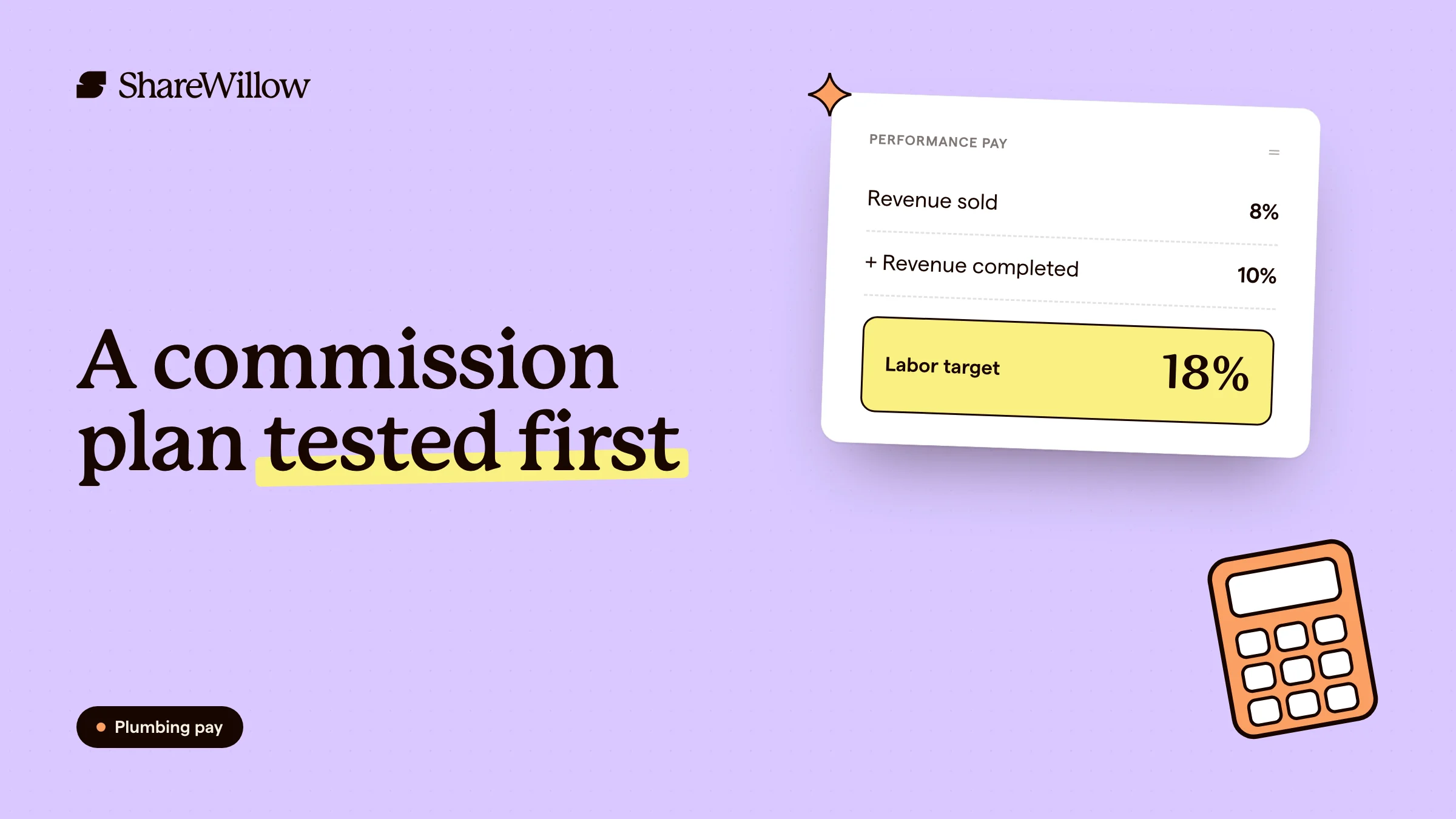
For a look at the same back-test approach on a larger commission, see how a plumbing company tested an 18% commission structure against real payroll. And if you want to model tiers and a callback bonus on your own job data, here is how ShareWillow works for pest control companies.
FAQ: Pest Control Technician Commission
How much commission do pest control technicians make?
It varies widely with the base wage and the type of work. The company in this story pays 1% to 3% of weekly completed revenue on top of hourly pay, plus 10% on jobs a technician estimated. Plans that replace part of the hourly wage usually pay a higher percentage. Start from what your margin can fund in a normal week.
Should pest control technicians be paid hourly or commission?
Many companies do both. Hourly pay gives technicians a stable base, and a commission on top rewards productive weeks. Keeping the base in place also makes a first incentive plan much easier to introduce, because no one's paycheck can go down.
How do I stop commission from causing callbacks?
Pay for quality in the same plan. Track each technician's callback or retreat rate, charge return visits to the people who did the original job, and pay a bonus for staying under a set rate. This company pays up to $500 a quarter for a retreat rate under 6%, and nothing at 10% or above.
Related reading
- Technician Pay Plans: How One Home Services Company's Techs Earned Up to 55% More on Commission Than Hourly
- Plumbing Commission Structure: How One Company Back-Tested an 18% Plan to Within $18 of Payroll
- How to Maximize Employee Performance with Tiered Bonus Structures
- How to Use HVAC SPIFFs to Boost Business Profit
Conclusion
Commission gets the week full. A callback bonus keeps the work clean. Put both in the plan from the first day and neither one has to be policed.
See what performance pay would pay your techs.
On a free call, we'll show you what your techs would earn for the great work they already do.
Book a free call
Ryan Shank is the founder of ShareWillow. Before ShareWillow, he spent 15 years building software for the trades and founded PhoneWagon, which CallRail acquired.