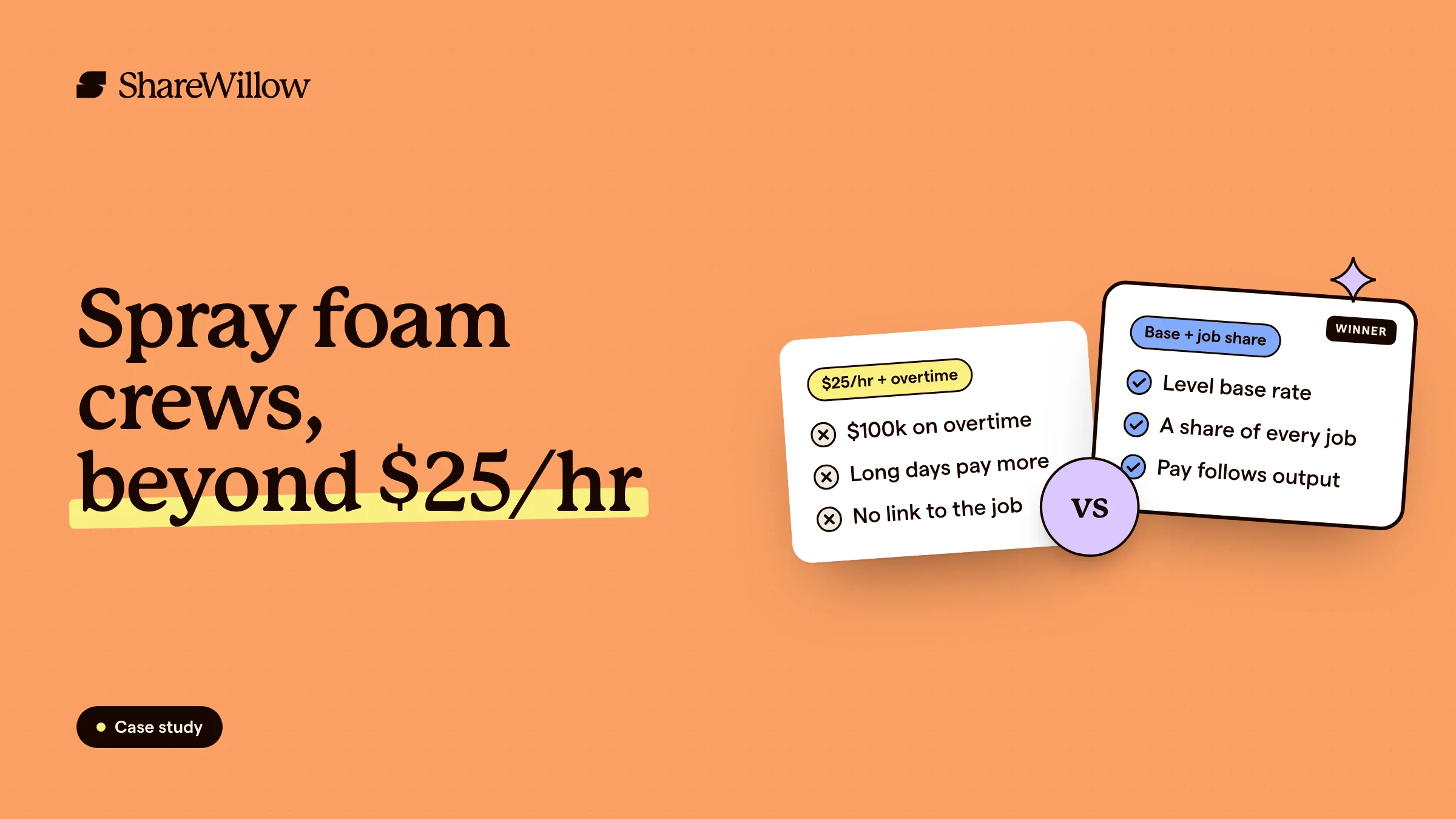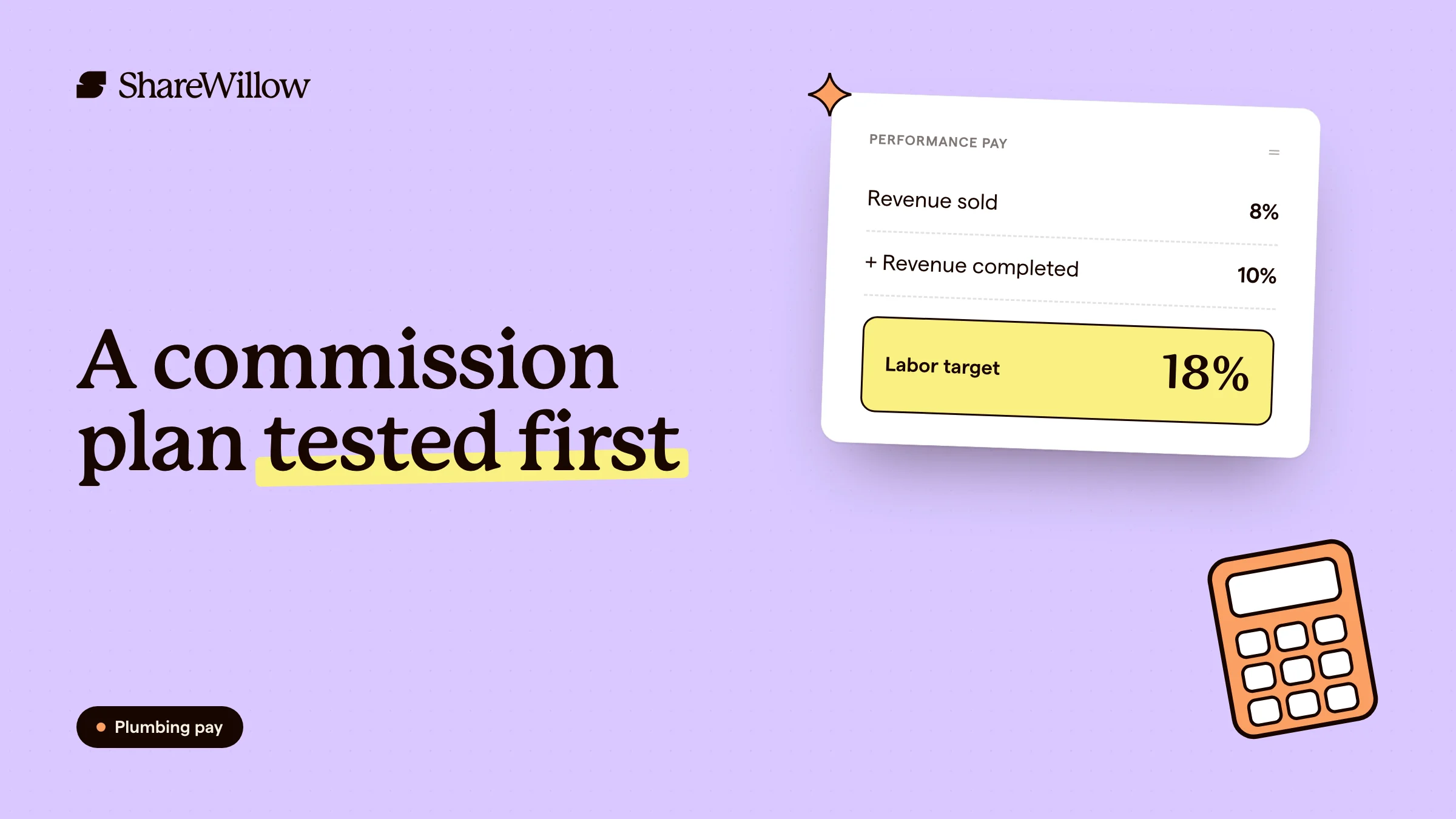
A plumbing commission structure built on 8% sold plus 10% completed, back-tested to within $18 of a real payroll week before launch. Here is the math.
Most owners pick a plumbing commission structure the same way: they borrow a percentage from a friend in the trade, add a threshold that feels safe, and find out a few months later what it really costs. By then the plan is in everyone's head and hard to change.
A plumbing company in Northern California, with two selling technicians and an install crew, did it in the other order. The owner chose the share of revenue he was willing to pay his technicians, built the commission formula backward from that number, and ran it against weeks he had already paid before saying a word to the team. In an ordinary week, the new plan came out $18 away from the paycheck he had actually written.
This post walks through the old plan, the new formula, and the back-test, with the real numbers from our calls with the owner. One thing up front: the plan had not launched when we last spoke. What follows is a back-test on real payroll weeks, and we say so wherever it matters.
The Old Plan: Hourly Pay With a Bonus Stacked on Top
The company runs on ServiceTitan. Everyone in the field was paid hourly. The two selling technicians, who diagnose, quote, and often do the work themselves, also earned a weekly bonus: 10% of every dollar they sold above $10,000. Installers earned hourly pay plus $30 for each lead they set for a selling technician and 3% of the sale when one of those leads closed.
Nothing about that is unusual. The trouble showed up in three places.
Labor cost only moved one way. Hourly pay was the floor and the bonus sat on top of it. A strong week cost full hourly plus a bonus. A weak week still cost full hourly. As the owner put it, it is hard not to be on commission in some form, because hourly pay gets expensive fast when people are not producing what they should.
The total was invisible. Bonuses were figured outside of payroll, so the payroll report showed wages and nothing else. To know what a technician really cost in a given week, someone had to add two numbers from two places.
Big weeks produced surprising checks. In one week in November, a selling technician sold about $27,000, helped along by a single $20,000 job. By the owner's recollection he wrote a bonus check of roughly $4,000 for that week, on top of the technician's hourly pay. Nobody did anything wrong. The plan simply had no link to what the company could afford to pay for that revenue.
His goal was specific. He wanted a structure that rewards a technician when it should, without over-rewarding to the point that it hurts the margin.
The New Plumbing Commission Structure: 8% Sold Plus 10% Completed
The redesign started with a target instead of a rate. For service work, the company settled on paying technicians about 18% of the revenue they bring in, inside a typical range of 16% to 20%. Then it split that 18% between the two things a selling technician does:
- 8% of revenue sold, credited to the one technician who sold the job.
- 10% of revenue completed, split among the technicians on the job by the time each one spent on it.
A technician who sells a job and completes it alone earns the full 18%. A technician who sells a repipe that the install crew does next week earns the 8%, and the completion side goes to the people who did the work. There is no $10,000 threshold anymore, and no cliff to chase on a Friday afternoon.
Then comes the rule that changes the economics. Each week, the technician is paid the greater of base pay or performance pay. Not both.
Base pay is regular hours, overtime, and idle time. Performance pay is the 8% and 10% formula. If performance pay is higher, the technician gets that. If it is lower, they get their hourly pay exactly as before. When the owner first saw it he stopped to check that he had understood: you get paid one or the other, whichever is greater? Once that was confirmed, his next words were, "That's what protects the margin."
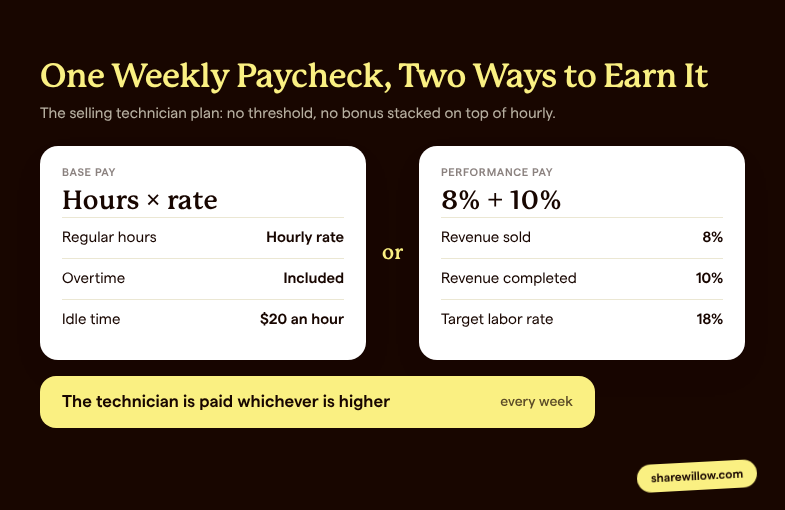
Nobody takes a pay cut in a slow week, and the company stops paying hourly plus a bonus in a strong one. We have seen the same guarantee make a commission trial far less frightening for the team in a home services company that tested commission against hourly pay before committing to it.
The small rules that keep the plan honest
A commission plan lives or dies on its edge cases. This company wrote them down before launch:
- Revenue counts when it is collected. A job is credited only when the invoice is paid and the balance is zero. Technicians are not paid on money the company has not received.
- Idle time has its own rate. Time between jobs is paid at $20 an hour and counted in base pay, so an hour in the yard does not earn the same as an hour on a job.
- Overtime includes incentive pay. In California, incentive pay has to be folded into the overtime rate. The plan applies that true-up automatically each week.
- Recalls are a qualifier. Callbacks count against qualifying for performance pay, which takes away the reason to rush a job.
Pay runs weekly, and the owner reviews the numbers before they are final.
A separate rate for installers
Installers do not control what gets sold, so they got their own formula: 12% of install revenue, credited by time on the job, compared against hourly pay with the same greater-of rule. Install work usually carries a lower labor percentage than service, often 10% to 14%, because more of the ticket is material. Our guide to HVAC commission pay covers why selling roles and installing roles rarely belong on the same rate, and the reasoning carries straight over to plumbing.
The Back-Test: Running the Plan Against Weeks Already Paid
Here is the step most owners skip. Before rolling anything out, the company ran the new formula against real weeks and compared the result to what had actually been paid.
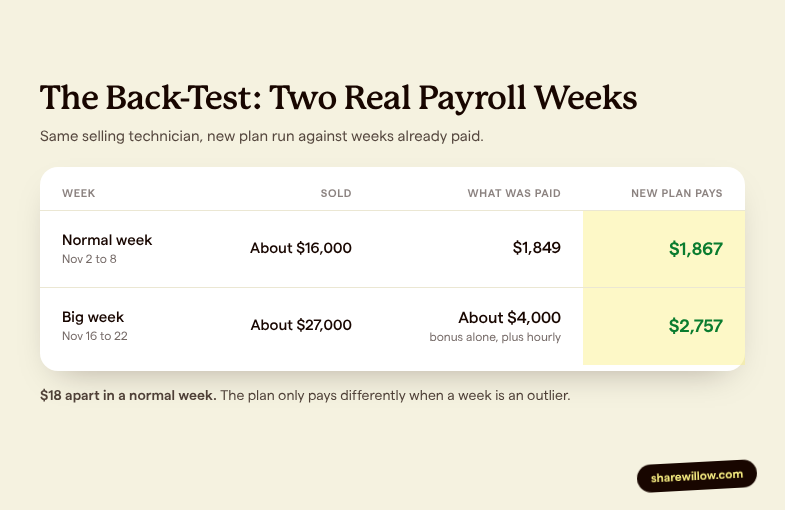
A normal week, November 2 to 8. One selling technician sold about $16,000. Under the new plan his base pay for the week was $1,467 and his performance pay was $1,867, so the plan would have paid $1,867. The owner pulled up what he had actually paid for that week: $1,849. The difference was $18.
That number matters more than it looks. It means that in an ordinary week the new formula pays almost exactly what the technician already earns. The plan can be introduced without a normal paycheck changing at all.
A big week, November 16 to 22. The same technician sold about $27,000 and completed about $5,600. The new plan calculated $2,757 for the week. Under the old plan, that was the week of the roughly $4,000 bonus check plus hourly wages. The old figure is the owner's recollection, since bonuses were not itemized in his payroll system, but the direction is not in doubt.
So the plan pays about the same in a normal week and noticeably less in an outlier week. The owner's reaction was honest. The new system will pay out less than he pays now, he said, and there is nothing wrong with that, but he needs an explanation for the technician. The 8% and 10% split is that explanation. It fits in one sentence, and it is the same sentence every week.
The back-test also caught something unrelated to pay design. Midway through, the owner's records showed about $20,000 sold for a week where the model showed $16,000. A resync fixed it. It is much better to find a data gap in a test than on a paycheck.
What the installer weeks showed
Three installer weeks at 12% told a different story:
- $8,103 of install revenue credited: performance pay $972 against base pay of $456. The plan pays $972.
- $7,940 credited: performance pay $952 against base pay of $1,362. The plan pays $1,362.
- About $13,000 credited: performance pay $1,566 against base pay of $1,352. The plan pays $1,566.
The middle week is the greater-of rule doing its job: a long week on jobs that did not bill much, so the installer falls back to hourly. Across the weeks tested, installers beat their base pay only three times at 12%. That is worth knowing before launch. It says 12% is safe for the margin, and it also says installers will rarely feel the plan unless install revenue per hour rises or the rate moves. The company kept the rate adjustable for that reason. It is the same discipline behind an HVAC company that set one labor-cost target for employees and subcontractors: choose the percentage on purpose, then check it against real jobs.
Where the Plan Stands Today
As of our last call, the owner had decided on the direction. In his words, he did not think anything in the model needed to change, and this is what the company is going to do. He asked to run one more week of data before presenting it to the team.
That patience is the point of the story. The company knows what its labor cost will be under the new plan before the first check is written. It knows which weeks will pay more, which will pay less, and which will pay the same. And the owner can walk into the team meeting with a real week on the screen instead of a promise.
How to Back-Test Your Own Commission Structure
You can run the same exercise with a spreadsheet and a few weeks of payroll.
- Find your real number first. Add every dollar paid to field technicians last month, including bonuses and spiffs paid outside payroll. Divide by collected revenue for the same period.
- Pick the percentage you can live with. Give yourself a range, the way this company did with 16% to 20% for service.
- Split it between selling and completing. If different people sell and do the work, each needs separate credit. An 8 and 10 split is one option, not the only one.
- Guarantee the hourly base. Pay the greater of base or performance pay so nobody is exposed in a slow week.
- Test at least one normal week, one big week, and one slow week. If the normal week does not land close to current pay, adjust the rate before you launch.
- Write down the edge cases. When revenue counts, how shared jobs split, what callbacks do, and how overtime is calculated.
For the arithmetic behind each step, our guide on how to calculate bonus pay walks through the formulas. Doing this by hand works for a couple of technicians and a few weeks. Past that it gets tedious, which is why this company ran the test in ShareWillow with its ServiceTitan data synced in. If you run a plumbing company and want to see your own weeks modeled, here is how ShareWillow works for plumbing companies.
FAQ: Plumbing Commission Structures
What is a typical commission percentage for plumbers?
It depends on your pricing and on what the technician is responsible for. The company in this story targeted 18% of revenue for selling technicians, split into 8% for selling and 10% for completing, and 12% for installers. A common range is 16% to 20% for service and 10% to 14% for install. Start from your own labor cost, not someone else's rate.
Should plumbers be paid hourly or commission?
You do not have to choose. A greater-of plan guarantees the hourly base and pays a percentage of revenue whenever that comes out higher. Technicians keep the security of a wage, and the company's labor cost stays tied to revenue in strong weeks.
How do I split commission when one plumber sells the job and another completes it?
Pay the two activities separately. Give the selling technician a percentage of the sale, then divide a completion percentage among the people who did the work, by time on the job. In this plan the seller earns 8% and the completion side shares 10%, so one person doing both earns the full 18%.
Related reading
- Technician Pay Plans: How One Home Services Company's Techs Earned Up to 55% More on Commission Than Hourly
- How to Pay HVAC Subcontractors: How a Growing HVAC Company Built One Labor-Cost Target for W-2 Techs and 1099 Subs
- HVAC Commission Pay: How to Design a Plan That Drives Profit (Not Problems)
- How to Calculate Bonus Pay: A Step-by-Step Guide to Fair and Motivating Compensation
Conclusion
A commission plan is easier to launch when a normal week pays what it always did. Test it against payroll you have already run, and you will know that before anyone else does.
See what performance pay would pay your techs.
On a free call, we'll show you what your techs would earn for the great work they already do.
Book a free call
Ryan Shank is the founder of ShareWillow. Before ShareWillow, he spent 15 years building software for the trades and founded PhoneWagon, which CallRail acquired.