Plumbing profit sharing plan: one company keeps the first $100,000 of profit, shares 20% above it by points, and pays 50% of gross profit over 58%.
A plumbing profit sharing plan that sits on top of commission
Most owners who ask us about a plumbing profit sharing plan are trying to solve one problem: how do you let the people in the trucks share in a good year without handing out money the company has not earned yet? A plumbing and heating company we started working with in November has a clear answer. The first $100,000 of annual profit stays with the company. Employees share 20% of everything above it.
That profit share is the top layer of a pay plan with five parts, and the company only began paying commissions about a month before our kickoff call. "Just started doing commissions, like, literally a month ago," the person who runs the plans told us. "It's something very new to us."
So this is an early look, and we want to be upfront about that. The profit share has not paid out yet. The first payout is planned for next spring. What we can show you is the full design, the reasoning behind each number, and the problems that surfaced in month one. If you are sketching your own plan, those are the useful parts.
The problem: a month-end report nobody cares about
The plan was not the issue. The reporting was.
Every month she pulls invoices from the company's field service software, pulls a profit and loss statement for each plumber from the accounting system, and builds each commission report by hand. Her description: "It's just a lot of manual work."
The bigger problem is what happens when the report lands. "Giving these guys a report at the end of the month and being like, okay, here's everything you hit, here's how much you're getting paid," she said. "They don't really care."
That is a timing problem, and it gets worse with profit sharing. A plumber who learns in the first week of December what he earned in November cannot change anything about November. A profit share that pays once a year, months after the year closes, is even further from the work. She wants the opposite: "Something that they can just have the live data, see where they're at for the month, see where they can improve every day."
The base layers: commission, efficiency, reviews, and memberships
Before the profit share, here is what each plumber can earn during the year.
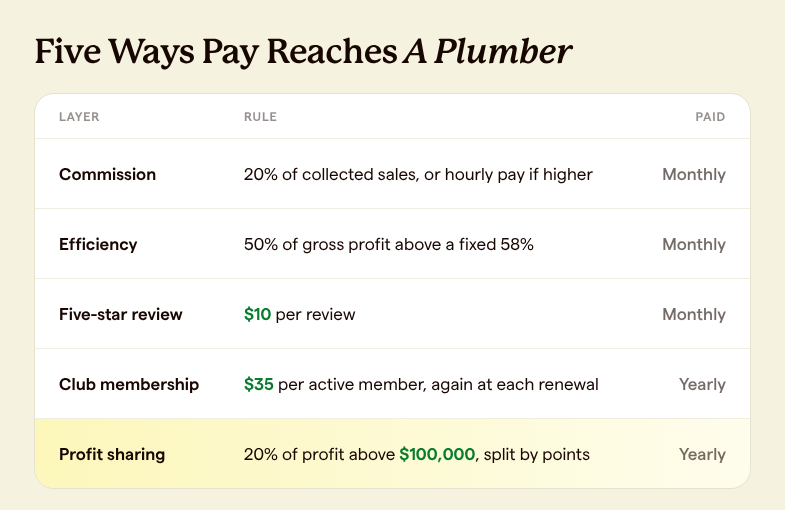
- Commission against hourly pay. Plumbers earn 20% of their sales, with their hourly pay drawn against it. In practice a plumber takes home the greater of the two. It is calculated monthly, on a cash basis, so a sale counts when the invoice is paid.
- Estimated jobs. On larger jobs sold by the company's estimator, the estimator earns 10% of the sale. The plumbers on the job share 20% of what is left after that 10% comes out, divided by the hours each one worked on it.
- Efficiency commission. Each plumber is budgeted at a 58% gross profit. When a plumber's gross profit for the month comes in above 58%, the company shares 50% of the difference with them.
- Five-star reviews. $10 per review.
- Club memberships. $35 per year for every active member a plumber has signed up, paid once a year. When the customer renews, the plumber earns the $35 again.
The hours-based split on estimated jobs is a pattern we see often. Another company took a similar route when it split a 22% commission pool between the seller and the techs who finish the job.
How the plumbing profit sharing plan works: a $100,000 floor, 20% above it
The profit share has three rules.
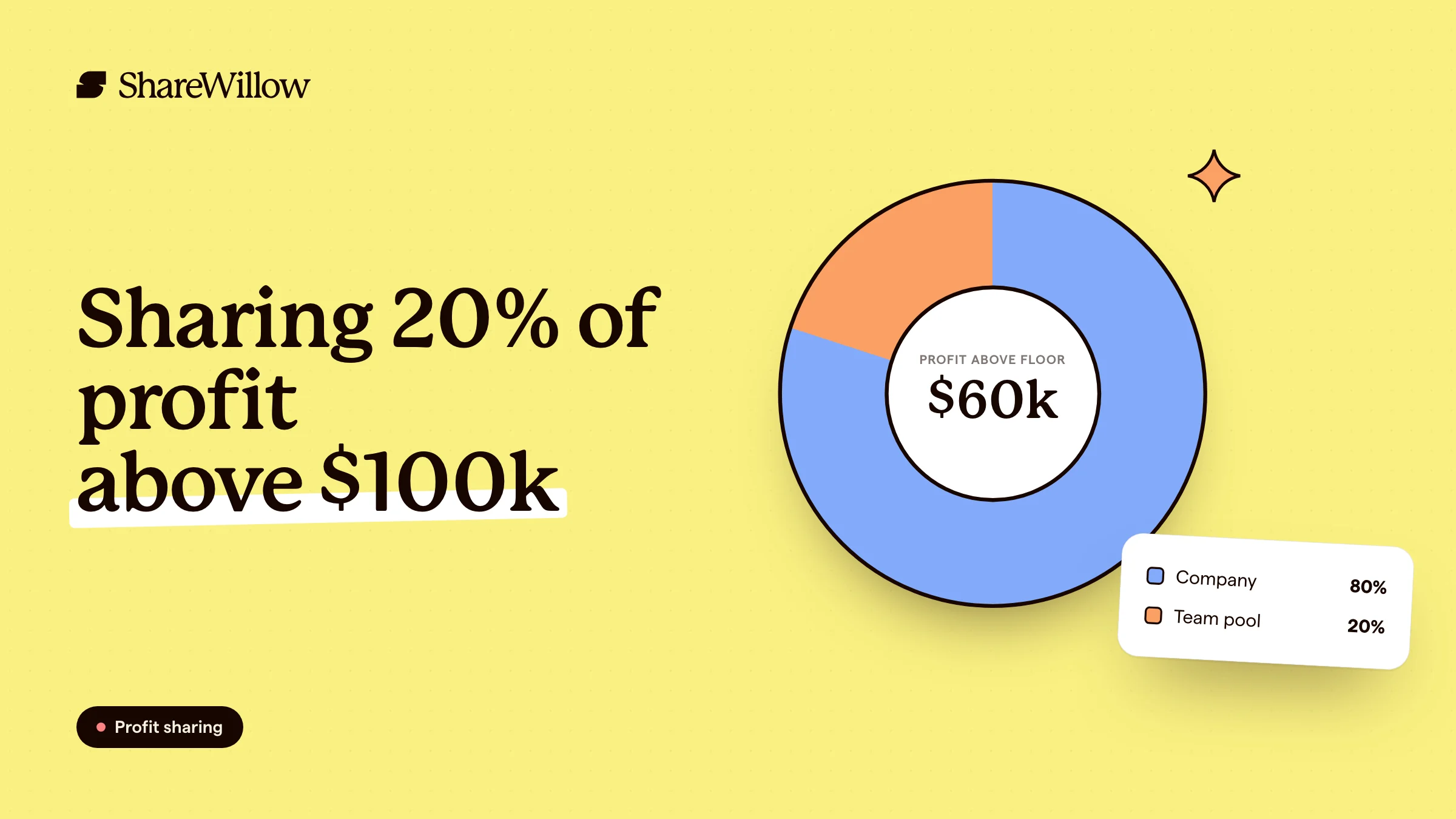
- The company keeps the first $100,000. "The first 100,000 of profit stays with the company," she said. Below that line, the pool is zero.
- Employees share 20% of the rest. The pool is 20% of annual company profit above $100,000, taken from the company's books.
- Points decide each share. "It's like a point system," she explained. "The guys that are higher up in the company or have been longer in the field, they get more points than the other guys." Each person's share is their points divided by the total.
She plans to wait until taxes are filed and pay the first profit share around the end of April or May 1. She was also clear the design is not locked: it has never paid out, and she is open to adjusting it.
Why a floor matters more than the percentage
Owners tend to argue about the percentage. The floor does more work. A pool that starts at dollar one pays out in a year when the company barely covered its own needs: equipment, a cash cushion, the owner's return. A floor says the company gets healthy first, and after that everyone wins together. It also makes the plan easy to explain in one sentence, which matters more than most owners expect.
Here is how the math runs. These figures are an illustration, not this company's results.
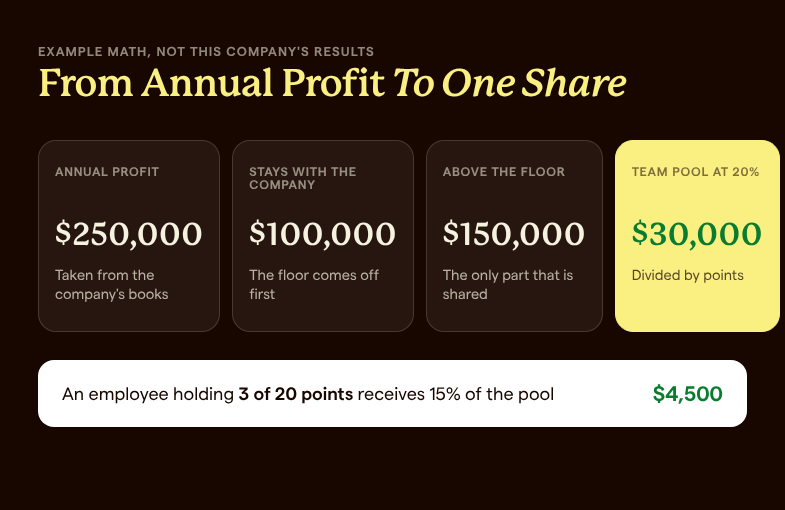
If a company with this rule earned $250,000 in profit, $150,000 would sit above the floor and the pool would be $30,000. An employee holding 3 of 20 total points would receive $4,500. If profit came in at $90,000, the pool would be zero, and everyone would have known that was possible from the start.
If you want to compare this design with other approaches, we collected seven profit sharing plan examples from companies of different sizes. For a version tied to net profit in the trades, see how an electrical company built a technician bonus plan based on company profit with a 47% team margin gate.
The efficiency commission: a monthly share of gross profit above 58%
The annual profit share is slow by design. The efficiency commission is the monthly version of the same idea, and it is the piece we would copy first.
"If their materials are lower, their time's lower," she said. "If we have a better budget on the job, then I split the difference of that profit with them."
Three details make it work.
- The target does not move. "It's just a hard number. That number doesn't change." Plumbers are not chasing a goal that shifts every quarter.
- It is measured across the month. One rough job does not wipe out the bonus. The gross profit on all of a plumber's work for the month is what counts.
- It uses real costs. The number comes from the accounting system, where fuel and credit card fees are booked as cost of goods sold. As she put it, "If they're driving around too much and they're refueling all the time," that shows up in the result.
That last point created the main setup task. The field service software holds jobs, hours, and invoices. It does not hold fuel or card fees. To show a plumber a gross profit number that matches the one he gets paid on, the plan has to read the per-plumber profit and loss from accounting, not only job data. We see the same choice in other margin plans, including a plumbing technician bonus plan built around a 50% gross margin floor.
What month one exposed
A month of running the plan by hand turned up four issues. None is unusual, and each is cheaper to fix before employees have live numbers in front of them.
One plumber's hourly pay beat his commission
One employee's sales were low enough that his hourly pay came to more than his 20%. Nothing is broken there: he keeps the hourly pay. The risk is in how it looks. "I don't wanna just show them their 20% commission, and they think that they're gonna get a big commission, and then they don't get anything," she said. The fix is to show hours and commission side by side all month, so the greater-of rule is visible long before payday.
Cash-basis pay depends on billing speed
Commission counts when an invoice is paid, and much of the billing happens a day or so after the work. A job finished on the 30th can slip into next month's commission. The rule going forward is simple: update paid invoices before the month is closed.
Membership pay arrives up to a year after the sale
Counting active members once a year rewards retention, which is smart. It also means a plumber who signs up a member in March waits until the following February to see $35. Most companies we work with pay on the initial sale, since the next sale is what motivates. She is open to that change. The option on the table is to pay when the membership is sold and keep a year-to-date count of active members so retention stays visible.
The annual pieces were invisible
Plumbers also get annual allowances for boots and pants, hand tools, and community giving. Those balances lived in the accounting system, and so did the running total behind the profit share. Her request was to show the remaining balance for each one next to monthly commission, so the full value of the job is in one place.
How to adapt this for your company
- Set the floor from your own numbers. $100,000 fits this company. Yours should cover what the business needs to keep before sharing makes sense. Ask your accountant.
- Write the point rules down before the first payout. Tenure and role are reasonable inputs. What causes trouble is a point table employees first see on payout day.
- Pair the annual share with something monthly. A once-a-year check is a thank-you. A monthly efficiency bonus changes how a job is run on Tuesday.
- Show progress during the year. A profit share nobody can see for twelve months motivates no one for eleven of them.
- Check the payroll rules. This is a cash bonus plan, not a retirement plan, and formula-based bonuses can affect overtime calculations for hourly employees. Confirm the details with your payroll provider or accountant before launch.
For the arithmetic behind each bonus type, our guide on how to calculate bonus pay walks through profit sharing step by step. This company is building all five layers in ShareWillow so plumbers can see each one as the month goes. Before anyone gets access, we will run past months through the plan and check the results against the payouts she already calculated by hand.
Frequently asked questions
How much profit should a plumbing company share with employees?
There is no standard number. This company shares 20% of annual profit above a $100,000 floor. The floor matters as much as the percentage, since it decides whether a thin year produces a payout at all. Start with what the business must retain, then pick a percentage you can afford in a strong year.
Should profit sharing be split evenly or by points?
Either can work. An even split is the easiest to explain. A point system lets you weight tenure or responsibility, which this company chose so that senior plumbers earn a larger share. Whichever you pick, publish the rule before the year starts.
Does profit sharing replace commission for plumbers?
No. In this plan it sits on top. Commission, the efficiency bonus, reviews, and memberships reward what one plumber does this month. The profit share rewards what the whole company did this year.
Related reading
- Plumbing Technician Bonus Plan: How a Plumbing Company Built a Quarterly Plan Around a 50% Gross Margin Floor
- Technician Bonus Plan Based on Company Profit: How an Electrical Company Gates Every Bonus on Net Profit and a 47% Team Margin
- Plumbing Commission Structure: How a Plumbing Company Split a 22% Pool Between the Seller and the Techs Who Finish the Job
- 7 Profit Sharing Plan Examples for Your Small Business
Conclusion
Keep what the company needs first, share a clear slice of the rest, and let people watch the number all year.
See what performance pay would pay your techs.
On a free call, we'll show you what your techs would earn for the great work they already do.
Book a free call
Ryan Shank is the founder of ShareWillow. Before ShareWillow, he spent 15 years building software for the trades and founded PhoneWagon, which CallRail acquired.