Year-end bonus for employees: how a 13-person HVAC company replaced about $8,450 in flat $500 checks with a $10,000 pool split by tenure and role.
Every November, owners start asking the same question: how big should the year-end bonus for employees be this year, and who gets what? A 13-person HVAC company we work with had been answering it the way most home service companies do. The owner picked a number in December, cut everyone a check of roughly $500 net, and hoped it landed well.
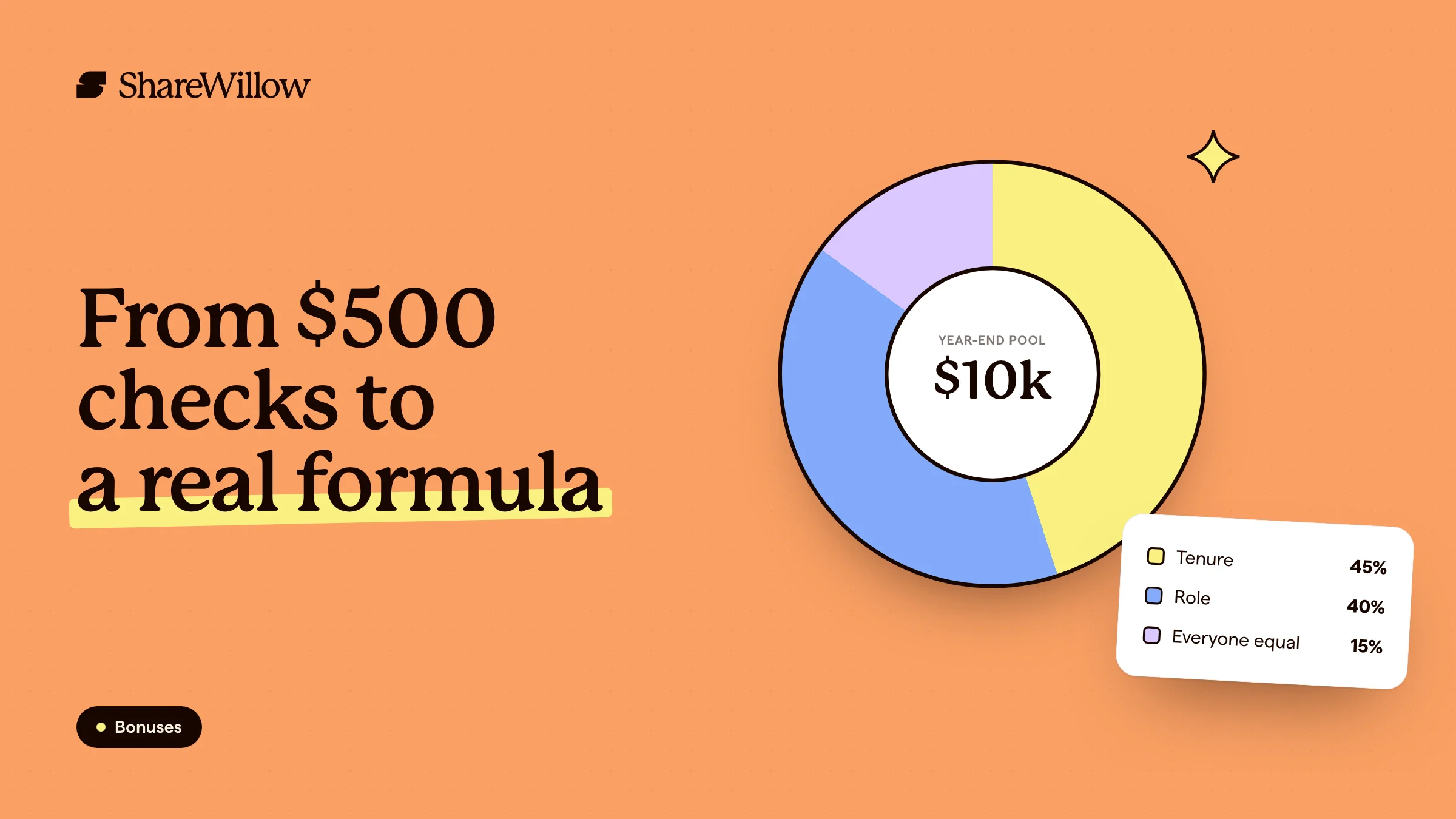
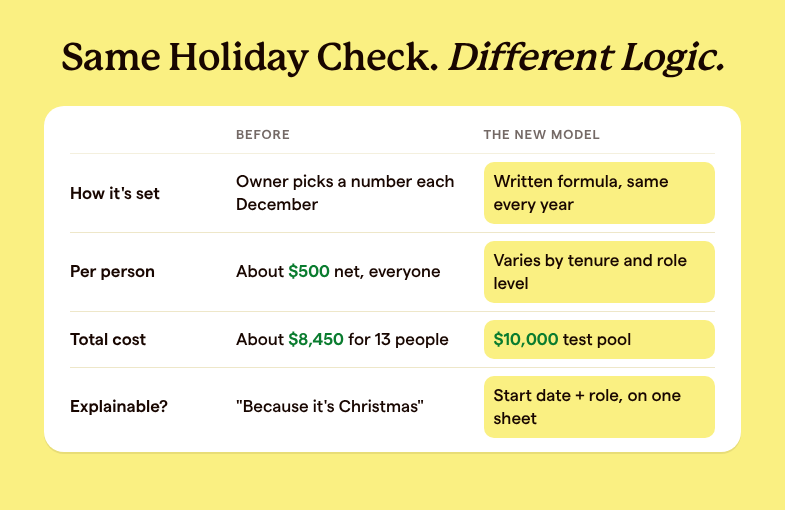
This year the owner wanted something different: a year-end bonus that follows a written formula, rewards the people who have stayed, recognizes the people carrying more responsibility, and can be explained to any employee in one sentence. During a recent planning call with ShareWillow, the company settled on a model that splits a single bonus pool 50% by tenure and 50% by role level, and asked us to run it against a $10,000 test pool.
This is a plan-design story. The company had not paid the new bonus when we spoke, so there are no payout results yet. What it does have is a clear before and after on cost, a formula anyone can audit, and a set of decisions worth borrowing if you are setting your own year-end numbers right now.
The Problem: A Flat $500 Check With No Formula Behind It
The old approach was simple. Everyone got about $500 net at the end of the year. The owner estimated that a $500 net check really costs the company about $650 per person once payroll taxes and withholding are grossed up, which puts the total near $8,450 for 13 employees.
Nothing about that is unusual. Gusto's small business data shows the average year-end bonus at small companies was $2,789 in December 2025, and plenty of owners still default to a flat amount or about one week's pay. But a flat, discretionary check had three problems for this company:
- It treated a 9-year manager and a 6-month maintenance technician the same. Long-tenured people noticed.
- It was not tied to anything. The amount could not be explained, so it could not be anticipated, and a bonus nobody can anticipate does not do much to keep people around.
- It changed with the owner's mood and the bank balance. The owner wanted employees bonused even in a thin year, but wanted the method to stay consistent from year to year.
The owner described the goal plainly: a consistent, explainable year-end bonus method instead of discretionary payouts.
The Year-End Bonus Formula: 50% Tenure, 50% Role Level
The model the company chose has two halves, and each half answers a different question.
- Tenure half (50% of the pool): who has stayed? Each employee earns a share based on years with the company, calculated from start dates. The office manager already kept those dates in a spreadsheet, so the input existed.
- Role half (50% of the pool): who carries more responsibility? Every role gets a level. The draft framework uses three: apprentice is level 1, technician roles are level 2, and managers are level 3. The owner decided that maintenance technicians, who are entry-level and mostly run tune-ups, belong at the apprentice level.
To turn that into dollars, you divide each half of the pool by the total units in that half. Here is the math on a $10,000 pool, using an illustrative 13-person roster of 2 managers, 7 technicians, and 4 apprentices with 48 combined years of service. These are example numbers to show how the formula behaves, not this company's actual payouts.
- Tenure dollars: $5,000 divided by 48 years of service is about $104.17 per year with the company.
- Role dollars: the roster carries 24 level points (2 managers at 3, 7 technicians at 2, 4 apprentices at 1). $5,000 divided by 24 is about $208.33 per level point.
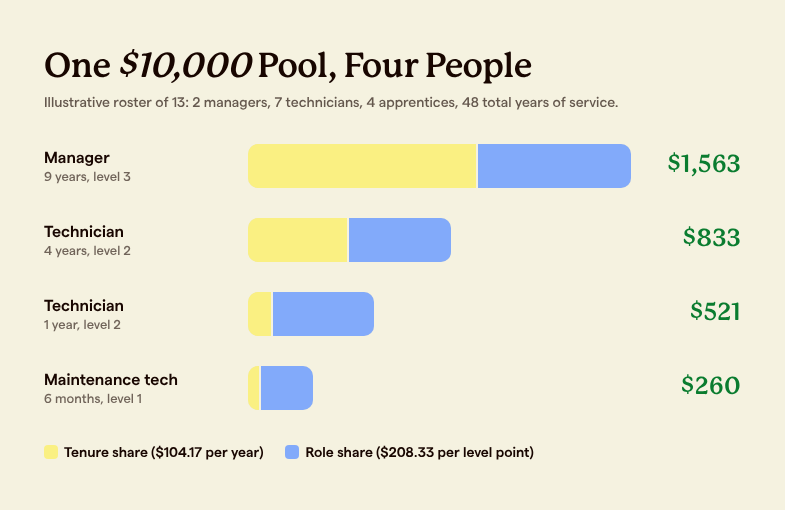
So a manager with 9 years earns about $937.50 from tenure plus $625 from role, roughly $1,563. A technician with 4 years earns about $833. A technician with 1 year earns about $521. A maintenance technician with 6 months earns about $260. The whole pool comes to exactly $10,000, and every number traces back to a start date and a role.
That spread is the point. Under the old method, all four of those people got the same check. Under the formula, the manager earns about six times what the newest hire earns, and the reason is visible on one sheet.
Why the Company Modeled a $10,000 Pool First
The owner did not commit to a profit percentage on the call. Instead, the request was to model a $10,000 test pool and look at what each person would receive. That was smart for two reasons.
First, it is close to what the company already spends. Moving from about $8,450 to $10,000 is an increase of roughly 18%, small enough to approve without a long debate, and large enough that the people at the top of the tenure list see a meaningful raise over their old $500 check.
Second, it exposes the edge cases before anyone sees a number. In the illustration above, a brand-new apprentice lands below the old $500 check. If that is not acceptable, the company can fix it now: add a minimum payout, give a starting tenure credit, or shift the split toward role. It is much easier to make those choices on a model than to explain a smaller check to someone in December.
If you want a deeper look at how other companies size a pool against profit, our breakdown of a technician bonus plan based on company profit shows how an electrical company gates every bonus on net profit, and the job profit bonus plan case study shows a pool split 30% by level and 70% by hours.
Where the Profit Number Comes From
The pool eventually needs to connect to company results. The owner wants the bonus tied to how the year went and to employee effort, while still paying something in a low-profit year. The challenge is data: the field service software the company runs does not report net profit, so the annual profit figure has to come from the accounting system or be entered by hand.
That is common. Most home service companies keep revenue in their field service platform and profit in their books. The practical fix is to enter one profit number per period, set the pool as a percentage of it, and add a floor so the bonus never drops to zero. A floor answers the owner's concern directly: in a thin year the company still pays, and in a strong year the pool grows on its own without another December negotiation.
What the Owner Considered and Left Out
The owner also suggested attendance as a third factor. It is a reasonable instinct, since showing up is part of earning a share. The team agreed to hold off until there is a reliable way to track missed days. A factor you cannot measure cleanly turns into an argument at payout time, which is exactly what this change was meant to avoid.
Two other details came up that are worth copying:
- Clean up pay data first. While reviewing the roster, the office manager caught a technician whose wage in the system was out of date after a raise. Any formula is only as good as the records behind it.
- Keep the year-end bonus separate from monthly incentives. The same company runs tiered service commissions and per-item spiffs for its maintenance team. The year-end bonus does a different job: it rewards loyalty and responsibility, not individual sales.
How to Build Your Own Year-End Bonus for Employees
If you are deciding on year-end bonuses this month, here is the short version of what this company did:
- Write down what you spent last year. Include the gross cost, not just the net check. This company's flat $500 net was really about $650 each.
- Pick two or three factors you can measure. Tenure and role level are easy because the data already exists. Leave out anything you cannot track yet.
- Choose a split and a test pool. 50/50 is a clean starting point. Model a pool close to last year's spend so the decision is easy.
- Look at the lowest and highest payout. Add a minimum or a cap if either one feels wrong.
- Explain it before you pay it. Tell employees the formula in advance. A year-end bonus people can predict is one they work to stay for.
For more structures you can adapt, our guide to profit sharing plan examples walks through seven real plans, and how to calculate bonus pay covers the math step by step. If you want the pool calculated automatically from your start dates, roles, and profit number, see the ShareWillow product features.
The old year-end check said "thanks for the year." The new formula says exactly why each person earned what they did, and it will say the same thing next December.
How much should a year-end bonus be for employees?
There is no single right number. Many small businesses pay about one week's wages or a flat amount, and Gusto reported an average of $2,789 at small businesses in December 2025. A better approach is to set a pool you can afford, often tied to profit, and divide it with a written formula.
How do you split a year-end bonus pool among employees?
Divide the pool into parts that reward different things. This HVAC company put 50% toward tenure, paid per year of service, and 50% toward role level, paid per level point. Each person's share is their units in each half multiplied by that half's dollar rate.
Should year-end bonuses be based on tenure?
Tenure is a good factor when retention matters, because it rewards people for staying and the data is easy to verify. Pair it with role level or performance so newer employees in key roles are still recognized, and add a minimum payout if new hires would otherwise get very little.
Related reading
- Technician Bonus Plan Based on Company Profit: How an Electrical Company Gates Every Bonus on Net Profit and a 47% Team Margin
- Job Profit Bonus Plan: How an Electrical Company Pays 10% of Paid Job Profit, Split 30% by Level and 70% by Hours
- Team Bonus Pool for Technicians: How an Electrical Company Plans to Share 5% of Gross Profit on Project Work and Keep Flat-Rate Pay Individual
- 7 Profit Sharing Plan Examples for Your Small Business
Conclusion
Replace a flat discretionary check with a written pool split by tenure and role, and model it before you pay it.
See what performance pay would pay your techs.
On a free call, we'll show you what your techs would earn for the great work they already do.
Book a free call
Ryan Shank is the founder of ShareWillow. Before ShareWillow, he spent 15 years building software for the trades and founded PhoneWagon, which CallRail acquired.