Technician bonus plan based on company profit: how an electrical company pays bonuses only after net profit, with a 47% team margin gate and a 60/40 job split.
A technician bonus plan based on company profit answers a question most incentive plans dodge: what happens when the techs hit their numbers and the company still loses money? One electrical contractor decided the answer should be written into the plan before the first payout. Bonuses are earned on sold hours, but they are only paid when the company is profitable after the bonuses themselves are counted.
The owner's rule was blunt. A good month for a technician should never be paid for by a bad year for the business. Here is how the company built that rule into technician, helper, and office plans, and how you can borrow the structure for your own team.
The Problem: A Bonus Based on Gross Profit Can Still Sink the Company
The company's first draft paid technicians 5% of gross profit. It looked sensible until the owner walked through what gross profit leaves out. Training time, apprentices, warranty work, and overhead all sit below that line. A technician could post strong job margins in a month when the company, as a whole, had a thin or negative bottom line, and the draft plan would still have sent bonus checks out the door.
Three questions came up on the planning call, and they are the same three that trip up most home service companies:
- What are we actually paying on? Gross profit swings with job costing. Sold hours are easier for a technician to control and easier for an owner to audit
- Who gets credit when one person sells and another finishes? Without a written split, this turns into an argument every payday
- Who protects the company when profit is thin? A bonus plan with no off switch pays the same in a great year and a terrible one
If you are earlier in the process, our guide to bonus structure examples covers the common building blocks before you add a profit gate on top.
Technician Bonus Plan Based on Company Profit: The Three Layers
The finished design has three layers, and each one answers one of those questions.
- Earn it on sold hours. The technician plan moved off the 5% gross profit draft and now tracks sold hours and overall revenue, with the existing multiplier tiers kept as a starting point
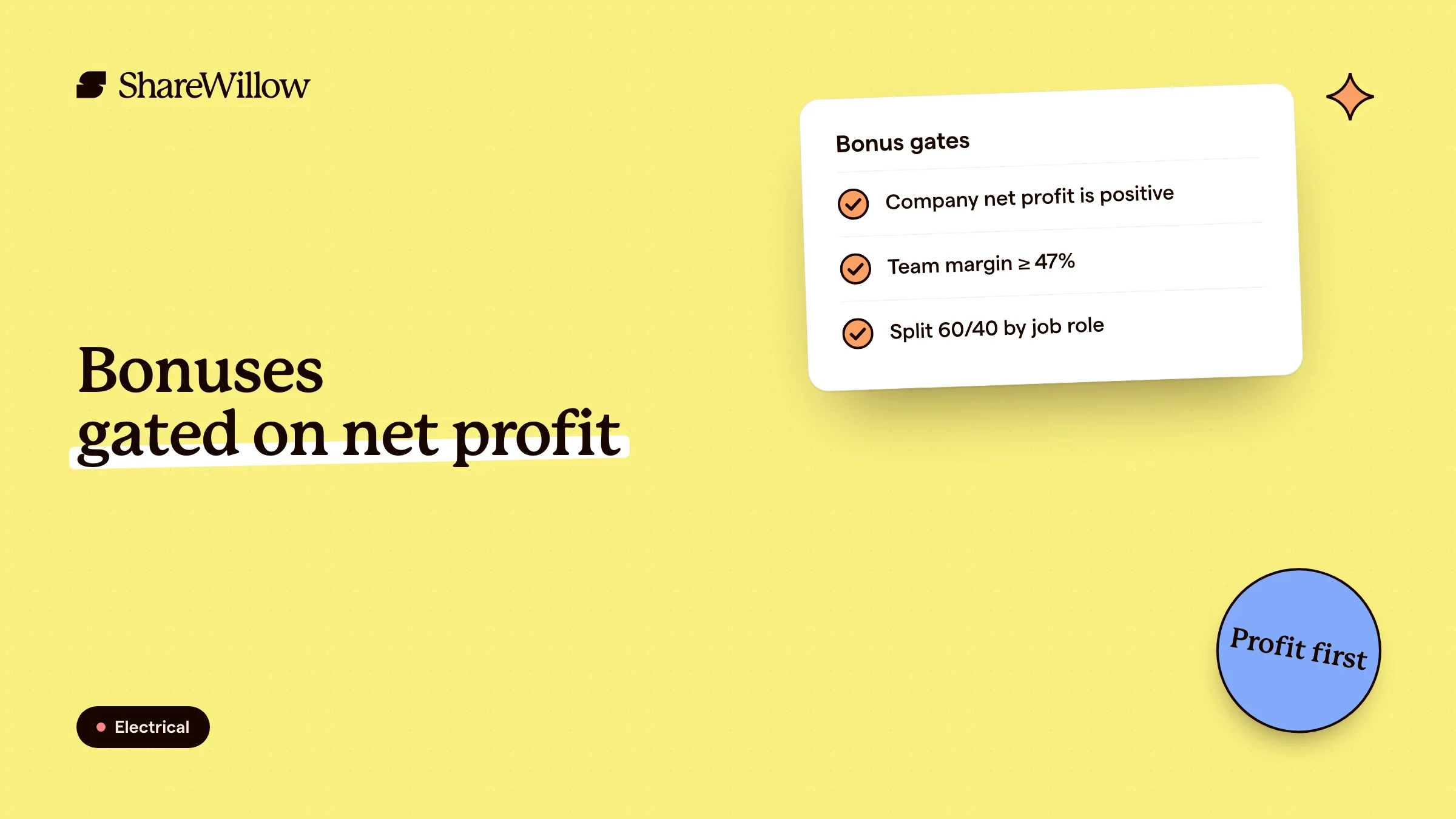
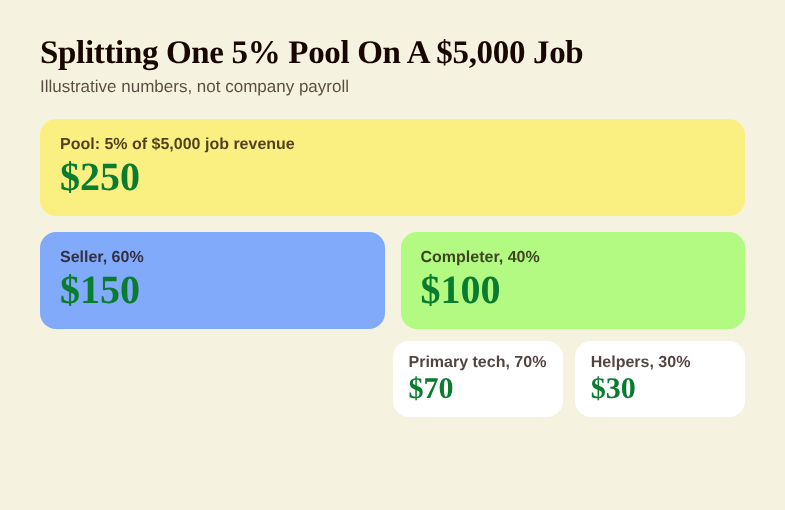
- Split the credit in writing. When one person sells a job and another completes it, 60% of the job credit goes to the seller and 40% to the completer. The completer's share is then divided 70% to the primary technician and 30% to assigned helpers
- Gate the payout on net profit. No bonus is paid unless the company has year-to-date net profit after the bonuses are counted, and the books must be closed by the 15th before any payout is calculated
The split is easiest to see with made-up numbers, shown in the image above. Say a $5,000 job earns a 5% pool, which is $250. The seller's 60% is $150 and the completer's 40% is $100. Inside that $100, the primary technician takes $70 and the helpers share $30. Those figures are illustrations, not payroll, but the arithmetic is the same on every job.
The 70/30 completer split was a deliberate choice. Journeymen do most of the skilled work and they do the training, so they should keep the larger share. Our case study on an electrical company that pays 10% of paid job profit, split by level and hours reaches a similar conclusion from a different direction.
Sold hours also respect how electrical work really sells. The company has two job types with different economics. Flat-rate service jobs are quoted and finished in the field, with a higher bill-out rate on the first three hours, so an eight-hour day can produce around six sold hours. Project work of at least two days and over $2,000 runs closer to one sold hour for every hour worked. Whether those two streams should be tracked with separate cadences was left open on the call, which is a fair thing to leave open until real data comes in.
How the Net Profit Gate Works
The gate is the part that makes this a profit-based plan rather than a sales plan with a profit label. Three rules define it.
- Close the books first. Monthly bonuses wait until the prior month is reconciled and closed by the 15th. October bonuses, for example, are not calculated until after November 15
- Test profit after bonuses. The check uses the bottom line of the profit and loss statement, with the bonuses themselves treated as an expense. A technician's strong result is not enough on its own
- Prorate when profit falls short. If profit cannot cover everything earned, employees receive a proportional share
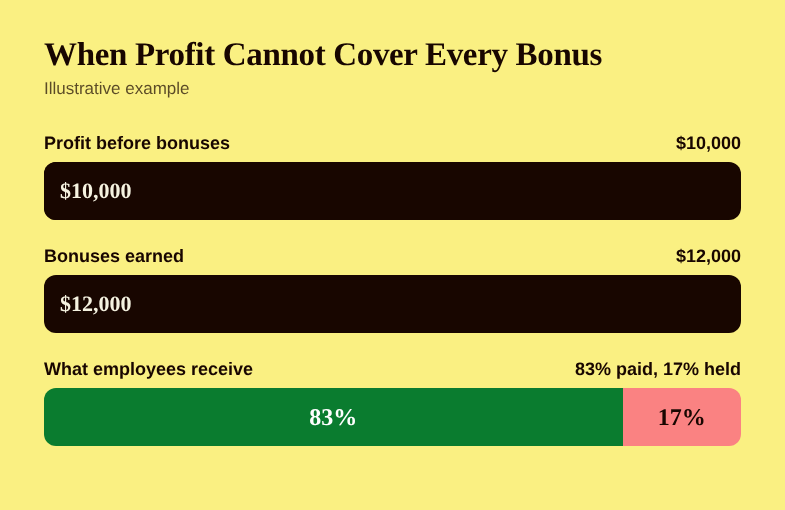
Here is the proration with the owner's own example. Suppose the company has $10,000 of profit before bonuses and technicians have earned $12,000. Employees receive 83% of what they earned, and the remaining 17% is held until profit supports paying it. Any balance still unpaid at the October 31 fiscal year-end is canceled, and the count resets on November 1.
That last rule drew a caution from the ShareWillow side of the call, and it is worth repeating. Deferred payouts can feel like a promise that keeps getting pushed back, and technicians remember a held bonus longer than the owner does. If you copy this approach, decide in advance whether a held balance carries forward or simply expires, and tell the team which one it is on day one.
There was also a practical question about data. The profit figure lives in QuickBooks, and its API access can be limited. The planned approach is to pull the profit and loss number into ShareWillow on the 16th of each month, and if a direct pull is not possible, the figure can be entered by the team on a set schedule. Either way, the gate only works if the profit number is current and trusted, so close the books before you run the plan.
If a profit-linked plan is new to you, our roundup of profit sharing plan examples shows several ways to size and distribute a pool. This company's version is closer to a gated bonus than a true profit share, because individual technicians still earn on their own sold hours.
The Quarterly Team Margin Bonus
On top of the individual plan, the company added a team bonus that rewards everyone for protecting margin together. It runs quarterly rather than monthly, because some months contain three payrolls and can make profit look weaker than it is. A quarter smooths that out.
The rules are short:
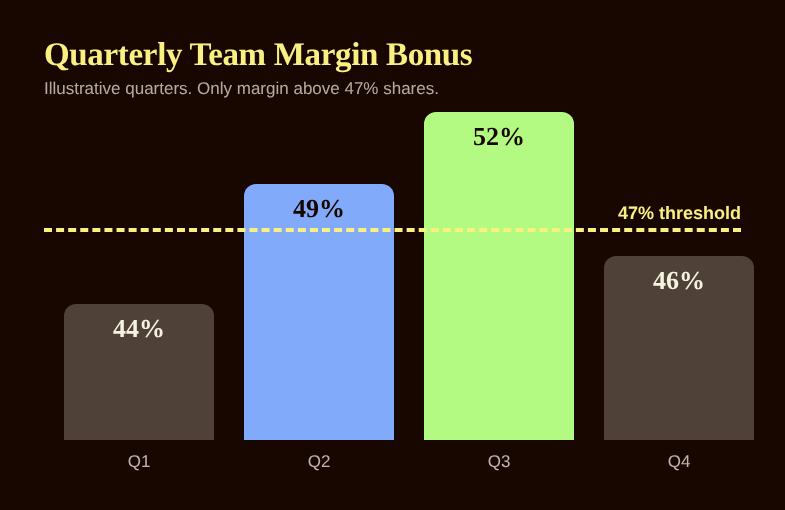
- The threshold is a 47% average gross profit margin across the quarter, measured company-wide from job-based margin, not per technician
- Only the gross profit above 47% is shared. The owner preferred a percentage of that excess over a flat amount, split evenly across the team. The exact percentage had not been set at the time of the call
- The net profit gate still applies. A great margin quarter does not override a company that is losing money
To picture it, imagine a quarter with $400,000 of revenue at a 50% margin. Gross profit is $200,000, and the three points above the 47% line equal $12,000. If the team percentage were 10%, the shared pool would be $1,200, split evenly. Those numbers are hypothetical. What matters is the shape: nothing is shared at or below the line, and the pool grows only as margin improves.
The same idea shows up in a related plan we covered in how an electrical company plans to share 5% of gross profit on project work and keep flat-rate pay individual. A team pool works best when the people sharing it can all influence the number.
Office Staff and Apprentices: Two Details That Prevent Resentment
Two details in the plan are easy to overlook and expensive to get wrong.
The office joins the team plan. The company's CSR had a 1% gross profit share built into her individual plan. On the call, the owner agreed to remove it and enroll her in the quarterly team plan instead, so she benefits from the same margin result the field team does. Her individual plan keeps its booking-rate and manual-call tiers, which pay for inbound calls converted to booked jobs and outbound follow-up. Booking credit goes to the booking date, not the completion date.
Training does not get punished. The owner worried that technicians would resist taking on apprentices if training lowered their bonus. A job tag to exclude training jobs from the metrics was offered, then set aside. The reasoning was that training is a real business expense, and the net profit gate already accounts for it. Keeping the 70/30 split favors the journeyman while still paying helpers, which is its own incentive to teach.
Time off got the same careful treatment. Approved vacation and statutory holidays reduce the weekly or daily sold-hour goal, so nobody loses a bonus chance for taking time they were entitled to. A sick call or an early departure leaves the goal unchanged, which lowers the odds of hitting it without moving the finish line. Whether those two cases should be handled differently is a policy call, and it is better to make it before the first dispute than after.
The Result: A Plan That Cannot Pay More Than the Company Earns
The plan is in its final design stage, and no bonus has been paid under it yet, so there is no payout figure to report. What the company has is a set of written rules that answer the hard questions up front: what technicians earn on, how a sold job is credited, when the books must close, and what happens when profit cannot cover the bonuses.
The remaining work is practical. ShareWillow is checking whether QuickBooks can feed the profit figure automatically, and the owner will receive a written summary of the structure, open questions, and a walkthrough video before launch. Results will be worth writing up once a few payout periods have run.
How to Build a Profit-Gated Bonus Plan
- Pay on something a technician controls. Sold hours or completed revenue work better than a profit line they cannot see
- Write the credit split down. Seller, completer, and helper percentages should be in the plan, not in anyone's memory
- Pick a close date. Run payouts only after the books are reconciled
- Test profit after bonuses. Treat the bonus as a cost when you check the gate
- Decide what happens to a shortfall. Prorate, carry forward, or cancel, and say which in advance
- Add a quarterly team layer. Share only the margin above a company-wide threshold
- Keep your numbers honest. A gate is only as good as the profit and job cost data behind it
For an electrical contractor that wants to see how sold hours, credit splits, and profit gates turn into payouts, ShareWillow's product features walk through the setup. Our guide to a 2% installer pool that only opens above a 45% gross margin shows a simpler margin gate if you want to start smaller.
Frequently Asked Questions
How do you tie a technician bonus to company profit?
Let technicians earn on a metric they control, such as sold hours, then require the company to show positive net profit after bonuses before anything is paid. Close the books first so the profit number is final.
What should happen if profit does not cover every bonus earned?
One option is to prorate. With $10,000 of profit and $12,000 of earned bonuses, employees would receive 83% and the other 17% would be held or canceled at year-end. Decide which one applies before launch so nobody is surprised.
Should office staff share in a technician bonus plan?
Often yes, through a team layer tied to company margin. Keep individual office metrics, like booking rate, in their own plan, and let the team bonus cover the shared result.
Related reading
- Team Bonus Pool for Technicians: How an Electrical Company Plans to Share 5% of Gross Profit on Project Work and Keep Flat-Rate Pay Individual
- Electrical Installer Bonus Plan: How a Contractor Funds a 2% Pool Only on Jobs Above a 45% Gross Margin
- Job Profit Bonus Plan: How an Electrical Company Pays 10% of Paid Job Profit, Split 30% by Level and 70% by Hours
- Employee Bonus Pool Calculation: How a Healthcare Company Caught Bonuses Showing 100% on an 87.9% Funded Pool
- Year-End Bonus for Employees: How a 13-Person HVAC Company Swapped $500 Discretionary Checks for a Tenure-and-Role Formula
Conclusion
Pay bonuses on sold hours, split credit in writing, and release nothing until the books are closed and the company is profitable after bonuses.
See what performance pay would pay your techs.
On a free call, we'll show you what your techs would earn for the great work they already do.
Book a free call
Ryan Shank is the founder of ShareWillow. Before ShareWillow, he spent 15 years building software for the trades and founded PhoneWagon, which CallRail acquired.