A project manager commission structure only works with clean data. See how a service company fixed a 47% vs 44.67% margin gap and a status field before payouts.
A project manager commission structure that depends on one status field
A project manager commission structure looks easy on paper: pay a percentage when the project makes money. The trouble starts when the data behind the percentage is wrong. One service company that runs both standalone jobs and larger projects is finding that out this month, and the lessons are useful for any company that pays project managers, estimators, and salespeople on the same work.
The company uses ServiceTitan, and its team has been building commission plans for project managers (PMs), estimators, and sales. On a working session this week, three problems surfaced in about thirty minutes: projects left "In Progress" long after the work was done, a margin number that did not match the project financials, and a project manager field that was filled in on one screen but empty on another. Each one could quietly change who got paid and how much.
If you have ever wondered why project commission reports never quite match what the team expects, this is the story. For a related example on the estimating side, see how a commercial service company paid 0.5% per role and caught a job showing negative margin.
Pay commission when the project is complete, not when a job is
The first design decision is timing. Under this company's plan, project-based commission is paid after every job in the project is finished and the project itself is marked Complete. That makes sense: a project is not profitable, or even finished, until the last invoice and the last material delivery are in.
It also has a side effect that the team talked through openly. A preventive-maintenance contract might have one purchase order and one price but many jobs, such as quarterly visits over a year. If that contract sits inside a project, commission would wait until the end of the year-long term. The group estimated that this setup touches roughly 5% to 10% of jobs and decided it was manageable. One suggestion was to keep recurring maintenance outside projects whenever commission should be paid job by job.
If you are deciding the same thing for your own company, the question is the one we explored in when to pay technician commission: pay on the work date, the completed date, or the paid date. Whichever you choose, write it down and make sure your software records that date reliably.
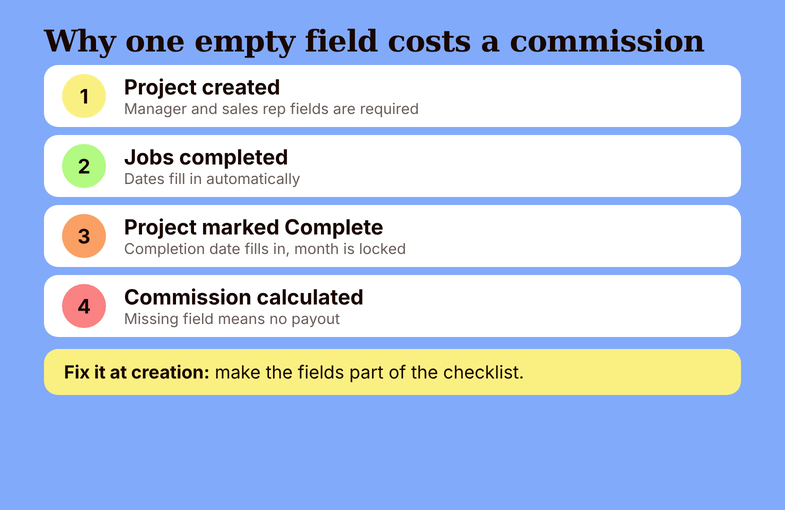
Which brings up the problem the team actually hit. Job completion dates fill in automatically. Project completion dates do not, unless someone changes the project status to Completed. In a live test during the call, flipping the status filled the date in right away. The dates had been blank because projects had been left In Progress despite repeated reminders. Every one of those was a commission payout that could land in the wrong month, or not land at all.
The fix was a deadline. The project lead asked the team to correct October project statuses and completion dates by Wednesday, giving the commission analyst a day to pull and check the data before the next review. October was chosen as the review month because the plans pay monthly, so a full month of clean records makes a real comparison possible.
Use one margin number for project manager commission
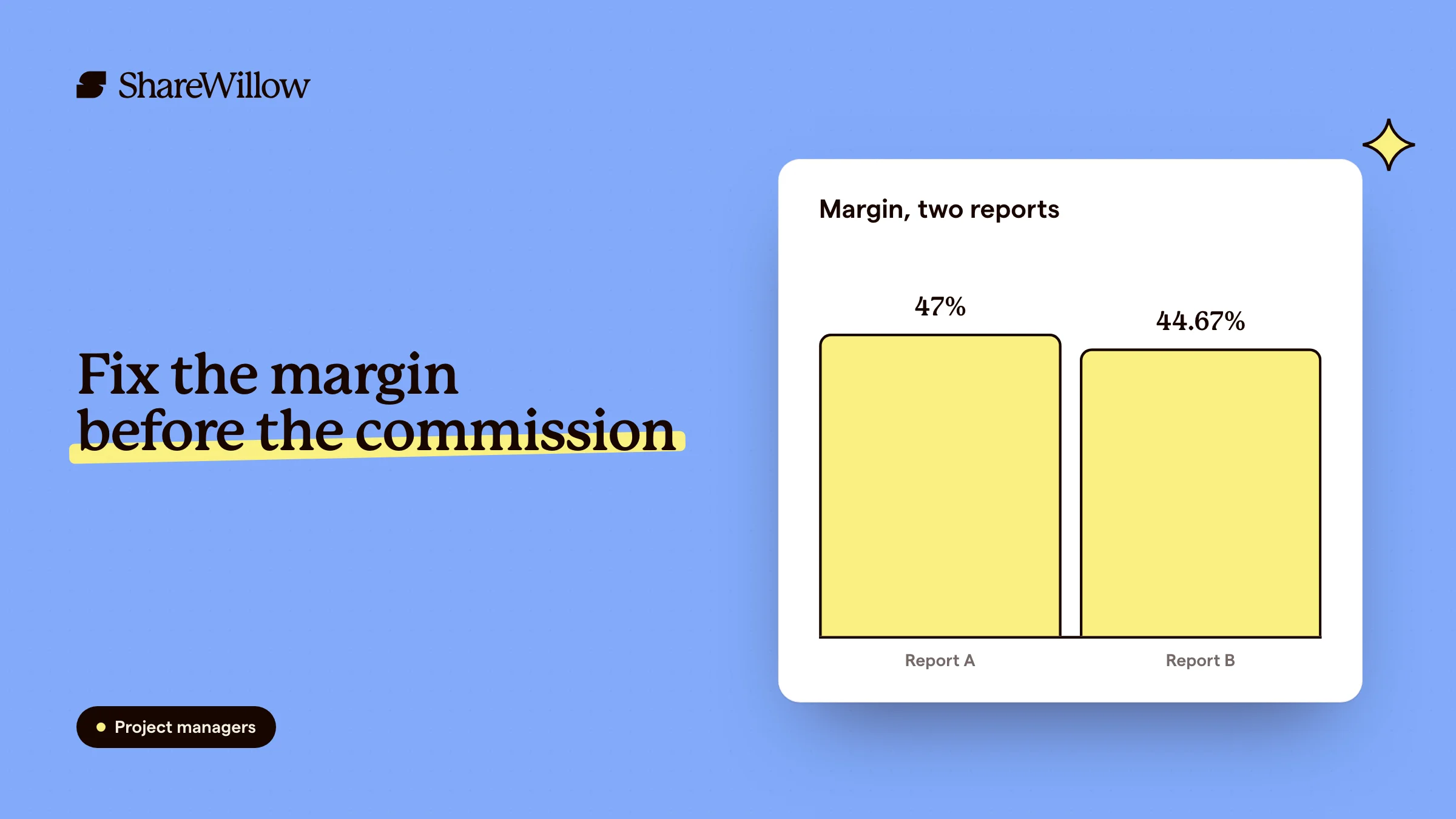
The second problem was subtler. For one project, the commission report showed a margin of about 47%. The project financials page showed 44.67%. Both numbers came out of ServiceTitan, and neither was a mistake.
The reason is the denominator. One field, margin percentage, divides margin by total revenue. Another field, actual margin, divides by invoice billing. Different bases give different answers on the same project. A three-point gap does not sound like much, but on a large project it can move a PM's payout by real money, and it is exactly the kind of difference that starts an argument at the next pay meeting.
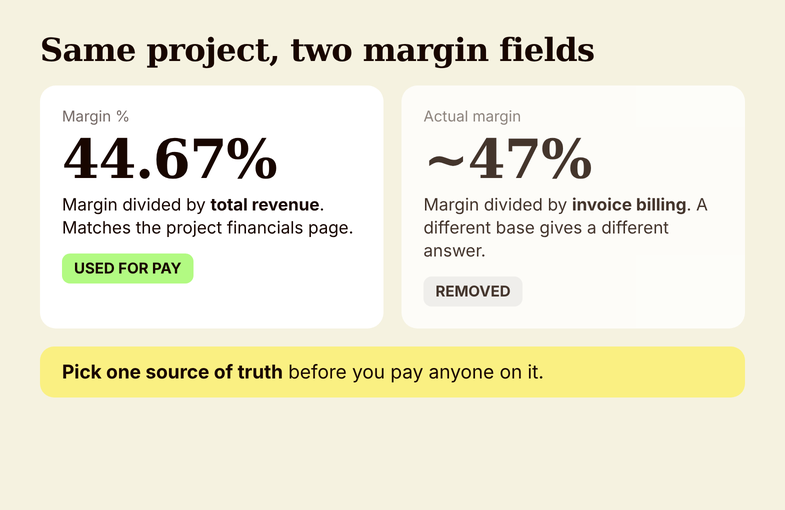
The team made a clean call. Their estimating lead pointed to the project financials page as the authoritative figure, and the commission analyst chose the margin percentage field because it matched. The alternate margin fields came out of the report. The project lead also asked to see the total project amount and gross profit percentage instead of a margin dollar amount, which is easier for a PM to sanity check.
There was one more wrinkle worth borrowing. Estimators sometimes place a non-billable estimate job inside a project so the time spent selling the work counts against the project's gross profit. That is sensible accounting. It also means a single job can show a completion date while materials are still on order, so margin has to be read at the project level, not job by job. The analyst is adding logic for projects that share a number across several jobs, using project-level margin where it applies.
Raise the PM's rate as they hit their own goals
The plan pays project managers a percentage that steps up after each person reaches an individual annual goal. Once a PM hits their goal, their rate is higher for the rest of the year. The analyst is checking the shared spreadsheets to confirm that threshold logic is included in the calculation.
This is a design worth considering. A flat rate treats a PM who barely covers their own cost the same as one who far exceeds it. A rate that rises after a personal goal rewards the people carrying the most work, and it makes the goal feel like a milestone rather than a wall. For a broader look at structures like this, our guide to bonus structures for construction project managers covers the main options.
Notice also what the company did not do. It did not set a rate and hope. It set a goal for each manager, tied the rate to it, and then went looking for the data problems that could make the goal unfair. That sequence is why the status and margin issues surfaced before a single payout went out.
Make missing data a visible condition for commission
The third problem was the project manager field itself. On one project, a PM expected his name to appear in the commission report because it was assigned on the dashboard. The report read a different place: a custom field on the project edit screen. ServiceTitan showed two project manager fields, one under project basics and another custom one, and the report depended on the custom one. The sales rep field populated correctly. The manager field did not.
The team's answer was practical. Require every custom project field to be filled in when the project is created, and add the fields to the project checklist. They agreed that missing information can mean an employee does not receive the associated commission, and that employees should be able to see which jobs qualified for awards so they know when missing attribution is the reason. It is a firm rule, but it moves the work to the start of the project, where it takes seconds, instead of the end, where it takes an investigation.
A project commission checklist
- Decide the payout trigger. Pay on project completion if profit is not known until the end.
- Pick one margin field. Match it to the financials page your team already trusts.
- Require the people fields at creation. Project manager, estimator, and sales rep should never be optional.
- Set a status cleanup date. Give the team a deadline to close projects before payouts run.
- Review one full month first. Compare calculated payouts to your commission sheet before going live.
- Show employees what qualified. Transparency turns data errors into quick fixes.
The company is still in validation. The commission analyst will calculate October payouts for project managers, estimators, and sales once the project records are corrected, and the team will compare the results with ServiceTitan and its commission sheet at a follow-up on November 13. There are no payout results to report yet. What the call produced is a cleaner process: one margin definition, a status deadline, and required fields. If you want to see how ShareWillow handles project-level commission from your field service data, take a look at the product features.
Frequently asked questions
How do you structure commission for project managers?
Pay a percentage of project gross margin after the project is marked complete, and use one agreed margin field. Many companies also raise the rate once a manager reaches an individual annual goal, so the strongest performers earn more on every project after that point.
When should a project manager get paid commission?
Pay when the whole project is complete and the final margin is known. Paying job by job can overpay on projects that lose money later. Recurring work such as maintenance contracts is often kept outside projects so commission is not delayed for a year.
Why does my commission report show a different margin than my financials?
Software often has more than one margin field with different denominators, such as total revenue versus invoice billing. Choose the field that matches your project financials and remove the others from the commission report.
Related reading
- Estimator Commission Structure: How a Commercial Service Company Paid 0.5% Per Role and Caught a Job Showing -140% Margin
- When to Pay Technician Commission: Completed Date vs. Paid Date, and the $6,600 in Open Balances That Forced the Question
- How To Design Effective Bonus Structures For Construction Project Managers
- 9 Bonus Structure Examples Employees and Employers Love
- Incentives, Commissions, and Bonuses: What’s the Difference and Why It Matters
Conclusion
Project commission is only as fair as the project data behind it.
See what performance pay would pay your techs.
On a free call, we'll show you what your techs would earn for the great work they already do.
Book a free call
Ryan Shank is the founder of ShareWillow. Before ShareWillow, he spent 15 years building software for the trades and founded PhoneWagon, which CallRail acquired.