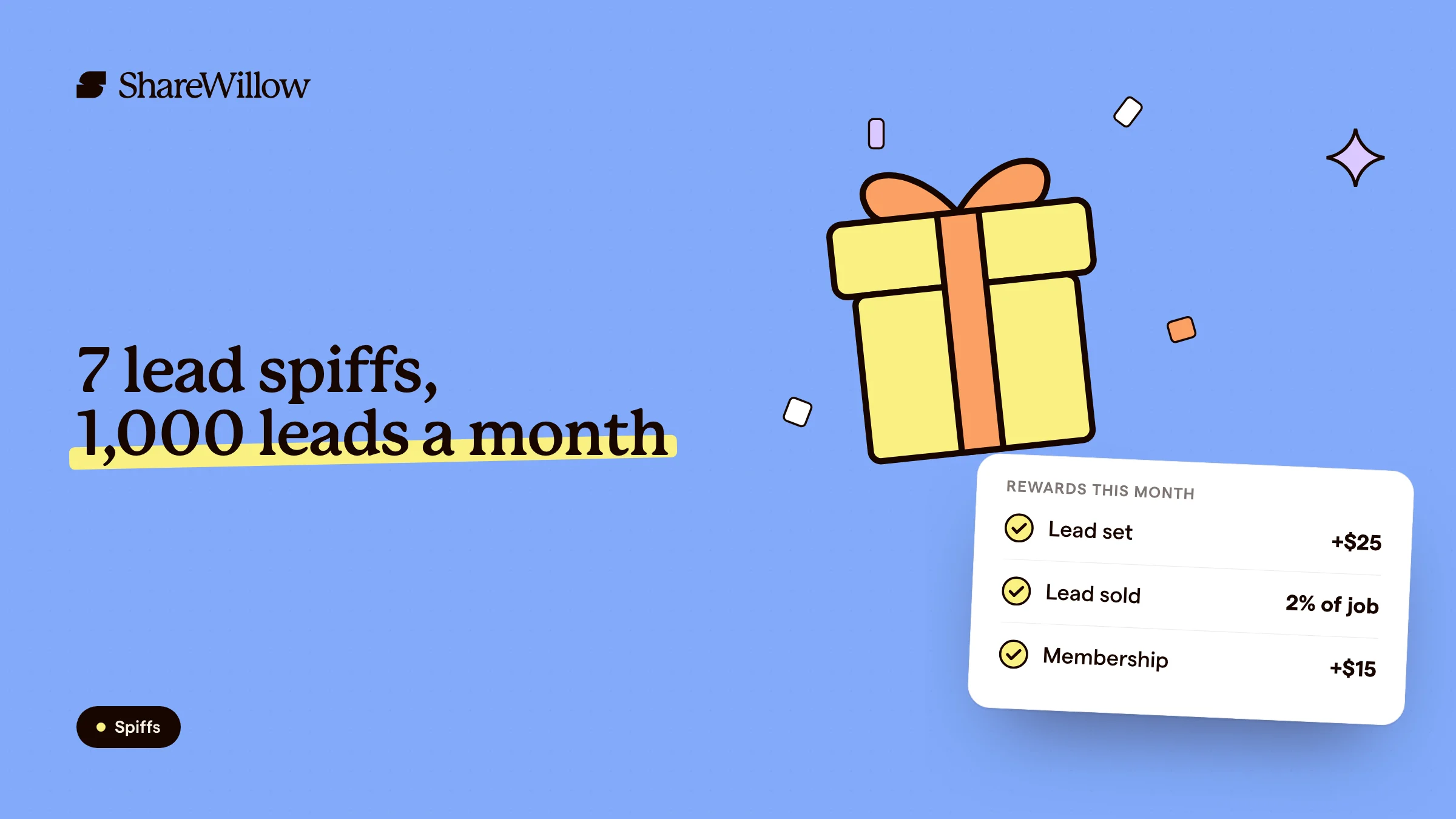
Technician spiff ideas from an 84-technician company: 7 lead spiffs, from $25 to 2% of the job, that bring in nearly 1,000 tech-generated leads a month.
Technician spiff ideas that put a lead on one of every two home visits
Most lists of technician spiff ideas are menus with no results attached. Pay $25 for this, $50 for that, and hope it works. This one comes with numbers, because the company behind it counts everything.
On a recent call, the leader who runs three departments at an 84-technician home services company in the Northeast walked us through the spiff program his team runs today. The company does HVAC service and installation, plumbing, electrical, pest and wildlife control, home energy work, and fuel delivery. Every technician in every division can earn a small spiff for spotting work that belongs to another department.
The results he shared were specific. Last month the technicians turned in just under 1,000 leads. Through the 15th of this month they were at 488. In his words, the company is at the point where one of every two unique home visits produces a lead.
One thing to be clear about: this is not a ShareWillow result. The company built this program itself and runs it on reports and spreadsheets. It came to us because tracking it by hand has become the hard part. We are sharing the design because it is one of the cleanest examples of a cross-department spiff program we have heard, and because the story of what happened when one department's spiffs went unpaid is worth the read on its own.
Why a multi-trade company leans on technician leads
This company started as a fuel delivery business. The leader told us the mix used to be about 75% fuel delivery, and it has moved to roughly a 60/40 split as the home service divisions have grown. It now carries more than 10,000 active service plans.
That history matters. A company with that many plan customers has technicians standing in thousands of basements and utility rooms every month. Each visit is a chance to notice an aging panel, a slow drain, a drafty attic, or a system near the end of its life. The spiff program exists to turn that noticing into a written lead that reaches the right department.
He also gave us a comparison most owners will recognize. A couple of years ago the company spent $2.8 million on marketing in a year. He said that spending did not come close to producing the work the company has gotten from paying its own people for leads and showing the results where everyone can see them.
The spiff menu: seven ways to earn
Here is the full menu as he described it. Everyone on it is paid hourly, and the spiffs sit on top.
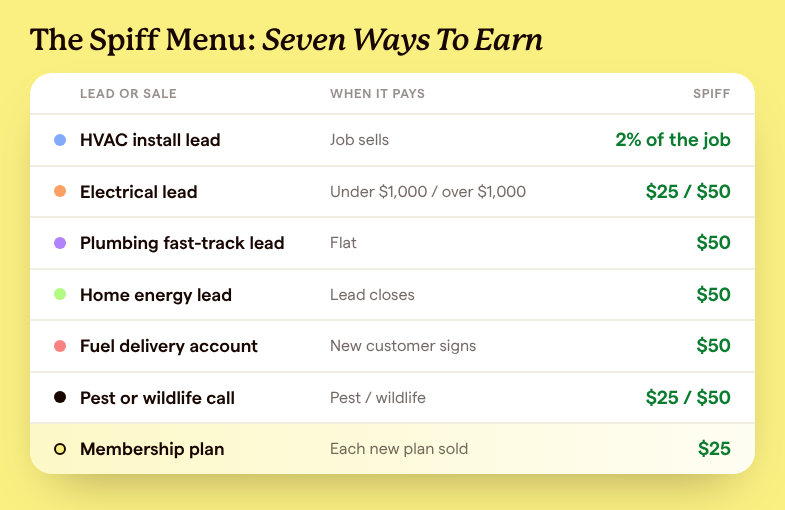
- HVAC install lead: 2% of the gross of the job.
- Electrical lead: $25 when the job is under $1,000, and $50 when it is over $1,000.
- Plumbing fast-track lead: a flat $50.
- Home energy lead: $50 for any lead that closes.
- Fuel delivery: $50 for each new customer who signs up.
- Pest and wildlife: $25 for a pest call and $50 for a wildlife call.
- Membership plans: $25 for every new plan sold. A technician who sells four more plans in one house earns $100.
The mechanics are simple on the technician's side. The tech fills out a lead form on the job in the company's field service software. When the job is closed, the form is emailed to the coordinator for the department that should follow up.
What the menu gets right
If you are collecting spiff ideas for your own team, the amounts here matter less than the three design choices behind them.
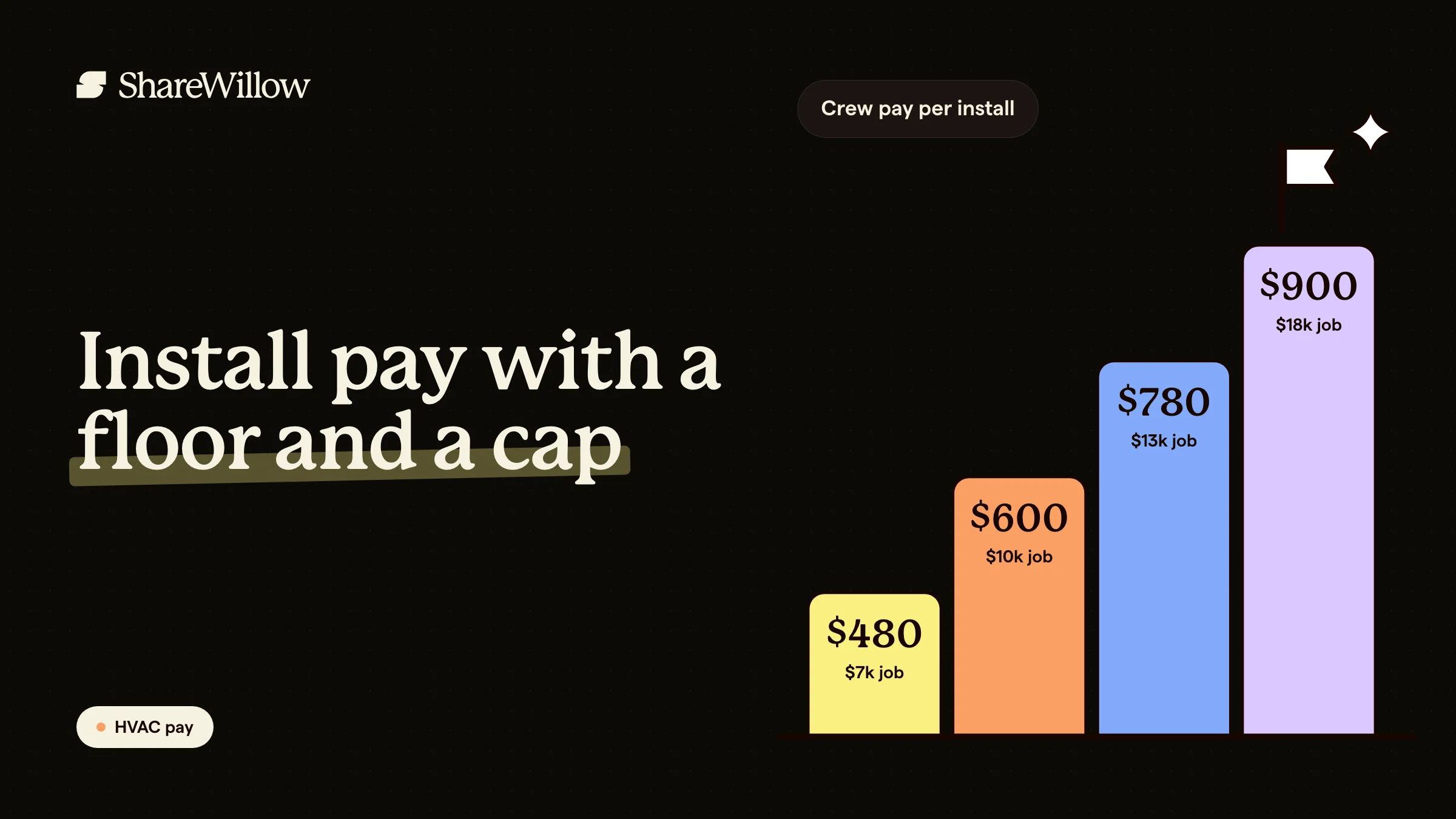
Small work gets a flat amount. Big work gets a percentage. A $50 plumbing lead is easy to explain and easy to remember. A system replacement is different. On a $15,000 installation, 2% is $300, and a flat $50 would undersell what the technician just handed the company. The top lead generator at this company earns about $30,000 a year in extra pay from HVAC sales leads, turning in 75 to 100 leads a month.
Every department is on the menu. A plumber can earn on an electrical lead. An HVAC technician can earn on a pest call. Nobody has to wonder whether a lead for another division is worth writing down. Our guide to HVAC spiffs covers the single-trade version of this idea, and the same logic stretches across trades without much change.
A technician can hold the whole thing in their head. Seven lines, most of them built on $25 and $50. A spiff program only works at the kitchen table, in the thirty seconds when a technician decides whether to bring something up. If the rules need a lookup, the moment passes.
Some of these spiffs pay on the lead and some pay when it closes or signs. Either can work. What matters is that each line says which one it is. We looked at that timing question closely in a post on how a $60 lead set spiff moved from a two-to-three-month wait to the next payroll.
What happened when one department's spiffs went unpaid
This was the most useful part of the call. The technicians used to send the home energy division hundreds of leads a month. By his estimate, about 15% of all jobs came back with a home energy lead or more.
But the technicians were not getting paid on those leads. The leads went in, and the spiffs did not come back.
The technicians noticed. Last month, he said, they turned in about 10 home energy leads out of roughly 1,600 jobs.
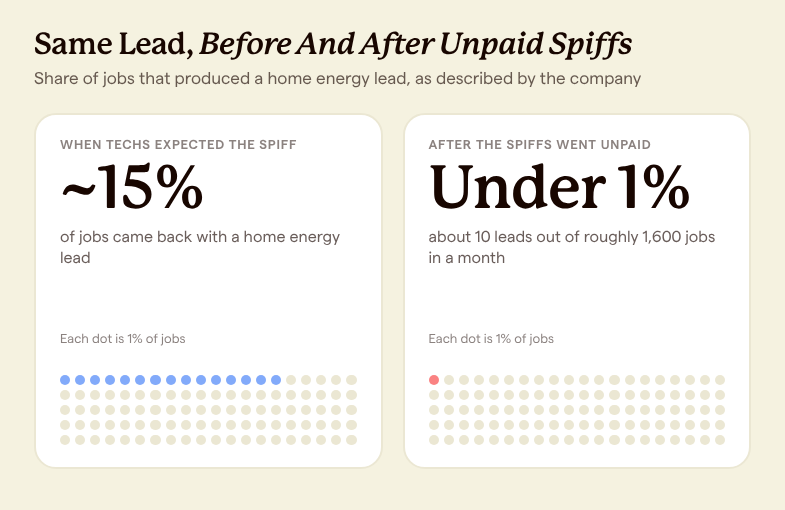
Same technicians. Same homes. Same division doing the same work. The difference was whether the promise was kept, and the lead flow went from about 15% of jobs to under 1%.
Owners sometimes ask whether a $50 spiff really changes behavior. This is the clearest answer we have heard. A spiff is a promise, and technicians keep score. A spiff you announce and do not pay is worse than no spiff at all, because it teaches the team that the other lines on the menu might not be real either.
Count leads per job, by department, where people can see it
The second half of the program is measurement. Each department has a lead rate goal: the share of its completed jobs that should come back with a lead attached. He read one example straight off his dashboard.
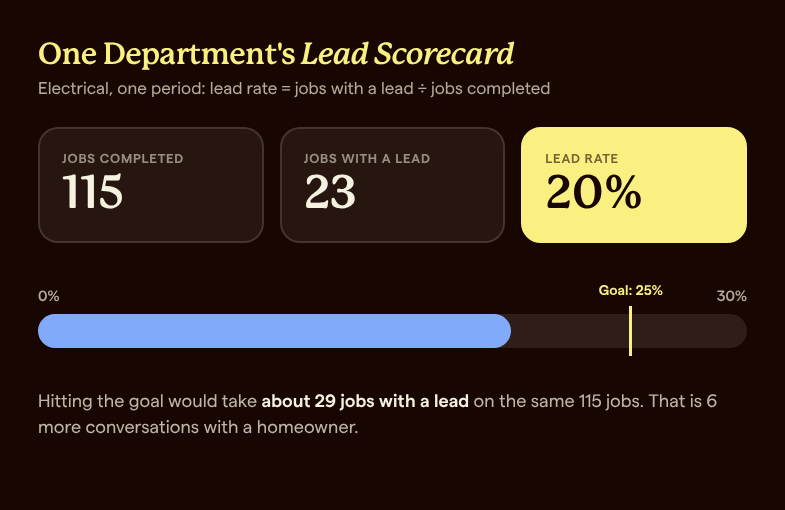
The electrical department completed 115 jobs. Of those, 23 produced a lead. That is 20% against a goal of 25%.
The math is worth doing out loud. Hitting 25% on 115 jobs takes about 29 jobs with a lead. The department was 6 short. That turns a vague instruction like "generate more leads" into something a supervisor can say in a morning meeting: we needed six more conversations this period.
He gave as much credit to displaying these numbers as to the money. A lead rate by department tells you where the habit is strong and where it is slipping, long before revenue shows it. We wrote about a similar visibility problem in a post on a technician lead generation bonus, where an HVAC and plumbing company found $52,000 in tech-sourced sales that its own report showed as zero.
The hard part is the tracking
A program this broad creates a lot of small payouts, and somebody has to get each one right. Today that is two people. Each department builds its own commission spreadsheet from field service reports. Those spreadsheets go to the department leader and the company's IT director, who audit all of them before payroll.
He said the standard weekly update is down to an hour or two. It grows every time a new measure is added. And the audit is doing real work. He described one job where the technician's name did not get attached to the lead. Without the manual check, that technician would have missed his commission on a $21,000 job. If that lead paid at the 2% install rate, that is $420 that would not have reached the person who found the work.
Put that next to the home energy story and the risk is plain. The program runs on trust that every lead gets credited. A manual process with two reviewers can protect that trust at 1,000 leads a month, but it gets harder with every department and every new spiff. That is the kind of work we built ShareWillow's incentive tracking for: pulling the lead and job data in, applying each rule, and showing every technician what they have earned before payday. For a single-trade view of the same problem, our HVAC page covers how lead and membership spiffs are usually set up.
How to build your own spiff menu
If you want to borrow this structure, here is the order we would do it in.
- List the handoffs you want. Write down every case where a person in one role could spot work for another. Service tech to install sales. Plumber to electrician. Any tech to memberships.
- Price each one. Use a flat $25 to $50 where the average job is small. Use a percentage where tickets are large. Check the amount against the margin on the work it produces. A plumbing spiff program we covered holds credit until the job is paid for exactly this reason.
- Say when each spiff pays. On the lead, on the close, or on the paid invoice. Put it in writing next to the amount.
- Make attribution part of closing the job. At this company the lead form lives on the job record, so each lead starts out tied to a job and the technician who was there.
- Set a lead rate goal for each department. Jobs with a lead divided by jobs completed. Start from what the team does today and move the goal up from there.
- Pay on the next payroll and show the math. If a technician cannot see which leads paid and which are still open, they will assume the worst.
More real examples
The same question comes up with other companies. Here is how a few of them answered it, with their numbers.
How a $60 Spiff Went From a 2-to-3-Month Wait to the Next Payroll
HVAC lead set spiff paid on the next payroll instead of 2 to 3 months later: how one company runs a $60 spiff with capped system sale commissions.
This is a story about timing, caps, and the quiet details that decide whether a spiff changes behavior. The company runs on ServiceTitan, has HVAC and plumbing technicians in the plan, and was live on payouts at the time of the call. Notably, it did not redesign its plans. It moved the ones it already had.
Before the move, the company paid its lead-set spiff through a manual process. In practice that meant a wait of two to three months between a technician setting a lead and getting paid for it.
Frequently asked questions
What are good spiff ideas for technicians?
The ones that reward a handoff the company wants more of. Common examples are a flat spiff for a lead to another department, a percentage of a system replacement the technician flagged, and a flat amount for each membership plan sold. This company uses seven, ranging from $25 to 2% of the job.
How much should you pay a technician for a lead?
For small-ticket work, flat amounts of $25 to $50 are common and easy to remember. For large jobs, a percentage keeps the reward in line with the value. This company pays 2% of the job on HVAC install leads, which comes to $300 on a $15,000 installation.
Do technician spiffs actually work?
The best evidence here is what happened when one department's spiffs went unpaid. Home energy leads at this company fell from about 15% of jobs to roughly 10 leads out of 1,600 jobs. Where the spiffs are paid and tracked, the same team turns in nearly 1,000 leads a month.
Related reading
- HVAC Lead Set Spiff: How a $60 Spiff Went From a 2-to-3-Month Wait to the Next Payroll
- Technician Lead Generation Bonus: How an HVAC and Plumbing Company Found $52K in Tech-Sourced Sales Its Report Showed as Zero
- Plumbing Spiff Program: How a Plumbing Company Holds Credit Until the Job Is Paid and Protects a 65% Profit Margin
- How to Use HVAC SPIFFs to Boost Business Profit
- 9 Bonus Structure Examples Employees and Employers Love
Conclusion
Keep the spiff menu short, pay every spiff you promise, and count leads per job where the whole team can see it.
See what performance pay would pay your techs.
On a free call, we'll show you what your techs would earn for the great work they already do.
Book a free call
Ryan Shank is the founder of ShareWillow. Before ShareWillow, he spent 15 years building software for the trades and founded PhoneWagon, which CallRail acquired.