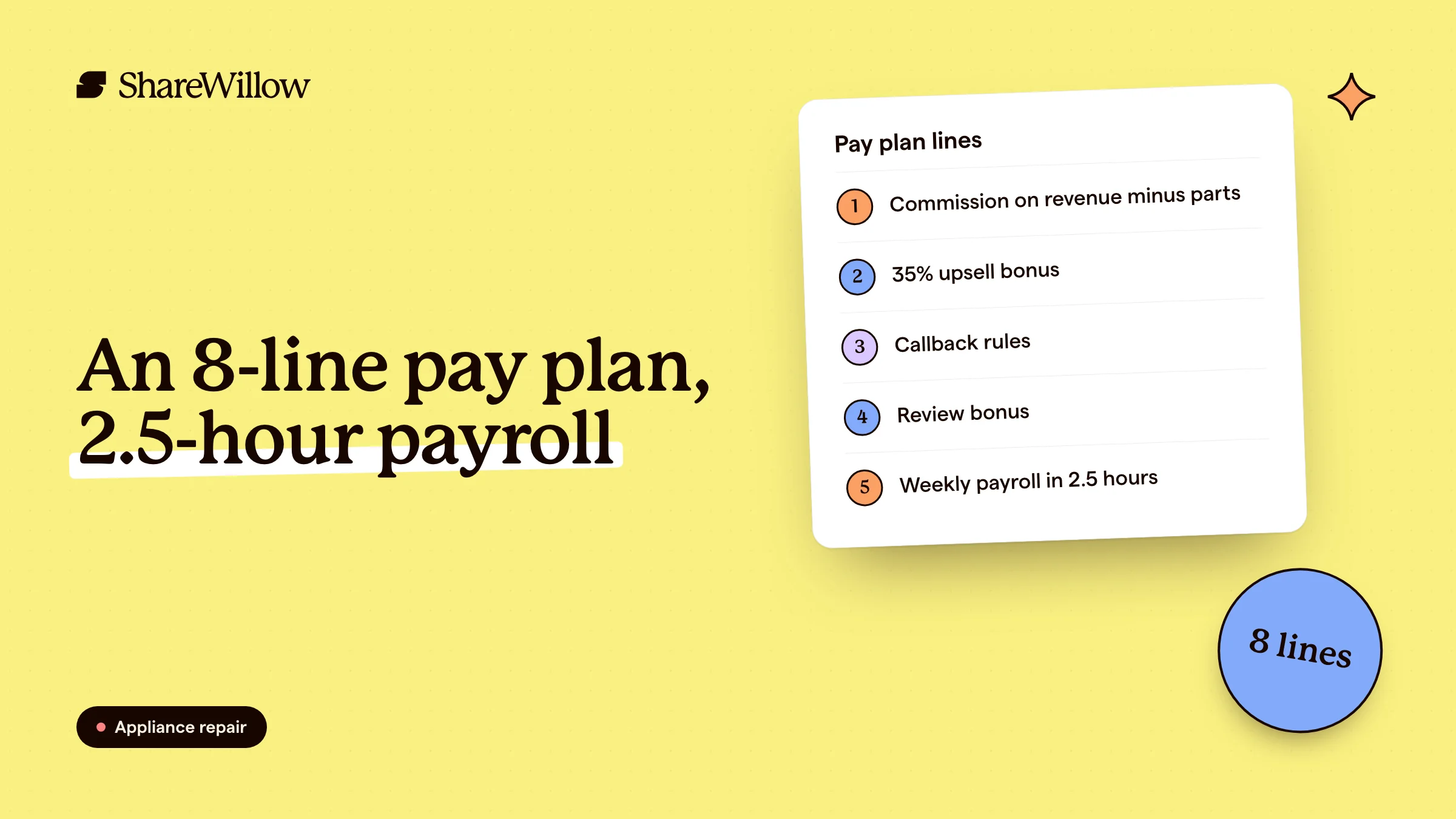
How to pay appliance repair technicians: one company's 8-line pay plan, from commission on revenue minus parts to a 35% upsell bonus, and its 2.5-hour payroll.
Ask ten owners how to pay appliance repair technicians and you will hear ten versions of the same answer: a commission on the work, plus a few bonuses, minus a few deductions. The trouble is not the idea. The trouble is that every one of those pieces needs its own rule, its own report, and its own judgment call, and someone in the office has to apply all of them by hand every pay period.
An appliance repair company we work with runs exactly that kind of plan. Its office manager walked ShareWillow through one full two-week payroll, October 22 to November 4, job by job. The goal was simple: compare her hand calculation for one technician against an automated one, then do the same for the rest of the team.
What came out of that review is a clear picture of how an appliance repair technician pay plan really works in practice, with eight separate lines on a single paycheck, and where the time and risk hide. The comparison was still in progress when we spoke, so this is the plan and the problem, not a finished result.
How This Company Pays Appliance Repair Technicians
Here is every component the office manager applies, in the order she works through them.
- Commission on revenue minus parts. The commission base is gross job revenue after subtracting the parts used on the job, so a technician is not paid on the cost of a $300 control board.
- Diagnostic pay at $15 each. Qualifying diagnostic visits pay a flat $15.
- A $60 minimum base on property-manager jobs. Property-management work has its own minimum so technicians are not penalized for low-ticket landlord calls.
- A 35% bonus on upsell revenue. When a technician sells additional work beyond the original repair, 35% of that upsell revenue goes to the technician.
- Extended warranty sales. Warranty sales are pulled from a separate report, filtered by technician, and recorded job by job.
- A flat $60 for compressor jobs.
- Tips, less a 3% card fee. Credit card tips pass through to the technician after the processing fee comes off.
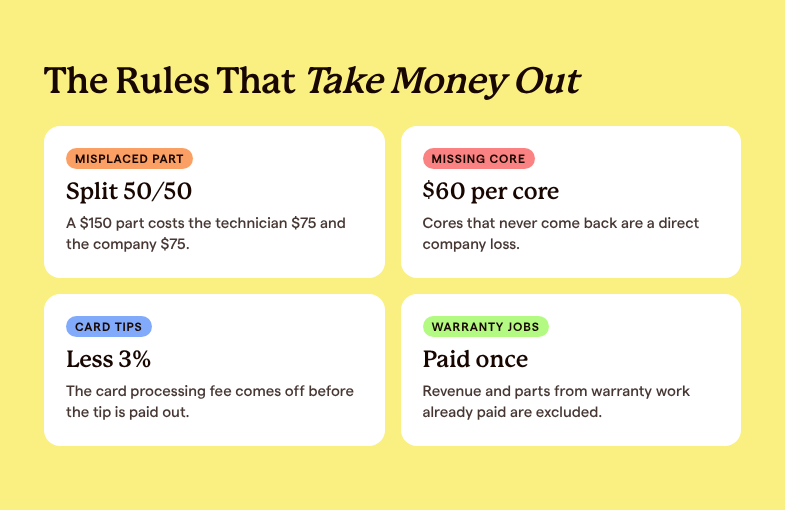
- Deductions. Misplaced parts are split 50/50 between the technician and the company, and missing cores are charged at $60 each.
Each line is fair on its own. Together they make a pay plan that rewards the right things: careful diagnostics, honest upsells, warranty sales, and taking care of company parts. They also make a payroll that takes a long time to run.
One Technician, One Payroll, Worked Out Line by Line
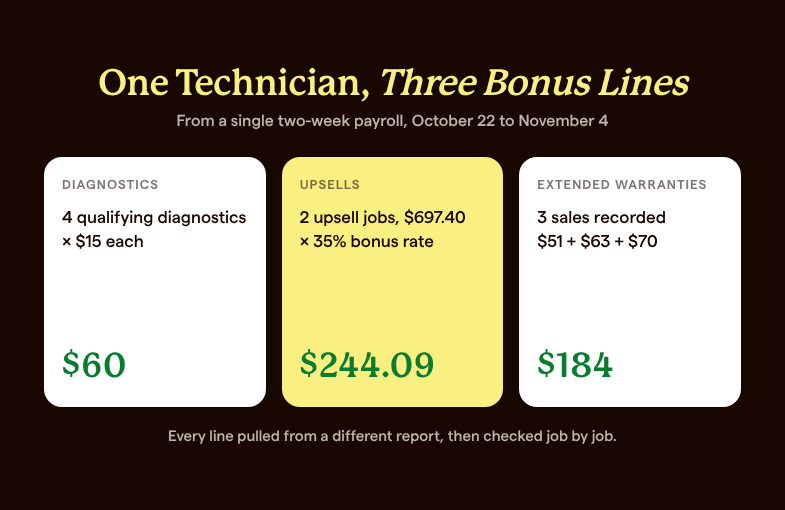
The office manager used one technician as the test case. For the October 22 to November 4 period, his bonus lines looked like this:
- Diagnostics: 4 qualifying diagnostics at $15 each, for $60.
- Upsells: 2 upsell jobs totaling $697.40 in upsell revenue. At the 35% bonus rate, that is $244.09.
- Extended warranties: 3 sales recorded at $51, $63, and $70, for $184.
- Service plans: none sold this period, entered as zero.
None of that math is hard. What takes time is finding the inputs. The diagnostic count requires looking at lower-value jobs one at a time to separate true diagnostics from property-manager calls and maintenance visits. The warranty and upsell figures come from a different report than the commission base, so each listed job gets opened and entered by hand with its job number.
The office manager said a full payroll takes about 2.5 hours once she is working on the right period. On a two-week cycle, that is roughly 65 hours a year spent by one person re-keying numbers that already exist in the company's software.
Where Appliance Repair Payroll Goes Wrong
The review surfaced four places where this kind of plan breaks. If you pay appliance repair technicians on commission, you probably have some version of each.
1. Warranty jobs that were already paid
When a unit comes back under warranty, the original repair was already paid out. Revenue and parts from those jobs have to be excluded from the current period, or the technician gets paid twice. The company identifies them with a warranty tag. When a job is missing the tag, the office manager has to read the job timeline and check prior payroll records to decide whether it was already paid. A missing tag is a manual investigation every time.
2. A rate the spreadsheet does not track
The $60 property-manager minimum lives in the owner's head and the office manager's memory, not in the payroll sheet. Because those jobs are not counted separately, she calculates from total revenue and then adjusts. Any rule that is not written into the calculation is a rule that will eventually be applied inconsistently.
3. Deductions that depend on someone else's report
Parts and core deductions come from inventory, so the office manager has to request that information and enter it. A $150 misplaced part costs the technician $75 and the company $75, and each missing core is a $60 company loss. Those are real dollars, and they only get applied if the report arrives before payroll does.
4. Running the wrong pay period
On a previous cycle, the office manager spent a morning preparing payroll for the prior period before noticing the date mismatch. She caught it before anything was submitted, but it was close to a duplicate payroll. Date mismatches are one of the most common payroll failures in this trade: our write-up on appliance repair payroll reconciliation covers a period mismatch that made a $4,062 paycheck look like $13,000.
The Fix: Write Every Rule Into the Calculation
The plan itself did not need to change. What needed to change was where the rules live. The approach the company is taking with ShareWillow is to turn each line into a defined metric fed directly from the job data:
- Commission base calculated per job as revenue minus parts, with previously paid warranty work excluded by tag.
- Diagnostics, compressor jobs, and property-manager minimums counted as their own job types, so each flat rate applies automatically.
- Upsell and warranty bonuses pulled from the same job records, with job IDs kept on every line so technicians can see exactly what they were paid for.
- Deductions applied from the inventory report as a separate step, so the 50/50 parts rule and the $60 core charge are visible rather than buried in a net number.
The first step is a side-by-side check. ShareWillow is comparing the test technician's hand-calculated payroll against the automated calculation, then reviewing the rest of the team for any metric that does not match. Every difference gets traced to a specific job before anyone relies on the automated number.
Two process fixes came out of the same call. The office manager plans to add a separate property-manager field so the $60 minimum is tracked instead of remembered, and she asked one technician to attach appliance photos, model numbers, and needed parts to every job. That last one is not a pay rule, but it matters: when a customer calls back, the office can identify the equipment, and parts get checked before the truck leaves instead of after.
A Simple Way to Think About Appliance Repair Technician Pay
If you are designing or cleaning up your own plan, sort every line into one of three groups.
- The base: commission on revenue minus parts. This is most of the paycheck, so define it carefully, especially how warranty and recall work is excluded.
- The behaviors you want more of: diagnostics, upsells, warranty sales. Flat amounts or percentages work, as long as each one is tied to a clear job type.
- The behaviors you want less of: lost parts and missing cores. Keep deductions small and predictable, and check your state's wage rules before deducting anything.
For a different take on the same trade, see how another company built an appliance repair technician bonus around three KPI tiers. For the general math behind percentage and flat bonuses, our guide on how to calculate bonus pay walks through it step by step. And if you want to see how each of these lines is calculated from your field service data, the ShareWillow product features page has the details.
Eight lines on a paycheck is not too many. Eight lines calculated by hand, from four reports, every two weeks, is. Writing each rule into the calculation once is what turns a 2.5-hour payroll into a review.
How are appliance repair technicians usually paid?
Most appliance repair companies pay hourly, commission, or a mix. Commission plans usually pay a percentage of job revenue, often after subtracting parts, plus flat amounts for diagnostics and bonuses for upsells or warranty sales. Hourly plans often add a bonus on top for production.
Should appliance repair technician commission be calculated before or after parts?
Calculating commission on revenue minus parts is common because it keeps technicians from earning commission on expensive components the company paid for. It also protects margin on parts-heavy repairs. Whatever you choose, apply it the same way on every job and show the parts amount on the payout.
Can you deduct lost parts from a technician's pay?
Some companies do, often splitting the cost, like the 50/50 rule in this story. Wage laws vary by state and some limit deductions from wages, so check before you deduct. Many companies apply the charge against bonus or incentive pay rather than base wages.
Related reading
- Appliance Repair Technician Bonus: How One Company Built Three KPI Tiers Around a Gap of $400 to $1,500 in Daily Sales
- The $13,000 Paycheck Number That Turned Out to Be $4,062
- Technician Callback Policy: How an Appliance Repair Company Allows Free Callbacks on 5% of Jobs and Deducts $25 After
- Commission on Net Revenue: How an HVAC and Plumbing Company Is Taking Card Fees, Finance Fees, and a $3,000 Warranty Out of the Commission Base
- Performance-Based Pay: Definition, Benefits, Challenges & Tips
Conclusion
Keep the pay lines technicians understand, and write every rule into the calculation so payroll becomes a review.
See what performance pay would pay your techs.
On a free call, we'll show you what your techs would earn for the great work they already do.
Book a free call
Ryan Shank is the founder of ShareWillow. Before ShareWillow, he spent 15 years building software for the trades and founded PhoneWagon, which CallRail acquired.