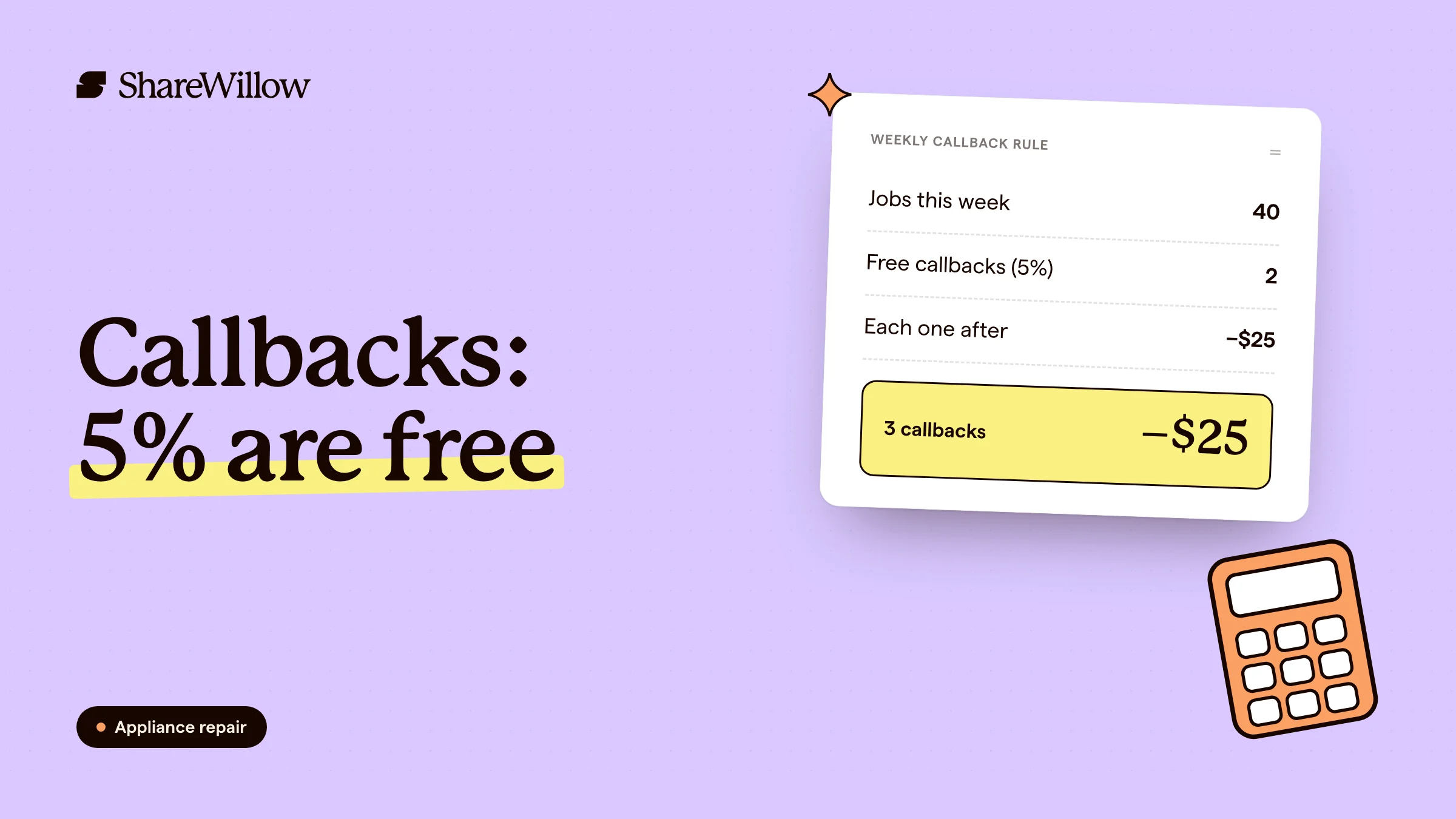
Technician callback policy: an appliance repair company allows free callbacks on 5% of weekly jobs, rounded up, and deducts $25 for each one beyond it.
A good technician callback policy does not pretend callbacks will never happen. Any technician who runs enough jobs will get a call back now and then, and a plan that charges for every single one teaches people to hide them, rush them, or refuse the hard jobs. An appliance repair company that also runs HVAC and commercial appliance work set up a different rule at its ShareWillow onboarding: each technician gets a free callback allowance every week, and only callbacks beyond it cost money.
This is a plan-design story from the kickoff stage. The company had not run its first payout when we talked, so there are no results to report yet. But the rule is specific, the math is easy to check, and the way the owner arrived at it is worth borrowing.
The Problem: A Monthly Callback Rate Punishes the Wrong Week
The company's first draft measured callbacks as a monthly rate. A rate sounds fair, but it has two problems for a small team. A technician who runs 20 jobs in a month and gets one callback is sitting at 5% on a single event, and one unlucky part failure can swing the whole number. And a month is long enough that a technician cannot connect a callback to the week it happened.
The owner wanted a measure that felt like a clear weekly standard, not a statistic that moved at the end of a pay period. The owner also wanted technicians to stay willing to take difficult repairs, because a plan that makes every callback expensive makes every hard job a risk.
Both goals pointed to the same answer: measure callbacks weekly, and give each technician a small buffer before anything is deducted.
The Technician Callback Policy: 5% of Jobs, Rounded Up, $25 After
The rule the company settled on has three parts.
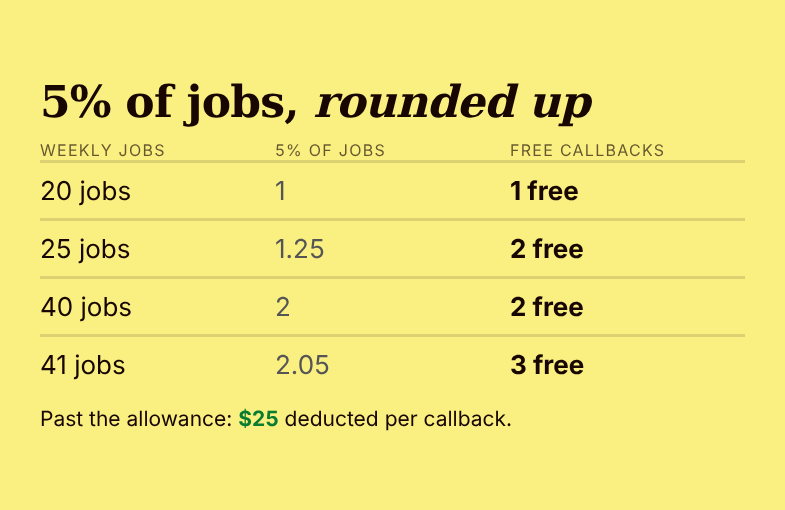
- The allowance is 5% of the week's jobs, rounded up. A technician who runs 20 jobs gets 1 free callback. A technician who runs 25 jobs gets 2, because 5% of 25 is 1.25 and the allowance rounds up.
- Beyond the allowance, each callback costs $25. The deduction is flat, so nobody has to argue about how bad a particular callback was.
- The measure is weekly. The monthly callback rate was removed from the plan so there is one callback standard, not two.
The rounding is the quiet design choice that matters most. Rounding up means even a technician with a light week, say eight jobs, still gets one free callback. Nobody is penalized for the first one. The deduction only starts when a technician's callbacks clearly exceed the normal rate for their volume.
A flat $25 is also deliberate. It is small enough that a single callback is a nudge, not a punishment, and large enough that a technician with several in one week will notice. If you want a stricter, install-focused version of the same idea, see how one company charges a fixed $50 callback back to the original install crew. And for a rate-based approach, here is how an HVAC company tied pay to a 3% callback quality bar.
Where the Callback Rule Sits in the Plan
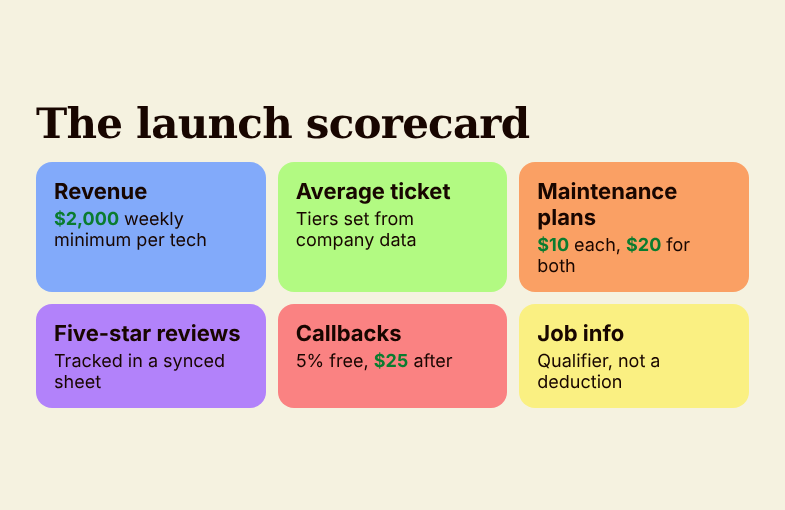
The callback rule is one of six measures in the plan. It is worth seeing the others, because the callback rule only works if it sits next to metrics that reward the right behavior.
- Revenue: a weekly minimum of $2,000 per technician. The owner clarified that this is an individual threshold, not a company-wide goal, and the setup was changed to match.
- Average ticket: tiers built from the company's own observed data, to be reviewed once complete weekly totals were available.
- Maintenance plans: $10 for every plan a technician sells, and $20 when one technician sells both an HVAC plan and an appliance plan. Credit can be split between two technicians on a shared job. The sales are tracked with separate job tags for each plan type in Housecall Pro.
- Five-star reviews: trialed with one review per technician as a test case. Automatic collection from Google was still pending, so a synced Google Sheet is the interim tracker.
- Job information: a qualifier, not a deduction. A technician with complete job notes and property details gets a zero in that field, and the owner wants the check automated, with a text reminder when something is missing.
- Callbacks: the weekly allowance above.
The ShareWillow team suggested launching with this clear structure and adding measures later, instead of overloading the first rollout with every idea. The owner agreed to ask the technicians what else they thought belonged in the plan before the plan went live. That conversation is a good habit. A metric technicians helped choose is easier to accept when it shows up on a pay stub.
The membership piece connects to something we have covered before. If you want to see how a capped per-plan payout was audited in practice, read about an HVAC membership sales commission and a $440 payroll gap. For a plan built around daily sales tiers in the same trade, see the appliance repair technician bonus with three KPI tiers.
Data Problems the Callback Rule Exposed
A rule like this is only as good as the data under it, and the kickoff turned up two gaps worth fixing before a payout.
Callback tags. Callbacks are counted from tags on the job. Three technicians did not appear to have a callback tag at all, which means their callbacks would have been invisible. The owner took the action to verify every tag, and to make sure a former employee's tag was not still attached to a current technician. Before you launch a callback rule, check that every technician has a tag and that every tag points at the right person.
Job segments. A job that runs in more than one visit has more than one segment, and each segment needed its own business unit. A later segment without one was not attributed to anyone, so the payout preview was missing jobs and the totals looked low. The ShareWillow team is testing logic that copies the business unit from the original job to later segments, which also saves technicians from entering it twice.
This is why the owner chose to see complete totals, separated by business unit, before judging whether the incentive amounts felt fair. Technicians were landing in different tiers from week to week across HVAC, commercial appliance, and residential appliance, and the owner wanted the structure to be fair across all three before launch.
What Is Still Open
No payout has run yet, so we cannot tell you how many callbacks the allowance will absorb or how technicians will react to the $25 deduction. Two items remain in progress: the automatic job-information check and the Google review sync. A payout also needs a manager to review and finalize it after each pay period, and the company plans to keep that manual until the first few payouts look right.
What is already clear is the shape of the rule: a weekly standard, a small rounded-up buffer, and a flat charge after it.
How to Write a Technician Callback Policy
- Define a callback in writing. A return visit for the same problem within a set window is a common version. Decide how warranty work and customer-caused returns are handled.
- Measure weekly. A weekly count is easier for a technician to connect to the work than a monthly rate.
- Set the allowance as a percentage and round up. This keeps light weeks fair. Use a simple table to show what the allowance is at 10, 20, and 40 jobs.
- Charge a flat amount after the allowance. A fixed deduction such as $25 avoids arguments about severity.
- Tag every callback to a technician. Without tags, the rule cannot be applied evenly.
- Keep the deduction on incentive pay. Check your state's wage rules before you deduct anything from base pay, and ask an employment attorney if you are unsure.
- Review the first payouts by hand. Look at every deduction before it lands.
For more ways to structure technician pay around quality, our guide to HVAC technician incentives is a good companion. If you want to see how a weekly callback allowance is calculated from your field service data, the ShareWillow product features page has the details.
A callback policy is a promise about how mistakes are handled. This company wrote theirs down before the first payout, and made it small enough that technicians will still take the hard jobs.
What is a fair technician callback policy?
A fair policy accepts that some callbacks are normal. One approach is a free weekly allowance, such as 5% of jobs rounded up, with a small flat deduction only after the allowance is used. That discourages repeated callbacks without punishing a single unlucky one.
Should technicians pay for callbacks?
It is safer to adjust incentive or bonus pay than to dock base wages, and wage laws vary by state, so confirm the rules before you deduct anything. Many companies avoid deductions entirely and track callback rate as a qualifier for a bonus instead.
How do you track technician callbacks?
The most reliable method is a tag or field on the return job that links it to the original technician. Check that every technician has a tag, and review the list each week before payroll.
Related reading
- HVAC Commission Chargeback: How an HVAC Company Charges a Fixed $50 Callback Back to the Original Install Crew
- Same Bonus, Any Callback Rate: How an HVAC Company Tied Pay to a 3% Quality Bar
- Appliance Repair Technician Bonus: How One Company Built Three KPI Tiers Around a Gap of $400 to $1,500 in Daily Sales
- HVAC Membership Sales Commission: The Capped Spiff That Caught a $440 Payroll Gap
- Performance-Based Pay: Definition, Benefits, Challenges & Tips
Conclusion
Give technicians a small, weekly, rounded-up callback allowance and charge a flat amount only after it runs out.
See what performance pay would pay your techs.
On a free call, we'll show you what your techs would earn for the great work they already do.
Book a free call
Ryan Shank is the founder of ShareWillow. Before ShareWillow, he spent 15 years building software for the trades and founded PhoneWagon, which CallRail acquired.