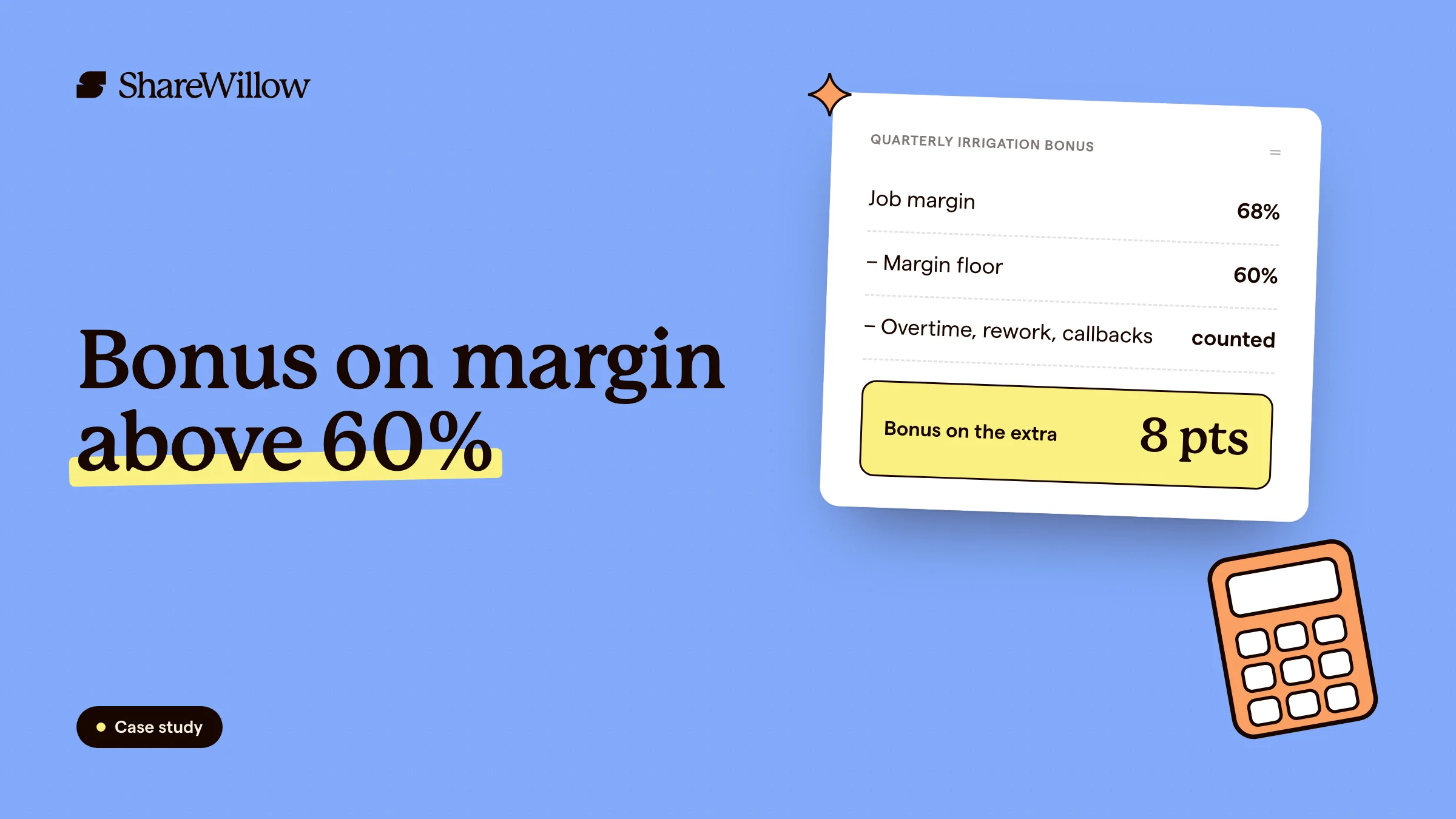
Irrigation technician bonus plan: a 3-tech company pays a quarterly bonus on job margin above 60% and counts job overtime, rework, and callbacks against it.
An irrigation technician bonus plan built on job margin, not hours
An irrigation technician bonus plan has to solve a problem most trades do not have in quite the same form: the technician often writes the estimate. At one irrigation and landscaping company, technicians diagnose the system, say how many hours the repair will take, whether a helper is needed, and what materials to bring. The office quotes the customer exactly that. Then the same technician goes and does the work, on the clock.
The company has three field technicians, an owner who still works in the field, a customer service rep, and a project coordinator. It runs on Jobber. On a recent call, the person who manages the office laid out the bonus plan the company wants to build: a quarterly bonus funded only by job profit margin above 60%, with any overtime caused by a specific job counted against it.
The plan has not been built yet, and nothing has been paid under it. What the company does have is a clear rule, a clear reason for it, and one uncomfortable discovery about its own job costing that every owner should check for. We will go through all three.
The problem: technicians bid the job, then set the pace
The technicians are paid hourly and typically work about nine hours a day, with overtime starting after the eighth hour. Nobody at the company thinks they are loafing. The description on the call was more precise than that:
They're not leaning on a shovel for sure, but they're taking their time at each job.
The trouble is structural. When the person who estimates the hours is also paid by the hour, there is no pressure in either direction. A generous estimate costs the technician nothing. Running past it costs the technician nothing. And once the day passes eight hours, every extra hour pays time and a half.
The office could see overtime piling up, but could not easily see why. An hour of overtime might come from a repair that ran long. It might also come from a drive across town, a stop at the supply house, or a late lunch that was never clocked. Unpaid lunches were landing in a bucket called general time. Sorting it out meant going through timesheets by hand, and the office had started writing a script in a spreadsheet to do it.
The production targets were already clear: $30,000 a month per technician, which is about $1,500 a day and $360,000 a year. What was missing was any link between hitting those numbers efficiently and what a technician took home.
The margin numbers were wrong
Before designing anything, the company looked hard at its job costing and found a problem:
We had elevated profit margins that were not actually accurate. Whatever was in Jobber was their hourly rate, not their full loaded or burden rate.
Labor on each job was being costed at the technician's wage alone. Payroll taxes, insurance, and the other costs that ride on every hour were missing, so every job looked more profitable than it was. When the jobs were re-run with a loaded rate, some of them came in around 50%, or in the high forties.
This matters for any bonus tied to margin. If the cost side is understated, you will pay bonuses on profit that does not exist. An electrical contractor we work with avoided the same trap by funding a 2% pool only on jobs above a 45% gross margin, measured after real costs. Fix the costing first, then set the gate.
The plan: a quarterly bonus on margin above 60%
Here is the rule as the company described it:
They're gonna have to make anything that's over 60% of profit margin. Anything higher than that is gonna be a quarterly bonus.
A job that finishes at or below a 60% margin covers the company and pays the technician's normal wage. A job that finishes above 60% feeds the bonus. The plan is tiered, so the share grows the further above the gate a job lands. The tier percentages have not been set, and we are not going to guess at them here.
The 60% figure is a first attempt. The company said it may lower the gate to 55% after it sees a quarter of real results, which is the right way to treat a threshold. A plumbing company we wrote about went through a similar exercise when it built a quarterly bonus plan around a 50% gross margin floor.
Job overtime counts against the bonus
This is the part that makes the plan different from a plain margin bonus:
If they spend too much overtime in each job, that's gonna count backwards onto what they're gonna be doing every quarter.
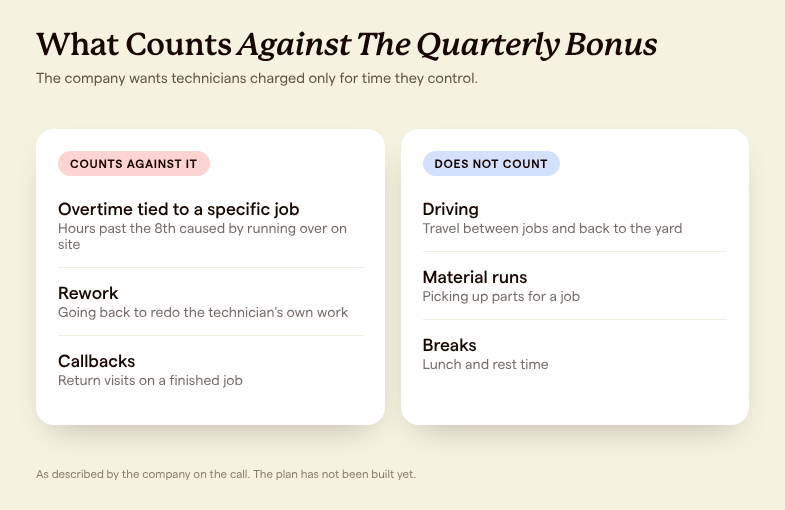
Overtime is expensive labor, so it already lowers a job's margin. The company wants to go a step further and make the connection visible: overtime that can be traced to a particular job, along with rework and callbacks, is subtracted from the quarterly bonus.
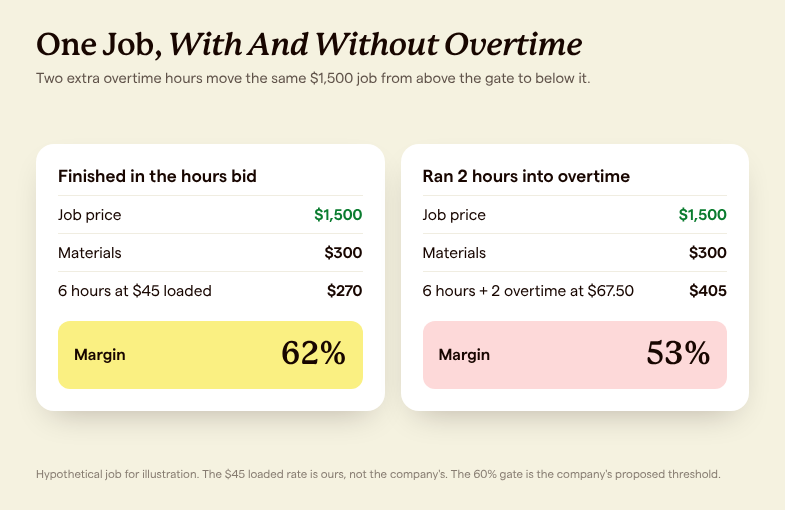
To see why that matters, take a hypothetical $1,500 repair with $300 in materials and six hours of labor at a $45 loaded rate. Labor is $270, total cost is $570, and the margin is 62%. That job clears the gate. Now let the same job run two hours into overtime at $67.50 an hour. Labor becomes $405, cost becomes $705, and the margin drops to 53%. Same customer, same price, same technician, and the job has gone from feeding the bonus to missing it. The loaded rate in that example is ours, chosen to show the mechanics. It is not the company's number.
What does not count
The company was just as careful about what should stay out of the calculation. Driving between jobs, runs to pick up materials, and breaks are not held against a technician. Those hours are shaped by the schedule and the route, not by how the technician works on site.
That distinction is the hard part to administer. It means every hour has to be tagged as job time or non-job time, and overtime has to be assigned to whichever one pushed the day past eight hours. That is the work the office was doing by hand. In a plan like this it comes from time entries tied to each job, so the split is made the same way every day instead of being reconstructed at the end of the quarter.
Smoothing a seasonal business
Irrigation work is seasonal. A bonus calculated one quarter at a time would be large in the busy months and close to nothing in the slow ones, and a technician could have a strong year and still feel shorted in two quarters out of four.
The company's answer is to calculate the bonus year to date. Each quarter, the plan adds up everything earned since January and subtracts what has already been paid. A strong spring and a slow winter average out, and a callback in July on a job from May lands in the same running total.
Making the bonus worth more than the overtime
A plan that takes overtime away has to give something back, or it is a pay cut with extra steps. The company knows that, and said so:
We want them to make just as much if not more, but not necessarily having to work overtime because they're being efficient.
Two design choices follow from that sentence.
The same opportunity for every technician, with no cap. The bonus is driven by job margin, not by hourly wage, so a newer technician at a lower rate has the same earning opportunity as a veteran. There is no ceiling on what a quarter can pay.
A side-by-side every technician can read. The company asked for a report that shows each technician two numbers: what they would have made on overtime alone, and what they made on the bonus. That comparison is the whole argument for the plan. If the bonus number is not higher for a technician who works efficiently, the gate or the tiers need to move.
Along the way, technicians see progress daily, weekly, and monthly, so the quarterly payout is never a surprise. The payout itself runs through the company's normal payroll.
The rest of the team
The owner still works in the field, and his hours are excluded from crew splits so he does not dilute anyone's share. How a job is divided between two leads, or between a lead and a helper, is still to be defined.
The customer service rep and the project coordinator will each get a plan of their own. The rep's will be tied to calls and bookings. The coordinator's will be tied to the things that role controls: quotes, staffing, the schedule, and job costs. The mechanics for both are still open.
One existing bonus carries over: a reward for a technician who earns 10 customer reviews in a month. Reviews matter to this company. It pays more than $500 per person for the tool that collects them.
If you want the bidding side to work in your favor too, pair a margin bonus with an upsell plan. A landscape company we covered is scaling irrigation upsell pay to ticket gross margin across three margin bands, which rewards finding extra work without discounting it.
How to build an irrigation technician bonus plan like this one
- Cost labor at a loaded rate. Wage alone overstates every margin. Add taxes, insurance, and benefits before you trust a job report.
- Re-run a quarter of jobs. See where real margins fall before choosing a gate. This company expected 60% and found some jobs near 50%.
- Set the gate, and say out loud that it may move. A first threshold is a hypothesis.
- Separate job time from everything else. Technicians should answer for hours on site, not for traffic.
- Count job overtime, rework, and callbacks against the bonus. These are the costs a technician controls.
- Calculate year to date if your work is seasonal.
- Show the overtime comparison. A technician should be able to see that the efficient week paid better.
For help choosing the steps above the gate, our guide to tiered bonus structures explains how to space tiers so each one is reachable. ShareWillow builds these plans for landscaping and irrigation companies from the job and time data already in your field software.
More real examples
The same question comes up with other companies. Here is how a few of them answered it, with their numbers.
How a Landscape Company Is Scaling Pay to Ticket Gross Margin
Irrigation technician upsell commission tied to gross margin: how a landscape company is scaling upsell pay across 70%, 60%, and 50% margin bands.
This company is just getting started, so there are no payout results to report. What follows is the design, the data problem that has to be solved first, and the practical lessons any seasonal field company can borrow.
The owner's concern is specific. The irrigation manager, the company's main field tech on shutdown work, tends to say there is no time for upsells or repairs and defers them until spring. Yet by the owner's description, the manager comes back at about 3:30 in the afternoon whether the day held 10 jobs, 15 jobs, or 20. Those numbers were examples used to explain the pattern, not targets, but the point holds: the finish line barely moves while the workload does.
Frequently asked questions
How do you bonus irrigation technicians?
Common approaches are a share of revenue above a monthly target, a commission on upsells, or a bonus tied to job margin. The company in this post is using margin: jobs that finish above a 60% profit margin feed a quarterly bonus, and job-caused overtime, rework, and callbacks reduce it.
Should overtime reduce a technician's bonus?
Only the overtime a technician controls. This company counts overtime tied to a specific job against the bonus, and leaves out driving, material runs, and breaks. Technicians are still paid every overtime hour they work at the legal rate. What changes is that slow work no longer pays better than efficient work.
What profit margin should an irrigation job make before a bonus is paid?
It depends on your pricing and how you count costs. This company is starting at 60% job profit margin and may lower the gate to 55% after a quarter. Whatever number you choose, measure it with loaded labor rates, or the bonus will be paid on margin that is not there.
Related reading
- Irrigation Technician Upsell Commission: How a Landscape Company Is Scaling Pay to Ticket Gross Margin
- Plumbing Technician Bonus Plan: How a Plumbing Company Built a Quarterly Plan Around a 50% Gross Margin Floor
- Electrical Installer Bonus Plan: How a Contractor Funds a 2% Pool Only on Jobs Above a 45% Gross Margin
- How to Maximize Employee Performance with Tiered Bonus Structures
- 9 Bonus Structure Examples Employees and Employers Love
Conclusion
Cost labor at a loaded rate, set a margin gate, and count only the overtime a technician controls, so the efficient week is the one that pays best.
See what performance pay would pay your techs.
On a free call, we'll show you what your techs would earn for the great work they already do.
Book a free call
Ryan Shank is the founder of ShareWillow. Before ShareWillow, he spent 15 years building software for the trades and founded PhoneWagon, which CallRail acquired.