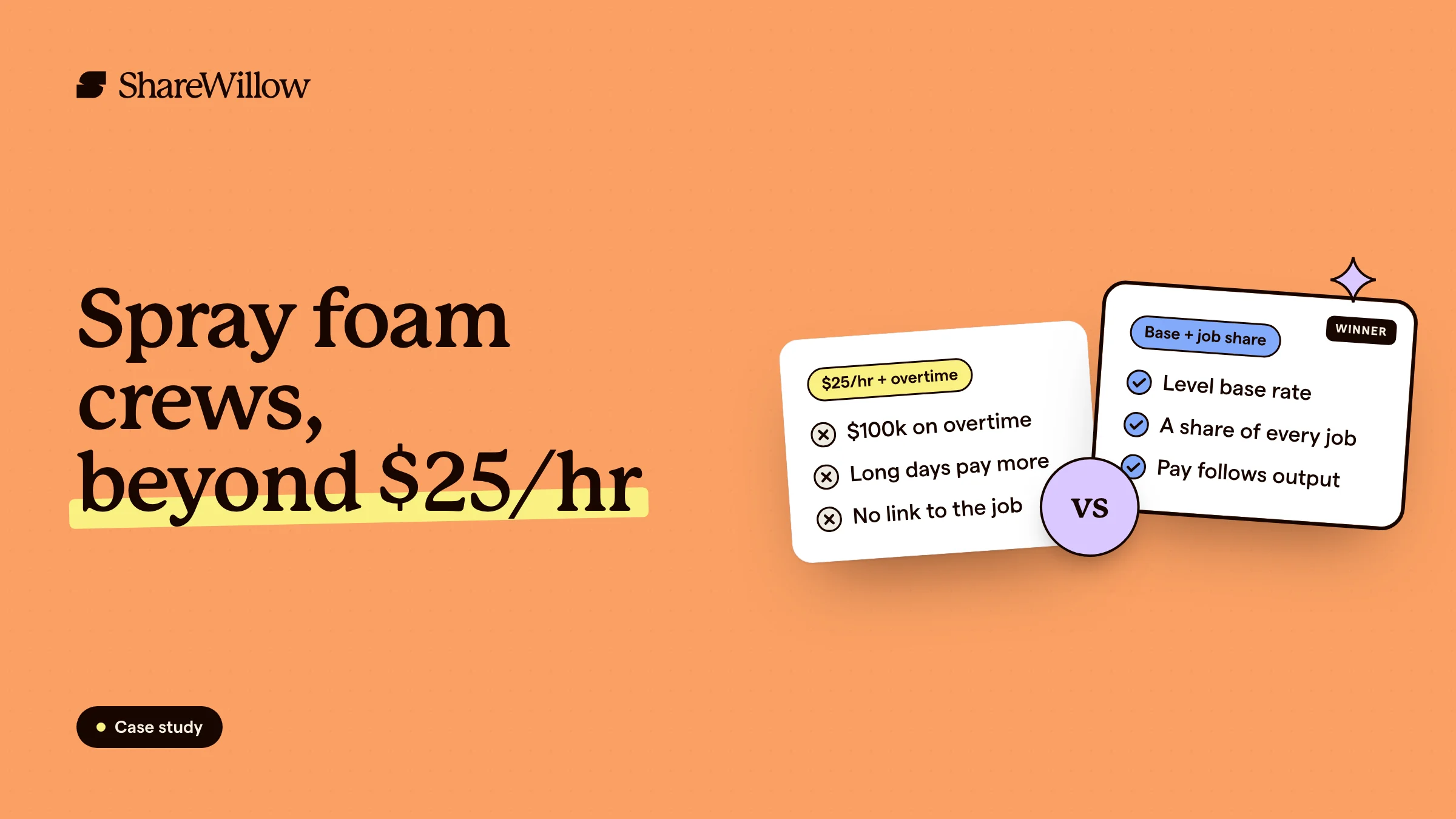
How to pay spray foam installers: one company with $25-an-hour crews earning $100,000 on overtime is moving to a level base rate plus a share of each job.
How to pay spray foam installers when overtime has become the pay plan
If you are trying to work out how to pay spray foam installers, the owner of a Midwest insulation company has a number that will sound familiar. Crew members on $25 to $28 an hour are earning more than $100,000 a year. Nobody got a raise to get there. They got there on overtime, and that overtime was never built into the price of a single job.
The company sprays foam in new construction, existing homes, and metal pole barns, and it also runs concrete lifting and blown-in insulation crews. Somewhere between 30 and 50 people would sit on the new pay plans. Jobs are scheduled in Jobber and payroll runs weekly. We spent most of an hour with the owner, the production manager, and the sales manager working through what should replace hourly pay.
One thing to say up front: this plan is not live. The company moved onto its field software in mid-October, so it has only a few weeks of clean job data, and the owner wants a shadow payroll in January before anyone's check changes. What follows is the problem in the owner's own numbers, the design on the table, and the rollout he is insisting on. There are no before-and-after results yet, and we are not going to pretend there are.
The problem: a paycheck that grows when the job runs long
Hourly pay has one incentive built into it, and it points the wrong way. The owner put it plainly:
We got guys that make 25, 28 bucks an hour making over a hundred thousand a year, and it's because the overtime is so drastic, and we don't have it built into our pricing model.
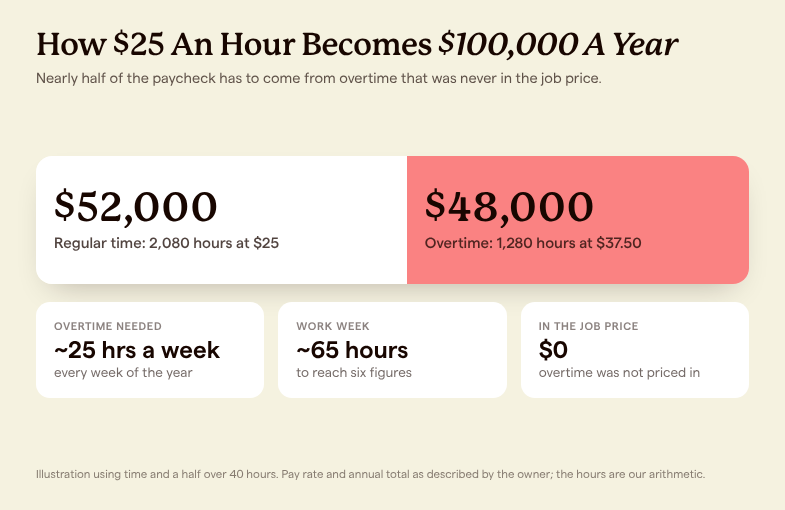
It helps to see what that takes. At $25 an hour, a full year of regular time is 2,080 hours, or $52,000. The other $48,000 has to come from overtime at $37.50, which works out to about 1,280 overtime hours, or roughly 25 a week, every week. That is a 65-hour week, all year. Those hours are our arithmetic, not a figure from the call, but they show how much of that income depends on the clock.
The owner does not think his crews are lazy. He thinks they are doing what the pay plan tells them to do. In his words, the people at the bottom of the labor pool “tend to drag their feet so that the job takes longer so they can make a higher paycheck.” Crews stay out until 7:00 at night because the last three hours of the day are the best-paid ones.
He also has the counterexample on his own payroll. One crew lead finishes $7,000 to $8,000 of installed work in a day and is back at the warehouse by 2:30. Under hourly pay, that lead earns less than a slower crew that produces the same revenue by dinner time.
There is a second cost that is easy to miss. To keep overtime from getting worse, the owner holds hourly rates lower than he would like. So the fast crews are underpaid on rate, the slow crews are overpaid on hours, and the job price covers neither.
Travel makes it harder. The company works up to two and a half hours from its base, so a crew can spend two to four hours a day in the truck. Crews clock in at the job site for job costing, but they are paid warehouse to warehouse. Any new plan has to pay for drive time without rewarding the drive.
The plan on the table: a level base rate plus a share of every job
The design the owner came in with has two layers.
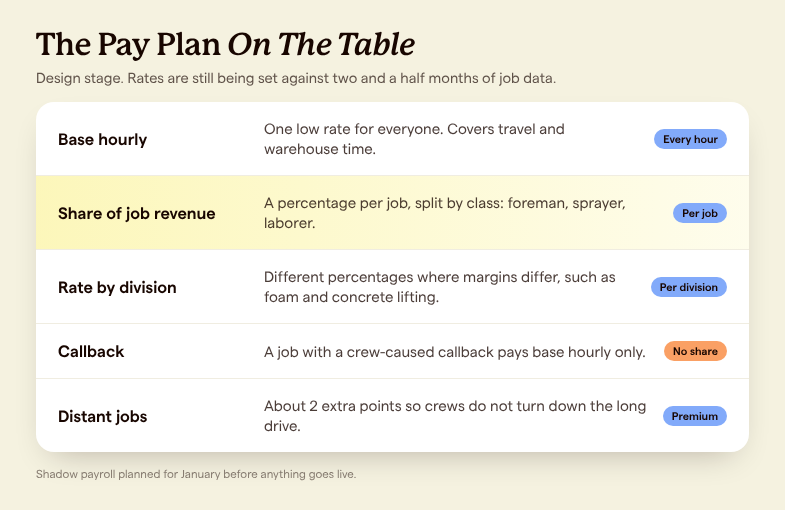
A base hourly rate that is the same for everyone. He floated $10 and $15 an hour as placeholders. The base covers every hour on the clock, including the drive and the time loading at the warehouse, and it comes straight from the payroll system.
A percentage of job revenue on top. When a job is completed, a set percentage of that job's revenue goes to the crew that did it. The share is split by job class, so a sprayer earns a larger piece than a laborer and the foreman has a defined piece of his own. Skill gets paid through the share instead of through a patchwork of hourly rates.
The effect is the one in the owner's favorite line from the call:
They don't have to work until 7:00 every night because they're just trying to build a paycheck. We're gonna pay them the same amount if they get done at 3:00 or 7:00.
To get a feel for the size of it, the owner said a foam crew installs $25,000 to $35,000 a week. During the call we used 9% as an illustration for foam work. At 9%, a $30,000 week would put $2,700 into the crew's share, on top of base pay. That rate is not decided. It is a placeholder to show the mechanics, and the real number will come out of the job data.
Different rates for different divisions
Foam, concrete lifting, and blown-in insulation do not carry the same margins, so they will not carry the same percentage. Our illustration on the call was 6% for concrete lifting against 9% for foam. The method matters more than the numbers: decide what share of each division's revenue can go to field labor, subtract what base pay already costs, and what is left is the room for a job share. A fencing company we work with did the same thing when it back-solved a 7% crew commission from a 12% labor target.
A callback pays base only
Paying by the job creates the opposite risk from paying by the hour. Crews can rush. The owner's answer is short:
If you get a callback, you make your $15 an hour, and that's it.
A job with a callback pays base hourly and no share. The production manager added a condition that makes the rule fair: the cause of each callback gets tagged in the field software as crew-caused, equipment, or a sales setup error. A crew does not lose its share because a salesperson measured wrong or a machine failed.
A premium for the long drive
The company has a salesperson working a metro area about two hours away and hopes to open a satellite location there in 2027. Until then, crews have to make the drive, and the owner already knows the objection. He voiced it himself: why would I want to work two hours away if I make the same as I do 15 minutes from the warehouse?
The fix under discussion is roughly two extra percentage points on distant jobs. Base pay covers the hours in the truck, and the premium makes the trip worth volunteering for.
Rotating crews so nobody cherry-picks
A big pole barn is a better payday than a retrofit in an existing home. If crews can choose, the easy revenue goes to whoever asks first. The plan is to rotate crews across job types over a month or a quarter, so the mix evens out. This is the same tradeoff a coatings company weighed when it compared production pay vs hourly pay for crews and landed on a team bonus instead.
Keeping the plan legal and the crews on board
The company has been through a payroll audit before, and the owner was clear that the structure has to hold up. Three points came up that apply to any installer plan built this way.
- The base still has to clear minimum wage, and it has to be paid for every hour worked, drive time included.
- Overtime does not go away. When a crew member works past 40 hours, the job share generally has to be folded into the regular rate before the overtime premium is calculated. We covered the mechanics in a post on overtime pay for commissioned employees. The difference under the new plan is that extra hours no longer raise the paycheck on their own.
- Have an employment attorney or payroll provider review it for your state before launch. This is not legal advice.
The sales side stays put, with one exception
Salespeople keep their existing commission, which is paid when the customer pays. The team asked for one manual override: when a crew error, such as overspray, delays payment, the rep should not wait on a commission through no fault of their own.
The owner also wants to rebalance what reps chase. Concrete lifting has a minimum ticket of about $1,000. A rep with seven lifting leads in a day would rather run three insulation estimates worth many times more. A richer commission on lifting and a higher minimum are both on the list.
A rollout built to be boring
This year was a rebuilding year with heavy turnover, and the owner will not risk another round of it:
We can't introduce a whole new pay structure and have our employees be upset and start jumping ship. The rollout has to be methodical. It has to be bulletproof.
So the sequence is slow on purpose. Collect about two and a half months of job data through December. Run a shadow payroll in January that shows every crew member what they were paid and what the new plan would have paid for the same weeks. Only then decide on a switch date. A small pilot of two or three people was discussed. Our recommendation was to shadow the whole team at once, because a pilot crew gets treated differently and its results do not tell you much about everyone else.
How to pay spray foam installers: a checklist from this design
- Find out how much of your payroll is overtime. If a $25 rate is producing six-figure W-2s, the clock is your real pay plan.
- Check whether your job prices include it. If they do not, every long day comes out of margin.
- Set one base rate that covers all hours, including travel and warehouse time.
- Add a share of job revenue, split by class. Foreman, sprayer, and laborer each get a defined piece.
- Set the percentage by division. Work backward from the labor share each line of work can carry.
- Write the callback rule and the cause codes together. Crews should only lose pay for callbacks they caused.
- Pay a premium for distance if you need crews to take the far jobs willingly.
- Shadow it before you switch. Show people both numbers for a month.
If you are weighing other ways to structure the share, our guide to bonus structure examples walks through the common options. And if you would like to see a job-share plan calculated automatically from your field software, ShareWillow's incentive plan features handle the splits, the callback rule, and the weekly payout report.
Frequently asked questions
Should spray foam installers be paid hourly or by the job?
Hourly pay is simple, but it pays more when a job takes longer. Pay by the job rewards finishing, but it needs a quality rule. The design in this post uses both: a base hourly rate for every hour on the clock, and a share of job revenue that is the same whether the crew finishes at 3:00 or 7:00.
What percentage of the job should a spray foam crew get?
There is no single right number. On this call we used 9% of job revenue for foam and 6% for concrete lifting as illustrations only. Start with the share of revenue you can afford to spend on field labor in each division, subtract base pay, and test the result against a few months of real jobs.
How do you stop crews from rushing when they are paid by the job?
Tie the share to quality. This company's rule is that a job with a crew-caused callback pays base hourly only. Tagging the cause of each callback keeps the rule fair when the problem came from equipment or the original estimate.
Related reading
- Production Pay vs Hourly Pay for Crews: Why a Coatings Company Is Moving to a Team Bonus Tied to Forecast Hours
- Fence Installer Pay: How a Fencing Company Is Back-Solving a 7% Crew Commission From a 12% Labor Target
- Overtime Pay for Commissioned Employees: How One Installer Company Pays the Greater of Base or Performance Pay
- 9 Bonus Structure Examples Employees and Employers Love
Conclusion
Pay a level base for every hour on the clock, pay a share of each job on top, and a crew earns the same whether it finishes at 3:00 or 7:00.
See what performance pay would pay your techs.
On a free call, we'll show you what your techs would earn for the great work they already do.
Book a free call
Ryan Shank is the founder of ShareWillow. Before ShareWillow, he spent 15 years building software for the trades and founded PhoneWagon, which CallRail acquired.