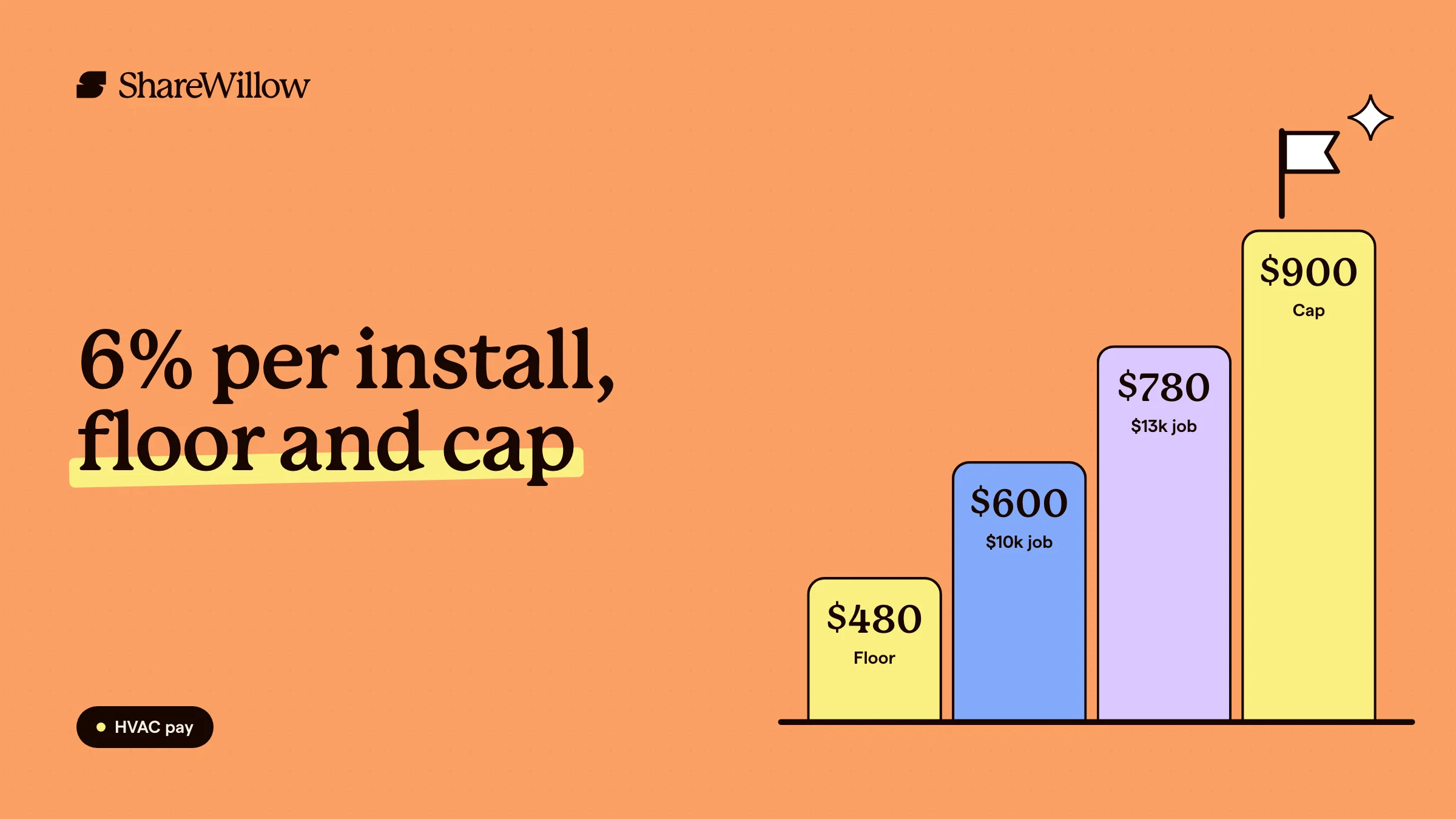
How to pay HVAC installers: one company pays 6% of each install invoice with a $480 floor and a $900 cap, steadying pay on $7,000 to $18,000 jobs.
How to pay HVAC installers when a $7,000 job and an $18,000 job take the same day
If you are working out how to pay HVAC installers, you have probably looked at the same three options everyone looks at: keep them hourly, pay a flat amount per install, or pay a percentage of the invoice. Each one breaks somewhere. Hourly pay gives nobody a reason to finish clean and on time. A flat amount ignores the job that came with a media filter, a new line set, and a condensate pump. A percentage looks fair until you notice that your biggest tickets are big because of the equipment, not because of the labor.
A franchise HVAC company we work with ran into exactly that last problem this month. The owner is moving a small team from straight hourly pay to a plan that pays for performance, and he is testing every piece of it against real weeks before any technician sees a number. Service was straightforward. Install was not.
What he landed on is simple enough to explain on a whiteboard: 6% of each install invoice, never less than $480 and never more than $900 per job. This post walks through why those three numbers were chosen, what they pay on real ticket sizes, and two smaller decisions from the same conversation that are worth borrowing. If you run an HVAC company with install crews, the reasoning will transfer even if your numbers are different.
The problem: install labor does not grow with the ticket
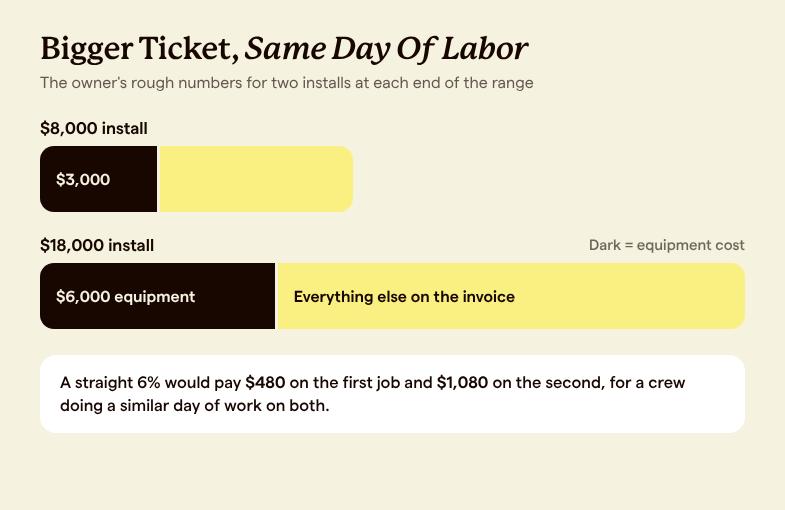
This company's install tickets run from about $7,000 to about $18,000. The spread comes mostly from the size and tier of the system, from a 1.5-ton unit up to a 5-ton unit. The owner put rough numbers on it. An $8,000 system might carry about $3,000 in equipment. An $18,000 job might carry about $6,000.
The crew, though, is doing a similar day of work on both. Two people, one house, one changeout. The larger system does not take twice as long to set, braze, wire, and commission. So a straight percentage of the invoice pays the crew more than double for the bigger job without the labor changing much at all.
That was the owner's first worry, and it was a specific one. His technicians are hourly today, so he knows what a day of install labor costs him. A percentage that looks reasonable on an average ticket can pay well above that cost on a large one. He also pointed out the things that quietly erode an install after the invoice is written: a partial refund, a callback, a change in equipment cost. The commission was calculated on the invoice, but the job-costing report at the end of the month tells a different story.
His second worry pulled the other way. He did not want a flat rate. A flat amount per install is easy to budget, but it is hard to adjust for the total ticket and the extra work. When accessories are added to a job, the crew has more to install. He wanted the people doing that extra work to earn more for it, and a percentage does that automatically.
So the question was not percentage or flat. It was how to keep a percentage and still stop it from running away at the top or collapsing at the bottom.
The answer: 6% with a $480 floor and a $900 cap
The formula the owner chose has three parts, and each one has a reason he could say out loud.
The rate is 6% of the install invoice. This is the part that moves with the job. Add accessories and the invoice goes up, so the award goes up with it.
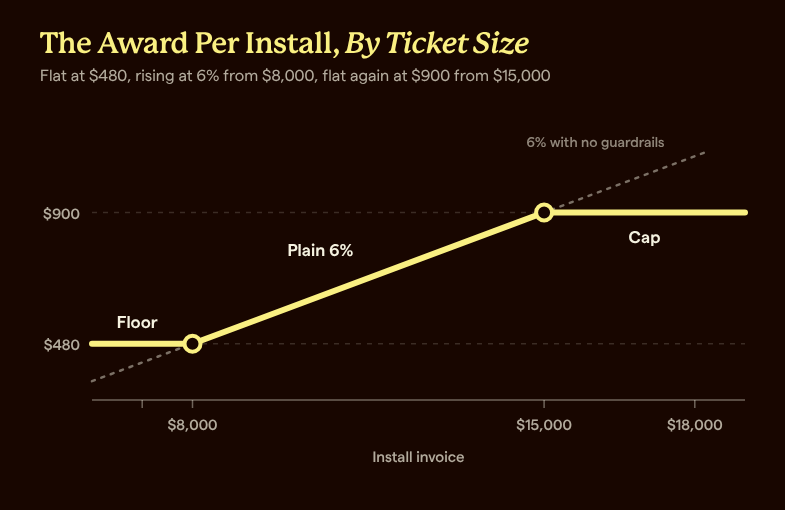
The floor is $480 per job. He built it from the labor he already pays. Two technicians at $30 an hour for an eight-hour day is $480. If the percentage ever comes out below that, the job pays $480. An installer should never look at a full day on a smaller system and see less than a normal day's wages attached to it.
The cap is $900 per job. That is 6% of a $15,000 invoice. Above that ticket size, the extra dollars on the invoice are mostly equipment, so the award stops climbing.
Here is what that pays across the range of tickets this company actually sells:
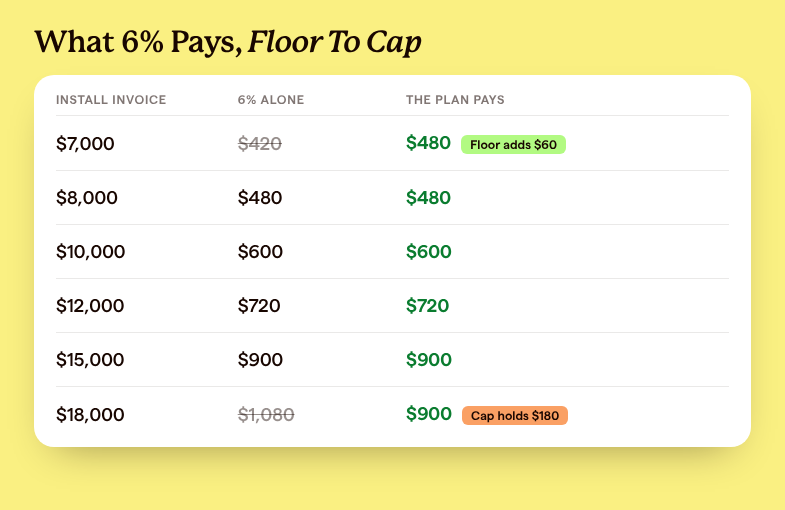
Two things stand out in that table. First, the floor only matters below an $8,000 invoice, because 6% of $8,000 is exactly $480. A $7,000 job would have paid $420 on the percentage alone, and the floor lifts it by $60. Second, the cap only matters above $15,000. An $18,000 job would have paid $1,080 on the percentage, and the cap holds it at $900, which works out to 5% of that invoice.
In between, from $8,000 to $15,000, the plan is a plain 6%. That is where most of the incentive lives. A crew that installs a system with added accessories earns more than a crew that sets the bare system, which is what the owner wanted from the start.
The effect on labor cost is the part owners care about. Across a ticket range that more than doubles, from $7,000 to $18,000, the install award stays inside a band of $480 to $900. As a share of the invoice, it moves between about 6.9% at the bottom and 5% at the top. A percentage with no guardrails would have paid $420 to $1,080 on the same jobs.
Paid per invoice, not per day
One rule keeps the math honest. The award is measured against each paid invoice, not against the number of days the crew spent on site. A job that runs into a second day is still one invoice and one award. That removes any reason to stretch a changeout, and it means the plan only pays once the customer has paid.
Timing matters more than most owners expect. We covered the tradeoffs in a separate piece on when to pay technician commission, and the short version is that paying on the paid invoice avoids clawing money back later.
Categories stay separate on purpose
The company's installs were already sorted into separate categories in its field service software. The owner kept them that way, even though one formula now covers all of them. If a few months of data show that one type of job deserves a different rate, a different floor, or a different cap, he can change that category without rebuilding the plan. Another company took that idea further and now pays a different rate by equipment level, which we wrote about in HVAC install commission by equipment tier.
Two smaller decisions worth copying
Show the ranking, not the dollars
The owner asked a question a lot of owners ask quietly: is it normal to show technicians every metric, every percentage, and every dollar amount? The honest answer is that practices vary. Some companies share everything. Some share the structure and keep individual payouts private.
He chose a middle path for three measures: average ticket, recalls, and reviews. Technicians will see where they rank on each one, without dollar amounts next to the names. His reason was practical. Technicians had recently told him how they thought they were doing, and their impressions did not match the data. Some thought they were ahead when they were not, and some thought they were behind when they were fine. A ranking fixes that without turning the office TV into a list of paychecks.
Split the review award when two people did the job
The plan pays $15 for a five-star review. On an install, two people usually earned it. The rule is simple: when two technicians were on the job, each gets $7.50. The company's review requests already ask customers to mention the technician by name, and for now the reviews are entered by hand while the owner works out whether his review tool can tag the original job automatically.
That is a small number, but it answers the question a crew will ask on day one. If you are building a wider set of small awards like this, our guide to HVAC spiffs covers which ones tend to pay for themselves.
What happens next
None of this has been shown to the team yet, and that is deliberate. The owner has been running the whole plan in the background for several weeks, comparing what it would have paid against what hourly pay actually cost. The new install formula is being applied to those prior weeks so he can look at real invoices and see what 6% with a floor and a cap would have done on each one.
That review is the real test. If most of his installs land between $8,000 and $15,000, the floor and the cap will rarely trigger and the plan behaves like a simple 6%. If a lot of jobs sit at the cap, that is a sign to look at the rate or the ceiling for the larger categories. Either way he will know before a single technician opens the app. We track plans like this in ShareWillow so the invoice-level detail is there when the questions come.
A different company solved the same overpayment worry from the other direction, by starting with a fixed award and subtracting the labor already paid. That approach is laid out in our piece on an HVAC installation spiff with a labor deduction.
How to set your own floor and cap
You can build the same structure in about ten minutes with three numbers you already have.
- Find your floor. Multiply your typical crew size by the hourly rate and by the hours in a normal install day. That is the least an install should pay.
- Pick the ticket where labor stops growing. Look at your larger installs and find the invoice size above which the extra money is mostly equipment. For this company it was $15,000.
- Set the rate between them. Choose a percentage that pays fairly in the middle of your range, then multiply it by the ticket from step two to get the cap. Check that the floor lands near the bottom of your real ticket range, not in the middle of it.
- Backtest it. Run the formula against the last two or three months of paid install invoices and compare the total with what you paid in hourly labor on those same jobs.
More real examples
The same question comes up with other companies. Here is how a few of them answered it, with their numbers.
How One Company Pays 6%, 7%, and 8% by Invoice Item
HVAC install commission by equipment tier: one company pays 6%, 7%, or 8% by invoice item and swapped a 2% lead rate for a flat $125 payout.
The company is early in the rollout, so this is a plan-design story rather than a results story. There is no payout total to brag about yet. What there is, though, is a set of specific decisions that most HVAC owners will recognize, and a few traps the team caught before the first paycheck went out.
Many install plans pay a single percentage on every system, whatever is on the invoice. It is easy to explain and easy to run, and it quietly treats a basic like-for-like swap the same as a premium system with better efficiency, better warranty terms, and a higher margin to the company. The technician gets no reason to walk a homeowner through the better option, because the better option pays the same.
How an HVAC Company Subtracts Job Labor From an $800 Award and Pays Only the Remainder
An HVAC installation spiff that subtracts job labor first: see how one company pays only the remainder of an $800 award, after the job is paid in full.
The company runs installation, service, sales, service management, and CSR roles out of ServiceTitan. Its plans cover installers, service technicians, one salesperson, and a service manager, and about eleven people had not yet been invited to the platform when the setup call happened. Here is how the install plan works, why each rule exists, and where an owner can borrow from it.
Most install spiffs look like this: complete a system, earn a set amount. It is clean and technicians understand it. The weakness shows up on the jobs that go sideways.
How an HVAC Company Charges a Fixed $50 Callback Back to the Original Install Crew
HVAC commission chargeback explained: a fixed $50 callback charge follows the original install crew, and commission waits until the job is paid in full.
This is a plan-design story, not a results story. The company was still building its plans at the time of the call. But the choices it made are specific, and they answer two questions that trip up almost every HVAC pay plan: who pays when an install comes back, and when exactly does a commission count as earned?
The company runs two kinds of work through the same service department. Install crews put in new systems. Residential service technicians handle repairs. When an installed system has a problem later, a service technician is the one who gets sent to fix it.
FAQ
What percentage should I pay HVAC installers?
It depends on what the percentage sits on top of and how your tickets are priced. This company chose 6% of the install invoice with a $480 minimum and a $900 maximum per job. The right rate for you is the one that matches your install labor target when you run it against real invoices.
Is it better to pay HVAC installers per job or by the hour?
Hourly pay is predictable but gives no reason to finish efficiently. Per-job pay rewards a clean, on-time install but needs guardrails so small jobs still pay a fair day and large jobs do not overpay. A percentage with a floor and a cap is one way to get both.
Should install pay be based on the invoice or on days worked?
Basing it on the paid invoice keeps the award tied to what the customer bought and removes any reason to stretch a job into a second day. This company treats a two-day install as one invoice and one award.
Related reading
- HVAC Installer Bonus: How One Company Set $300 to $1,000 Awards by Job Type Before Its First Payout
- HVAC Install Commission by Equipment Tier: How One Company Pays 6%, 7%, and 8% by Invoice Item
- Technician Bonus Cap: How an Epoxy Flooring Company Capped Crew Bonuses at $400 Per Job After 3 Techs Passed It
- HVAC Commission Pay: How to Design a Plan That Drives Profit (Not Problems)
- Performance-Based Pay: Definition, Benefits, Challenges & Tips
Conclusion
Build the floor from a real day of crew wages, set the cap where labor stops growing, and backtest the rate on paid invoices before launch.
See what performance pay would pay your techs.
On a free call, we'll show you what your techs would earn for the great work they already do.
Book a free call
Ryan Shank is the founder of ShareWillow. Before ShareWillow, he spent 15 years building software for the trades and founded PhoneWagon, which CallRail acquired.