How to pay pest control technicians: one company's weekly plan starts at $3,000, pays 1% to 3%, and backtested at $50 to $150 extra per tech each week.
How to pay pest control technicians without paying for rushed work
Ask ten owners how to pay pest control technicians and you will hear ten answers: straight hourly, hourly plus a bonus, production pay, a cut of every ticket. Each one solves a problem and creates another. Hourly pay is simple, but it does not reward a strong week. Production pay rewards a strong week, but it can also reward a fast, careless one, and in pest control a careless job comes back as a free return visit.
One small pest control company that focuses on rodent exclusion work just launched a plan that tries to hold both ideas at once. Hourly pay stays exactly as it is. On top of it, technicians earn a weekly commission that only begins once they complete $3,000 in revenue, a $20 award for every five-star review that names them, a 10% commission on estimates they write, and a quarterly award for keeping return visits low.
The owner walked the whole field team through the plan on launch day, and the questions the technicians asked are the same ones your team will ask. This post covers the plan, the numbers from a two-month backtest, and the data problem the owner caught in the very first payout review. If you run a pest control team of any size, most of it will transfer.
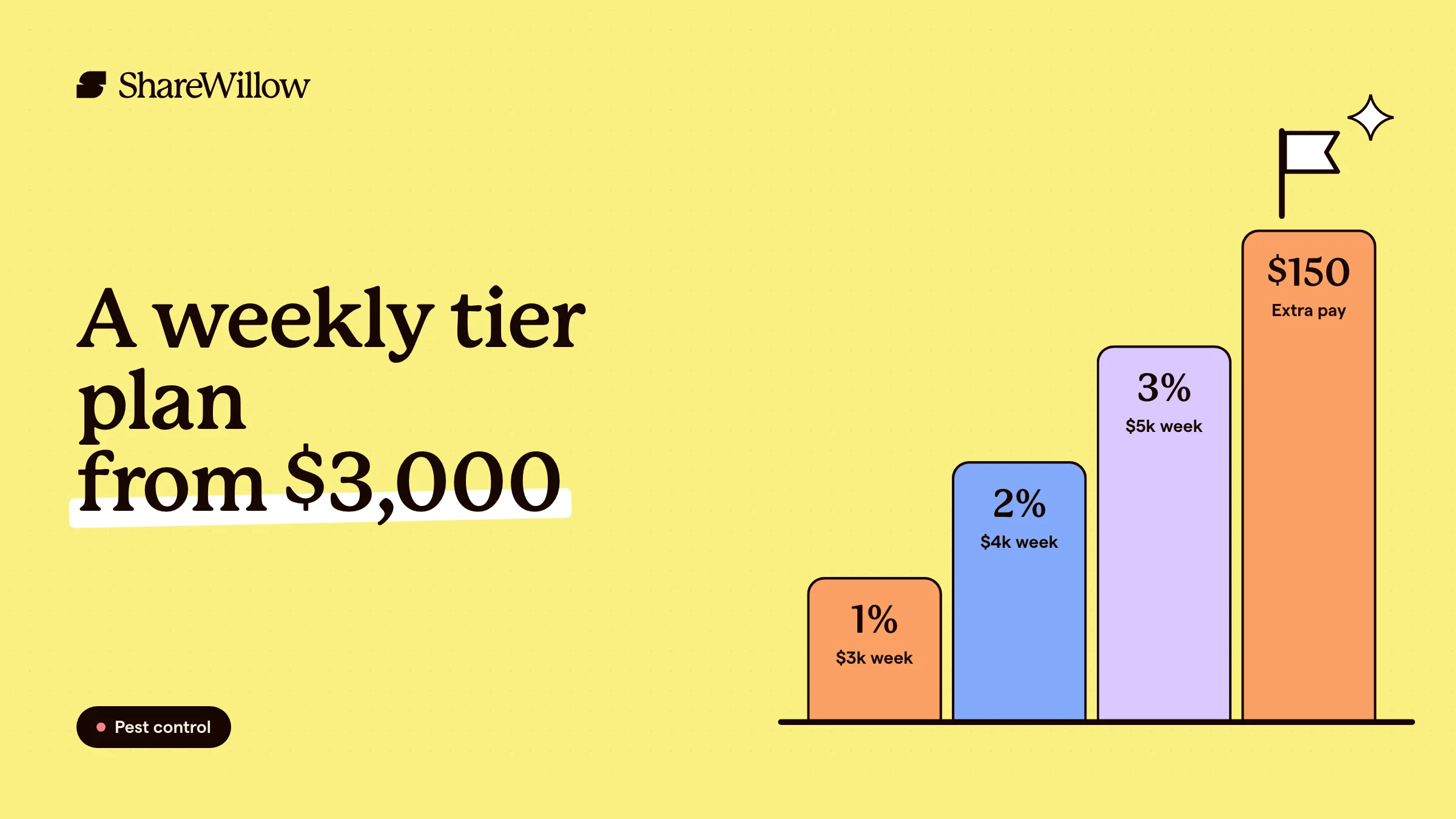
The weekly plan: nothing under $3,000, then 1% to 3%
The core of the plan is a tiered revenue commission, paid every week because payroll runs every week. Each technician's completed revenue for the week is added up. Below $3,000, there is no commission. Once the week passes $3,000, the technician earns 1%, and the rate steps up to 2% and then 3% at higher weekly totals.
Two details matter more than the percentages.
Shared jobs are split. Most of this company's work is done by two or three people at a time. If a $300 job has two technicians on it, each one is credited with $150, not $300. That keeps the company from paying commission on the same dollar twice, and it means the $3,000 line is a real measure of what one person produced.
Revenue is the ticket, not the payment. One technician asked what happens when a customer refuses to pay the second half of an invoice after the work is done. The answer: commission is based on the total ticket amount for the completed job, not on what has been collected. The owner said disputes like that are rare, so the team is not punished for them. If a customer drops a service at the end of the job, the ticket is adjusted and the commission follows the adjusted amount.
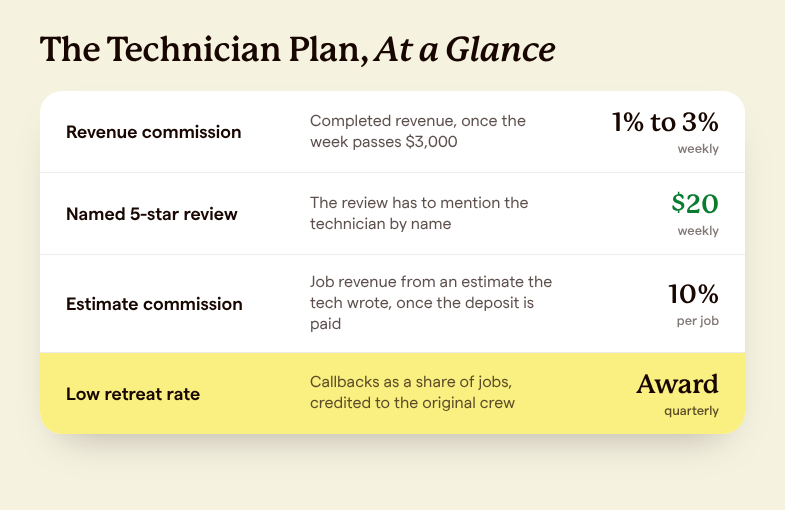
The rest of the technician plan is short:
- $20 for each five-star review that mentions the technician by name, paid weekly
- 10% of the job's revenue when a technician writes the estimate and the customer pays the initial deposit
- A quarterly award for keeping the retreat rate low
If the tiers look modest, that is on purpose. The plan sits on top of hourly pay, so nobody's base changes and nobody can earn less than before. For a broader look at how to set tier lines and rates, our guide to tiered bonus structures walks through the tradeoffs.
A separate ladder for the person who sells the work
One member of the team handles most of the estimates and also works on the jobs. Putting him on the same ladder as everyone else would have undersold what he does, so he has his own version of the plan. The starting line is the same $3,000 in weekly completed revenue, but his rate begins at 2% and jumps to 5% once his week passes $5,000. He also earns the 10% estimate commission on every job he sells.

The owner explained it to the team with a simple example. If three people install $15,000 of work in a week, that revenue is split three ways, which credits each of them with $5,000. For the estimator, that is enough to reach the 5% tier. The message was direct: the more completed work the crew gets through in a week, the more everyone takes home.
The estimate commission pays when the deposit is paid, which keeps it tied to real, booked work. We covered that part of this company's design in detail in an earlier case study on paying commission on estimates when the deposit lands.
The backtest: $50 to $150 a week per technician
Before anyone was enrolled, the plan was run against the company's actual weekly revenue for September and October. This is the step most owners skip, and it is the one that made the launch meeting easy. Instead of describing a formula, the owner could show each person what they would have earned.
For the two technicians, the busy weeks in September would have added more than $100 to a paycheck, and in some weeks more than $150. In a slower October week, the plan still would have paid $50 to $100. The estimator would have reached his 5% tier in several of the recent pay periods that were reviewed.
Those are not life-changing numbers, and nobody on the call pretended they were. What they are is believable. A technician can look at a week he remembers and see the amount next to it. One of the technicians summed up his read of the plan this way: the customer gets quality work, the company gets reviews, and the team gets paid more, so everyone wins.
The technicians also asked a clarifying question worth planning for: is this paid every week, every two weeks, or every quarter? The answer is both weekly and quarterly, depending on the award, and it needs to be said plainly. Revenue commission, review awards, and estimate commission follow the weekly paycheck. The quality award follows the quarter.
Quality: a retreat rate measured over a full quarter
In pest control, the quality problem has a name. A retreat is a return trip to a job that should have been finished the first time. Every retreat costs a truck, a technician, and a slot on the schedule, and it earns nothing.
This plan measures each technician's retreat rate, the share of completed jobs that led to a return visit, over three months. The award is paid when the rate stays low. The call did not set a public number for the target, but the reasoning behind the quarterly window was clear: with a weekly measure, a single retreat would wipe out the award, and people stop trying once the award is gone. A quarter gives a large enough pool of jobs that one bad day does not decide the outcome.
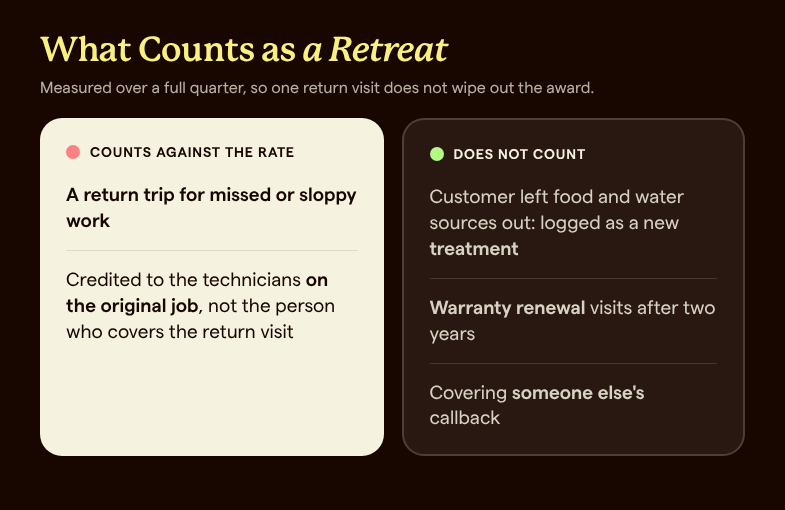
The technicians pushed on the edges right away, and the answers are worth copying:
- Credit goes to the original crew. If you cover a return visit on a job someone else did, it does not count against you.
- Customer behavior is not a retreat. When a customer keeps leaving food and water sources out and the mice keep coming, the next visit is logged as a new treatment, which is a different job type.
- Warranty renewals are not retreats. The company inspects homes again after two years, and those visits get their own job type so they stay out of the rate.
The owner also gave the crew a habit to go with the metric. At the end of each job, before anyone heads home, the technicians check each other's work and try to find three or four things the other person missed. The point, he told them, is not to criticize each other. It is to teach each other, because each of them notices things the other does not.
If you are weighing a deduction instead of an award, compare this with how an appliance repair company handles it in our piece on a technician callback policy with a free allowance.
The first payout review caught a missing job
After the technicians left the call, the owner opened the first weekly payout to review it, and one technician's revenue looked light. This is exactly what a first review is for.
Going through the list job by job turned up two things. The first was harmless: a job the owner expected to see under one technician was correctly sitting under the two people who were assigned to it. The second was a real gap. A rodent sealing job that four people had completed at the end of the week was not in anyone's revenue. In the company's field service software, the visit had been saved as a lead with a future date on it, not as a completed job. The work was done, but the record said otherwise, so the plan had nothing to pay on.
The owner recognized the cause. Converting a lead into a job in his system can move the lead on the calendar without creating a separate job record. Two fixes came out of the call. In the short term, he can create a job tied to that lead so the revenue shows up. In the longer term, the plan is being checked to see whether lead records can be pulled in alongside jobs and matched against them, so a completed visit is counted once whichever way it was saved.
The lesson is not about one software product. Every incentive plan pays on whatever the system of record says happened. If a completed job can be stored in a way the plan does not read, a technician will be underpaid, and he will notice before you do. A payout view that shows every job behind every dollar turns that from an argument into a two-minute check.
What to take from this plan
- Keep hourly pay and add a threshold. A commission that starts at $3,000 a week pays for strong weeks without raising the cost of average ones.
- Split shared revenue. When crews work together, credit each person with their share so the threshold means something.
- Give the estimator a different ladder. The person who sells the work can have a higher rate and an estimate commission without changing the plan for everyone else.
- Measure quality over a quarter. A longer window keeps one return visit from ending the incentive.
- Define what does not count. Write the exceptions down as job types before the first dispute, not after.
- Backtest, then audit week one. Show people what they would have earned, and check the first payout job by job.
For another pest control team that moved from guesswork to predictable weekly pay, see our case study on a pest control commission structure built around capped payouts and quality deductions.
More real examples
The same question comes up with other companies. Here is how a few of them answered it, with their numbers.
How a 4-Technician Company Tied Weekly Pay to Revenue and Callbacks
A pest control technician commission plan with 1% to 3% weekly revenue tiers, $20 review bonuses, and up to $500 a quarter for a low callback rate.
A pest control company in the Midwest that specializes in rodent exclusion, with an owner and four field technicians, went live with its first incentive plan in mid-November. Until then everyone was paid hourly and nothing else. The owner wanted two things at once: more installs completed each week, and fewer jobs the team had to go back to. The plan he built with us pays for both, on separate clocks.
Here is how the plan works, what the back-test showed, and what the technicians said when they saw it. The plan has only been live for a short time, so the pay figures below come from running it against earlier weeks, not from months of results.
Why a Two-Technician Company Chose 13% of Completed Revenue and a $125 Bonus for Zero Callbacks
Pest control performance pay at a two-technician company: 13% of completed revenue against hourly, plus a monthly callback bonus of $125 at zero callbacks.
The company is small. It has two technicians. In winter, one works three days a week and the other works five. Both are paid hourly today. The owners were direct about what they wanted to fix. They called it the winter slump: less motivation, and technicians sitting in a driveway a little longer than the job needs, no matter what they are being paid.
One of them put the worry as a question on the call. Would a technician sit around and get only four jobs done, milking the hourly rate?
How a Pest Control Company Pays 10% When the Deposit Lands and Dates Every Job by the Day It Was Worked
Commission on estimates is easiest to run when it pays at the deposit. See how a pest control company pays 10% on collected deposits and dates jobs by work day.
The field team is four people, including a crew leader, and each technician finishes about four or five jobs a week. The owner still goes out and works jobs alongside them. Revenue commission was already on the books: technicians earn 2% of weekly revenue once they clear $1,400 and 3% once they clear $1,600, with a company goal of $3,000 a day, or $15,000 a week. What was missing was a clean way to pay for the work that happens before the work: the estimate.
This story is a good one to learn from because it surfaces two separate pay-timing problems at once. The first is when to pay a commission that depends on a customer deposit. The second is which date decides which week a job belongs to. Both sound like accounting trivia. Both quietly decide whether your technicians trust their paychecks.
Frequently asked questions
How do most companies pay pest control technicians?
Most pay hourly and add some form of incentive: a commission on completed revenue, a bonus per sale or review, or a production target. Straight commission is less common for service technicians because it can push people to rush. Keeping an hourly base and adding a commission above a weekly threshold is a common middle ground.
What is a fair commission rate for a pest control technician?
It depends on what the commission sits on top of. In this plan, technicians keep full hourly pay and earn 1% to 3% of completed revenue above $3,000 a week, while the person who sells jobs earns 2% to 5% plus 10% on estimates. Higher rates usually come with a lower base or a higher threshold.
How do you keep commission from hurting service quality?
Pair every production award with a quality measure. Here, a quarterly retreat rate rewards technicians whose jobs do not need a return visit, and the credit goes to whoever did the original work. Clear rules on what does not count, such as uncooperative customers and warranty renewals, keep the measure fair.
Related reading
- Pest Control Commission Structure: How One Company Traded Guesswork for a Plan Techs Could Predict
- Commission on Estimates: How a Pest Control Company Pays 10% When the Deposit Lands and Dates Every Job by the Day It Was Worked
- How a Pest Control Company Designed Pay That Rewards Quality, Not Just Speed
- How to Maximize Employee Performance with Tiered Bonus Structures
- How to Pay Lawn Care Technicians: Why a Company Producing $3,000 a Day Per Tech Is Moving From $20 an Hour to 10% of Every Job
- Performance-Based Pay: Definition, Benefits, Challenges & Tips
Conclusion
Start the commission where a good week starts, pay it weekly, measure quality over a quarter, and audit the first payout job by job.
See what performance pay would pay your techs.
On a free call, we'll show you what your techs would earn for the great work they already do.
Book a free call
Ryan Shank is the founder of ShareWillow. Before ShareWillow, he spent 15 years building software for the trades and founded PhoneWagon, which CallRail acquired.