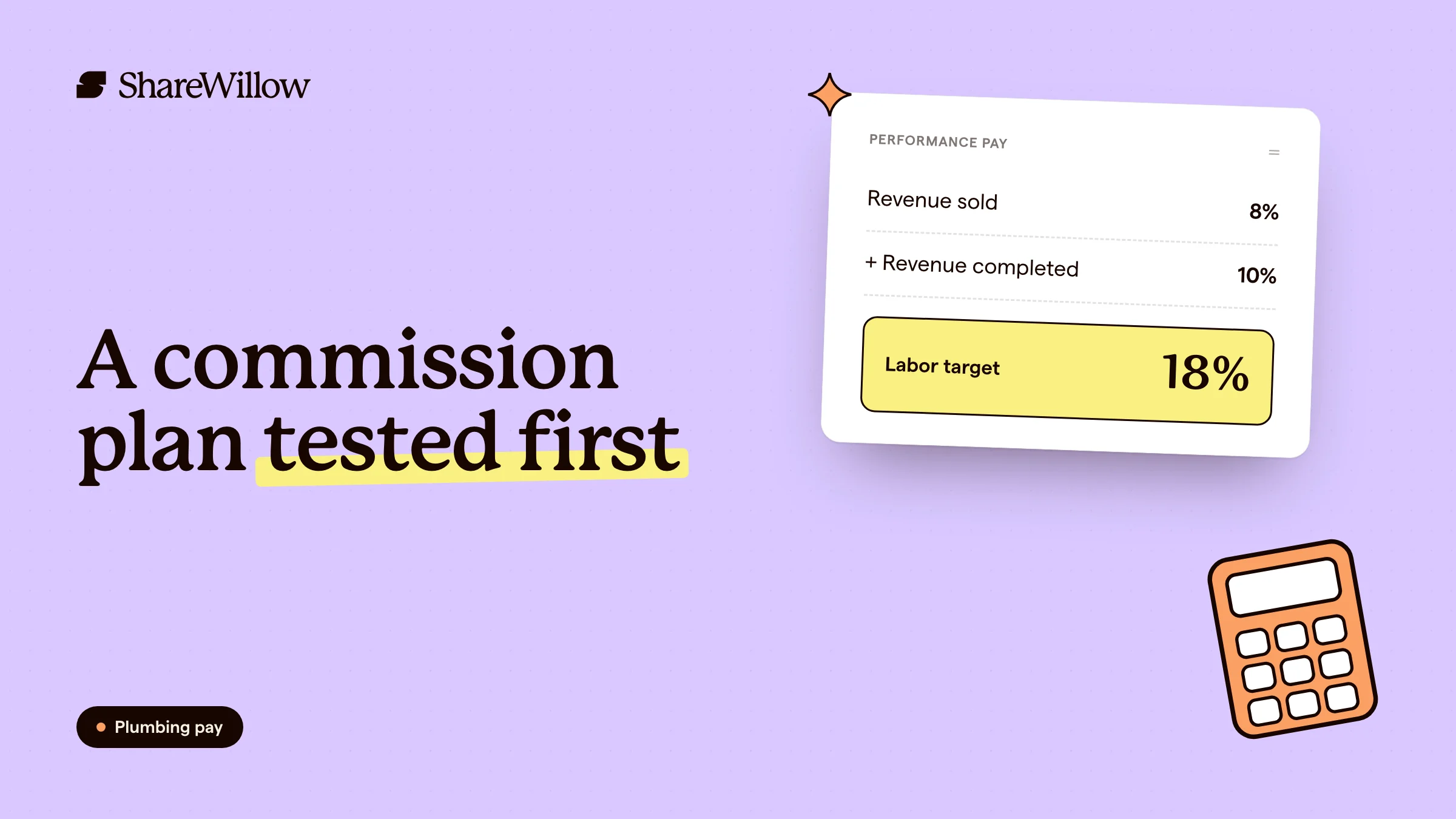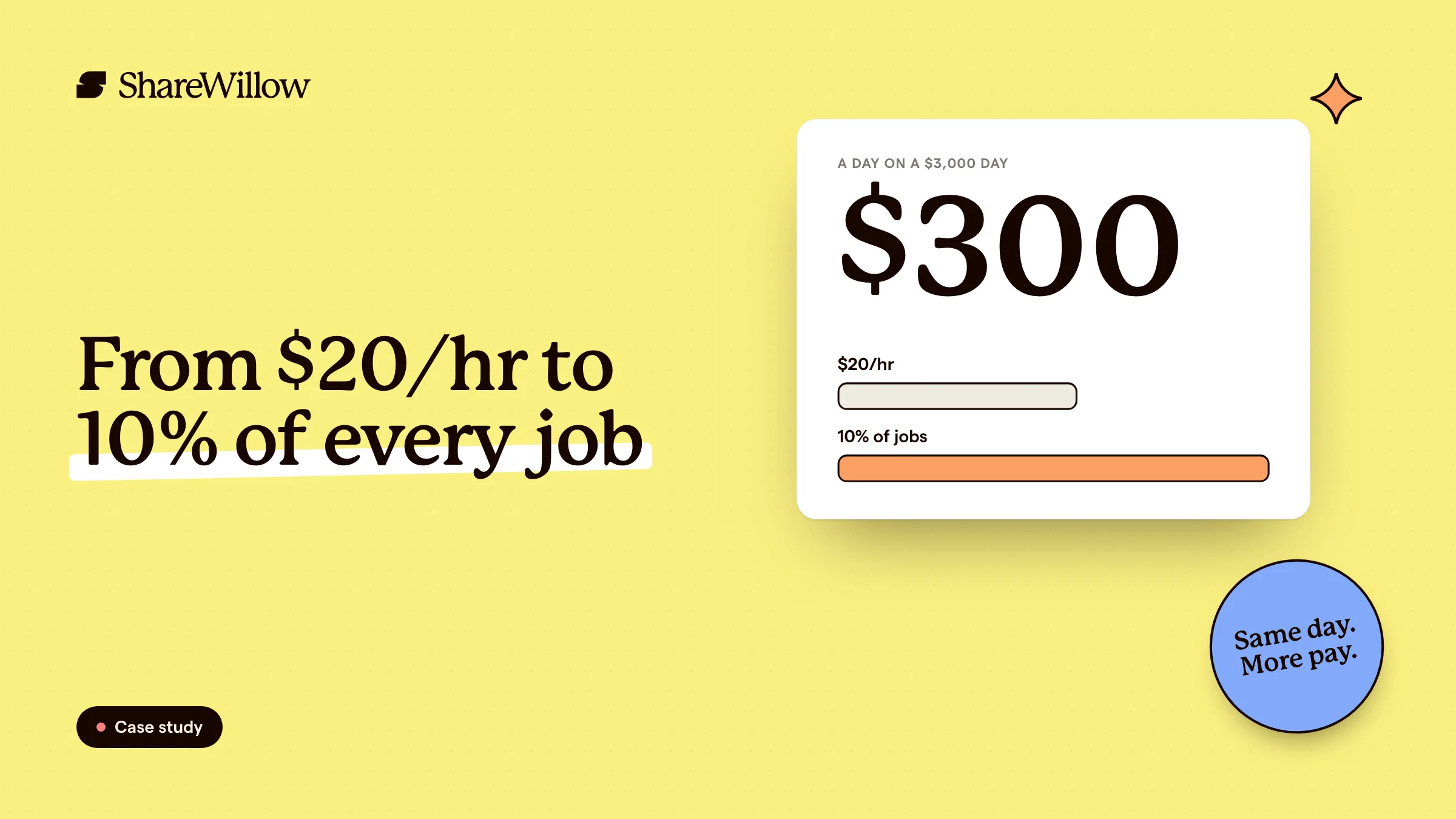
How to pay lawn care technicians: a company whose techs produce $3,000 a day is replacing $20 an hour with 10% of every job, turning $200 days into $300.
How to pay lawn care technicians who produce $3,000 a day
Most advice on how to pay lawn care technicians starts with the going hourly rate in your area. The owner of a small lawn and plant health care company in the Northeast started somewhere else: with what his two technicians actually produce. Each one averages about $3,000 a day in completed work. Each one was paid $20 an hour this year.
The company does lawn fertilization, weed control, and tree and shrub spraying. It will finish the year at about $1.1 million in revenue with two technicians in the field, each producing roughly $500,000. The owner wants to reach $1.5 to $2 million next year. He knows he will not get there, or keep the people he has, on $20 an hour.
On a recent call he walked us through the plan he wants to launch when the season opens on April 1: drop hourly pay as the main event and pay technicians 10% of every job they complete. This post covers the reasoning, the math, and the pieces we suggested adding. The plan has not launched, and the rate has not been tested against a full year of data, so everything below is design and arithmetic, not results.
The problem: hourly pay that ignores production
The owner was blunt about the gap between what his technicians bring in and what they take home:
Sometimes they're making like 4 or 5 thousand a day for me, and I'm only paying them an hourly rate. Right now I'm taking advantage of that, but I want to attract top talent.
At $20 an hour, a technician earns about $160 to $200 for a day in which he completes $3,000 of work. That is 5% to 7% of production. Both technicians are in their early twenties and new to the trade. The owner has offered $25 an hour for next year once they are licensed, but a $5 raise does not change the shape of the deal.
Hourly pay also produced a few behaviors he did not want to pay for:
- Rushing, then getting paid to come back. One technician hurried through jobs, generated a run of callbacks, and then earned overtime the following week returning to fix them.
- Hours as the goal. The technicians work 45 to 50 hours a week in season. One complains when a week comes in at 38.
- No reason to care about the equipment. Breakage was a recurring cost all year.
Why he ruled out budgeted hours
The owner belongs to a peer group where the popular answer is budgeted hours: estimate the time each job should take and bonus the technician for beating it. He considered it and passed.
His reasons are specific to route work. A lawn application can take five minutes. Traffic between stops is out of the technician's hands. Large properties often have no cell service, the mobile app crashes, and technicians do not reliably clock in and out of each stop. In his words: “I don't want to penalize my guys off of budgeted hours because they got stuck in a traffic jam.”
Budgeted hours can work well when the time data is solid. One landscaping company we wrote about learned what happens when it is not, when a report showing 31.83 hours saved turned out to be 54.25 real hours on a 50-hour bid. If you cannot trust the clock, do not build pay on it.
The plan: 10% of every job completed
The owner's rule is the one he repeated more than once on the call: keep it as simple as possible. His pitch to the technicians fits in two sentences.
You're getting 10% of every job that you do on the day. They average 3,000 a day, so you're making $300. You got a 50% raise from the get-go.
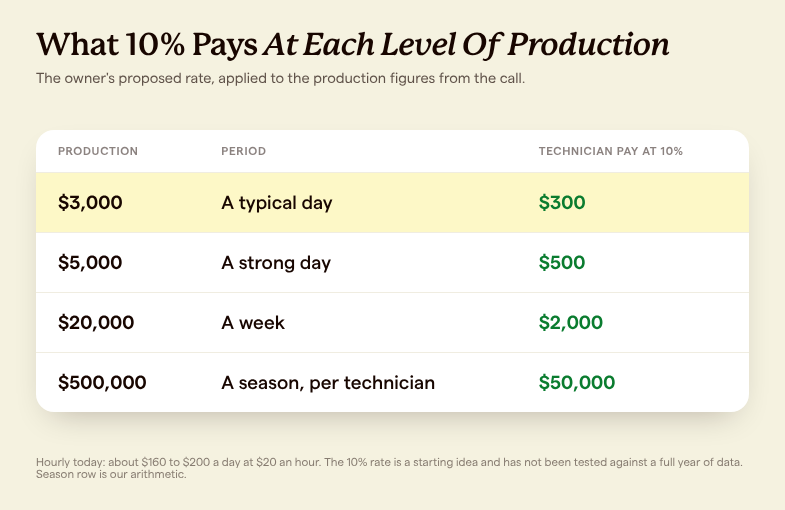
The math is easy to check in the truck. A $3,000 day pays $300. A $5,000 day pays $500. A $20,000 week pays $2,000. Revenue completed is already in the company's field software, so there is nothing new for a technician to track.
Is 10% the right number?
It is a starting point, and we said so on the call. Two pieces of arithmetic are worth doing before committing to it.
First, the season. A technician who produces $500,000 would earn $50,000 at 10%. The owner told us his goal is for both technicians to make six figures. At 10%, that takes $1 million of production per technician, or a different rate, or other pay on top. None of those is wrong, but the goal and the rate should be set knowing how they connect.
Second, the labor budget. Across the home service companies we work with, total labor from selling the job through completing it often lands around 20% of revenue. A company paying 10% to the technician has room left, but it also has a salesperson to hire and a winter crew to pay. The right percentage depends on what labor costs today, which is why the first step in onboarding is to run 12 months of real jobs through the plan. A pest control company did the same and found its weekly tier plan backtested at $50 to $150 extra per technician before anyone was told about it.
Keep an hourly floor underneath it
Pure commission has gaps. Rain days, yard days, and the weeks of door-knocking and prep before April 1 produce no completed revenue. Our suggestion was a “greater of” structure: track hours as usual, calculate an hourly amount, calculate the 10%, and pay whichever is higher each period. The floor can be modest. Its job is to cover the slow days and keep the plan on the right side of minimum wage and overtime rules, not to compete with the commission.
This is the same approach an HVAC company used when it protected base pay while launching a 5% service and 3% install plan. Technicians hear “you can only make more,” which is a much easier meeting than “your pay is changing.”
Callbacks without a deduction
The owner did not want to dock pay for callbacks, and he doubted it would be legal in his state anyway. Under a commission plan he does not need to. A callback is a return visit that earns no new commission. The company still covers the fuel and the product. The technician's cost is the time, which could have gone to a paying stop.
One caution we raised: the return trip is still time worked. It has to be recorded and it counts toward the hourly floor and toward overtime. What changes is that redoing a job stops being a way to earn more, which was exactly the problem under hourly pay.
Jobs done together
When both technicians work the same property, the ticket is split between them. The owner is also considering a three-person tree pruning crew for the winter. His first idea was 10% each. Our alternative was a 20% labor pool split 8, 8, and 4 between two leads and a helper, which holds the total at a known share of the job.
The details that keep a 10% plan honest
Commission follows the price the customer paid
The company offers a prepay discount: 10% off for customers who pay for the season before February 1, and 5% off before March 1. Commission will be calculated on the discounted amount. A program that lists at $1,000 and is prepaid at $900 pays the technician $90, not $100. It is a small rule, and it should be written down before the first payout, because it is the first question a technician will ask.
A year-end equipment allowance
Instead of charging technicians for broken equipment, the owner plans a $3,000 year-end bonus that unnecessary breakage is charged against. Treat the sprayer well and the full amount is yours in December. It turns a cost nobody owned into a balance each technician can see.
The salesperson: a draw, then 8%
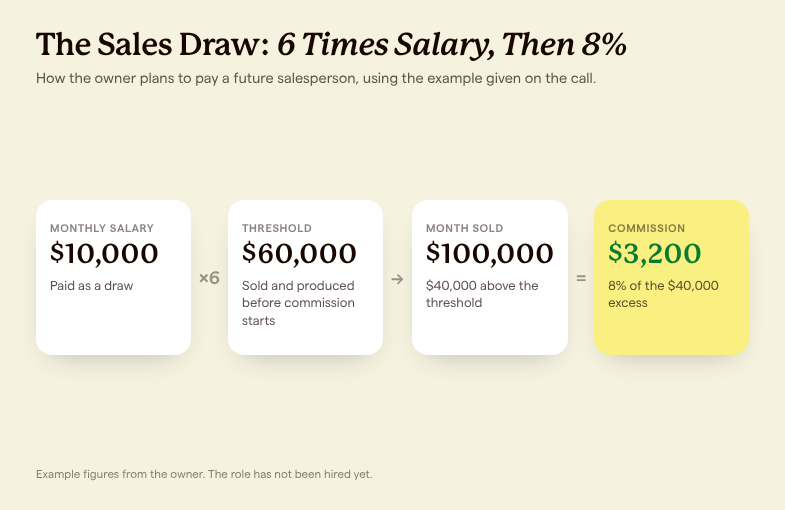
A salesperson is on the hiring plan for next year, and the owner already knows the structure he wants, modeled on a former employer. The example he gave: a $10,000 monthly salary treated as a draw. The rep has to sell and produce six times that, or $60,000, before commission begins. Above the threshold, the rep earns 8%. Sell $100,000 in a month and the commission is 8% of $40,000, or $3,200.
If you are considering a draw, read how one company found only $9,900 of commission behind $24,000 in draws before you set the threshold.
What happens next
The company's field software does not offer an open connection for outside tools, so the data will take some extra work to bring in. The owner is planning to revisit in February and wants to be live for the April 1 start. Between now and then, the job is to pull the last 12 months, run both technicians through 10% with an hourly floor, and see what each would have earned by week.
How to pay lawn care technicians: the short version
- Compare pay to production. Divide a technician's daily pay by the revenue he completes. If the answer is 5% to 7%, your best people can see it too.
- Pick a metric you already trust. Completed revenue is in your software today. Per-stop time often is not.
- Set the rate from your labor budget, then check it against the income you want technicians to reach.
- Put an hourly floor under it for rain days, prep weeks, and compliance.
- Decide the callback rule, the split rule, and the discount rule before launch.
- Backtest a full season. Lawn care revenue is uneven, and one good week proves nothing.
Our guide on how to calculate bonus pay covers the formulas behind each of these. If you run route-based crews and would like the commission, the floor, and the splits calculated for you, see how ShareWillow works for landscaping and lawn care companies.
Frequently asked questions
Should lawn care technicians be paid hourly or commission?
Hourly pay is predictable but pays the same for a $2,000 day and a $5,000 day. Commission ties pay to production but leaves gaps on rain days and in the off season. Many companies combine them by paying the greater of an hourly amount or a percentage of completed revenue each pay period.
What commission percentage do lawn care technicians get?
It varies with pricing and route density. The owner in this story is starting at 10% of completed revenue for fertilization and plant health care technicians, which turns a $3,000 day into $300. Test any rate against 12 months of your own jobs before announcing it.
How do you handle callbacks when technicians are paid on commission?
The simplest rule is that a return visit earns no new commission. The technician's time is still recorded and covered by the hourly floor, and the company covers materials. Because going back no longer adds to the paycheck, the incentive to get the application right the first time is built in.
Related reading
- How to Pay Pest Control Technicians: The Weekly $3,000 Tier Plan That Backtested at $50 to $150 Extra Per Tech
- Technician Commission vs Hourly Pay: How an HVAC Company Protected Base Pay While Launching a 5% Service and 3% Install Plan
- Landscaping Crew Bonus Plan: Why a 31.83-Hour Savings Report Turned Into 54.25 Real Hours on a 50-Hour Bid
- How to Calculate Bonus Pay: A Step-by-Step Guide to Fair and Motivating Compensation
- Performance-Based Pay: Definition, Benefits, Challenges & Tips
Conclusion
Measure pay against production, pick a rate technicians can check in the truck, and put an hourly floor under it before the season starts.
See what performance pay would pay your techs.
On a free call, we'll show you what your techs would earn for the great work they already do.
Book a free call
Ryan Shank is the founder of ShareWillow. Before ShareWillow, he spent 15 years building software for the trades and founded PhoneWagon, which CallRail acquired.