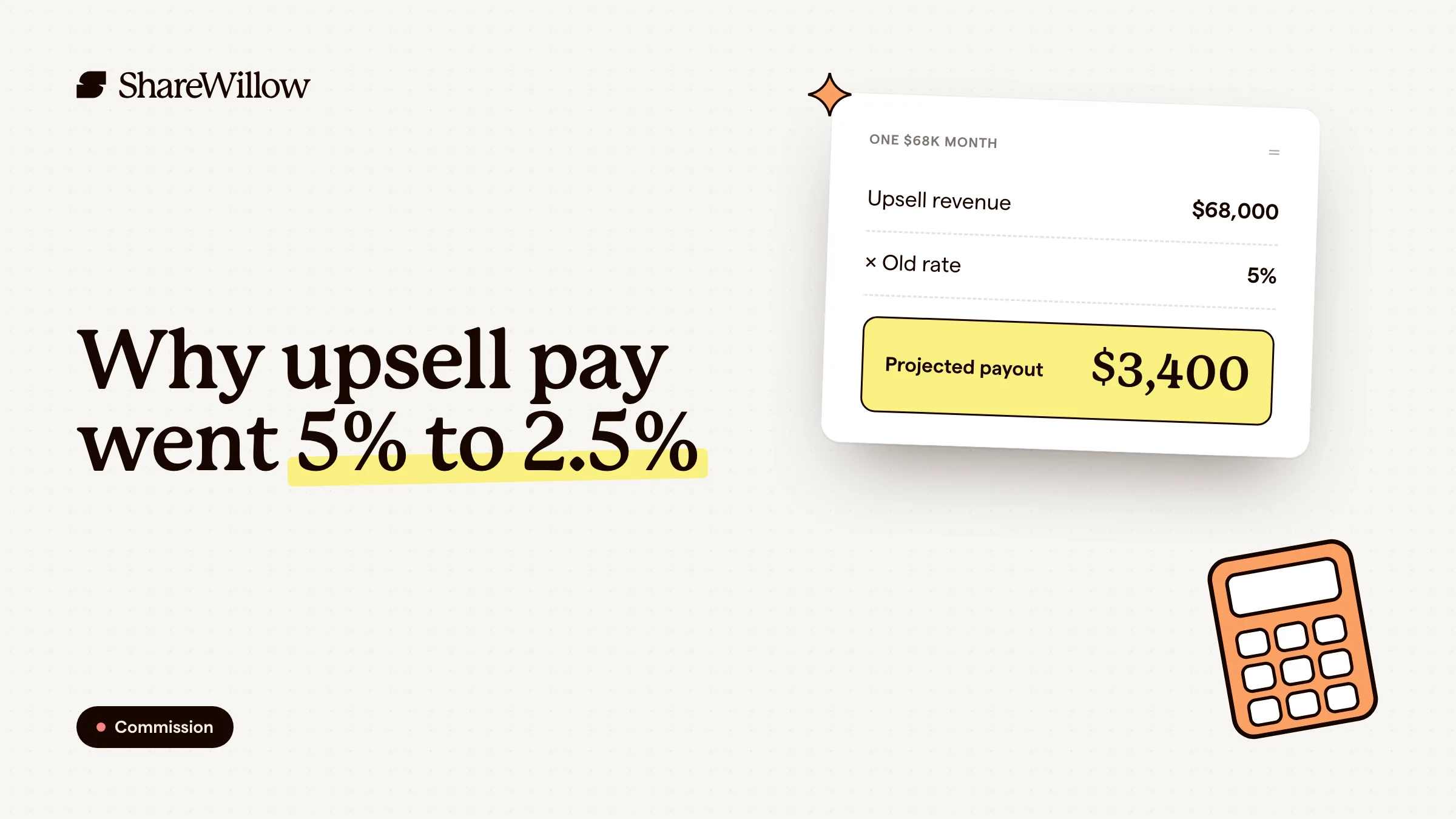
Service technician commission percentage: a 9-technician company cut upsell pay from 5% to 2.5% after a $68,000 month projected a $3,000 payout.
Ask ten owners what the right service technician commission percentage is and you will get ten answers, most of them somewhere between 2% and 10%. The number on its own tells you very little. What matters is what the percentage is multiplied by, and how many other rewards land on the same dollars.
A home service company we work with learned that early in the rollout of a new incentive plan. The company runs nine technicians across three pay levels, handling service calls, installs, after-hours emergencies, and residential and commercial memberships. The owner had built a plan with a handful of modest-looking rates: 5% here, 2.5% there, a few flat spiffs. Then one of his technicians opened the app, looked at his own projected payout, and walked over to show him.
The technician had done $68,000 in the previous month. His projected incentive was between $3,000 and $3,300, on top of his hourly pay. Across the four technicians enrolled at that point, the projected total was $4,400.
The owner's reaction on the call with our team was honest. "I definitely want to do this," he said, "but I don't want to get hurt." This post walks through what the plan looked like, why three small percentages added up to a large one, and the four changes the company made in a single call. Nothing here is a payroll result yet. These were projected payouts, caught before they became a habit, and the company is reviewing its first full month on the corrected plan in mid-November.
The Service Technician Commission Percentage Plan That Looked Safe on Paper
Here is the plan as it was first set up. Every technician was on it, with one difference by level: the monthly revenue minimum.
- Completed revenue: 2.5% of the technician's completed revenue, once a monthly minimum was reached.
- Service upsell: 5% on service jobs over $500.
- Install upsell: 5%.
- After-hours on-call jobs: 50%.
- Memberships: $10 per residential membership sold, $50 per commercial membership.
- Reviews: $25 for each five-star review.
The monthly minimums were $26,400 for Level 1, $29,000 for Level 2, and $36,960 for Level 3. Those figures were not picked out of the air. They were worked backward from each level's hourly rate and a target labor rate. The example our team used on the call: a technician earning $25 an hour, at a 20% labor target, needs to produce about $20,000 a month before incentives make sense.
That part of the design is sound. If you want the method, our guide on how to calculate bonus pay covers the same back-solving approach, and another company used it to sort its team in this tiered commission structure for technicians.
The trouble was not any single line. It was how the lines behaved together once a strong technician had a strong month.
Where a 5% Rate Turned Into a $3,000 Payout
The technician who showed the owner his number is a Level 3. He cleared his $36,960 minimum easily, so the 2.5% completed revenue bonus switched on. Much of that same revenue also came from service jobs over $500 and from installs he had recommended, so 5% applied to those dollars too. And he had taken after-hours calls.
Two problems were hiding in that stack.
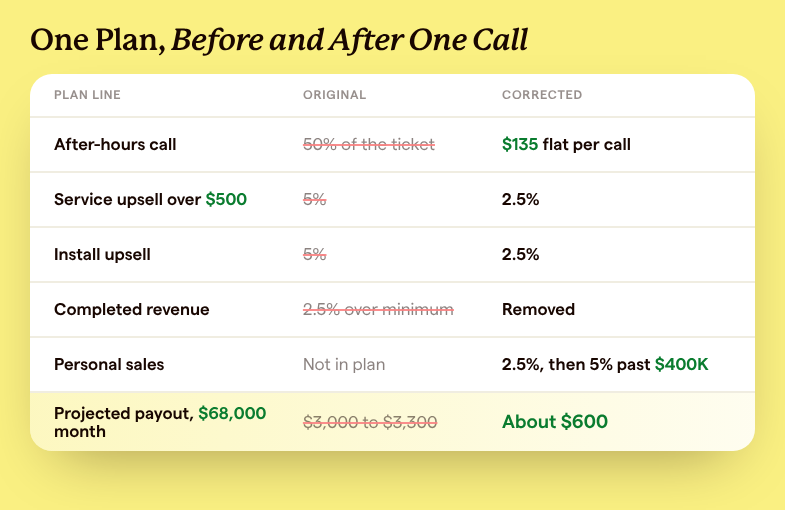
Problem one: the on-call line was paying on the wrong base. The owner's intent was to give the on-call technician half of the emergency fee the company charges for an after-hours visit, which is $269.99. The plan was configured as 50% of the entire after-hours ticket. Those are very different numbers. Take an after-hours call that turns into an $1,800 repair (our figure, for illustration). Half of the emergency fee is about $135. Half of the ticket is $900.
The owner saw it immediately once the payout was in front of him. "I can't give up 50% of the job," he said. "I'll be out of business."
Problem two: the same dollars were being paid twice. A $2,000 service repair counted toward completed revenue at 2.5% and toward the service upsell at 5%. Each rate looked reasonable alone. Together the technician was earning 7.5% on that job before any spiffs. Nobody had decided that 7.5% was the right service technician commission percentage. It was just what two overlapping rules produced.
Put the pieces together and a $68,000 month projected to roughly $3,000 to $3,300 in incentive pay, or about 4.4% to 4.9% of everything that technician produced, on top of his hourly wage. With nine technicians, the owner did the multiplication in his head and did not like the answer.
It is worth pausing on how this was caught. No audit found it. A technician found it, because he could see his own number, got excited, and showed his boss. "The guys are getting excited," the owner told us. "They start to see their numbers." The visibility that made the plan motivating is the same thing that surfaced the error early instead of months later.
The Four Changes Made in One Call
The owner did not want to scrap the plan. He wanted it to pay for the right things at a cost he could carry. Here is what changed.
- On-call pay became a flat amount. Half of the $269.99 emergency fee, rounded to $135 per after-hours call. The repair itself now flows through the normal rules like any other job. A different plumbing and HVAC company landed on the same logic, which we covered in technician on-call pay at 50% of the dispatch fee.
- Upsell rates were cut in half. Service upsells on jobs over $500 and install upsells both moved from 5% to 2.5%. The emergency fee is kept out of the $500 threshold, so an after-hours visit does not qualify as an upsell just because the fee pushed the ticket over the line.
- The completed revenue bonus was removed. The owner first considered trimming it to 1% or 1.5%. In the end he took it out entirely, because any rate on completed revenue would still pay a second time on dollars the upsell rule already covered.
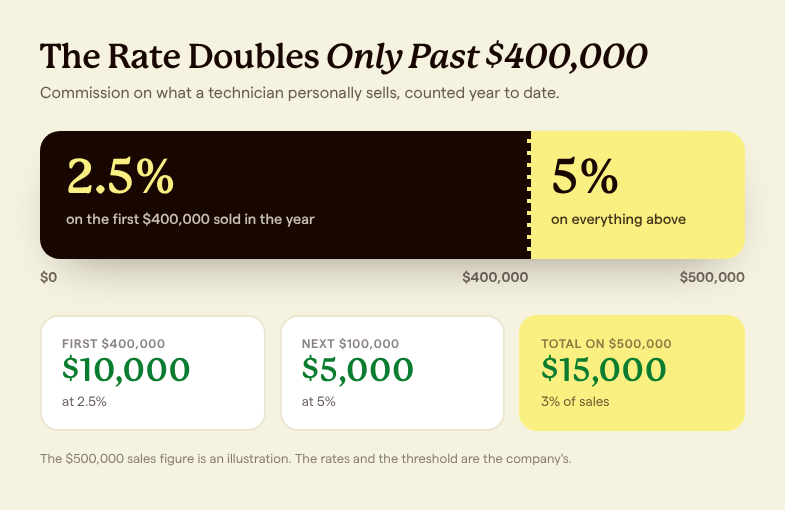
- A sales commission replaced it. Each technician earns 2.5% on what he personally sells, up to $400,000 for the year, and 5% on everything above that.
That fourth change carries the owner's real philosophy. He was clear that he did not want to pay commission on work the office booked and handed to a technician. He wanted to pay for work the technician created. Completed revenue rewards showing up. Sold revenue rewards finding the work. If the difference between those two is fuzzy in your own plan, the breakdown in sales commission on sold vs completed revenue is a useful read.
The three levels and their monthly minimums stayed. So did the $10 and $50 membership spiffs and the $25 review bonus.
What the Numbers Looked Like After the Fix
Our team rebuilt the plan while the owner was still on the line, and the projections updated in front of him.
- The technician whose payout started the conversation dropped from a projected $3,000 to $3,300 down to something closer to $600 for the same month.
- Another technician had taken four after-hours calls. Under the corrected rule that is four times $135, or $540. Clear, predictable, and easy for him to check.
- The $400,000 annual threshold is now in the system for every technician. Two of them already had offer letters promising exactly that 2.5% and 5% structure, so the plan finally matches what they were told when they were hired.
The year-to-date tier is worth a quick example, since it is the piece most owners have not seen before. Say a technician sells $500,000 in a year (our number, not the company's). The first $400,000 pays 2.5%, which is $10,000. The remaining $100,000 pays 5%, which is $5,000. Total sales commission: $15,000, or 3% of what he sold. A technician who stops at $300,000 earns $7,500. The rate only doubles for the people who are clearly carrying the company.
Is roughly $600 on a $68,000 month too low now? Possibly. The owner said as much: "I'm not trying to be cheap." That is why a review is already on the calendar for the middle of November, after a full month of real data. If technicians stop checking their numbers, or the payouts feel too thin to matter, the rates move again. It is much easier to raise a rate that was set carefully than to take back one that was set too high.
How to Set Your Own Rate Without Getting Hurt
A few lessons carry over to any company setting a commission percentage for service technicians.
- Write down the base for every percentage. "50% on after-hours calls" is not a rule until it says 50% of what. The fee, the ticket, the labor, the margin. Each one gives a different payout by a wide gap.
- Add up the rates that touch the same dollar. List one real job and run it through every line of the plan. If a single repair earns under three rules, the true rate is the sum, not any one of them.
- Test your best month, not your average one. Plans break at the top. Take your strongest technician's strongest month and calculate the payout before you announce anything.
- Pay for selling and for doing on purpose. Decide which one each rule rewards. Our longer guide to HVAC commission pay goes deeper on that choice and applies to most trades.
- Let technicians see the math. This company's error was found by a technician reading his own dashboard. If you want that kind of visibility without building it yourself, here is how ShareWillow shows each technician their numbers.
The company in this story is not a cautionary tale. It had sensible minimums, clear levels, and an owner who wanted his people to earn more. It also had one rule on the wrong base and two rules on the same revenue. Both were fixed in one call, before a single oversized check became the new expectation.
What is a typical service technician commission percentage?
There is no single standard, and most home service companies end up between 2% and 10% depending on what the rate is applied to. A rate on everything a technician completes is usually lower than a rate on what he personally sells. This company settled on 2.5% of personal sales up to $400,000 a year and 5% above that, plus 2.5% on upsells.
Should technicians earn commission on jobs the office booked?
That depends on what you want to reward. This owner chose not to, and moved from a completed revenue bonus to a commission on work the technician sells. If you do pay on completed work, keep the rate low and make sure it does not overlap with a separate upsell or sales commission on the same job.
How much should you pay a technician for an after-hours call?
A flat amount tied to the emergency or dispatch fee is the easiest to control. This company pays $135 per call, which is half of its $269.99 emergency fee. Any repair sold on that visit is paid under the normal commission rules, so the technician is still rewarded for the larger ticket without receiving half of it.
Related reading
- Technician On-Call Pay: How a Plumbing and HVAC Company Pays 50% of the Dispatch Fee and 3% on Discovery Leads
- Tiered Commission Structure for Technicians: How a Multi-Location HVAC Company Turned $15,316 in Weekly Sales Into a Real Payout
- Sales Commission on Sold vs Completed Revenue: How a 16-Person Home Services Company Caught $224,000 of Installed Work Posing as Sales
- HVAC Commission Pay: How to Design a Plan That Drives Profit (Not Problems)
- Incentives, Commissions, and Bonuses: What’s the Difference and Why It Matters
Conclusion
Name the base for every percentage, add up the rates that touch the same dollar, and test your best technician's best month before launch.
See what performance pay would pay your techs.
On a free call, we'll show you what your techs would earn for the great work they already do.
Book a free call
Ryan Shank is the founder of ShareWillow. Before ShareWillow, he spent 15 years building software for the trades and founded PhoneWagon, which CallRail acquired.