Technician on-call pay works when the base is clear. See how a plumbing and HVAC company pays 50% of the dispatch fee plus a 3% discovery lead commission.
Technician on-call pay: the part of the ticket nobody defined
Technician on-call pay is one of those items that quietly causes arguments. A technician takes the after-hours call, drives out, fixes the problem, and then wonders what share of the ticket belongs to them. The owner wonders the same thing from the other direction. A plumbing and HVAC company we work with was in exactly that spot, and while rolling out a new technician bonus plan it wrote down a rule that is simple enough to repeat from memory.
The company has plumbing service technicians, HVAC service technicians, and an install crew, spread across two technician levels plus a lead and helper structure for installs. Its bonus plan combines revenue tiers, membership sales, technician-generated leads, average ticket, callbacks, and on-call pay. This post covers the three pieces that were hardest to pin down: on-call pay, estimate commissions, and the discovery lead.
The on-call rule: 50% of the dispatch fee, nothing more
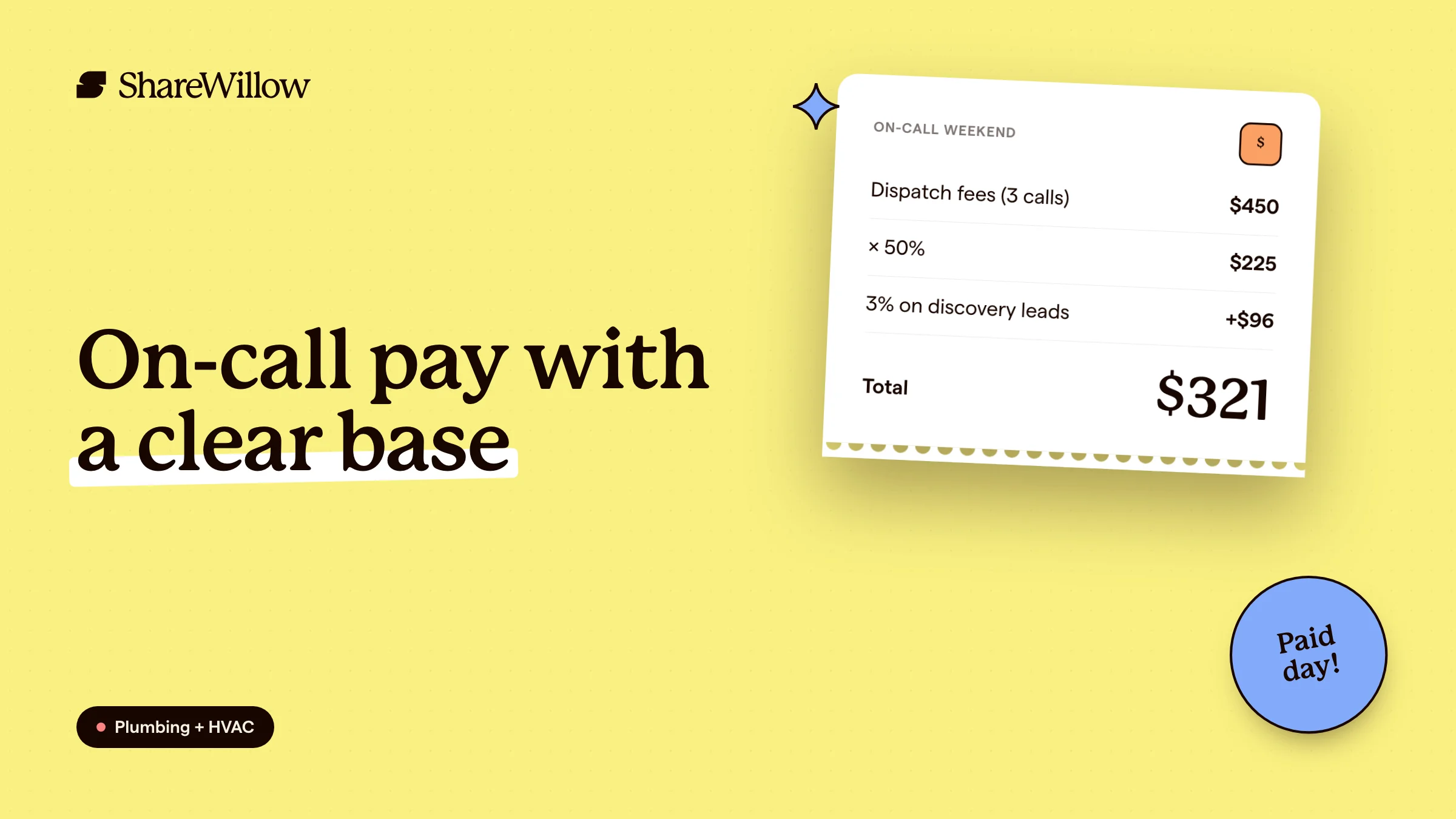
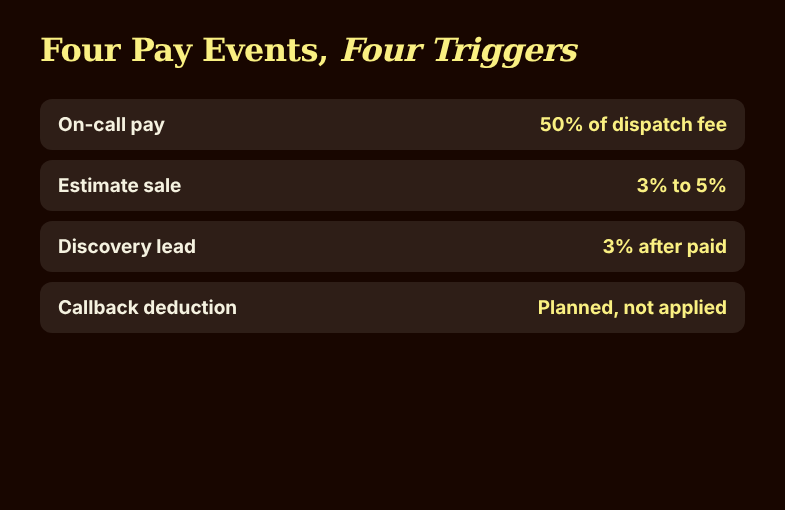
The company pays on-call technicians 50% of the dispatch fee. It does not pay 50% of the whole call. If the dispatch fee is $2.50, the technician earns $1.25. The remaining ticket amount, the repair or the replacement the customer actually buys, flows through the normal ticket-sale calculation like any other job.
That distinction matters more than the dollar figure suggests. If on-call pay were a share of the full ticket, an emergency water heater replacement would pay a technician half the job, and a small leak repair would pay almost nothing. Neither outcome tracks effort. Splitting the pay into two parts keeps it predictable: a fixed, small amount for taking the call, and the regular sales pay for what gets sold.
When we checked how the system was calculating it, it was already pulling 50% of the dispatch fee only, which is the behavior the owner wanted. That is worth verifying in any plan. A rule that is obvious in a conversation can still be set up incorrectly in the software, and nobody notices until a technician asks why a check looks off.
Why separate on-call from sales pay
Standby pay, call-out pay, and sales commission reward different things. Standby pay compensates availability. Call-out pay compensates the trip. Commission compensates the sale. Mixing them makes every dispute harder to settle, because nobody can say which part of the check is for what. Keep them separate and each one has a plain explanation.
Estimate commissions: 3% to 5% and a pending move to ticket sales
The company currently pays technicians 3% to 5% on estimate sales, depending on how the work is completed. The owner is considering moving to a ticket-sale structure, where technicians are paid on the sold ticket instead, and wants to see the difference in dollars before telling the team.
That is the right way to handle a change like this. Before anyone announces a new formula, run the last few payouts through both versions and compare. The company's operations lead sent a payroll report so the new numbers could be checked against what technicians actually earned. Installer figures looked close to ready, while the Level 1 and Level 2 technician figures needed another review to confirm the underlying math. A comparison like that is also the fastest way to learn how technicians are likely to react, because you can see who gains, who loses, and by how much.
If you are weighing the same decision, our guide to designing HVAC commission pay walks through how rates, tiers, and paid-date rules fit together. And if timing is part of your question, the case study on when to pay technician commission shows what happened when completed dates and paid dates disagreed.
The 3% discovery lead and why it stays manual
The second piece is the discovery lead. A technician who spots a failing system and identifies a likely replacement does something valuable even when the technician is not the one who sells it. The company pays 3% on those leads, but only under one condition: the sale has to be completed and paid.
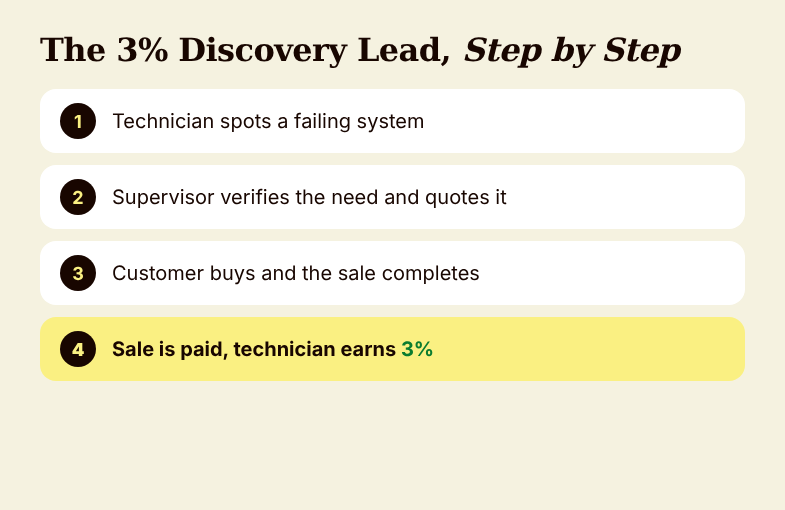
The path has four steps. The technician flags the problem. A supervisor verifies that a replacement is needed and provides the quote. The customer buys. Once the sale is paid, the technician earns 3%. Requiring payment protects the company from paying commission on a quote that never turns into cash.
Here is the practical wrinkle. Discovery work is currently marked with a "D" and the supervisor's initials on the work-order summary, not in a field in the field service software that can drive a calculation. Rather than build a fragile workaround, the company is handling these commissions as a manual entry that goes in with payroll. That is a perfectly reasonable answer. Not every pay event deserves automation on day one, especially when the data does not exist in a clean form yet. If you want to see what happens when technician-sourced leads are invisible in reporting, the story of a company that found $52K in tech-sourced sales its report showed as zero is worth reading.
The callback deduction nobody has enforced
The last item is the awkward one. Technicians have been told that callbacks will count against them, but the deduction has never been applied. Management held off because it expected pushback.
That is a common pattern, and it is a trap. An unenforced rule teaches technicians that the rule is optional, and the first time it is applied it feels like a surprise. The company plans to make the deduction a firm, visible part of the new plan, so it launches alongside everything else instead of arriving as a penalty later. If you want a model for how to do this cleanly, an HVAC company that charges a fixed $50 callback back to the original install crew shows one version with a clear, predictable amount.
What this means for your own on-call pay plan
You do not need two technician levels and an install crew to borrow the thinking. A few rules carry over to any home service company.
- Define the base. Say exactly what the on-call percentage applies to. A dispatch fee is easy to audit. A full ticket is not.
- Keep pay events separate. On-call, estimate commission, discovery leads, and callbacks each get their own trigger and their own line on the check.
- Require payment for lead commissions. Pay the discovery commission after the sale is collected, not when it is quoted.
- Be honest about manual entries. If the data lives on a work order, a manual entry beats a broken automation.
- Compare before you change. Run recent payouts through the old and new formulas so you know the impact.
- Enforce the rules you announce. A deduction that is never applied is not a policy.
The company is still validating the numbers before launch, so there are no final payout results to report yet. What it does have is a set of rules that each fit in one sentence, which is the best sign that a pay plan will survive contact with a payroll run. When technicians can also see their earning opportunities in the ShareWillow app, the cost of a missed sale or membership becomes visible, and the plan does some of the coaching for you.
Frequently asked questions
How much should you pay technicians for on-call duty?
There is no single standard, so choose a base you can audit. This company pays 50% of the dispatch fee, so a $2.50 fee pays $1.25, and everything else on the ticket goes through normal sales pay. Check your state wage rules for standby time as well.
Should technicians earn commission on leads they find but do not sell?
Many companies do, because spotting a failing system is real work. A common approach is a small percentage, such as 3%, paid only after a supervisor verifies the need and the sale is completed and paid.
What if the data for a pay rule is not in your software?
Handle it as a manual entry at first. Track it consistently on the work order, submit it with payroll, and automate it later once the data is captured in a field that can drive the calculation.
Related reading
- Technician Lead Generation Bonus: How an HVAC and Plumbing Company Found $52K in Tech-Sourced Sales Its Report Showed as Zero
- HVAC Commission Chargeback: How an HVAC Company Charges a Fixed $50 Callback Back to the Original Install Crew
- When to Pay Technician Commission: Completed Date vs. Paid Date, and the $6,600 in Open Balances That Forced the Question
- HVAC Commission Pay: How to Design a Plan That Drives Profit (Not Problems)
- Service Technician Commission Percentage: How a 9-Technician Company Cut 5% to 2.5% After a $68,000 Month Projected a $3,000 Payout
- Performance-Based Pay: Definition, Benefits, Challenges & Tips
Conclusion
On-call pay is easiest to defend when it has one clear base, and every other pay event has its own trigger.
See what performance pay would pay your techs.
On a free call, we'll show you what your techs would earn for the great work they already do.
Book a free call
Ryan Shank is the founder of ShareWillow. Before ShareWillow, he spent 15 years building software for the trades and founded PhoneWagon, which CallRail acquired.