HVAC labor cost percentage in practice: one company divides hourly pay by a 20% target, so a $32-an-hour tech must clear $14,000 a period before commission.
What HVAC labor cost percentage looks like when it becomes a number on a technician's screen
Most owners can tell you their HVAC labor cost percentage target without looking it up. Far fewer can tell you what that target means for one technician in one pay period. A percentage on a profit and loss statement does not tell a $32-an-hour technician how much work has to be finished before that pay rate is covered.
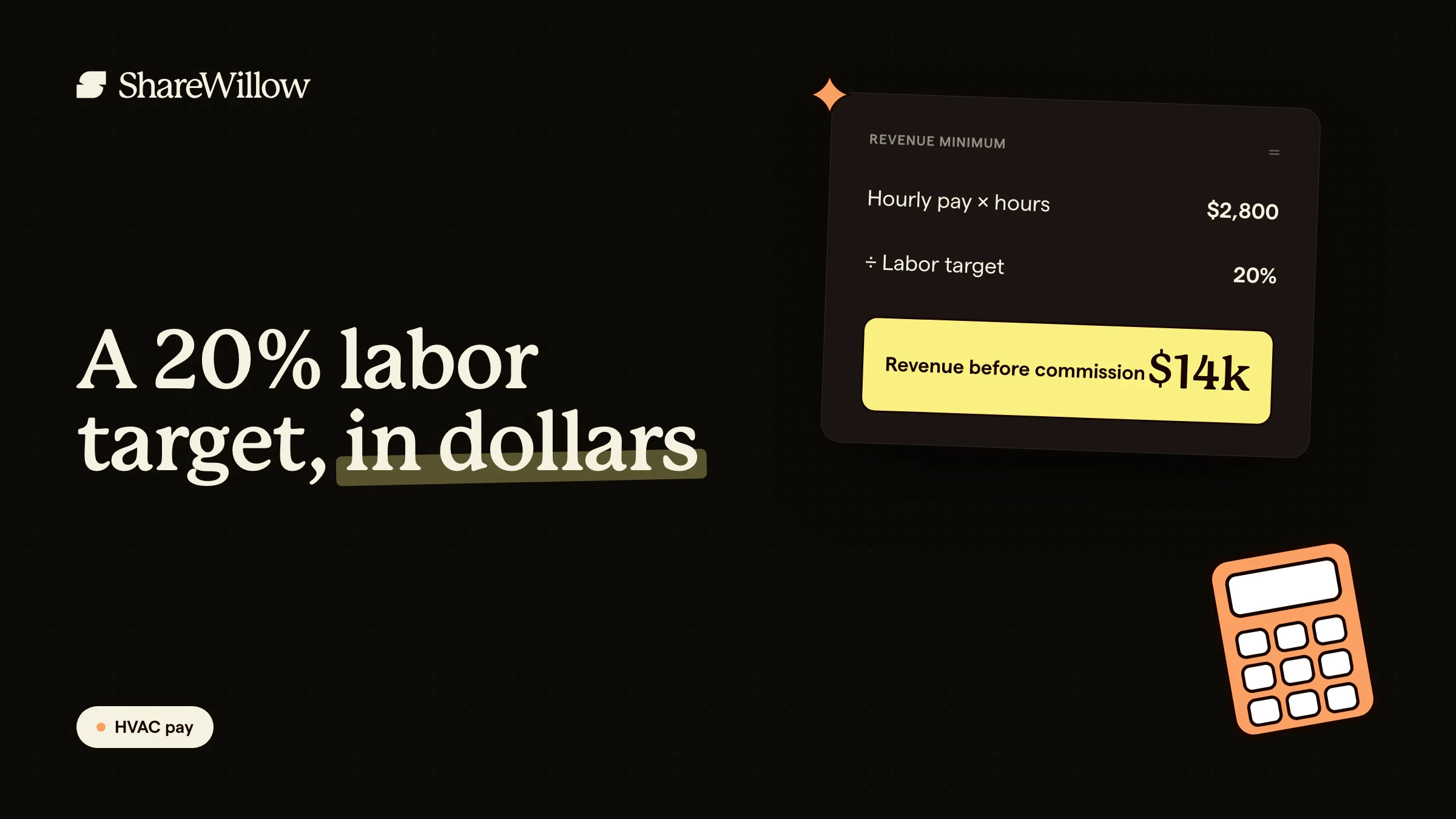
On a recent onboarding call, the owner of a small HVAC company walked us through a way to close that gap. The company runs a handful of service technicians on ServiceTitan and pays them every two weeks. The rule is simple: take what a technician costs in hourly pay for the period, divide it by the labor target, and the answer is the revenue that technician has to complete before any commission starts.
The target is 20%. When we asked whether a different number made sense, the answer was no. In the owner's words, that is the industry standard, and everything else is built around it.
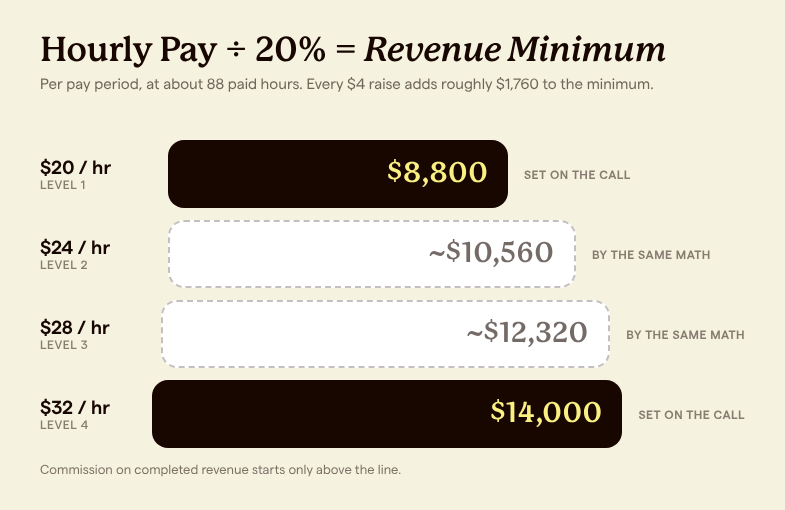
The result is a short table. A technician at $20 an hour has to complete $8,800 in a pay period. A technician at $32 an hour has to complete $14,000. Nothing is paid on top of hourly until the technician is past that line.
One thing to be upfront about: this plan has not been rolled out to the technicians yet. The owner plans to introduce it over the next two company meetings and use the data on the following payroll. What we can share today is the design, the math, and what a recent pay period looked like when the plan was run against real numbers. Those results were humbling, and they are the most useful part of the story.
The problem: a labor target that lived in the owner's head
Before this call, the company already had levels. Technicians were paid $20, $28, or $32 an hour depending on experience, and each level was supposed to carry its own revenue expectation. The trouble was that nobody could see it.
The owner told us the most recent payroll's performance pay was calculated by hand, because the plan data had not populated in time. That means pulling completed revenue for each technician, checking memberships and upsells, subtracting callbacks, and comparing the total to what each person had already earned hourly. It is exactly the kind of work that gets skipped in a busy month.
There was a second question that hand math could not answer: after giving someone a raise, how do you know when to move that technician up to the next level? A raise changes the cost of the technician. If the revenue expectation does not move with it, the labor percentage quietly drifts up, one raise at a time.
That drift is common. We have written about a company whose HVAC labor cost reached 58.5% of revenue before anyone redesigned the plan, and about a 6-technician company whose labor cost swung from 16% to 50% in a single month. In both cases the percentage was something the owner found out afterward. This owner wanted it decided in advance.
The formula: hourly pay divided by the labor target
Here is the whole idea in one line: revenue minimum = hourly pay for the period ÷ labor cost percentage target.
The two minimums the owner set on the call were $8,800 for the $20 level and $14,000 for the $32 level. Work backward and both land on about 88 paid hours in a pay period. That is our arithmetic, not a figure the owner stated, but it shows how the pieces fit:
- $20 an hour: 88 hours is $1,760 in pay. Divide by 20% and the minimum is $8,800.
- $32 an hour: 88 hours is $2,816 in pay. Divide by 20% and you get $14,080, which was rounded to $14,000.
Read it the other way and it is a promise about margin. If a $32 technician completes exactly $14,000 in a period, the hourly pay is 20% of the revenue produced. Complete less, and the company's labor cost on that technician is above target. Complete more, and there is room to share the difference, and that is where commission begins.
Answering the raise question with $4 steps
The old ladder was $20, $28, and $32. The gap between the first two levels was $8 an hour, which made a promotion feel like a cliff. On the call, the owner decided to add a fourth level and space them evenly: $20, $24, $28, and $32.
With even steps, the raise question answers itself. Using the same formula and the same 88 hours, every $4 raise adds about $1,760 to the revenue minimum. The two middle levels were not set on the call, but by that math they would land near $10,560 and $12,320. A technician who wants the next $4 knows what it takes to carry it, and the owner knows that a raise will not move the labor percentage.
This is a different approach from a company we covered that sorted 6 technicians into 3 levels under one 25% labor target, but the principle is the same. The percentage comes first. The levels are just the percentage applied to different pay rates.
What sits on top of the minimum
Revenue is not the only thing the plan counts. The owner kept four smaller pieces that pay, or cost, regardless of whether the technician clears the minimum:
- Memberships: $20 for each one sold.
- Upsells: 3% of upsell revenue.
- Callbacks: a $50 deduction for each service callback.
- Five-star reviews: credited when the owner enters them by hand.
Commission on completed revenue starts only above the minimum. The rate above the line was not discussed on the call, so we are leaving it out instead of guessing. If you are deciding on a rate of your own, our guide to HVAC commission pay covers the common ranges and the tradeoffs.
The owner reviews and finalizes each period. Once that is done, the numbers lock, so what a technician sees in the plan matches what lands on the paycheck.
The backtest: two technicians, both under the line
With the plan built, we ran it against a recent pay period, October 26 through November 10. These are calculations inside the plan, not amounts that were paid. They are still worth looking at closely.
The first technician completed $6,948 in revenue. The minimum was $14,000, so that was less than halfway there and no revenue commission was earned. One membership added $20, and $1,047 in upsells added about $31 at 3%. One callback took $50 back. The net award for the period came to about $1.
The second technician completed $9,039, also under the minimum. Memberships and upsells added up to $195.
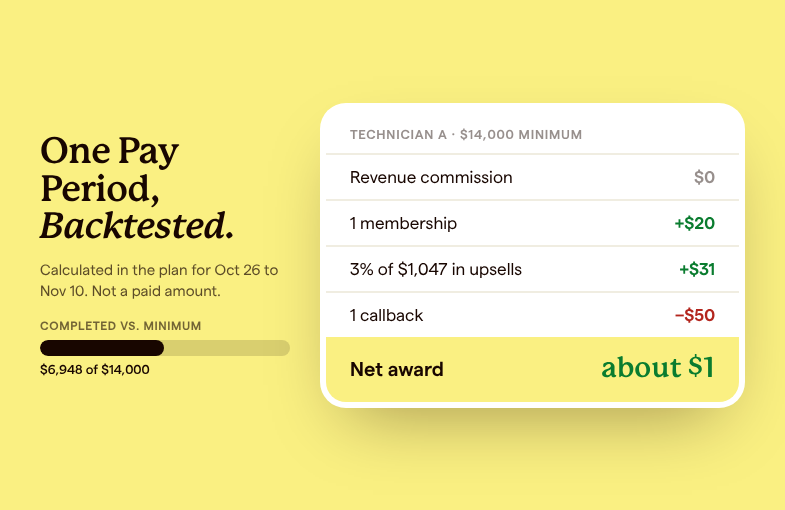
It would be easy to read that as a plan that does not work. We read it the other way. For the first time, the owner can see a technician producing about half of what a $14,000 minimum requires at a 20% target. That gap existed before the plan did. It was just invisible, buried in a labor line that only shows up at month end.
It also raises a fair question about the minimum itself. A target nobody reaches does not motivate anyone. Another HVAC company we work with ran into the same thing and reset a weekly minimum from $7,800 to $6,700 after a backtest showed a $774 miss. The owner here now has the data to make that call on purpose: hold the line at 20% and coach toward it, or adjust it for a slow season and know exactly what that does to labor cost.
A small fix that changed someone's week
One more detail from the call. An office employee who sells memberships was showing zero in the plan. It turned out she sells under a second profile in ServiceTitan, so her sales never reached her name. Once the report was fixed, she showed four memberships for the week.
The owner said she is excited about it, and that she joked the company would need to hire a maintenance technician because of how many memberships she plans to sell. The technicians had a reaction of their own: they asked whether the plan could go back in history and pay for all their old five-star reviews. The owner's answer was that everyone is starting fresh.
How to set your own HVAC labor cost percentage target
- Choose the percentage before you choose anything else. This owner uses 20% for technician hourly pay against completed revenue. Your number depends on what you count as labor, so write the definition down next to the target.
- Turn it into a revenue minimum for each pay rate. Hourly pay for the period divided by the target. Do it for every level you pay.
- Space your levels evenly. Equal raises mean equal jumps in the minimum, and nobody has to ask what the next level takes.
- Backtest before you announce. Run two or three past pay periods through the plan. If nobody clears the minimum, decide whether the problem is the target or the production.
- Show technicians their number during the period. A minimum they only hear about on payday is a surprise. One they can check on a Tuesday is a goal.
If you want to see where each technician stands against a labor target without building it by hand, ShareWillow's incentive plans for HVAC companies pull completed revenue from your field service software and do this math every day.
More real examples
The same question comes up with other companies. Here is how a few of them answered it, with their numbers.
Why an HVAC Company Replaced Three Levels With One $29,000 Monthly Target
Technician revenue goals: an HVAC company replaced three levels with one $29,000 monthly target and a $119 maintenance credit before launch.
An HVAC company with six technicians changed its answer to that question a few days before launch. A few weeks ago we wrote about how this company sorted its team into a technician pay scale with three levels, each with its own monthly revenue goal scaled to hourly pay. On its last review call before rollout, the company scrapped the levels. Every technician now has one goal: $29,000 a month.
The reason had nothing to do with math. It had to do with two technicians who are friends, and what the owners knew those two would say to each other the first evening after the plan went live.
How a Company Is Scaling Weekly Revenue Tiers to Four Hourly-Pay Bands With a 20% Labor Target
An HVAC technician bonus plan works when targets match pay. See how a company ties 1%, 2%, and 3% weekly revenue tiers to hourly pay and a 20% labor target.
The company has six technicians on its service team. Two earn under $30 an hour and four earn above it. The highest sits around $39, and two more land in the mid-$30s. The existing plan paid $10 for every membership sold, 3% on leads a technician generated, and $10 for every five-star review. On top of that sat a fixed weekly bonus for collected revenue, set by tier. Two qualifiers guarded all of it: a callback rate under 5% and good attendance.
Nothing in that plan is unusual. Plenty of companies run something very similar. The trouble is the word fixed. A fixed bonus for a given revenue number pays the same dollars to a technician earning $28 an hour and a technician earning $39, even though the company has very different amounts of money riding on each of them.
How an HVAC Company Is Sorting 6 Techs Into 3 Levels Under One 25% Labor Target
A technician pay scale works best when levels are simple. See how an HVAC company sorted 6 techs into 3 levels on one 25% labor target and fixed a lead report.
The answer they landed on is three levels, two technicians in each, all sitting under a single 25% labor target. Each level has its own monthly revenue goal, calibrated to the hourly rate of the people in it. The awards on top are the same for everyone: a payment for each membership sold, a payment for each five-star review, a percentage on technician-generated leads, a percentage on equipment sales, and a deduction for callbacks.
This is a useful design to study because the numbers are small, the rules are written down, and the company spent most of its review meeting on two details that every incentive plan eventually runs into: how to describe the levels to the team, and how to make a payout traceable to a real job. If you are building a technician pay scale for your own HVAC team, both are worth thinking through early.
How an HVAC Company Reset a Weekly Minimum From $7,800 to $6,700 After a Backtest Showed a $774 Miss
A technician sales quota set from labor cost beats a guess. See how an HVAC company moved a weekly minimum from $7,800 to $6,700 after a $774 miss.
The company had been paying a fixed weekly bonus once a technician crossed a $4,500 collected-revenue minimum. The owner wanted a plan he could present to the team as "you earn more when you hit your targets," and he wanted the math to make business sense. So the plan was rebuilt around a labor target: the company decides what share of each technician's revenue it is willing to spend on that technician's pay, and the minimum falls out of that percentage. If you want the earlier chapter of this story, we covered the first draft in how a company scaled weekly revenue tiers to four hourly-pay bands.
This post is the sequel. It is about what happened when the first version of the quota met real data, why the number moved from about $7,800 to about $6,700, and the simple formula you can use to set a technician sales quota at your own company.
How a $250 Credit Per Job Fixed a Revenue Goal That Penalized Tune-Up Months
HVAC maintenance technician pay fixed: a $250 credit per maintenance job lifted a maintenance-heavy tech toward a $16,896 monthly revenue goal.
The company runs its jobs through ServiceTitan and had just been through a round of tuning with the ShareWillow team. Equipment sales were now tracked job by job, the labor-rate target was being raised, and the owner was reviewing prior months of payouts to see whether the revenue goals were realistic. That review is where the maintenance problem showed up.
The plan the company started with is a common one. Each technician has a monthly revenue goal, set from their hourly pay and a target labor rate, and awards kick in once the technician clears that goal. It is a fair design for a technician who spends most of the week on repair calls, because repair tickets are large enough to clear the line.
Frequently asked questions
What is a good labor cost percentage for an HVAC company?
It depends on what you include. This owner targets 20% for service technician hourly pay as a share of completed revenue and calls it the industry standard. Targets that include installers, helpers, payroll taxes, or benefits run higher. The number matters less than defining it once and measuring it the same way every period.
How do you calculate HVAC labor cost percentage for one technician?
Divide what the technician was paid for the period by the revenue that technician completed in the same period. A technician paid $2,816 who completed $14,080 is at 20%. The same technician completing $6,948 is at about 41%.
How much revenue should an HVAC technician generate per pay period?
Divide the technician's pay for the period by your labor target. At a 20% target and about 88 paid hours, a $20-an-hour technician needs $8,800 and a $32-an-hour technician needs about $14,000. Change the target or the hours and the minimum moves with them.
Related reading
- Technician Pay Scale: How an HVAC Company Is Sorting 6 Techs Into 3 Levels Under One 25% Labor Target
- HVAC Technician Sales Goals: How a 7-Tech Company Set Revenue Targets From Hourly Pay Instead of a Flat Commission
- Plumbing Labor Cost Percentage: How a Leak Detection Company Held Payroll at 25%
- How to Calculate Bonus Pay: A Step-by-Step Guide to Fair and Motivating Compensation
- Performance-Based Pay: Definition, Benefits, Challenges & Tips
Conclusion
Pick the labor percentage first, turn it into a revenue number for every pay rate, and let technicians see that number before payday.
See what performance pay would pay your techs.
On a free call, we'll show you what your techs would earn for the great work they already do.
Book a free call
Ryan Shank is the founder of ShareWillow. Before ShareWillow, he spent 15 years building software for the trades and founded PhoneWagon, which CallRail acquired.