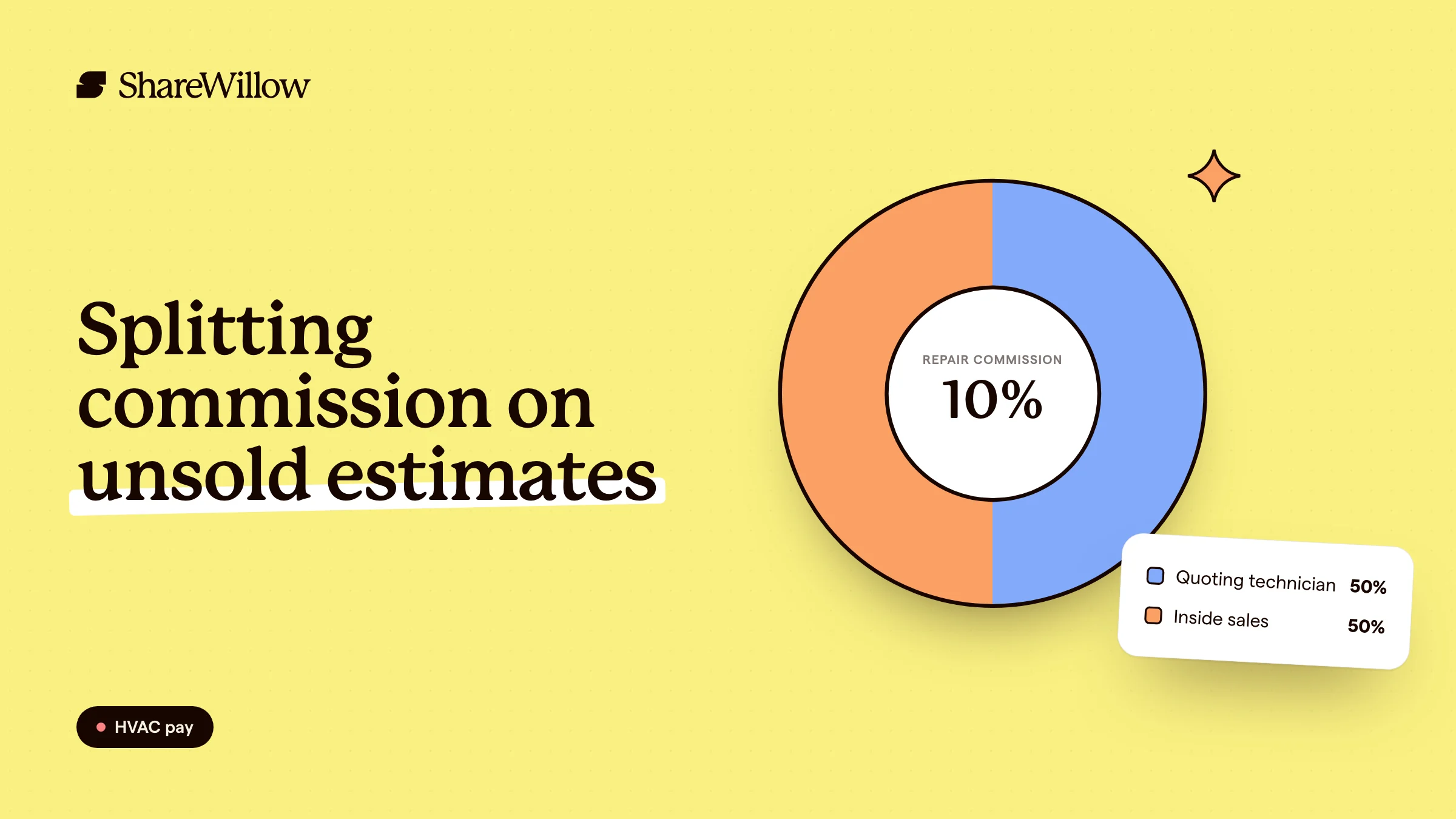
HVAC unsold estimates need a pay rule. One company plans to split its 10% repair commission 50/50 between the quoting tech and inside sales.
Most advice on HVAC unsold estimates is about cadence: call on day two, text on day five, email on day ten. Very little of it covers the question that decides whether the follow-up happens at all. When a technician quotes a repair, leaves without a signature, and somebody else closes it a week later, who gets paid?
An HVAC and plumbing company we work with had to answer that this month. The owner told us the technicians do not follow up well on previous jobs. In the owner's words, once they leave the house, they forget about it. So the job went to a new hybrid role, part customer service rep and part inside sales, that started the first week of November. Then came the harder part: deciding what a closed follow-up pays, and what happens to the technician who wrote the estimate.
The answer the owner is leaning toward is a split: the company already pays 10% on repair work, and a follow-up sale would divide that 10% in half between the inside sales rep and the quoting technician. This post walks through that rule, the one field in the software that makes it possible to track, and why none of it is being paid for real yet. The whole plan is running in shadow mode, so there are no live payout results to report. There are three weeks of shadow numbers, and they are worth looking at.
HVAC Unsold Estimates Need an Owner and a Pay Rule
The company runs on ServiceTitan and has three HVAC service technicians in the plan, plus a customer service rep and the new hybrid rep in the office. The technician plan is weekly and pays the greater of base pay or performance pay. The part that matters here is the repair line: 10% commission on repair work, paid on completed revenue. The owner was specific about that choice. The company pays on what gets finished, not on what gets sold.
That 10% is the pot a follow-up sale draws from. Here is the rule as the owner laid it out. It is a proposal, not a final decision:
- Technician closes on the spot: the technician earns the full 10%.
- Inside sales closes it later: the 10% is split 50/50. The inside sales rep earns 5% and the technician who wrote the estimate earns 5%.
- The quoting technician has left the company: inside sales earns the full 10%.
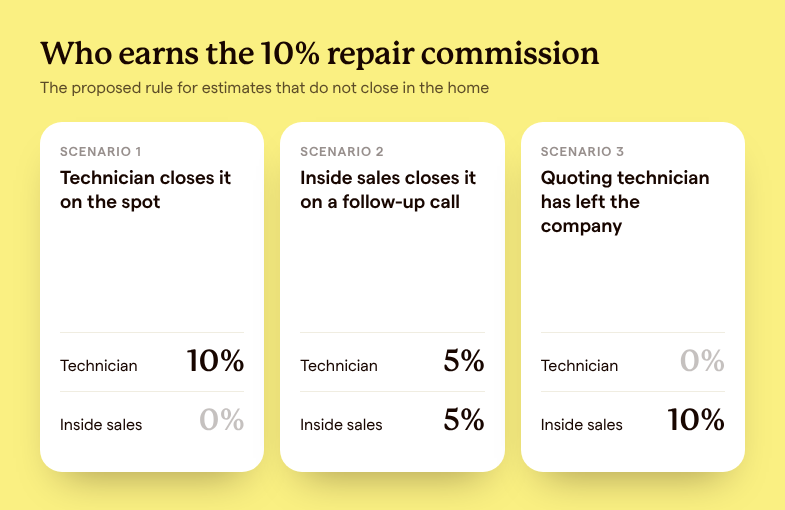
On a $1,200 repair, to use a round number of our own, that is $120 to the technician if it closes in the home, or $60 each if the office closes it afterward. The company pays the same $120 either way. Its labor cost on the job does not move. The only thing that changes is who shares it.
There are two reasons to like the split over the alternatives. If the technician keeps all 10% no matter who closes, the inside sales rep is working for free and the follow-up calls will stop. If inside sales takes all 10%, the technician has a reason to stop writing estimates the customer will not sign that day, or to rush a weak quote. Half each keeps both people interested in the same outcome: a good estimate, and a call back.
The Tracking Problem: One New Field
A split only works if the system knows which sales were follow-ups. Out of the box it does not. An invoice records who sold the job, and that is usually the technician. If the inside sales rep closes it and the invoice still shows the technician as the seller, the rep gets nothing. If the rep overwrites the seller, the technician gets nothing.
The fix was a custom field on the job called "follow up sold by". When the inside sales rep closes an old estimate, the rep's name goes in that field. The original seller stays where it is. The pay plan reads both: a job with a name in the follow-up field pays the split, and every other job pays the technician in full. We wrote about the same credit question from the phone side in a piece on HVAC inside sales commission, where a company had to decide who gets credit when a rep books a call and a technician closes it.
The owner raised a related problem that makes the case for checking before paying. Sometimes an invoice comes through with no seller on it at all. When that happens, a technician's sales are undercounted and nobody notices until the technician does. A missing seller is a small data error. It becomes a trust problem the first time it shorts a paycheck. A 16-person company we work with found a much bigger version of this when it compared sold revenue against completed revenue and caught $224,000 of installed work being counted as sales.
Why the Plan Is Running in Shadow First
None of this has been announced to the team. The plan is built, the data is flowing, and every week it calculates what each person would have earned. The technicians are still paid the way they were before. The owner wants to watch it run before launching it and giving everyone the app.
The shadow numbers so far show why that is a good idea. These are calculated figures from the plan, not money paid out.
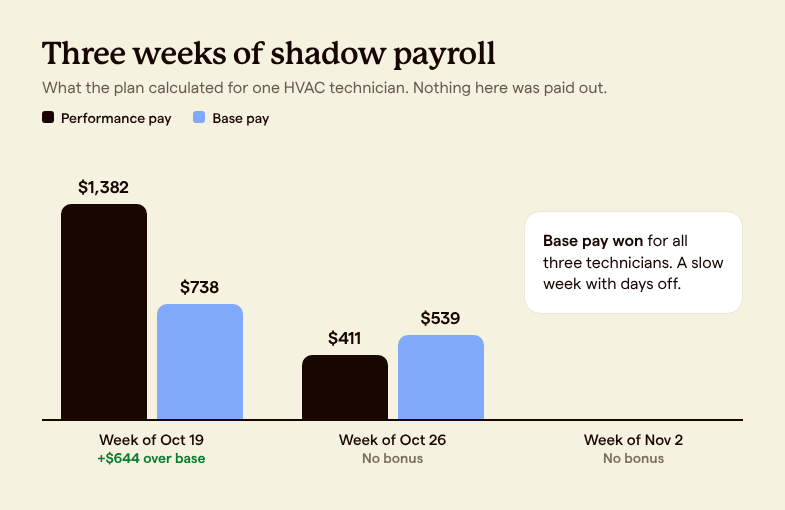
- Week of October 19: one technician's performance pay came to $1,382 against base pay of $738. That is an extra $644.
- Week of October 26: the same technician's performance pay was $411 against base pay of $539. Base pay won, so no bonus.
- Week of November 2: base pay beat performance pay for all three technicians. The owner said it was a slow week with days off.
One strong week, then two weeks where nobody beat base. If the plan had launched on October 19, the team's first three paychecks would have told a confusing story. Seeing it in shadow lets the owner ask the right questions first. Is 10% the right repair rate? Is the plan too dependent on a busy week? Are sales being missed because of the blank seller field? A septic company we work with did the same thing and ran a full month of shadow payroll before changing anyone's check.
The rest of the technician plan, for reference, is a short list of flat amounts on top of the commission: $15 for each service agreement sold, 10% on indoor air quality sales, $125 for a tech-generated lead that sells, an award for a 5-star review, a $50 deduction for a new 1-star review, and a deduction for recalls. Average ticket is tracked and shown on a leaderboard, but it does not pay anything.
The Other Half: Paying the Office
The inside sales split came out of a bigger goal. The owner wants to reward office staff the way the trades already reward technicians. The owner put it this way: you cannot pay a customer service rep $50 an hour, but a rep could get their pay up to $50 an hour by doing superstar-level work. An hourly raise cannot tell the difference between someone who is hustling and someone who is coasting. Performance pay can.
The customer service plan is weekly and built on three things: booking rate, calls booked, and membership sales. Booking rate has two steps. A fixed award starts at an 80% booking rate, and a larger one kicks in above 85%.
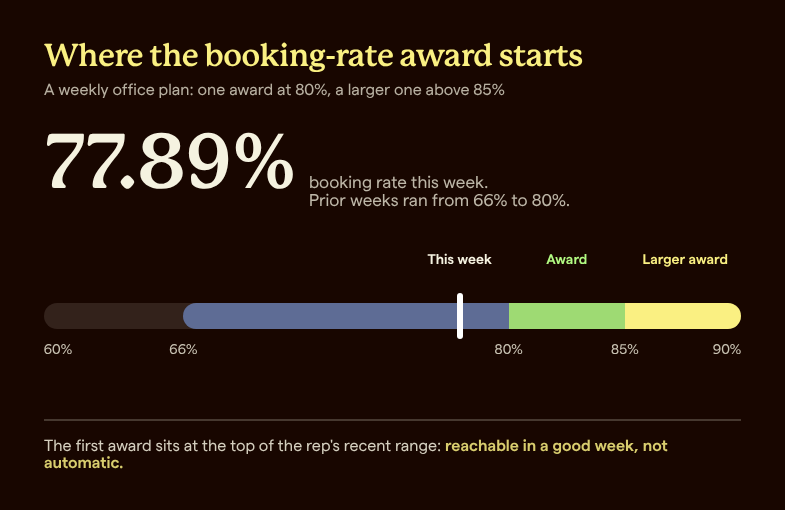
The data showed something useful right away. The rep's booking rate for the current week was 77.89%, and in prior weeks it ranged from 66% to 80%. So the first step sits right at the top of what the rep has been doing. That is a reasonable place for a goal: reachable in a good week, not automatic. It also means that in shadow mode the rep would not have earned the booking award most weeks, which is exactly the kind of thing to know before you announce a plan. For a fuller example of an office plan, see how a plumbing company built its CSR bonus structure around memberships and booking tiers.
If you want to run the same kind of plan without building it in a spreadsheet, ShareWillow reads the seller, the follow-up field, and completed revenue from your field service software and shows each person their number during the week.
How to Set Up Commission on Unsold Estimates
- Name one owner for follow-up. If it belongs to everyone, it belongs to no one. This company gave it to an inside sales role.
- Use the commission you already pay. Split the existing rate so a follow-up sale costs the same as an on-the-spot sale.
- Keep the quoting technician in the deal. A share of the follow-up sale rewards a careful estimate.
- Decide the edge cases now. What if the technician has left? What if the estimate is six months old? Write the rule before the first dispute.
- Add a field for the follow-up seller. Never overwrite the original seller. You need both names.
- Pay on completed revenue. A follow-up sale that never gets installed should not pay anyone.
- Run it in shadow for a few weeks. Compare what the plan would have paid against base pay, and fix data gaps such as missing sellers before launch.
For more on dividing credit, see how an HVAC and electrical company handles splitting commission between technicians by logged time, and our guide to HVAC technician incentives for the wider menu of options.
FAQ
Who should get commission when an unsold estimate closes later?
Both the person who wrote the estimate and the person who closed it. The company in this post plans to split its 10% repair commission 50/50 between the quoting technician and the inside sales rep. If the technician no longer works there, inside sales earns the full amount.
Should technicians follow up on their own unsold estimates?
Some will, but most are focused on the next call. This owner found the technicians rarely followed up once they left the house, so the task moved to an office role. Giving the technician a share of the follow-up sale keeps them invested without asking them to make the calls.
How do you track follow-up sales in ServiceTitan?
This company added a custom job field called "follow up sold by" and left the original seller in place. The pay plan reads both fields to decide whether a job pays the technician in full or pays the split.
Related reading
- HVAC Inside Sales Commission: How One Company Fixed a September Report That Showed 31 New Memberships and Zero Renewals
- How to Split Commission Between Technicians: How an HVAC and Electrical Company Divides Completed Revenue by Logged Time
- CSR Bonus Structure: How a Plumbing Company Built One Around Memberships, Booking Tiers, and Call Categorization
- HVAC Technician Incentives to Motivate Your Team
- Incentives, Commissions, and Bonuses: What’s the Difference and Why It Matters
Conclusion
Give follow-up one owner, split the commission you already pay, track the follow-up seller, and run it in shadow first.
See what performance pay would pay your techs.
On a free call, we'll show you what your techs would earn for the great work they already do.
Book a free call
Ryan Shank is the founder of ShareWillow. Before ShareWillow, he spent 15 years building software for the trades and founded PhoneWagon, which CallRail acquired.