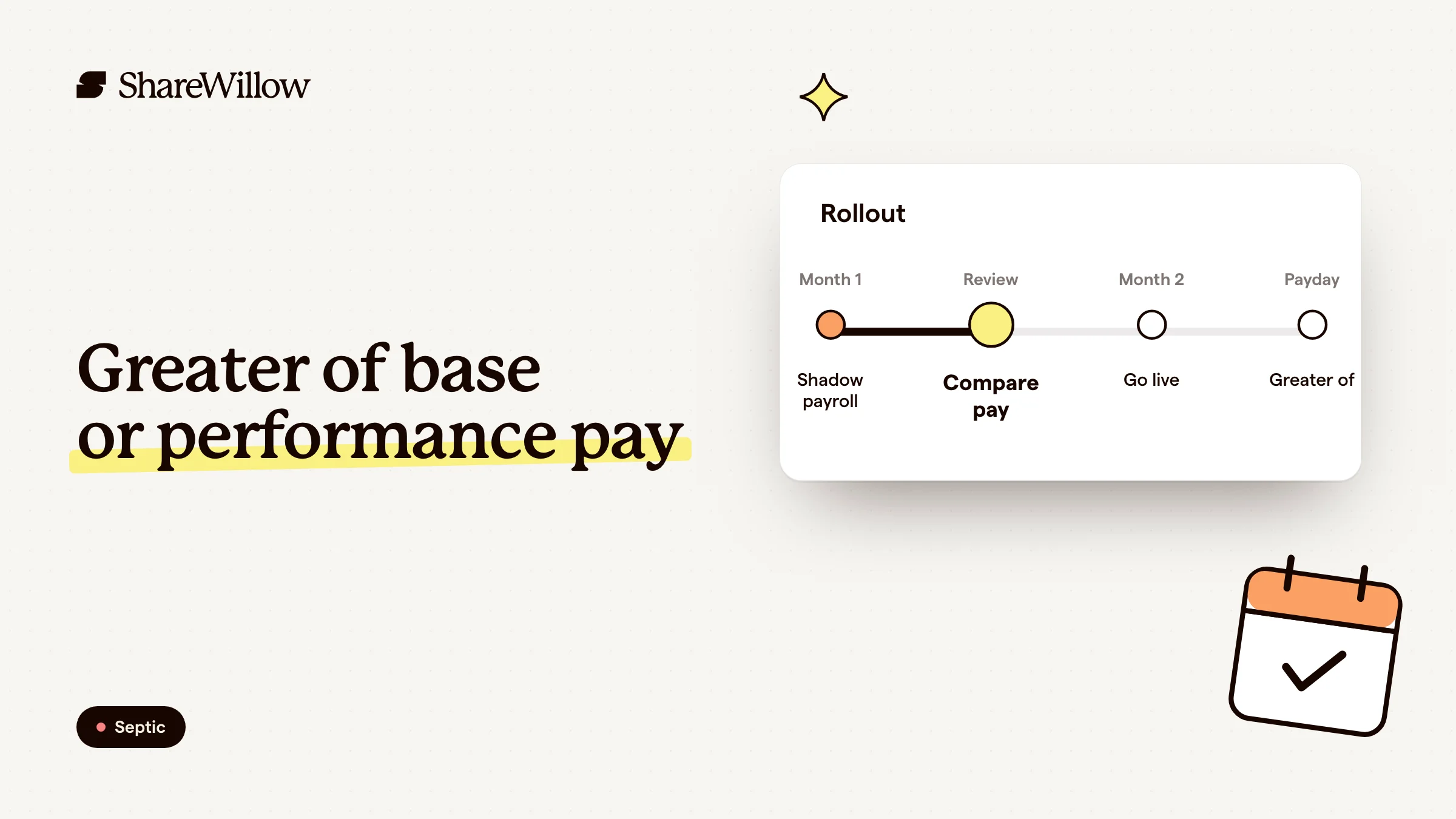
How to pay septic technicians: a franchised septic company will pay the greater of base or performance pay, after one month of shadow payroll.
If you are working out how to pay septic technicians, the hard part is rarely the commission percentage. It is the slow week, when pumping demand dips and a performance-only plan shrinks a good technician's check. A franchised septic company with two corporate locations and a plan to reach 40 states spent a recent ShareWillow demo working through exactly that problem. The plan they sketched is worth borrowing: pay the greater of base or performance, add a few guardrails, and run a month of shadow payroll before anyone's real pay changes.
A note on where this story sits. It comes from an early demo, not a finished rollout. The company had not run a payout yet, so there are no results to report. What we can share is the reasoning, the specific rules they are leaning toward, and one data point from their own history that explains why they want variable pay at all.
The Starting Point: Salaried Technicians and a $100,000 Two Weeks
Today, most of the company's technicians are salaried, and a few are paid on commission. That split gave the owners an unplanned experiment. One technician who moved to commission sold $100,000 in two weeks, and the owners described a visible change in how that person approached every call. Variable pay made selling worth the effort, and it made labor cost easier to predict because pay moved with revenue.
The same story came with a caution. A subcontractor brought in to help on that work was injured on the job. The owners did not treat that as a reason to avoid incentives, but it shaped how they think about pace. Pay that rewards speed with no guardrails can push people harder than the work should allow, and that is a risk to the crew and to the company.
Why Performance-Only Pay Is Risky in a Seasonal Trade
Septic work does not arrive at an even pace. Pumping demand rises and falls, and a technician can do everything right in a week with fewer jobs on the board. Under a plan that pays only on performance, that week produces a small check. The owners were direct about the downside: one of their most valued technicians supports a large family, and a plan that makes that paycheck unpredictable could cost them the person they most want to keep.
Two more pressures made the owners careful.
- Franchise disclosure. As a franchisor, the company publishes financial performance for prospective franchisees. If a new pay plan eroded margin, it would show up in the numbers it uses to sell new locations.
- Pay-plan churn. One owner had watched other companies change pay every six months. Employees got confused and frustrated, and culture took the hit. The owners wanted to get the design right once and tune it on a calm, annual rhythm.
How to Pay Septic Technicians Without Punishing Slow Weeks
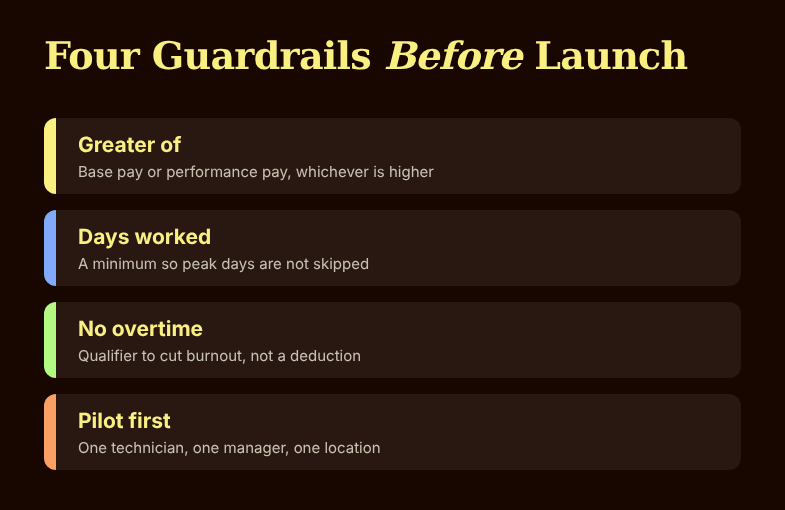
The answer they kept returning to is a greater-of structure. Each week, you calculate two numbers: the technician's base pay, and what the performance plan would pay. The technician receives whichever is higher.
Here is an illustration. These are made-up numbers, not figures from the company. Suppose a technician's base works out to $1,400 for the week. In a slow week, the performance calculation comes to $1,100, so the technician is paid $1,400. In a strong week, performance comes to $2,000, so the technician is paid $2,000. The technician never drops below base, and the upside is fully open.
This is a familiar pattern in the field. A fire protection company used the same rule to build pay that technicians could trust, and an installer company applies it to overtime for commissioned employees. The structure works because it separates two jobs that a single formula tends to do badly: protecting income and rewarding output.
Guardrails: Qualifiers for Days Worked and Overtime
A greater-of plan protects the bottom. It does not stop a different problem at the top. One owner described a technician who worked intensely for 20 days straight and then wanted Monday through Wednesday off, which are core workdays. The performance numbers were great. The coverage was not.
The fix they discussed is a qualifier, not a penalty. Performance pay only counts when the technician meets a condition, such as a minimum number of days worked in the pay period, or staying under an overtime limit. A qualifier does two things at once. It keeps peak days staffed, and it reduces burnout, because the plan stops rewarding the all-out sprint followed by a long break.
If you are choosing qualifiers, keep them few and easy to explain. A technician should be able to look at the plan and know in ten seconds what earns the bonus. Our guide to bonus structure examples covers qualifier patterns that work across trades.
Role-Specific Targets and State Rules
The owners did not want one plan for everyone. They want plans tailored by role, with targets that match what each role controls. For a technician, they talked about lead revenue, septic replacement revenue, and five-star reviews. A manager would carry a different set. They also wanted plans that can flex for state and local rules, since pay law differs as the company enters new states. Confirm those rules with an employment professional before you publish any plan.
Because the company is a franchisor, they also asked for something owners of a single location rarely need: a view across franchisees that shows how each location performs against the same plan. That is a reporting question as much as a pay question, and it is a good reminder to pick a plan structure you can measure the same way everywhere. You can see how that kind of visibility works in the ShareWillow product features.
Shadow Payroll: Test the Plan Before It Touches a Paycheck
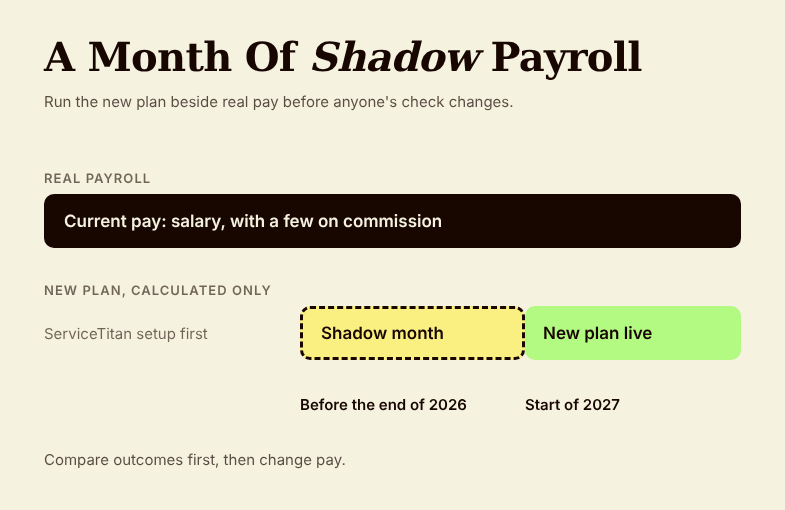
The part of this plan we like most is the sequencing. The company is moving to a new field service platform, and the owners expect it to be running within about four weeks. Their plan is to run one month of shadow payroll before the end of 2026, then introduce the new pay model at the start of 2027.
Shadow payroll means you calculate what every technician would have earned under the new plan, using real jobs, while real pay stays exactly as it is. Nobody's check changes. You are only checking the math and the fairness. The company expects to keep running actual payouts through its existing payroll provider, so the new plan does not require changing how checks are cut, only how the numbers are calculated.
During that month, there are four things worth watching.
- Who gains and who loses. Compare each person's shadow pay to their actual pay. A valued technician who would earn less is a design problem to fix before launch.
- Slow weeks. Confirm the base floor actually catches them, and see how often it triggers.
- Margin. Total the shadow payouts against revenue and check the labor percentage. This is the number the franchise disclosure depends on.
- Data quality. Missing tags, unassigned jobs, and mismatched dates all show up in a shadow run, while they are still cheap to fix.
The owners also proposed a small pilot: one technician, one manager, and a skeleton crew at the headquarters location, with written procedures to follow before the plan reaches other locations. That is the same logic applied to people. Prove it small, write down what you learned, then repeat it. A company that did this well while protecting margin is described in The Pay Plan That Clawed Back 2 Points of Margin, Without Losing the Team.
What to Take From This
You do not need a septic company to use this plan. Any home service company with uneven weekly demand can use the same four moves.
- Pay the greater of base or performance so a slow week never cuts a good technician's check.
- Add one or two simple qualifiers, such as days worked or overtime, to protect coverage and prevent burnout.
- Set targets by role, and keep an eye on state and local pay rules.
- Run a month of shadow payroll before the plan touches a real paycheck.
The most useful part of this conversation was how little the owners wanted to guess. They wanted to see the numbers first and change pay once. That patience is the real plan.
If you are about to design your own version, start with two questions. First, what is the lowest weekly check you would be comfortable with for your best technician, and does your current formula ever go below it? Second, what behavior is the plan accidentally rewarding at the top end? Answering those two honestly tells you whether you need a floor, a qualifier, or both.
What is the best way to pay septic technicians?
There is no single best method, but a greater-of structure is a safe starting point. It pays a base amount and a performance amount each week and gives the technician the higher one, so slow weeks do not cut pay while strong weeks still pay more. Add simple qualifiers so the plan does not reward burnout.
How do you pay technicians when demand is seasonal?
Protect a pay floor so income stays steady when job volume dips, and let performance pay add on top in busy weeks. A floor plus an uncapped performance side keeps good people through slow periods and still rewards a strong week.
What is shadow payroll for a technician pay plan?
Shadow payroll is a trial run where you calculate what each technician would earn under the new plan using real jobs, without changing anyone's actual pay. It lets you find unfair outcomes, data errors, and margin problems before the plan goes live.
Related reading
- The Greater-Of Rule: How a Fire Protection Company Built Pay Techs Could Trust
- Overtime Pay for Commissioned Employees: How One Installer Company Pays the Greater of Base or Performance Pay
- How an HVAC Company Built a Hybrid Pay Plan That Pays Whichever Is Higher
- The Pay Plan That Clawed Back 2 Points of Margin, Without Losing the Team
- Performance-Based Pay: Definition, Benefits, Challenges & Tips
Conclusion
Pay the greater of base or performance, add qualifiers that protect your people, and run a month of shadow payroll before the first real check changes.
See what performance pay would pay your techs.
On a free call, we'll show you what your techs would earn for the great work they already do.
Book a free call
Ryan Shank is the founder of ShareWillow. Before ShareWillow, he spent 15 years building software for the trades and founded PhoneWagon, which CallRail acquired.