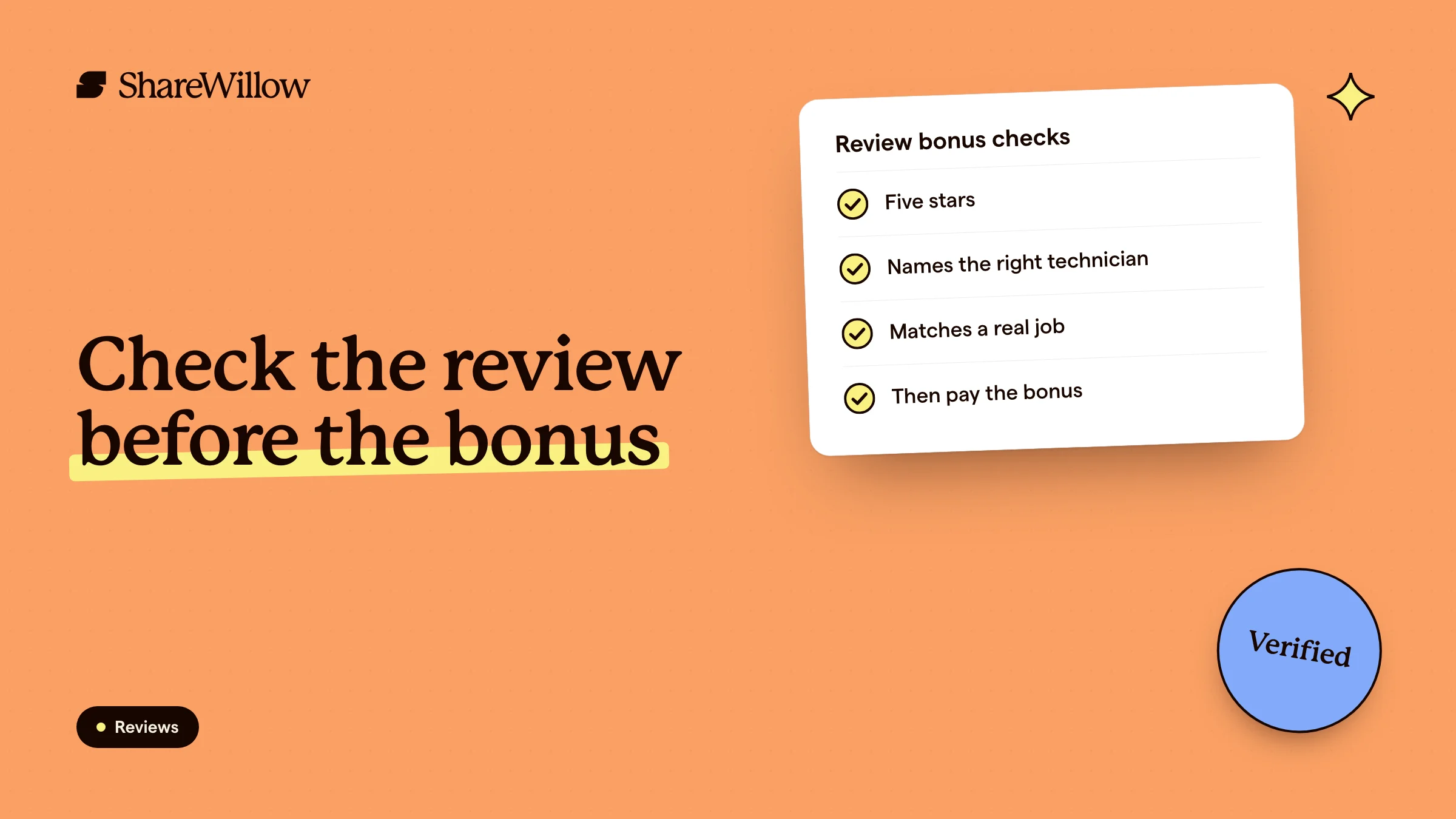
Technician review bonus: a multi-trade company found reviews credited to the wrong job, so it vets every five-star review before the bonus is paid.
A technician review bonus is easy to promise and hard to pay correctly
A technician review bonus looks like the simplest incentive you can run. A customer leaves five stars, the technician who did the job gets a few dollars, and everyone understands the rule in ten seconds. The hard part is the step in the middle: knowing which technician earned the review.
A multi-trade home service company we work with ran into that step during a plan kickoff in November. The company does appliance, electrical, plumbing, and HVAC work, with separate installers and service technicians in each trade. The person running the rollout wanted a five-star review bonus in the technician plans. She also did not trust the data that would decide who got paid.
"There are times where it attributes reviews to a completely wrong job," she said of the company's field service software. "Nothing to do with that customer. Nothing to do with that job."
This post covers what she decided, why the same problem showed up in the callback numbers on the same call, and how to set up a review bonus your technicians will believe. The plan is still being built, so there are no payout results yet. The numbers here are the ones that surfaced while we checked the data.
The problem: an incentive history that did not stick
The company had tried two things before.
- A ticket system for reviews. Technicians got tickets for five-star reviews when a customer mentioned them by name.
- A flat weekly bonus. Technicians earned a set amount if they hit a certain level of sales revenue for the week.
Neither one took hold. On the weekly bonus, she was blunt: there was not much participation, and "it didn't really work." When we asked whether the technicians had any incentive system they understood and liked, the answer was one word: no.
That history matters for a review bonus. A team that has already watched two programs fade will judge the next one by its first few payouts. If the first review bonus goes to the wrong person, the program is finished before it starts.
Why she did not trust the review data
The software links each incoming review to a job, and the job to a technician. Most of the time that works. Some of the time the review lands on a job that has no connection to the customer who wrote it. She had already shown examples to the vendor and was told a fix is in progress.
Her hesitation was reasonable. "I'm just a little nervous to pay people on spiffs on things," she said. "Like, I do wanna do the 5 star review."
The decision: turn the review bonus on, and vet every review
Our first recommendation was the cautious one. If the attribution is known to be wrong, leave reviews out of the plan for now and add them once the data is clean.
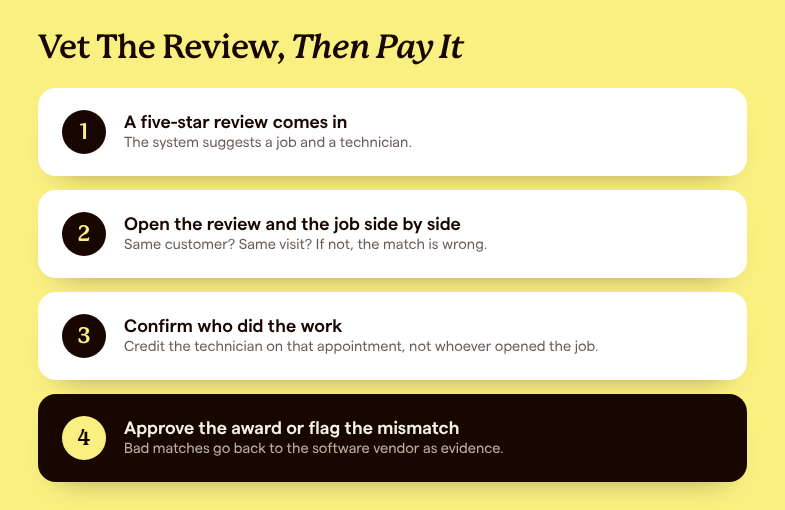
She chose a different path, and we think it was the better call. "Let's put the 5 star reviews on, and I will go in and look at them," she said. "We'll vet them."
The logic has three parts.
- The review bonus exists from day one. Technicians see that good service gets noticed, which is the reason to have the bonus at all.
- Nothing pays without a human check. Before a pay period closes, she opens each credited review, compares it with the job, and confirms the technician on that visit.
- Every bad match becomes evidence. A mismatch does not just get corrected. It goes back to the software vendor as a documented case, which is how the root problem gets fixed.
On the amount: the figure we see most often for a review bonus is $10 per five-star review, and that is the starting point we put in front of her. The final amount had not been confirmed when the call ended.
The review bonus sits next to the other proposed lines in the service technician plan. Technicians would take home the greater of their hourly pay, including overtime, or 20% of the service revenue they generate. A membership sale would pay $25, once, on the date it is sold. Those are proposals under review, not final rules. If you want to see how a similar company built out the rest of the plan, read about an appliance repair technician bonus with three KPI tiers.
The same attribution problem, in the callback numbers
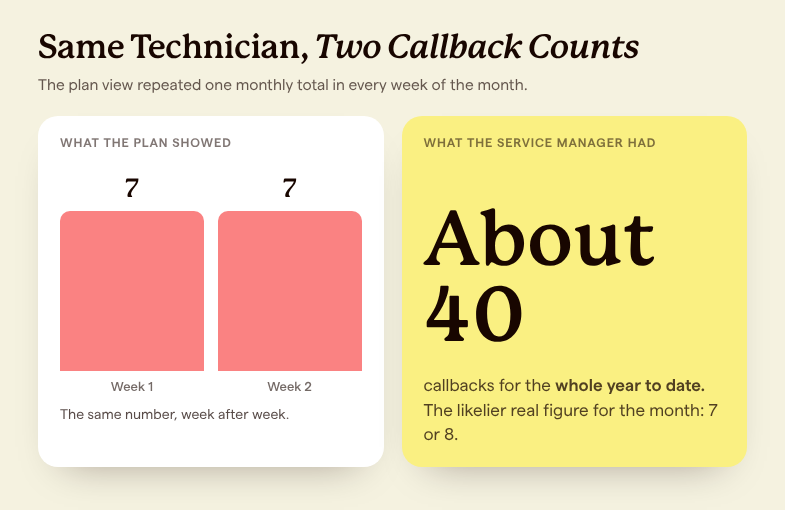
Reviews were not the only number that looked wrong. The plan also carries a deduction for callbacks, and when we opened one technician's view, it showed 7 callbacks in every week of the month.
Her reaction: "That's disgusting. I really hope that would be wrong."
It was. Her service manager's count for that technician was about 40 callbacks for the entire year to date. "So it's weird that in the last, like, two weeks, it said he had 16," she said.
The cause was on our side of the data. The report feeding the plan grouped callbacks by month, so one monthly total was being repeated in each week. The fix is to tie every callback to the specific day it happened. Once that is done, the likely figure for that technician is 7 or 8 for all of November, not 7 a week.
When the callback belongs to someone else
There was a second, subtler issue. On an HVAC install, the first person on the job is often a ductwork technician who measures, takes photos, and lists materials. The installers come later and put in the equipment on that same job. If a recall comes in and the job was not set up correctly, the software assigns it to the first appointment. The ductwork technician gets a callback he had nothing to do with.
"It's pulling the right data," she said, "but it doesn't understand it."
That is the review problem again in a different field. The record is real. The link to a person is wrong. For a closer look at how one company wrote its rules here, see this technician callback policy with a free allowance and a $25 deduction.
How to set up a technician review bonus that holds up
The lesson from this kickoff is that the rule is the easy part. Attribution is the work. Here is what we would copy.
- Credit by job, not by name. The company's old ticket system depended on the customer typing a technician's name. A job record is a better anchor, since it shows who was actually on the visit.
- Check before the pay period closes. A weekly review of credited reviews takes minutes when volume is normal. It is far cheaper than clawing back a bonus.
- Decide the shared-job rule in advance. If two technicians were on the visit, say up front whether the bonus is split or paid to each. This company has not set that rule yet, and it should before the first payout.
- Keep the customer out of it. The bonus goes to the technician for service that earned a review. Customers should never be offered anything for leaving one, and review platforms have their own rules about how reviews are requested. Read the current policy for any platform you use before you launch.
- Show technicians the result. A review bonus motivates when a technician can see the review and the award together. A company that put its numbers where technicians could see them had bonus payouts nearly triple in a month.
We build plans like this in ShareWillow so each award traces back to a job an owner can open and check.
The bigger pattern: tie pay to data you are willing to audit
She applied the same thinking to timekeeping. Some technicians forget to clock in or out, and someone in the office fixes the punches every time. Her plan is to connect clean punches to the incentive, so the habit has a cost. "I want to make it tied to the incentive so that it forces them," she said.
She also wants customer service reps to use slow periods to call customers with unsold estimates. Instead of a flat fee per call, each rep will get a booking tag, and credit will follow jobs that carry it. Her reason was practical: the tag reports are the ones that work.
Across reviews, callbacks, hours, and bookings, the test is the same. If you cannot open the record and see why a person was credited, do not attach money to it yet. For more incentive ideas you can measure, see our guide to HVAC technician incentives.
Frequently asked questions
How much should a technician review bonus pay?
The amount we see most often is around $10 per five-star review. Keep it small enough that it rewards good service without becoming the main thing a technician chases. The company in this post started from $10 and had not finalized its figure.
Who gets the review bonus when two technicians are on the job?
Pick one rule and write it down: split the bonus, or pay each technician in full. Either can work. What causes trouble is deciding case by case after a review comes in.
How do you track which technician earned a review?
Match the review to the job, then to the technician on that appointment. If your software does this automatically, spot-check it. This company found reviews attached to unrelated jobs, so it reviews each one by hand before paying.
Related reading
- Technician Callback Policy: How an Appliance Repair Company Allows Free Callbacks on 5% of Jobs and Deducts $25 After
- Appliance Repair Technician Bonus: How One Company Built Three KPI Tiers Around a Gap of $400 to $1,500 in Daily Sales
- Technician KPI Bonus Plan: How a Home Services Company Is Replacing Weekly Spreadsheets With 4 Qualifiers and a Double-Dollars Tier
- How to Use HVAC SPIFFs to Boost Business Profit
- 9 Bonus Structure Examples Employees and Employers Love
Conclusion
A review bonus works when the review, the job, and the technician all match, so check the match before the money moves.
See what performance pay would pay your techs.
On a free call, we'll show you what your techs would earn for the great work they already do.
Book a free call
Ryan Shank is the founder of ShareWillow. Before ShareWillow, he spent 15 years building software for the trades and founded PhoneWagon, which CallRail acquired.