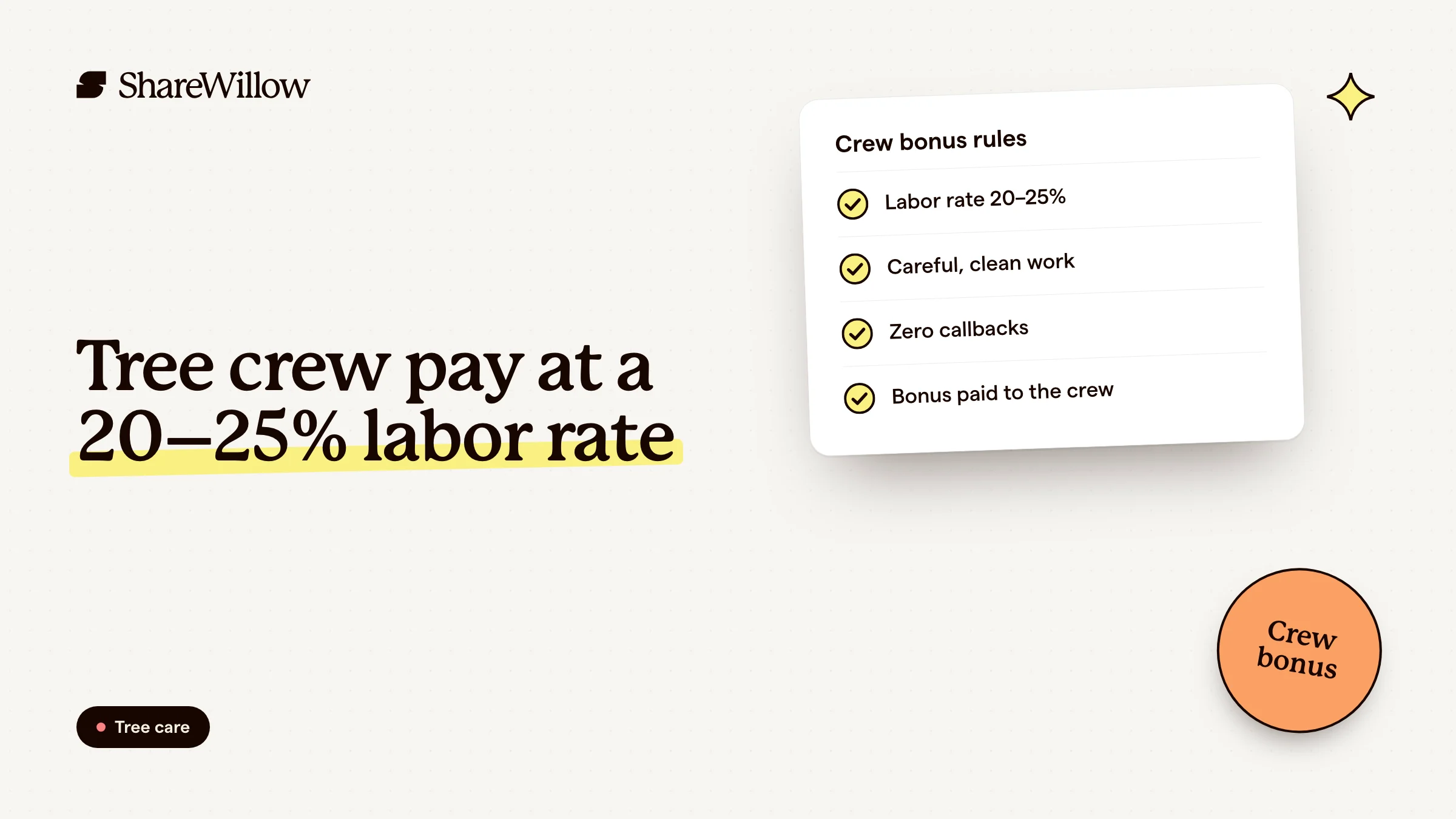
A tree service crew bonus plan should reward careful work and protect margin. See how one company ties crew pay to a 20 to 25% labor rate and zero callbacks.
The tree service crew bonus plan that discretionary cash never built
A tree service crew bonus plan is not a new idea, but most tree care companies still run on the same two tools: an hourly wage and an occasional bonus when cash happens to be strong that week. The owner of one tree care company told us the second tool does not work. The bonuses are appreciated for a day, then forgotten, and nothing about the crew's behavior changes the next morning.
This company specializes in large tree removals in residential backyards. A typical day means several jobs and several customer conversations, all around expensive equipment, falling wood, and a homeowner's fence and garden. The owner cannot be on every site. When the owner is somewhere else, crews sometimes leave tools behind or cause property damage, and the office ends up handling the customer fallout and the review requests.
The owner is about to bring on new crew members and is writing the company's first employee manual while updating its safety manual. It is the right moment to put a real pay structure next to the new expectations. This is the story of how the plan is taking shape, and what any tree company can borrow from it. If you want to see how other crews structure this kind of pay, our breakdown of a crew leader bonus structure built on labor savings is a useful companion.
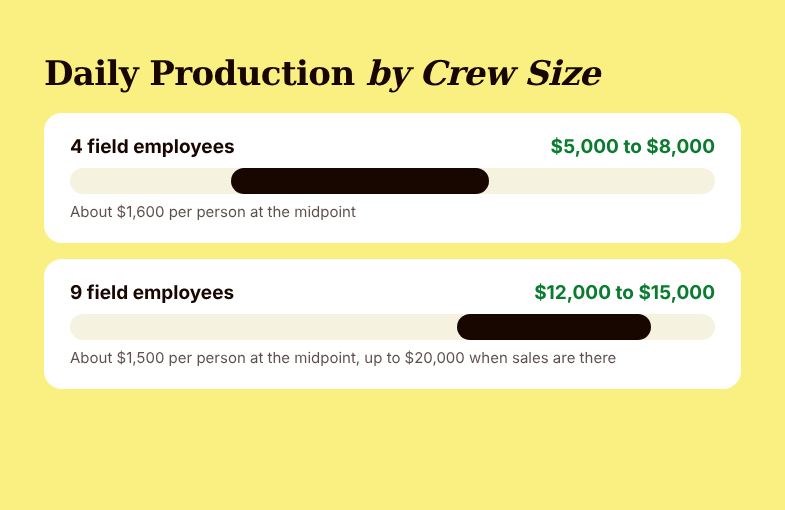
The numbers behind the problem
Before designing anything, the owner shared how production moves with crew size. With four field employees, the company produces roughly $5,000 to $8,000 a day. With nine, it produces $12,000 to $15,000, and it can reach $20,000 when enough sales are lined up. Revenue per person is fairly steady, around $1,500 to $1,600 at the midpoint, which tells you something important: the company does not make money by squeezing each person harder. It makes money by keeping a bigger crew working on well-sold jobs without waste.
Waste is where the cost hides. The owner described mistakes that run from a $5 rake left in a yard to a $2,000 chainsaw left on a job site. Property damage, such as a cracked concrete pad, can cost more than either. A flat penalty for any mistake would treat the rake and the chainsaw the same, and that is not fair to anyone. The plan has to recognize severity.
Labor cost is the other constraint. The owner worries that incentives could push labor spending out of control, which is a reasonable fear. The answer is to design the plan from the labor rate backward. Our team recommends keeping the base hourly rate fixed and tying extra earnings to the value the crew produces, with total labor, incentives included, held to a target such as 20 to 25% of revenue.
Designing the plan from the labor rate backward
Here is how the structure is being shaped. Each piece answers a specific thing the owner said out loud.
1. Fixed base pay, variable upside
Crews stay on their hourly wage. The incentive sits on top and unlocks only after the crew clears a revenue or efficiency threshold. That protects the labor rate, because the company only pays more when it has already earned more. It also removes the fear that a bonus plan is a pay cut in disguise.
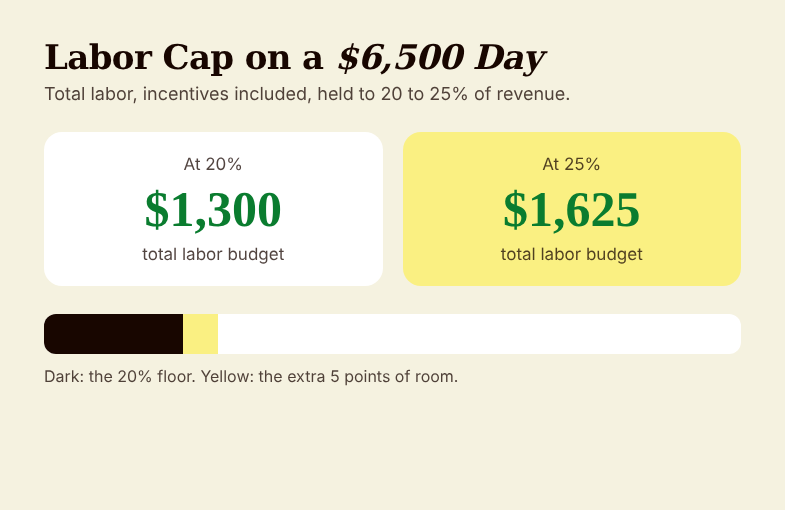
The picture above shows the math on a $6,500 day, which sits in the middle of the four-person range. A 20% labor rate is $1,300 and a 25% rate is $1,625. Everything the plan pays, base wages and incentives together, has to fit inside that window. If the incentive would push a day past the cap, the threshold was set too low.
2. Quality gates before dollars
The owner wants to reward positive customer interactions, five-star reviews, returning tools, and avoiding damage and callbacks. The cleanest way to do that is a set of gates. A crew that causes damage or generates a callback does not qualify for that day's payout, no matter how strong the revenue was. We have seen the same approach work for service teams, where an HVAC company tied the same bonus to a 3% callback quality bar.
3. Severity-based consequences
A forgotten rake should not cost a crew what a lost chainsaw costs. The plan separates minor items from expensive equipment so the consequence matches the loss. Crews can see where they stand, and the owner is not stuck arguing over small stuff.
4. Role-specific plans
Foremen, climbers, equipment operators, and ground crew do different jobs, so they get different metrics. Only one or two designated employees get lead generation credit, because not everyone is placed to bring in sales. Leaderboards compare people within the same role, a foreman against a foreman and an operator against an operator, using performance metrics rather than earnings. That answers the owner's worry about animosity from comparing a foreman with a groundsman.
5. A separate plan for storm and emergency work
Storm response means weekend and overnight work, and crews are not naturally eager to leave home for it. A separate emergency plan ties extra pay to emergency revenue and longer shifts, so mobilizing feels like a real earning opportunity. It sits outside the everyday plan so it never muddies the normal thresholds. If you are weighing how far to scale rewards, our guide to tiered bonus structures shows how steps and thresholds are usually laid out.
One more design choice came from the owner: shared accountability. A small team reward for a five-star review or for avoiding concrete damage gives everyone a reason to watch each other's work. It is the same instinct behind a team plan that pays an outdoor living crew $50 for every hour saved.
What a tree care company has to get right before launch
A good plan still fails on bad data. The company runs its sales and management in an industry CRM, but crews are not yet routinely assigned to projects there, and a paper board is still how jobs, trucks, and crews get shuffled when weather changes the day. Incentives need to know who worked which job, what revenue it produced, and whether it came back.
So the work before launch is mostly about habits. Office staff will enter project assignments and job checklists consistently. Callbacks will be flagged with a job field or tag so they count against the payout. Hours can come from digital clock-ins instead of a punch clock. None of that is glamorous, but it is what lets the plan pay people the right amount, on time, without a spreadsheet. The platform can then show each crew member job-by-job earnings, an effective hourly rate, and upcoming earning potential through the ShareWillow employee app.
What to borrow for your own tree crews
- Start from a labor rate, not a bonus budget. Pick the percentage of revenue you can spend on labor, then work backward to the thresholds.
- Keep base pay fixed. Pay extra only for value above the threshold.
- Use quality gates. Damage and callbacks should block the payout for that period.
- Match consequences to severity. A rake is not a chainsaw.
- Build by role. Compare foremen to foremen, not to groundsmen.
- Give storm work its own plan. Make the extra hours worth it.
- Fix the data first. Assignments and callbacks have to be recorded for the math to work.
The company has not launched yet, so there is no payout result to report. What it has is a baseline: production by crew size, a labor target, and a clear list of behaviors it wants to pay for. That is the right starting point for any crew plan.
Frequently asked questions
How do you structure a tree service crew bonus plan?
Keep hourly base pay fixed and add an incentive that unlocks above a revenue or efficiency threshold. Add quality gates for damage and callbacks, and cap total labor, incentives included, at a target such as 20 to 25% of revenue.
Should tree service bonuses be the same for climbers and ground crew?
No. Different roles control different outcomes, so each role should have its own metrics and thresholds. Compare people within the same role so the plan feels fair.
How do you pay crews for emergency storm work?
Use a separate plan that ties extra pay to emergency revenue and longer shifts. Keeping it separate protects your normal thresholds and makes storm response feel worth the sacrifice.
Related reading
- Crew Leader Bonus Structure: How an 80-Person Landscaping Company Is Testing a 10% Lead and 20% Crew Split on Labor Savings
- Crew Bonus Plan: How an Outdoor Living Company Is Paying $50 for Every Hour Its Crews Save
- Technician Bonus Cap: How an Epoxy Flooring Company Capped Crew Bonuses at $400 Per Job After 3 Techs Passed It
- How to Maximize Employee Performance with Tiered Bonus Structures
- 9 Bonus Structure Examples Employees and Employers Love
Conclusion
A tree crew bonus works when it pays for the value the crew protects and produces, inside a labor rate the company can afford.
See what performance pay would pay your techs.
On a free call, we'll show you what your techs would earn for the great work they already do.
Book a free call
Ryan Shank is the founder of ShareWillow. Before ShareWillow, he spent 15 years building software for the trades and founded PhoneWagon, which CallRail acquired.