How to pay electricians: a 7-technician company pays $37.50 per labor hour sold and worked, plus spiffs. Zero of 7 bonused in a slow two weeks.
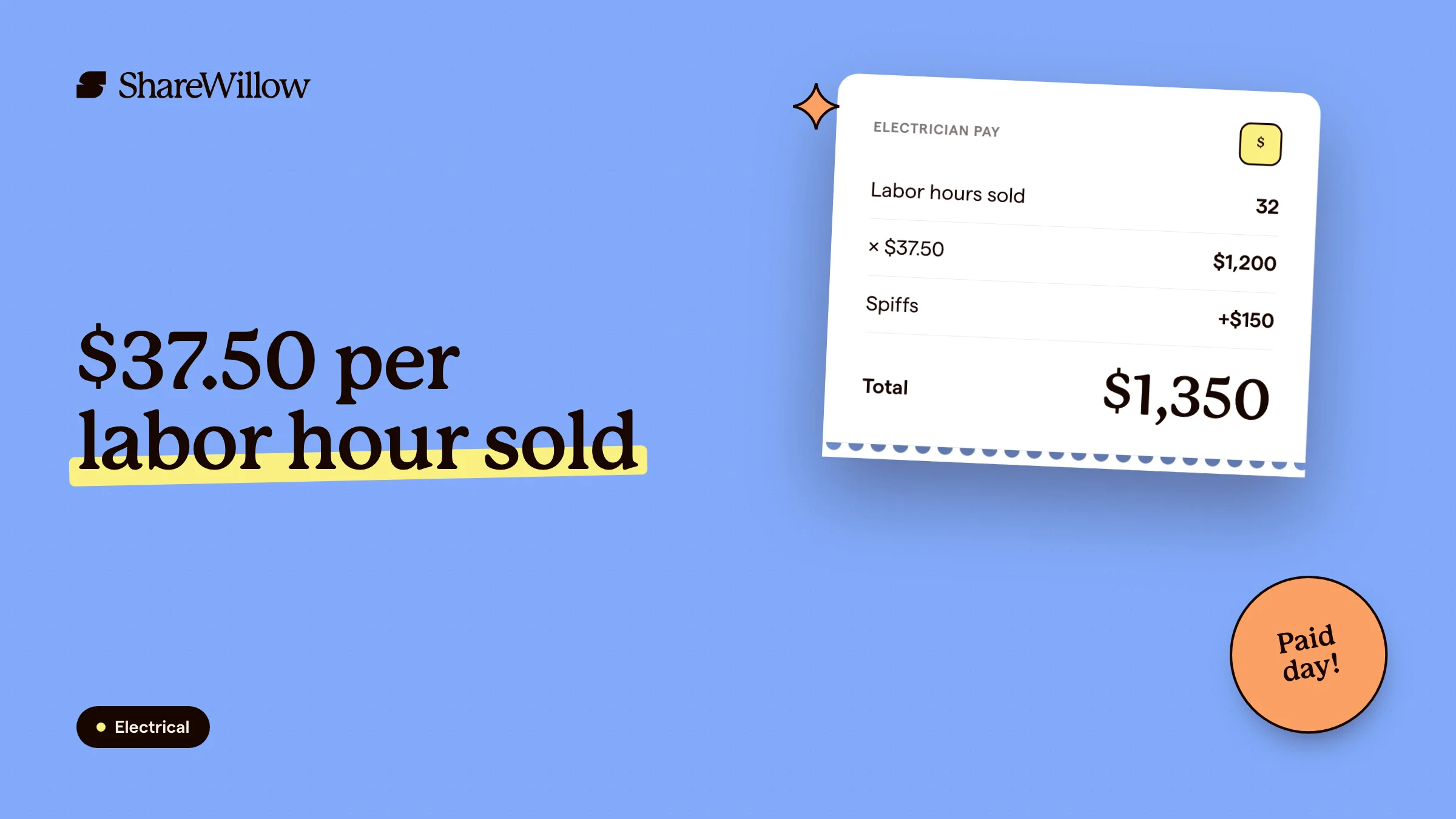
Most advice on how to pay electricians comes down to a choice between two options: an hourly wage, or a percentage of the ticket. An electrical and HVAC service company we started working with this month uses neither as its main lever. Its seven technicians are paid on labor hours. The technician who sells a job earns $37.50 for every labor hour sold. The technician who does the work earns $37.50 for every labor hour worked. If that adds up to more than their hourly base for the pay period, they get the difference.
The plan has been running for a while, and the owner is honest about where it stands. In the two-week payroll that ran from October 10 to October 23, none of the seven technicians earned a bonus. Three of them bonus regularly in the busy months. So the company has a structure it believes in and a result it cannot yet explain to the people being paid.
This post covers how the plan works, why the owner chose labor hours over ticket revenue, the two spiffs and one new deduction that sit on top of it, and what the company is changing now. No new payout results exist yet. The setup is in progress, and the first job is to find out how often the plan actually pays.
How to Pay Electricians on Labor Hours Instead of Ticket Size
Here is the plan as the owner described it:
- Selling credit: $37.50 per labor hour sold, paid to the technician who sold the job.
- Working credit: $37.50 per labor hour worked, paid to the technician who performed it. When more than one technician is on the job, the hours follow the job assignment.
- Install work: $43.75 per install hour. A typical crew is a mechanic and a helper who split that 60/40. A third person on the crew, if there is one, is paid hourly.
- True-up: every technician has an hourly base. When performance pay for the period is higher than base pay, the technician receives the difference. When it is lower, they receive their base.
- Pay period: two weeks, starting on a Saturday.
A technician who sells a job and then does it earns both credits, which works out to $75 for each labor hour on that job. A technician who only runs the work someone else sold earns half of that. The plan pays for the two things the owner wants: finding work and finishing it.
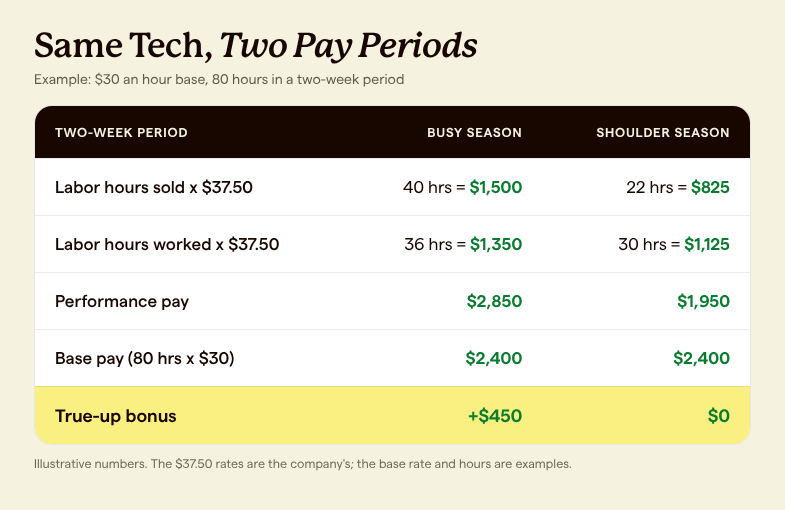
To see how the true-up behaves, take an example. The $37.50 rates are the company's. The base rate and hours are ours, for illustration. A technician earns $30 an hour and works 80 hours in the period, so base pay is $2,400. In a busy stretch they sell 40 labor hours and work 36. That is $1,500 plus $1,350, or $2,850 in performance pay, and a $450 bonus on top of base. In a slow stretch they sell 22 hours and work 30. That is $825 plus $1,125, or $1,950. It is below base, so the bonus is zero and the paycheck is $2,400.
Same technician, same effort, very different result. That gap is the whole story of the October payroll.
Why This Owner Will Not Pay Commission on the Total Ticket
A percentage of the invoice is the most common performance plan in the trades, and it would be easier to explain. The owner has a specific reason for avoiding it. If technicians earn a cut of everything on the ticket, parts included, the plan rewards them for putting more parts on the ticket. He does not want a customer to wonder whether a panel or a device was recommended because it was needed or because it paid. The company's reputation is worth more to him than a simpler formula.
Labor hours sidestep that. A technician is paid for the time the job is priced at, not for the material that goes into it. Other companies have reached the same conclusion from different directions. A six-technician company we work with tied its bonuses to sold hours for the same reason, and an electrical contractor took a third route with a job profit bonus plan that pays 10% of paid job profit, so material cost works against the payout instead of for it.
The tradeoff is that an hours-based plan depends completely on the price book. Every task has a labor time attached, and that time is what the technician is paid on. This company is in the middle of rebuilding its price book, which means those hours are moving. The owner gave a useful rule of thumb here. If billable efficiency across the whole team is sitting around 50%, that is not seven people having a bad month. It points to task times or pricing that are off.
Two Spiffs and One Deduction
The labor-hour pay does most of the work. Three smaller pieces sit on top of it.
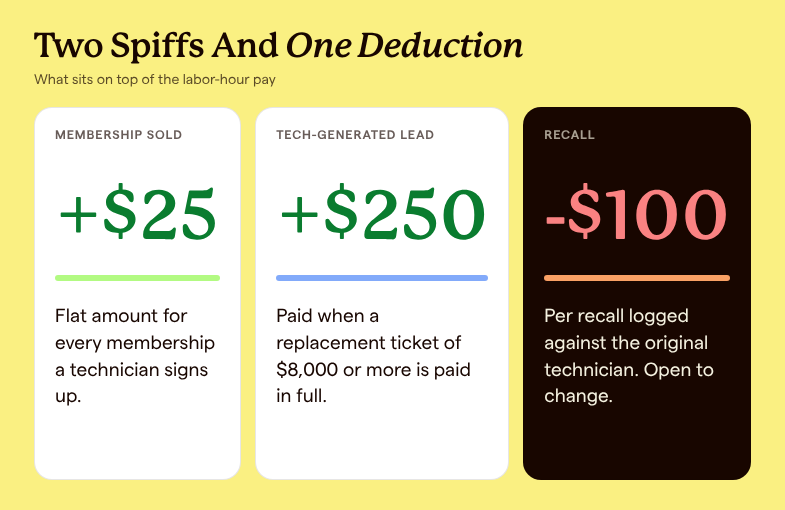
$25 per membership. A flat amount each time a technician signs a customer up for a membership. It is small on purpose. A membership is a long-term asset for the company, and the spiff is a thank-you, not a sales commission.
$250 per tech-generated lead. When a technician flags a replacement opportunity and it turns into a ticket of $8,000 or more, the technician earns $250. It is credited by the date the job is paid, not the date it is sold, so nobody is paid on work that cancels. The hard part is attribution. The company had been identifying these leads by job type, and the office does not always pick the right one. The owner's suggestion was to use the field that records who set the lead, because it gets filled in more consistently. An HVAC and plumbing company ran into the same blind spot, and found $52K in tech-sourced sales its report showed as zero.
$100 off per recall. This one is new. When a customer calls back about a problem, the original technician is sent to fix it and a recall is logged against the job. Going forward, each recall takes $100 off that technician's performance pay. The owner picked the number with context: the company's average job opportunity over the last 90 days was $1,336, so $100 is about 7.5% of a typical job. At $37.50 an hour it also equals a little under three hours of working credit. He was clear that the amount is a starting point and will be revisited once he sees how it changes behavior.
Two cautions on a recall deduction. First, it only works inside a true-up. The deduction reduces performance pay, and base pay stays protected, so a technician is never pushed below their hourly wage. Second, decide what counts before the first deduction lands. This company is still working out how to handle warranty calls, which are not the technician's fault. An appliance repair company we work with solved that with a callback policy with a free allowance, where the first 5% of jobs carry no penalty. If you are weighing which spiffs are worth adding at all, our guide to using spiffs to boost profit covers the common ones.
The Problem: Nobody Bonused, and Nobody Knew Until Payday
The October 10 to 23 payroll paid zero bonuses across seven technicians. The owner put it down to shoulder season, and he is probably right. Fewer calls means fewer labor hours sold and worked, and the base does not shrink to match.
But a slow season is only half of the problem. The other half is that technicians cannot see where they stand until the check arrives. On the last day of a pay period, a technician who is $80 short of bonusing and one who is $800 short look exactly the same to themselves. Neither knows whether one more sold job would have tipped it. A plan that only reveals the score after the game is over cannot change how anyone plays.
So the company set two goals for the next few months:
- Show technicians their numbers during the pay period. Hours sold, hours worked, spiffs, recalls, and the gap to base, updated from the field service software so nobody has to wait for payroll.
- Measure how often the plan pays. How many technicians bonus each period, by how much, and whether that changes once they can see it. The owner wants that data before deciding whether to move the team to pure performance pay with no hourly true-up.
That order matters. Moving to pure performance pay while nobody is beating base would be a pay cut with a new name. Bonus frequency is the number that tells you whether the rates are set right. If the strong technicians bonus most periods and the newer ones bonus sometimes, the plan is healthy. If nobody bonuses for a season, either the rate is too low, the base is too high for the rate, or the price book hours are wrong.
The owner also asked for an example of a shared team pool, funded when the company hits a quarterly goal, along with contests for membership sales and fewest recalls. Nothing is decided yet. It is a reasonable complement, because a team reward keeps paying attention to the company's goals in the periods when individual bonuses are thin.
How to Build a Labor-Hour Pay Plan for Your Electricians
- Decide what you are paying for. If you want to avoid rewarding parts sales, pay on labor hours or on profit, not on the ticket total.
- Set separate credit for selling and for doing. Equal rates, like this company's $37.50 and $37.50, tell the team both matter.
- Protect the base. Pay the greater of base or performance pay each period. It costs you nothing in a good period and keeps people whole in a slow one.
- Back-test the rate. Run the last six months of payroll through the formula. If you want help with the math, our guide on how to calculate bonus pay walks through it. Count how many technicians would have bonused in each period, slow months included.
- Keep the extras few. Two spiffs and one deduction is plenty. Each one should be traceable to a field in your software that the office fills in reliably.
- Make it visible before payday. See how ShareWillow shows technicians their pay in real time if you want that handled for you.
An electrical company that pays apprentices needs one more piece, because apprentices cannot sell or lead jobs yet. Another company we work with handles that with an electrician bonus plan built on passed inspections and a weekly apprentice scorecard.
The company in this story did not come to us with a broken plan. It came with a sound one that pays on the right thing, a slow October with zero bonuses, and a team that could not see any of it. The rates may turn out to be fine. It will know after a few pay periods of watching.
Should electricians be paid hourly or on commission?
Most electrical service companies end up with a mix: an hourly base that is always protected, plus performance pay on top. The company in this article pays $37.50 per labor hour sold and $37.50 per labor hour worked, and pays the difference when that total beats the hourly base. Pure commission can work, but it moves all of the slow-season risk onto the technician.
What is a fair way to pay an electrician who sells a job someone else completes?
Split the credit between selling and doing. In this plan each side earns the same $37.50 per labor hour, so the technician who found the work and the one who finished it are both paid. On install crews, the company pays $43.75 per install hour and splits it 60/40 between the mechanic and the helper.
Should you deduct pay for callbacks?
A small deduction can work if it only reduces bonus pay and never touches the hourly base. This company set $100 per recall, about 7.5% of its $1,336 average job, and plans to adjust it after seeing the effect. Define which calls count first, and leave out warranty issues the technician did not cause.
Related reading
- Job Profit Bonus Plan: How an Electrical Company Pays 10% of Paid Job Profit, Split 30% by Level and 70% by Hours
- Electrician Bonus Plan: How an Electrical Company Rewards Passed Inspections and Scores Apprentices Every Week
- Technician Callback Policy: How an Appliance Repair Company Allows Free Callbacks on 5% of Jobs and Deducts $25 After
- How to Calculate Bonus Pay: A Step-by-Step Guide to Fair and Motivating Compensation
- Performance-Based Pay: Definition, Benefits, Challenges & Tips
Conclusion
Pay on labor hours, protect the base, keep the spiffs few, and let technicians see the number before payday.
See what performance pay would pay your techs.
On a free call, we'll show you what your techs would earn for the great work they already do.
Book a free call
Ryan Shank is the founder of ShareWillow. Before ShareWillow, he spent 15 years building software for the trades and founded PhoneWagon, which CallRail acquired.