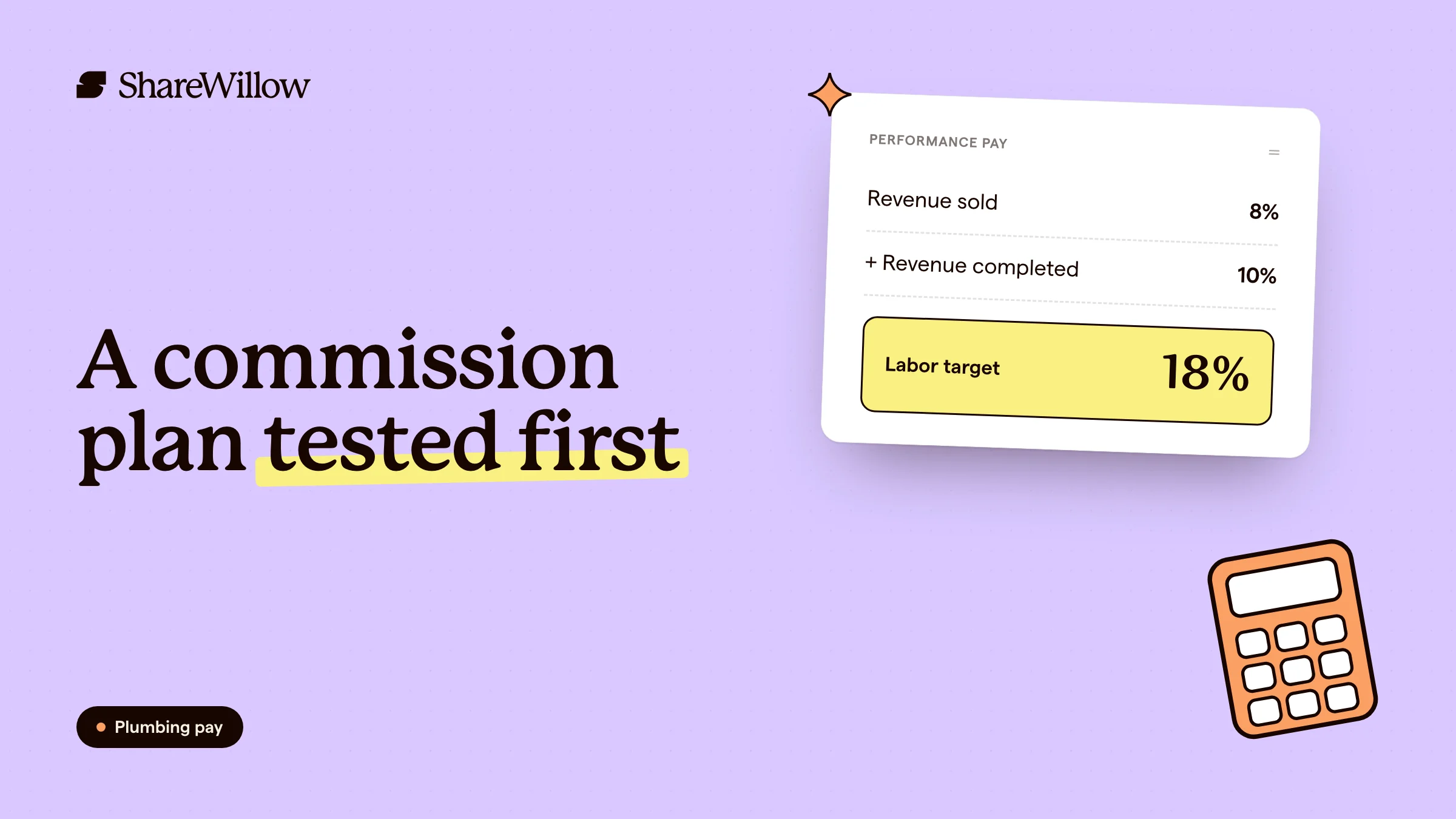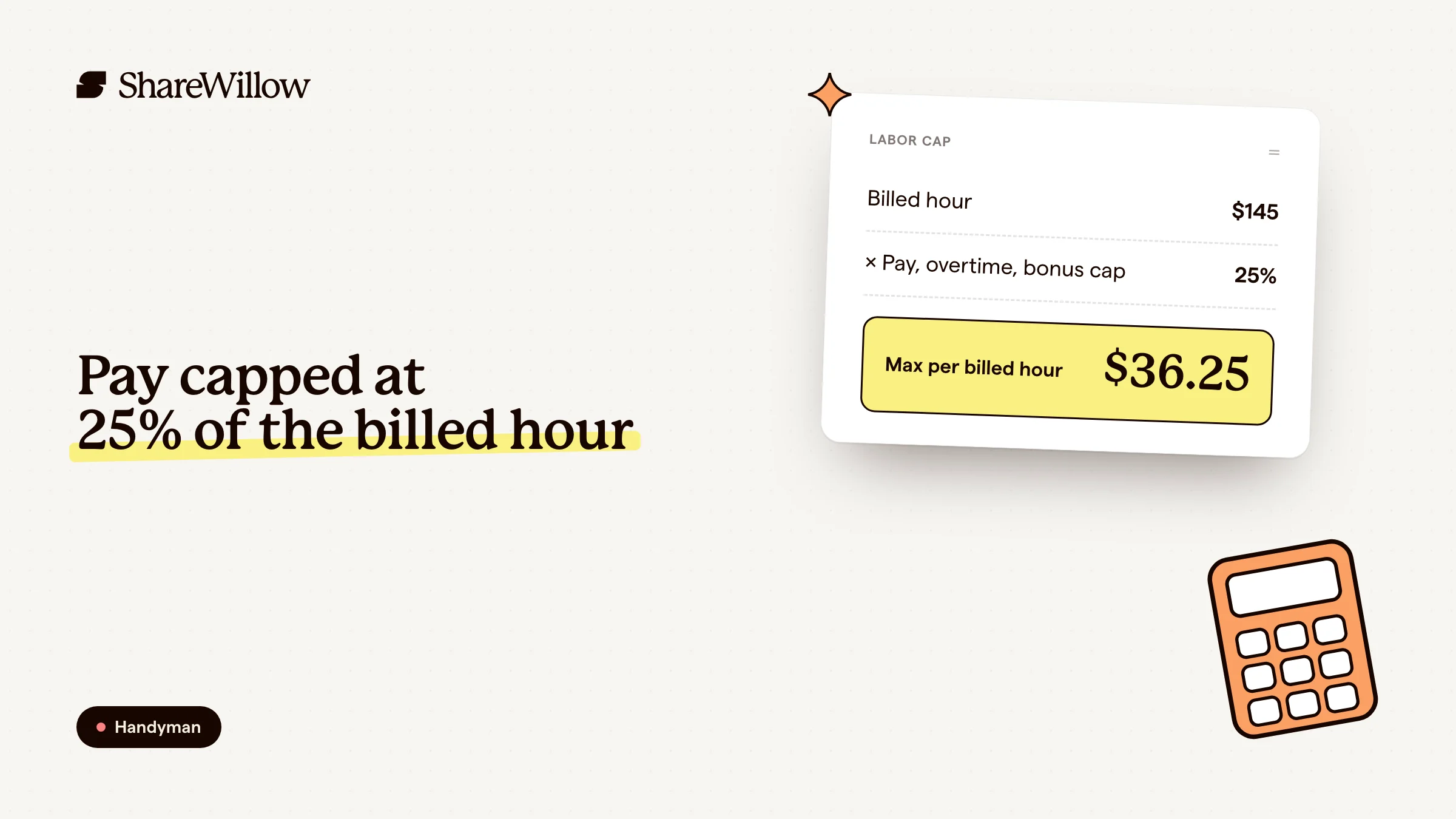
How to pay handyman technicians: one company caps regular pay, overtime, and bonuses at 25% of a $145 billed hour, or $36.25, and tests it on 30 days.
How to pay handyman technicians when overtime keeps eating the margin
Most advice on how to pay handyman technicians starts with a number: an hourly rate, a commission percentage, a bonus amount. A handyman company we work with started somewhere else. Before anyone talked about what a bonus should pay, the owner drew a ceiling and said every dollar of pay had to fit under it.
The company runs technicians across several neighboring territories and bills its work by the hour. On a November planning call, the owner laid out the math in one breath. The company charges $145 an hour. His labor target is 25% of that. Twenty-five percent of $145 is $36.25.
That figure is the most a billed hour can carry in technician pay. It is also where most of this post lives, because the company has not launched its plan yet. There are no before-and-after results to report. What we can show is how the plan is being built, which rules are settled, which are still open, and the test the owner wants to see before a single technician is told about it.
The problem: three kinds of pay, one gross profit line
The owner was direct about why the ceiling matters now. "Our numbers have been off," he said, "and that's a bunch of overtime every single two weeks." Overtime was the leak. Adding an incentive on top of overtime, without a limit, would make it worse.
So he set the test for any plan we build: "I would need to see that with regular pay, overtime pay, and comp pay that we don't go over 25, because it's wreaking havoc on my gross profits."
A few details make that harder than it sounds.
- Pay is not uniform. Some technicians earn $30 an hour and a few earn $35. The owner hopes the plan can take a $30 technician to something like $38 with the right results.
- The ceiling is before burden. Payroll taxes and related costs add another 30% on top of whatever is paid, by the owner's count.
- $38 is above $36.25. The owner knows it. His exception is the right one: pay can go past the ceiling when the technician is generating more revenue per hour than the standard rate assumes. In his words, "we don't just go give dollars away for fun."
That last point is the whole design problem. An incentive that only adds cost breaks the ceiling. An incentive that pays out when revenue per paid hour goes up can raise a technician's income and still hold the ratio.
The benchmark the company already had: 32 billable hours out of 40
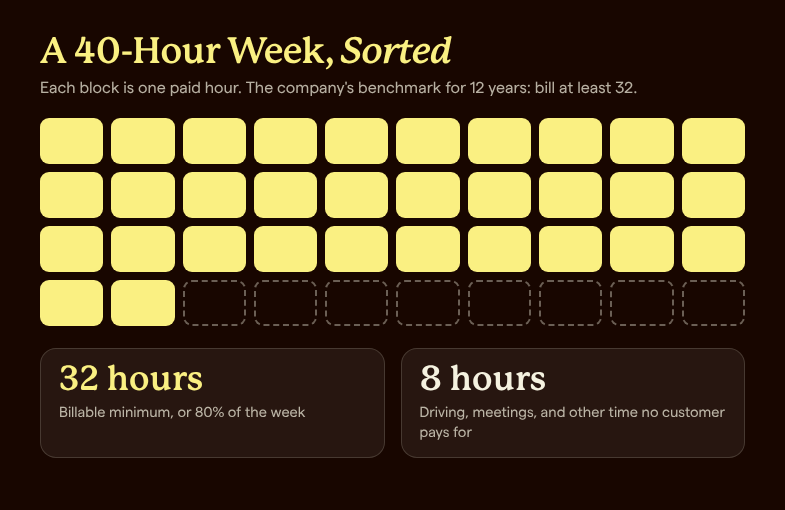
The company did not need a new metric to start. It has used the same one for 12 years: a technician should bill at least 32 hours in a 40-hour week, or 80%.
The other eight hours are real work that no customer pays for. Driving between jobs is most of it. Meetings are the rest, though the company has cut those from weekly to about once a month. As the owner put it, "before you know it, there's 8 hours a week spent doing things that are non billable."
Billable hours are a good anchor for a handyman pay plan because the business sells hours. If a technician bills 36 hours instead of 32, the company collects four more hours at $145 without adding payroll. So the first piece of the plan is simple: an award that starts at 32 billed hours in a week and grows as the count goes up. We covered a similar measure in a post on a plumbing technician billable hours bonus, where the gap between paid and billed time turned out to be much wider.
The handyman pay plan on the table
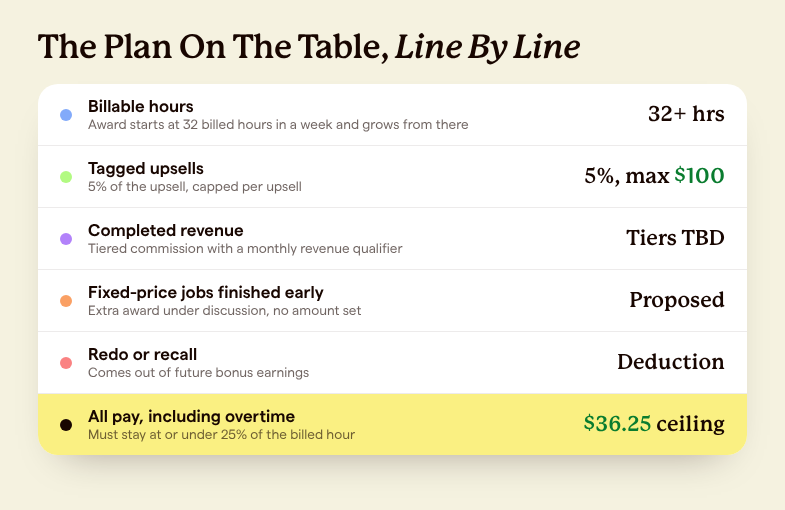
Here is what the plan looks like today. Some lines are decided. Others are proposals we are still modeling against the 25% target, and we have marked them that way.
Decided: 5% on tagged upsells, capped at $100
The company already pays 5% on upsells, up to $100 per upsell, and the general manager says technicians are using it. A typical upsell is a two-hour booking that turns into a four-hour job once the technician is on site. Each technician has an upsell tag, and the tag on the job is what triggers the pay. That rule moves into the plan as is. If upsells are a weak spot for you, we wrote about a company that tracked handyman upsells automatically and turned them into a team bonus.
Decided: the $10 meeting bonus moves out of the cash envelope
Technicians currently get $10 in cash at meetings when a job meets every condition on a short list: they made the night-before call to the customer, they billed for the hours they worked, and the job had no discount and no redo. A redo voids it. The owner wants that folded into the plan so it is tracked instead of handed across a table.
Proposed: tiered commission on completed revenue
The largest piece would be a tiered commission on completed revenue, with a monthly revenue minimum a technician has to reach before any bonus pays. The qualifier exists for the reason the owner gave: awards should only go up when revenue does. The tier amounts are not set. They depend on the dry run described below.
Proposed: an award for finishing fixed-price jobs early
The company sells some work at a fixed price. The general manager pointed out that those jobs are profitable and that technicians sometimes finish "a day early or two days early." Both leaders want that rewarded. An early finish on a fixed price is the cleanest case of revenue rising faster than labor, which is exactly when pay can rise too. No amount has been set. For the opposite problem, see how a plumbing company handles bid jobs that run past their sold hours.
Proposed: a deduction for redos
A redo would come out of future bonus earnings, never out of base pay. We suggested $50 per recall as a starting figure. The owner raised a timing question worth copying: today the gap between a job and the next meeting gives the office time to catch a redo before the $10 is paid. A plan that credits jobs within a day or two needs a rule for redos that show up later.
The office: credit for booked work, not booked estimates
The company's estimators are booked through the end of December. Part of the cause is that small jobs get sent out for an estimate when they could have been sold on the phone. So the rule for customer service reps is narrow on purpose. A rep earns credit only when a job carries two tags: the rep's own booking tag, and a two-hour, four-hour, or eight-hour package tag. Any estimator tag on the job disqualifies it.
The owner's reasoning: once a rep books an estimate, the outcome is out of the rep's hands, so there is nothing to reward. He also flagged a risk that comes with paying the office. With a shared pool of technicians, one rep could grab every call. Assigning reps to territories is on his list for later.
The dry run: 30 days of real data before anyone is told
The owner would not approve anything from a description. He asked for a dry run on as much history as we have, ideally a full 30 days, showing what each person would have earned under the proposed measures.
"I need everyone to see what that looks like before we say, okay, this is what we're gonna do," he said.
The dry run answers the only question that matters to him: with regular pay, overtime, and incentive pay added together, does labor stay at or under 25% of the $145 hour? If a technician's total goes past $36.25 per billed hour, the report has to show the extra revenue that paid for it.
It also surfaces data problems while they are still cheap. Two came up on the same call.
- Revenue lands on the wrong person. When two technicians work a job, the field software credits 100% of the revenue to whoever was booked first. The general manager fixes it by hand. "I have to remember to go in and break it down," she said. Until splits follow hours worked, a revenue commission would overpay one technician and skip the other.
- Clock-ins need cleanup. Payroll takes about three hours a week, and more when clock-outs are missed. Billable hours only work as a measure if paid hours are right.
The owner's standard for the finished system is that it does not add office labor. He does not want to count on his fingers and hope he did not overpay somebody. That is the job of the software: we run plans like this in ShareWillow so the split, the tags, and the ceiling check happen from job data instead of a spreadsheet.
What to take from this if you run a handyman company
You can copy the method without copying the numbers.
- Start with the ceiling. Multiply your billed hourly rate by your labor target. That is your limit per billed hour for all pay combined.
- Count overtime inside it. If overtime sits outside the plan, the plan will look affordable and the payroll will not be.
- Pay more only when revenue per paid hour rises. More billable hours, upsells, and fixed-price jobs finished early all qualify. Busy work does not. The owner said it plainly: "I'm done paying for busy work."
- Test on history first. A month of shadow results will tell you more than any projection. Our guide on how to calculate bonus pay walks through the arithmetic.
For more on how this works across trades, see our home services page.
Frequently asked questions
Should handyman technicians be paid hourly or on commission?
Many home service companies use both: an hourly base with performance pay on top. The base protects technicians in a slow week, and the performance piece rewards billable hours and upsells. Whatever mix you choose, measure the total against a labor target so the two parts cannot drift apart.
What percentage of revenue should handyman labor cost?
It depends on your pricing and overhead. The company in this post targets 25% of its $145 billed hour, which is $36.25, before payroll taxes. Use your own billed rate and margin goal to set the number, then check it against real payroll.
How many billable hours should a handyman technician have each week?
This company has used 32 billable hours out of 40 as its minimum for 12 years. The remaining eight hours cover driving and meetings. If your team is well below 80%, look at scheduling and travel before you change pay.
Related reading
- How a Handyman Company Turned Every Missed Upsell Into a $1,600 Team Bonus
- Hourly Plus Commission for Technicians: How a Home Services Company Caught an 8.75-Hour Pay Gap Before the First Payout
- Plumbing Technician Billable Hours Bonus: How a Plumbing Company Found Its Techs Bill 4 Hours of an 8-Hour Day
- 9 Bonus Structure Examples Employees and Employers Love
- Performance-Based Pay: Definition, Benefits, Challenges & Tips
Conclusion
Set the labor ceiling first, put every kind of pay under it, and run the plan against a real month before anyone's check changes.
See what performance pay would pay your techs.
On a free call, we'll show you what your techs would earn for the great work they already do.
Book a free call
Ryan Shank is the founder of ShareWillow. Before ShareWillow, he spent 15 years building software for the trades and founded PhoneWagon, which CallRail acquired.